International Shipping for Ecommerce: Costs and Customs
 Jakub Neander
Published 12 min read
The label is the cheap part. The real price of international shipping for ecommerce includes what the customer pays at the border: customs duty, import VAT, handling fees and the carrier's cut for collecting them. In 2026 every major market tightened the rules for small parcels, so a store that quotes only the postage is quoting half the price. This guide covers what a cross-border order really costs, how customs works, who should pay it, which carriers fit which job, and how to set it all up so the customer's last surprise is the box.
What International Shipping Really Costs
Domestic shipping has one price: the label. A cross-border parcel has a stack of them, and the total is called the landed cost: everything the buyer pays to get the goods into their hands.
- Item price and shipping, the parts you already charge.
- Customs duty, set by the product's tariff code and where it was made.
- Import VAT or sales tax of the destination country, usually charged on the item, the shipping and the duty together.
- Government fees, such as the EU's new per-line handling fee.
- Carrier fees for clearing the parcel and advancing the duty on someone's behalf.
The only real choice is who pays the bottom half of the stack, and when. Here is the same order both ways:
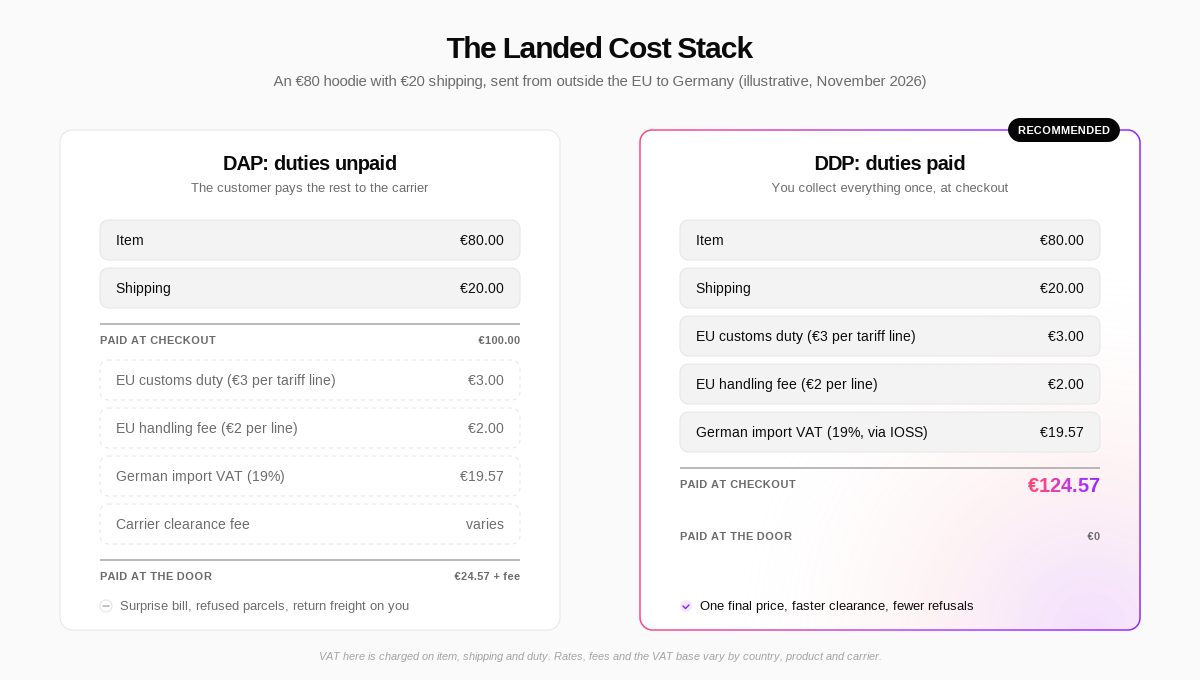
That €24.57 is why the cheaper-looking checkout loses. Baymard's research finds that 40% of shoppers who abandon an order do it because extra costs (shipping, tax, fees) were too high, and a bill at the door is the same problem arriving a week late, when the customer can refuse the parcel instead of closing a tab.
Customs Basics: HS Codes, Origin and Paperwork
Every international parcel is a small import declaration. Customs wants to know three things about each product, and getting any of them wrong costs you money or days.
1. The HS code
The Harmonized System, maintained by the World Customs Organization, gives every kind of goods a six-digit code that customs offices worldwide share. Countries add their own digits on top: the US uses the 10-digit HTS, the UK publishes its Trade Tariff, and the EU uses TARIC. The code decides the duty rate, so "clothing" is not good enough: a knitted cotton hoodie and a woven polyester jacket sit in different headings with different rates.
2. The country of origin
Duty follows where the goods were made, not where you ship from. A mug made in China and shipped from your warehouse in Ohio is a Chinese mug to every customs office it reaches.
3. The declaration
Couriers want a commercial invoice: description, HS code, origin, quantity, value and currency per line, plus who pays the duty. Postal services use the CN22/CN23 customs form for the same data. Most carriers and label tools now file it electronically, so the work is filling the fields correctly, not printing them. Write descriptions customs can act on ("women's knitted cotton sweater"), not your product names ("The Cozy One").
DDP vs DAP: Who Pays at the Border
The two terms you will meet in every carrier dashboard come from the ICC's Incoterms rules:
| DAP (often still called DDU) | DDP | |
|---|---|---|
| Who pays duty and import tax | The customer, on delivery | You, collected at checkout |
| Checkout price | Lower, but incomplete | Higher, but final |
| Customer experience | A bill before handover, often plus a carrier fee | Parcel just arrives |
| Your risk | Refused parcels, return freight, chargebacks, reviews | Under-collecting if your estimate is wrong |
| Setup effort | None | Duty calculation at checkout and a carrier that files DDP |
"DDU" (delivered duty unpaid) was dropped from Incoterms back in 2010 and replaced by DAP, but carriers and shipping tools still use the old name. They mean the same thing for parcels.
Our default: DDP for any market that matters to you, DAP only for the long tail. If you start with DAP, say so plainly at checkout. "Duties and taxes may be charged on delivery" in the cart is better than silence, and it is honest. We go deeper on the US side, including how duty is calculated after de minimis, in US import duties for ecommerce.
The 2026 Rules for International Shipping in the US, EU and UK
The theme of 2026 is that small parcels are no longer too small to tax. Here is where the three biggest markets stand.
United States: no duty-free parcels
The $800 de minimis exemption is suspended for every mode of transport. CBP's June 2026 rules extended the suspension to mail and all other modes, and since July 24, 2026 postal shipments go through a new postal entry process that only the owner, the purchaser or a licensed customs broker may file, as Troutman's summary explains. The same summary notes that the One Big Beautiful Bill Act ends the exemption by law on July 1, 2027. The direction is settled: no parcel enters the US duty-free just because it is small.
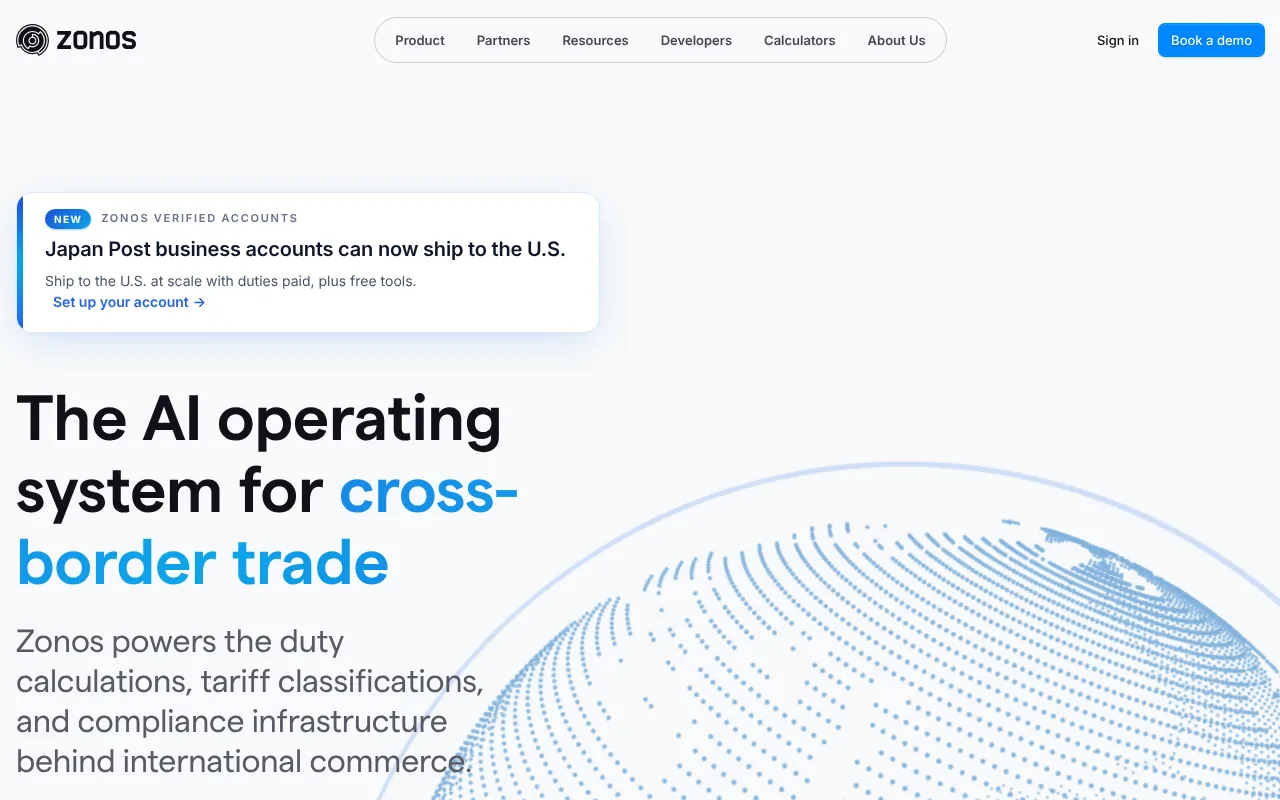
The postal side took the hardest hit. When the suspension started in August 2025, 88 postal operators suspended some or all services to the US and postal traffic into the country on 29 August was 81% lower than a week earlier. Some have since resumed through duty-collecting partners (Zonos now advertises Japan Post business accounts shipping to the US), but check your national post's current status before you promise US customers a postal option.
European Union: VAT from €0, duty from the first parcel
- VAT applies from the first euro, and the Import One Stop Shop (IOSS) lets you charge destination VAT at checkout for consignments up to €150, so the parcel clears without a VAT bill. Our EU VAT OSS guide covers registration.
- The €150 duty exemption ended on 30 June 2026. Since 1 July 2026, a temporary €3 customs duty applies to each item category in low-value parcels: five T-shirts pay €3, a T-shirt and a watch pay €6.
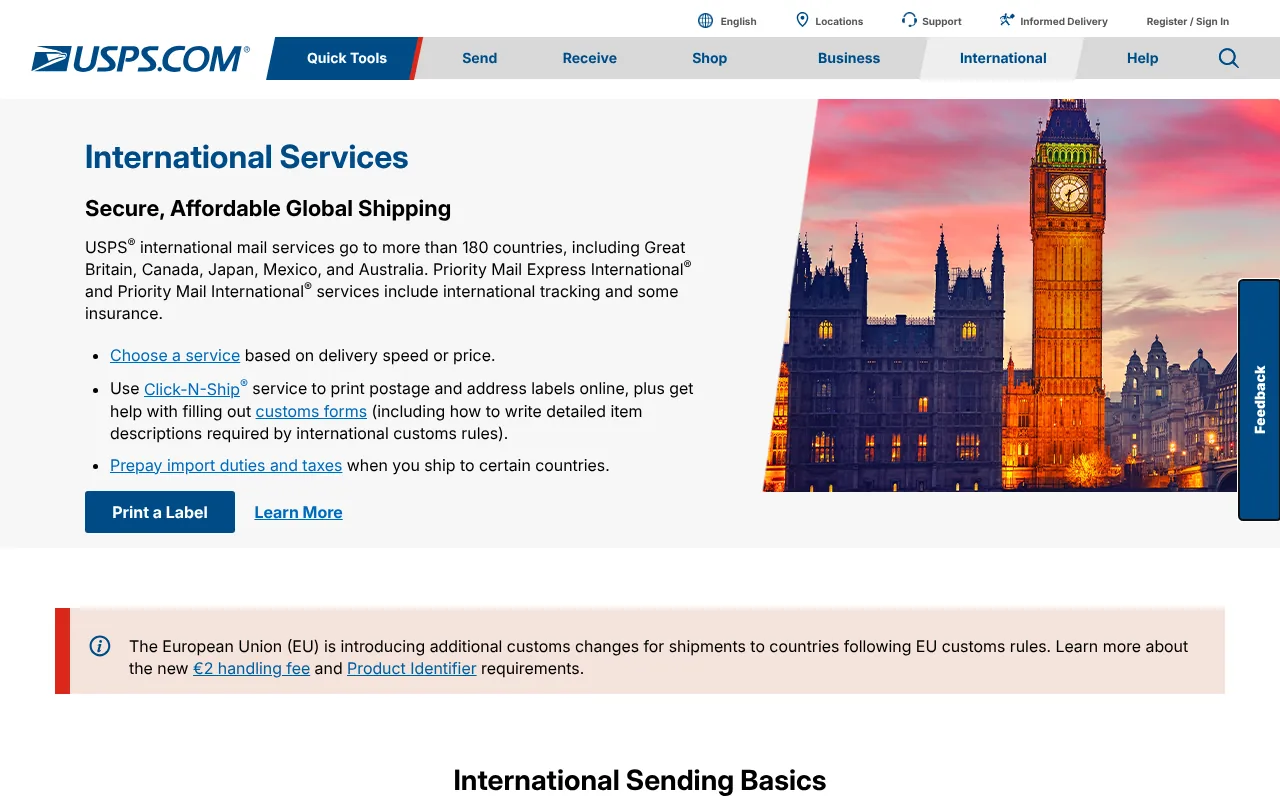
- A €2 handling fee per customs line applies to business-to-consumer parcels from 1 November 2026, according to USPS, along with new product identifier requirements.
The per-line structure rewards simple orders. A basket of six different products can pay €30 in duty and fees before VAT, so check your multi-item orders, not just your bestseller.
United Kingdom: VAT at checkout now, duty soon
For consignments of £135 or less sold to customers in Great Britain, the overseas seller charges UK VAT at the point of sale and registers with HMRC to pay it. Above £135, import VAT and duty are collected at the border. Customs duty relief for goods under £135 still exists, but the government will remove it by October 2028 at the latest, with overseas sellers liable for the duty and many needing a UK fiscal representative.
Always check the current rules where you sell. This guide summarizes US, EU and UK customs duty, import VAT and low-value parcel rules as of November 2026. These rules changed several times this year, depend on the product, its origin and the destination, and are applied differently by each carrier, so confirm the details with your carrier, a licensed customs broker or a tax specialist before you set prices. This is general information, not legal or tax advice.
International Shipping Carriers Compared
You will mix carriers, not pick one: express networks are fast and clear customs themselves, postal services are cheap and slow, and aggregators let you compare both.
| Best for | Speed | Customs | DDP | |
|---|---|---|---|---|
| DHL Express | Fast, high-value parcels worldwide | Express | Own brokerage | Yes |
| UPS | Heavier parcels, business accounts | Express and economy | Own brokerage | Yes |
| FedEx | Broad express coverage, paperless invoices | Express and economy | Own brokerage | Yes |
| USPS and national posts | Light, low-value parcels | Slow to medium | Destination post clears | Limited countries |
| Aggregators (Easyship, Shippo) | Comparing all of the above per order | Depends on carrier | Paperwork via carrier | Depends on carrier |
DHL Express
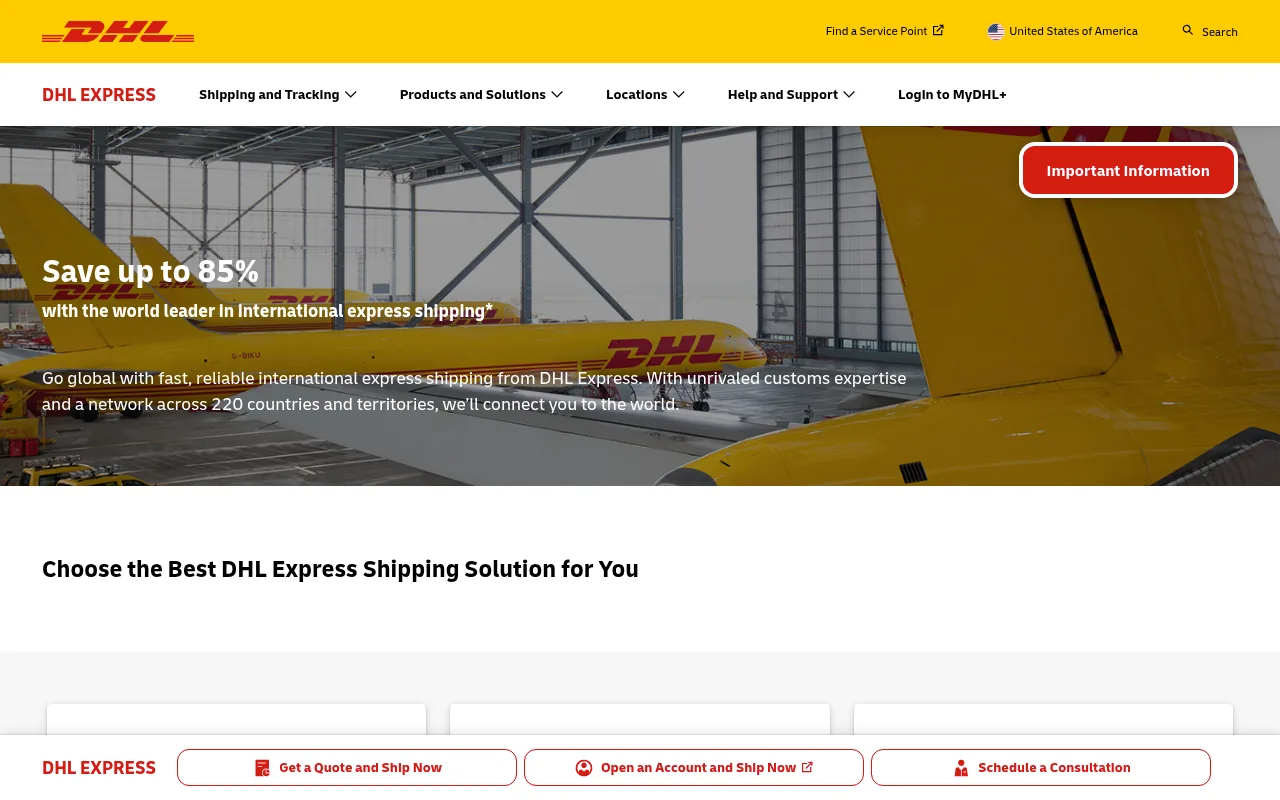
DHL Express reaches 220 countries and territories and is the default for fast cross-border delivery, especially into Europe. Its in-house customs brokerage handles clearance, which is where much of the speed comes from. It is rarely the cheapest option for a light parcel.
UPS
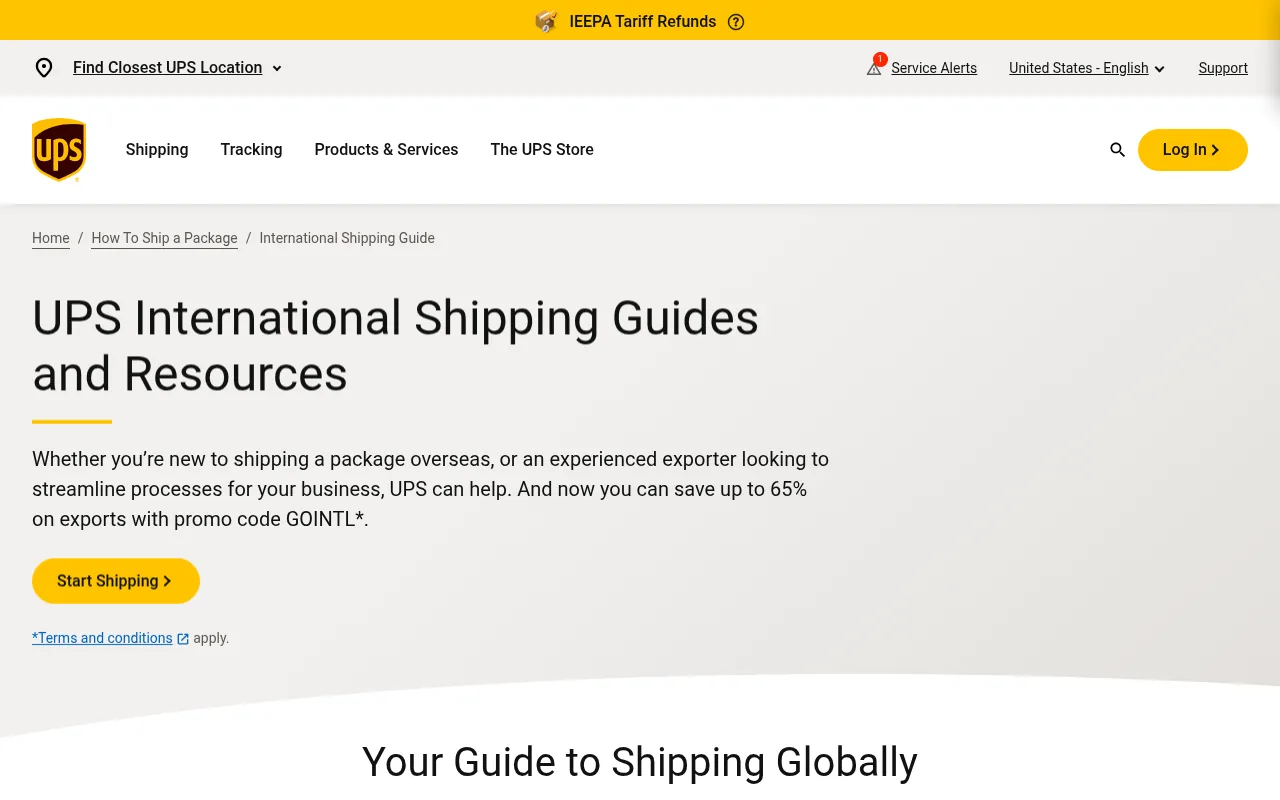
UPS is strongest as parcels get heavier and once you have a business account with negotiated rates. Its international guides cover commercial invoices, Incoterms and who pays duties in plain language and are worth reading before your first export.
FedEx
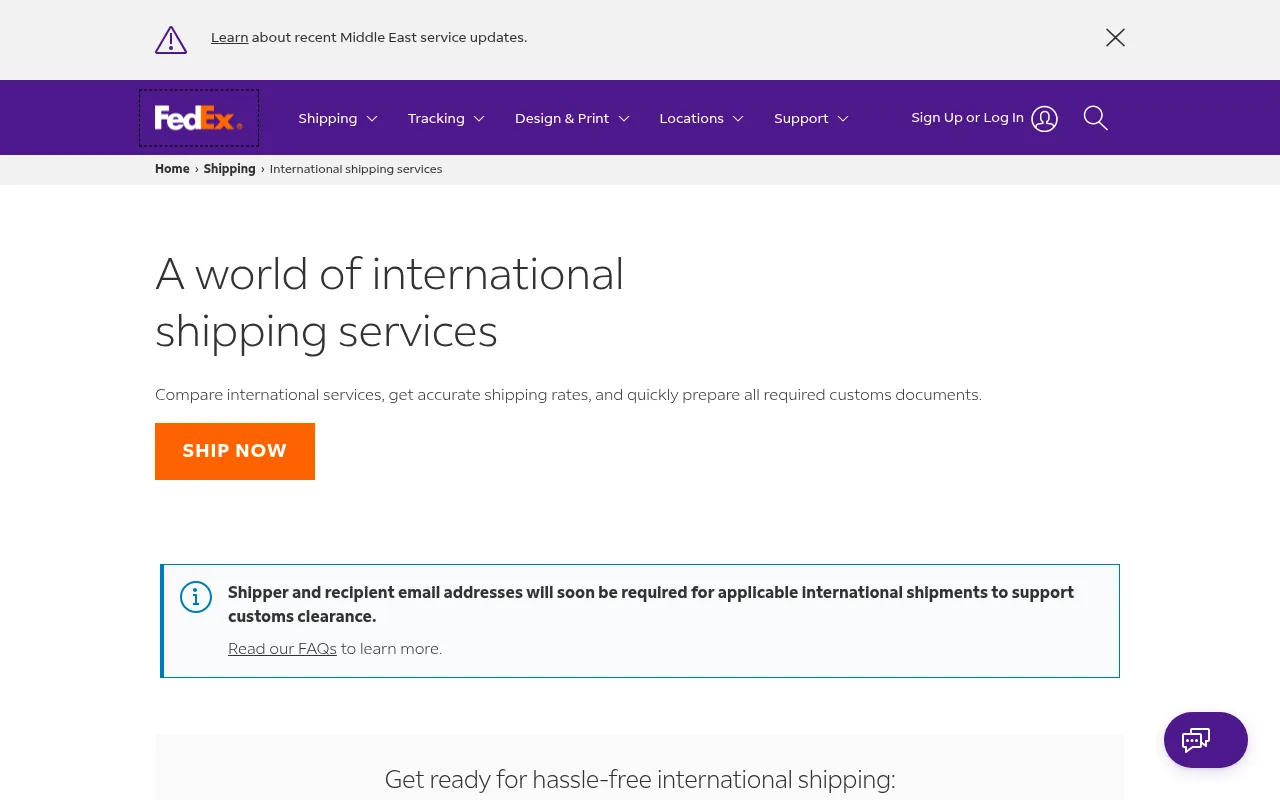
FedEx is a close match to UPS in coverage and service tiers, with electronic trade documents that send the commercial invoice to customs for you. Note the banner in the screenshot: FedEx says shipper and recipient email addresses will soon be required for some international shipments, so collect the email at checkout and pass it to the label.
USPS and national posts
USPS international services reach more than 180 countries and are hard to beat on price for light parcels. USPS now offers prepaid duties (DDP) to a list of countries, including most of Western Europe, Canada and the UK. The trade-off is speed and tracking: once the parcel leaves the US, the destination post handles it. The same goes for Royal Mail, Deutsche Post or any other national post you ship with outbound.
Aggregators and landed-cost tools
You rarely need a contract with each carrier. A multi-carrier platform gives you discounted rates from all of them through one account:
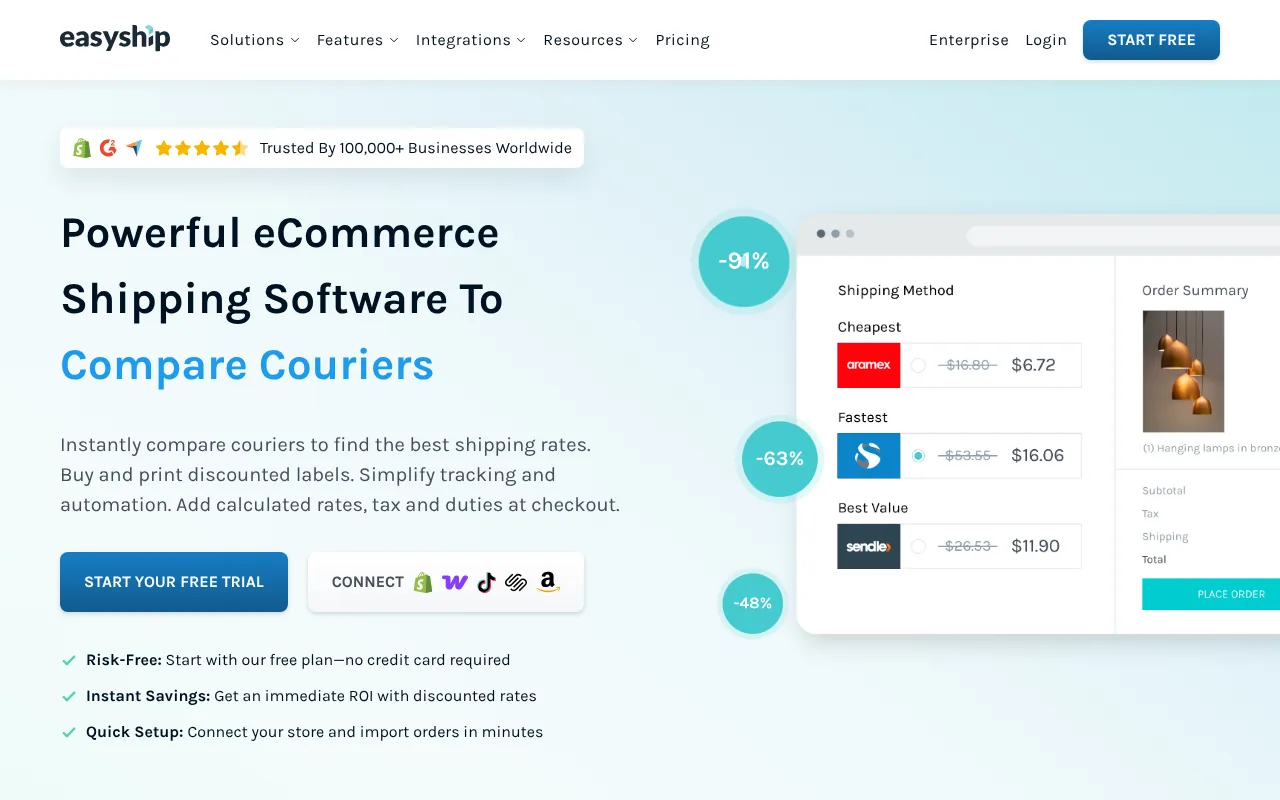
- Easyship focuses on cross-border shipping: it compares couriers per order and can add taxes and duties to the checkout rate.
- Shippo is the developer-friendly option, an API and app with rates from USPS, UPS, FedEx and DHL. It is also the US carrier integration in YNS (more below).
When duty accuracy matters more than rate shopping, a landed-cost specialist such as Zonos calculates duties and taxes at checkout, classifies products and handles the compliance side. That is the tool for DDP at scale.
Packaging and Dimensional Weight
Carriers charge the greater of actual and dimensional weight, and international rates make every extra centimeter expensive.
- DHL Express divides length × width × height in centimeters by 5,000 to get the weight in kilograms.
- UPS and FedEx use a divisor of 139 (cubic inches per pound) on daily rates, and USPS moved its own divisor from 166 to 139 for large parcels on July 12, 2026.
A 40 × 30 × 20 cm box of sweaters weighing 2 kg is billed as 4.8 kg by DHL. Pack the same sweaters in a 35 × 25 × 15 cm box and it bills at 3 kg (DHL rounds up to the next half kilo). On a long international lane, that difference can be worth more than the margin on the order. Our shipping strategy guide covers the domestic side of the same levers.
International Returns
Returns are where cross-border shipping gets expensive twice. A return label from Germany to the US can cost more than the outbound label, and the duty the customer paid does not come back automatically: refunds of import duty and VAT go through the destination's customs process or a duty drawback claim, which most small stores never file.
Three practical options:
- Refund without a return for low-value items, when return shipping costs more than the product.
- A local returns address through a 3PL or returns consolidator in your biggest market, so parcels travel domestically and ship home in bulk. See our fulfillment guide for when a 3PL pays off.
- A clear policy that says who pays return shipping and what happens to duties. Your return policy has to meet EU and UK consumer law anyway: a 14-day withdrawal right for distance sales.
Setting Up International Shipping in Your Store
Your Next Store is an AI-powered commerce platform with a managed backend and an open-source Next.js storefront. It does not calculate customs duty or file DDP entries for you. Here is what it does cover for cross-border orders:
- Rates per country. Each shipping method has a list of available countries, so you can charge one price at home and others abroad. Checkout only offers countries at least one method ships to.
- Weight and size rules. A method can be limited by order value, weight and parcel size, with your carrier's dimensional weight divisor (often 5,000 or 6,000) so a big, light parcel counts the way the carrier bills it.
- Live carrier rates. The Shippo integration returns rates from USPS, UPS, FedEx, DHL and more on every order, international ones included, with customs documentation handled on Shippo's side. For stores shipping from Poland, the FedEx add-on stores an HS code, country of origin and who pays duties (the buyer on delivery or you), and sends the commercial invoice to customs electronically.
- An honest DAP note. Turn on the customs note in checkout settings and every shopper who picks a country other than yours sees that import duties and taxes may be charged on delivery.
- Tracking. Carrier scans feed a shipment timeline on the order and on the customer's tracking page.
Plans start at $30 a month with 0% platform transaction fees, and Stripe Tax is available for the tax side. For true DDP you pair it with a carrier or landed-cost provider that collects and files duty. For the rest of the cross-border picture (currency, VAT registration, localization), see how to sell internationally.
What Nobody Tells You About International Shipping
- The carrier's clearance fee can exceed the duty. On a $40 parcel, a few dollars of duty plus a carrier fee for advancing it is a big share of the order.
- Refused DAP parcels are your problem. You pay to get them back, or you abandon them. Either way, you lose the sale and the shipping.
- Rules move faster than your shipping page. Put a quarterly reminder in your calendar to re-check every market you ship to.
Quote the whole stack, collect it once, and the border stops being your customer's problem.
FAQ
How much does international shipping cost for an online store?
The label is usually the smaller part. Budget for the landed cost: shipping, plus duty based on the HS code and origin, plus import VAT or tax in the destination, plus government and carrier fees. For a low-value parcel into the EU that means €3 duty and €2 handling fee per product line plus VAT at the local rate, before the carrier's own fees.
Should I ship DDP or DAP?
DDP for any market you care about. It costs setup work, but the customer pays once and the parcel arrives without a bill. Use DAP only for occasional orders to countries you do not target, and say clearly at checkout that duties may be charged on delivery.
Do I need an HS code for every product?
Yes, if you ship across borders. Carriers ask for it on the commercial invoice, the duty rate depends on it, and the EU charges its €3 duty per tariff category. Classify once, store the code on the product, and let your label tool reuse it.
Related Blog Posts

Before you spend more on ads,
check your store.
Get a free 25-point checklist to find what could be holding back your sales, from product pages to checkout.