Ecommerce Return Policy: EU and US Rules (Plus a Template)
 Jakub Neander
Nov 3, 202611 min read
Your ecommerce return policy is a legal document, a conversion tool and a cost control, all in one page. In the EU and UK, customers get a statutory right to cancel that you can't contract out of. In the US, the policy is mostly up to you, but a vague one loses disputes. This guide covers what each region requires, how to set the terms you do control, and ends with a template you can adapt in ten minutes.
Why Your Return Policy Matters More Than You Think
Shoppers check the return policy before they buy, especially from a store they haven't heard of. A clear one removes a reason to abandon the cart, and a hidden or confusing one pushes buyers toward Amazon. Return policy also shows up in three other places:
- Conversion. An easy-to-find policy reduces purchase anxiety. It belongs in the footer, on product pages and next to the checkout button.
- Margin. Returns cost you shipping both ways, handling and sometimes unsellable stock. Fashion and footwear see the highest return rates, while consumables see almost none.
- Disputes. When a customer disputes a charge with their bank, the policy you published is your evidence. Vague wording rarely wins.
The trick is to separate what the law forces on you from what you choose. Start with the law.
The Legal Floor by Region
European Union: The 14-Day Right of Withdrawal
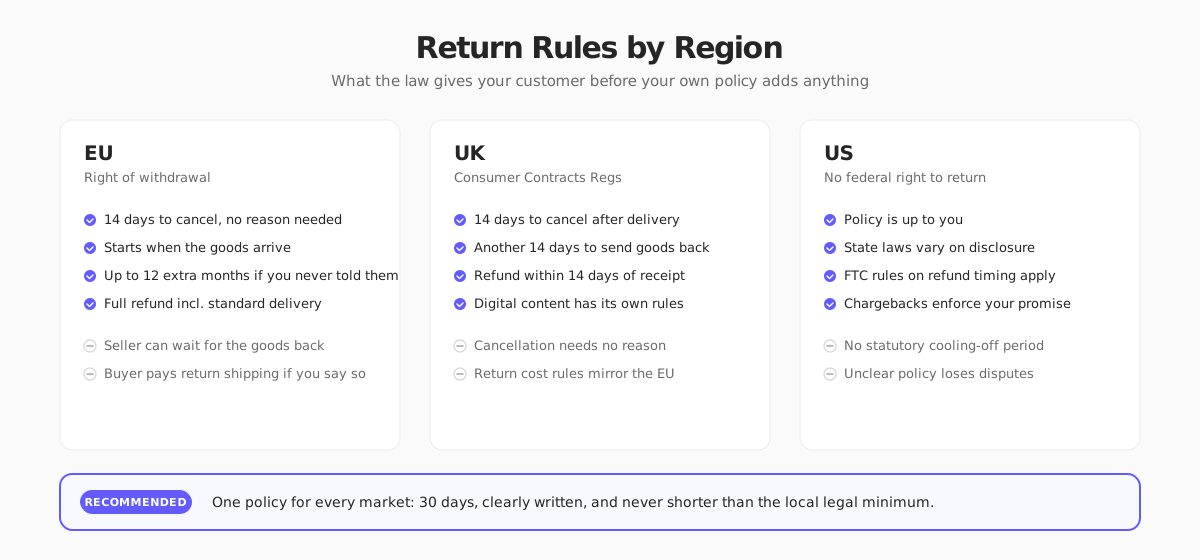
Under the Consumer Rights Directive, consumers who buy at a distance (online, phone, mail order) from a business can cancel without giving a reason. The essentials:
- Period: 14 days, counted from the day the customer receives the goods. For multi-item orders delivered separately, from the last item.
- Missing information: if you fail to tell the customer about the right to withdraw, the period extends by up to 12 months.
- Refund deadline: within 14 days of being told about the withdrawal. You may hold the refund until you receive the goods back or the customer proves they've sent them.
- What you refund: the price paid plus standard delivery. If the customer picked a more expensive delivery option, you don't have to refund the extra.
- Return shipping: the customer pays, but only if you told them so before they bought. Otherwise it's on you.
- Condition: the customer is only liable for loss in value caused by handling beyond what's needed to check the goods, so "tried it on" is fine and "wore it for a week" is not.
- Exceptions: custom-made goods, sealed hygiene or health products that were opened, perishable goods, sealed media that were unsealed, and a few other categories.
- Model withdrawal form: the Directive includes a standard form you must make available. Since Directive (EU) 2023/2673 applies from 19 June 2026, online sellers must also offer an electronic "withdrawal function": a clearly labeled button or equivalent that lets a customer start a withdrawal in a few clicks. Check how your platform supports it.
This is separate from the legal guarantee for faulty goods. Your Europe summarizes it: the seller must repair or replace goods that are faulty or not as described, with a refund if that isn't possible, and the guarantee lasts at least two years from delivery. National laws can add more.
United Kingdom: Same Idea, Different Statute
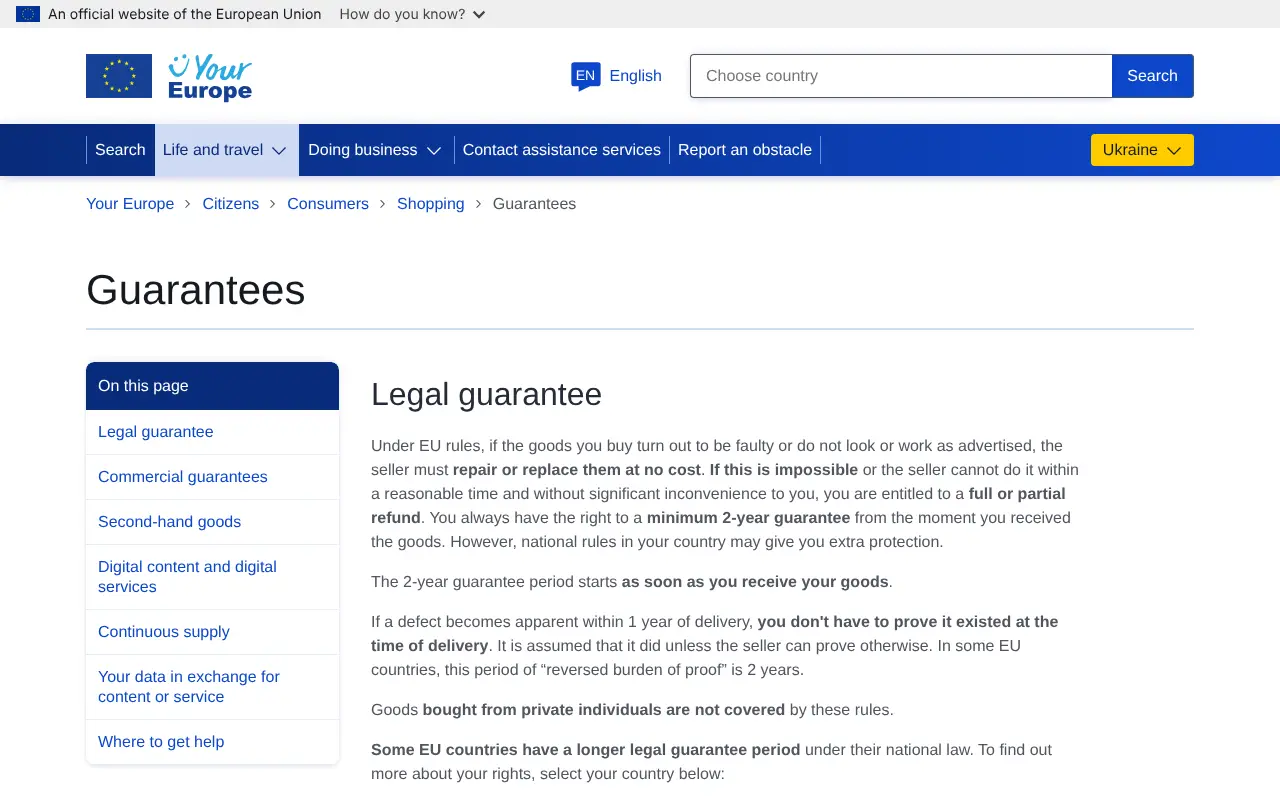
The UK's Consumer Contracts Regulations mirror the EU model: 14 days to cancel after delivery, then a further 14 days to send the goods back, and a refund within 14 days of receiving them. Faulty goods fall under the Consumer Rights Act 2015, which includes a 30-day short-term right to reject. If you sell to UK customers from outside the UK, these rules apply to you for those sales.
United States: No Federal Right to Return
In the US, no federal law requires you to accept returns of non-defective goods. The rules that do apply:
- FTC Mail, Internet, or Telephone Order Merchandise Rule. You must ship within the time you promised or, if you stated none, within 30 days, and give customers the option to cancel and get a refund if you can't. See the FTC's business guide.
- State disclosure laws. Some states, California among them, require return terms to be disclosed. In some cases, not posting a policy gives customers a statutory refund window. Check the states where you have the most customers.
- Card network rules. A customer can dispute a charge for goods "not as described" or not received. Your written policy is your defense, and a refund you refused unreasonably is a chargeback waiting to happen.
- Warranty law. Faulty goods are covered by implied warranties under state law, whatever your return policy says.
Selling Across Borders
If you sell to the EU, the UK and the US from one store, the EU and UK rules apply to those customers regardless of where you're based. You can't write a US-style "all sales final" policy and apply it to a customer in Germany. The practical solution is one policy built around the strictest region, with a short section for each market. For tax implications of the same cross-border setup, see our EU VAT OSS guide.
Always check the current rules where you sell. This guide summarizes EU, UK and US return rules as of November 2026. Regulations change and vary by country and state, so confirm the details with a consumer-law specialist or your local regulator before you publish. This is general information, not legal advice.
The Terms You Control
Once the legal floor is covered, everything else is a business decision.
Return Window
| Window | Works for | Trade-off |
|---|---|---|
| 14 days | Low-margin goods, high-risk categories | Matches EU/UK minimum, but feels strict |
| 30 days | Most physical products | Common default, long enough for gifts to arrive |
| 60 to 90 days | Premium brands competing on trust | Higher return rate, higher conversion |
| Extended holiday window | Gifts, Q4 | Seasonal, drives purchases in November and December |
For cross-border stores, 30 days is the easiest single number: it clears the EU and UK minimum with room to spare.
Who Pays for Return Shipping
- Free returns raise conversion and average order value but can quietly eat margin. Fashion brands that offer them often offset it with a higher price floor or free-returns-for-members.
- Paid returns (a flat fee deducted from the refund) cut serial returners. A flat fee is easier to explain than a calculated one.
- Free exchanges, paid returns is a good middle path: you keep the sale and cut the shipping loss.
- In the EU and UK, if you want the customer to pay return shipping you must say so up front. Put it in the policy and again at checkout.
Refund Method and Speed
Refund to the original payment method by default, and say how long it takes. "Within 14 days of receiving your return" matches the legal deadline in the EU and UK, but customers love "within 3 business days of inspection". Store credit is fine as an option, and a bonus (for instance +10%) nudges customers toward it, but it can't replace a legal cash refund in regions that guarantee one.
Condition Requirements
State what counts as returnable: unused, with tags, in original packaging. But remember that in the EU and UK the customer is allowed to inspect the goods as they could in a shop, so you can't refuse a return merely because the box was opened.
Non-Returnable Items
List them clearly and explain why: custom or personalized items, opened hygiene products, perishables, digital downloads once delivered, and final-sale clearance if you want it. The EU and UK allow the first four. A blanket "final sale" label on regular goods isn't valid there.
Making the Policy Easy to Follow
A good policy isn't just well written, it's well operated:
- Put it where people look: footer link, product page, cart and the order confirmation email.
- Use plain language and short sentences. Nobody reads 2,000 words of legalese.
- Offer a self-service return flow where the customer enters the order number and gets a label. It cuts support tickets, and the data tells you which products come back and why.
- Track return reasons. "Too small" on one product is a sizing-chart problem. "Not as described" is a photo or copy problem, and our guide to ecommerce checkout optimization shows where that same clarity helps conversion.
- Inspect and restock fast. The sooner returned items are back on the shelf, the lower the real cost of a return.
Make the Policy Readable for AI Assistants (GEO)
"Does this shop offer free returns?" is now a question shoppers ask ChatGPT, Perplexity or Google AI Overviews, not just your FAQ. Those assistants can only answer, and recommend your store, if they can find and read your policy. Generative Engine Optimization (GEO) covers this, and for returns it comes down to three things:
- A dedicated returns page linked from the homepage, usually in the footer, so crawlers find it without guessing.
- The policy as plain text in the page HTML, not inside a PDF, an image or a pop-up that loads with JavaScript.
- Return terms in structured data. A
MerchantReturnPolicyon your Organization, orhasMerchantReturnPolicyon each product offer, states the window, the fees and the method in a form Google and AI assistants read directly.
Our free GEO audit checks your returns page and return-policy markup, along with AI crawler access and product data, on your real product pages in under a minute.
Where Your Next Store Fits
Your Next Store gives you the operational side: order management, with refunds issued from your admin through Stripe, so a customer who qualifies for a refund gets it on the original payment method. The policy itself is your text, which you publish as a page on your store and link from the footer and checkout.
Every YNS storefront is server-rendered, with Product structured data and an llms.txt file, so AI assistants can read your catalog and the pages you link from it. To see how your current store looks to them, run a free GEO audit.
We don't ship a legal template that fits every country, and we wouldn't want you to trust one that claims to. Use the template below as a starting point and have it reviewed for the markets you sell in.
Return Policy Template
Copy this, replace the bracketed parts, and delete what doesn't apply. It's written for a store selling in the EU, UK and US from one policy.
Test your policy by reading it as an angry customer. If any sentence would lose a card dispute, rewrite it until it wouldn't.
FAQ
Do I have to offer returns on my online store?
In the EU and UK, yes, for most goods bought online: customers have a statutory 14-day right to cancel. In the US, there's no federal requirement to accept returns of non-defective goods, but you must follow the FTC's shipping and refund rules and any state disclosure rules. Even where it's optional, a clear policy usually improves conversion.
How long should my return window be?
Thirty days is the most common choice and works across regions, since it exceeds the 14-day EU and UK minimum. Premium brands often go to 60 or 90 days to build trust, while low-margin sellers stay closer to 14.
Who pays for return shipping?
Either can, as long as you say so before the sale. In the EU and UK, if you don't state beforehand that the customer pays, you bear the cost. US sellers are free to choose, and many charge a flat fee or offer free returns above a spend threshold.
Can I refuse a return if the item was opened?
Usually not in the EU and UK, because customers may inspect goods as they would in a shop, with exceptions such as opened hygiene products and sealed media. You can deduct for loss in value caused by excess handling. In the US, you can set your own condition rules as long as you disclose them.
Related Blog Posts
Before you spend more on ads,
check your store.
Get a free 25-point checklist to find what could be holding back your sales, from product pages to checkout.