EU VAT OSS for Ecommerce: Cross-Border Sales Guide
 Jakub Neander
Oct 26, 202610 min read
EU VAT OSS (the One Stop Shop) lets you report VAT for every EU country in a single quarterly return, instead of registering in each one. If you sell to consumers in other EU countries, it is the difference between one login and up to 26 foreign tax registrations. This guide explains when you need it, how to register, what you file, and how it differs for imports and for UK sales.
Why EU VAT OSS Exists
Until July 2021, a small online store could sell across the EU and mostly pay VAT at home. Distance sellers only had to register abroad once they passed a country-specific threshold, often €35,000 or €100,000. Those thresholds are gone. They were replaced by one EU-wide rule and one reporting scheme.
The rule is simple: VAT on a B2C sale is due where the customer is, not where you are. A Polish shopper pays Polish VAT, a French shopper pays French VAT, whatever country you ship from. The OSS is the filing shortcut that makes that workable for small sellers.
The numbers that matter, from the European Commission's OSS page:
- €10,000 per calendar year, excluding VAT, across all other EU countries combined, is the cross-border distance sales threshold. It counts the current and previous calendar year.
- Below it, you can keep charging your home country's VAT rate.
- Above it, the destination country's rate applies to every sale from that point on.
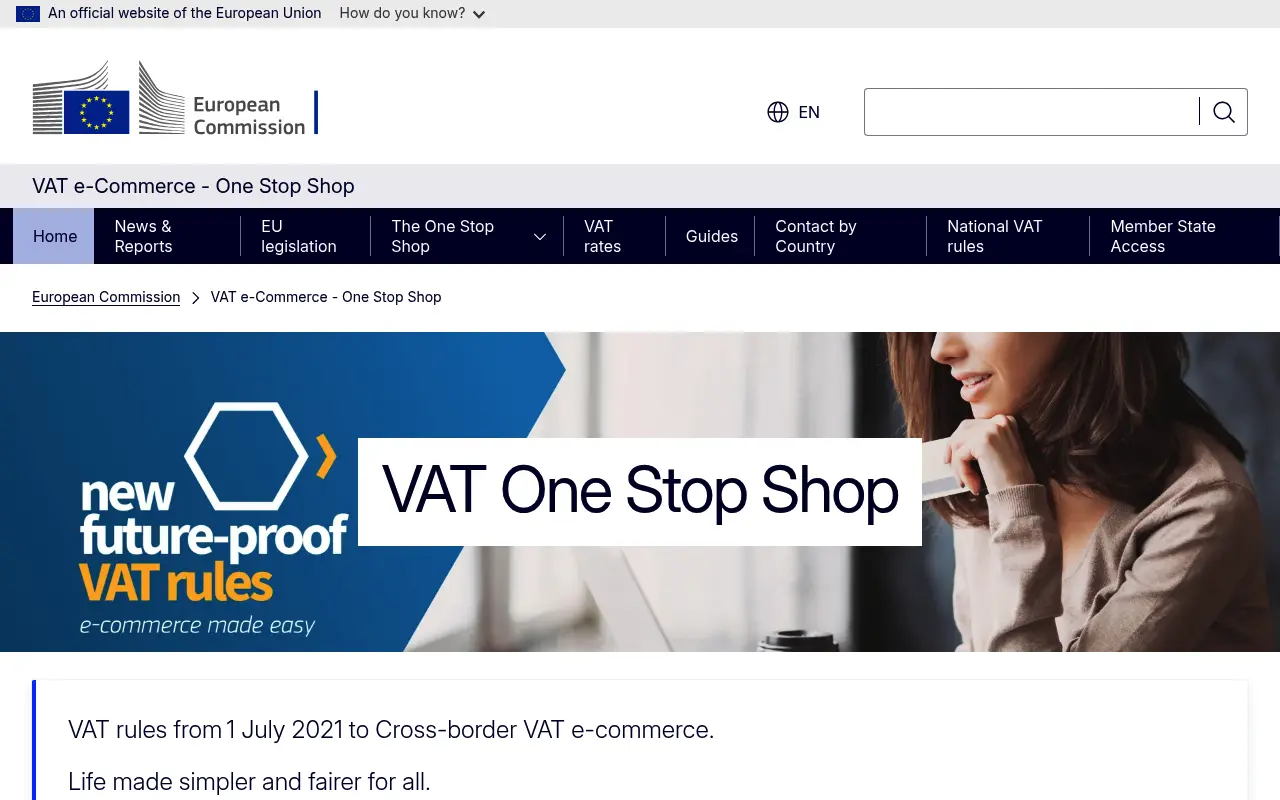
The €10,000 limit is one EU-wide total, not a per-country limit. Ten orders to ten different countries count together. It also only applies if your business is established in a single EU member state. The threshold covers B2C distance sales of goods and B2C digital services.
The Three OSS Schemes
"OSS" is really three optional schemes. Which one you use depends on where your business is and how your goods travel.
| Scheme | Who it is for | What it covers | Return frequency |
|---|---|---|---|
| Union OSS | Businesses established in the EU, and some non-EU sellers shipping from EU stock | Intra-EU distance sales of goods, B2C services | Quarterly |
| Non-Union OSS | Businesses with no establishment in the EU | B2C services supplied to EU customers | Quarterly |
| Import OSS (IOSS) | Anyone selling goods shipped from outside the EU in consignments up to €150 | VAT collected at checkout on low-value imports | Monthly |
For most small stores, one of two situations applies:
- You are an EU business shipping to other EU countries. You want the Union OSS.
- You ship from outside the EU (the US, UK, China or elsewhere) to EU consumers. You want IOSS, or you let the carrier handle import VAT at the door.
Once you opt into a scheme, it applies to all your relevant supplies in all member states. You cannot pick and choose countries.
Do You Need to Register?
Work through these questions in order.
1. Are you selling to consumers, not businesses?
OSS is for B2C sales. If the buyer is a business with a valid EU VAT number, the supply is usually a B2B transaction and a reverse charge can apply, so the customer accounts for the VAT. Collect and validate VAT numbers in the VIES system if you sell to both.
2. Do you ship goods to another EU country?
Selling within your own country is a normal domestic sale. OSS only covers sales that cross an EU border.
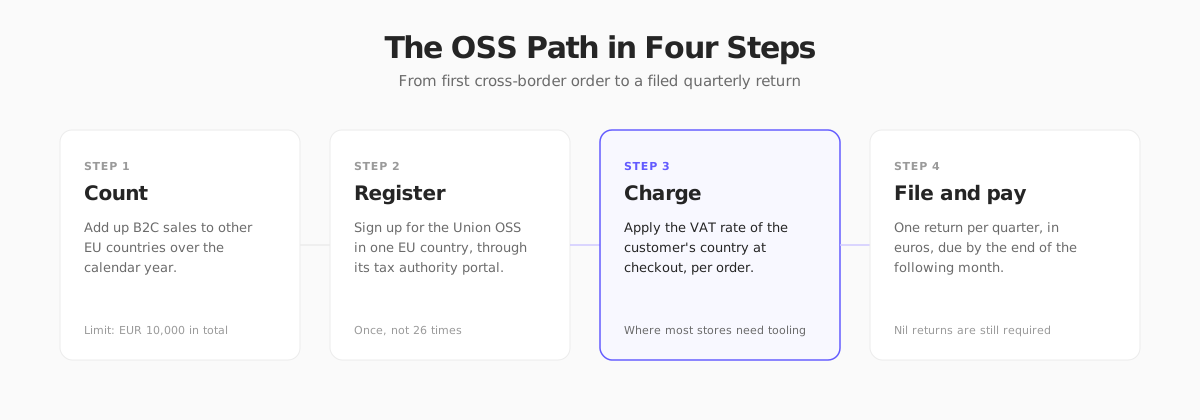
3. Have you passed €10,000 in cross-border sales?
Add up your B2C sales to other EU countries for the calendar year, excluding VAT. Under €10,000 in the current and previous year, you can stay on your home rate. Over it, you must charge destination VAT from the sale that crossed the line.
4. Do you want OSS, or separate registrations?
Once you owe VAT in other countries, you have two options: register for the OSS, or register for VAT separately in each country. Almost every small store should choose OSS. Separate registrations only make sense for sellers who already store stock abroad and need local registrations for other reasons.
Stock in another EU country changes things. If you keep inventory in a warehouse abroad (a 3PL or a fulfillment network), you can have a taxable presence there and may need a local VAT number even with OSS. Sales from that warehouse to customers in the same country are domestic sales, and OSS does not cover them.
How to Register for the Union OSS
You register once, with the tax authority of the country where your business is established. In most EU countries this is an online form inside the national tax portal.
- Check eligibility. You need a VAT registration in your home country. Some countries do not require VAT registration below a domestic threshold, so ask your tax office how they handle OSS in that case.
- Find your tax authority's OSS portal. The Commission lists every country's contact details and guides on the OSS site.
- Register and pick a start date. The scheme starts on the first day of the next quarter, or earlier if you cross the threshold mid-quarter. Ask your tax office to confirm the date, because the first day you crossed the limit decides when destination VAT applies.
- Update your checkout so it charges the customer's country rate from that date.
If you are a non-EU business, the route depends on the product. Goods shipped directly from outside the EU in consignments of €150 or less use IOSS, and non-EU sellers generally must appoint an EU-based intermediary to register for it. Goods shipped from stock you already hold inside the EU can use the Union OSS, registered in the country where that stock sits.
What You Charge: The Rate of the Customer's Country
Under OSS you charge the VAT rate of the destination country, not a blended rate. Standard rates run from 17% in Luxembourg to 27% in Hungary, and every country has reduced rates for certain goods such as food, books or children's clothing. Rates change, so pull them from the "VAT rates" section of the OSS portal or a tax tool rather than a spreadsheet you updated once.
Three practical points for your checkout:
- Show VAT-inclusive prices to consumers. In the EU, B2C prices are expected to include VAT. When the rate changes by country, the final price changes too, unless you absorb the difference in your margin.
- Decide how you handle price differences. Many stores keep one gross price (and accept a slightly different margin per country). Others set local prices per market. Both are legal.
- Put the VAT on the invoice. Show the net price, the rate, and the VAT amount per line, plus your VAT ID.
Margin check: a €50 gross price carries about €8.00 of VAT at 19% (Germany) and about €10.00 at 25% (Denmark). Over many orders, that gap adds up. Run the numbers for your top three destination countries before you decide on one price for all of them.
Quarterly Returns, Deadlines and Payment
The Union OSS return covers one calendar quarter, and it is filed in euros.
| Quarter | Covers | Return and payment due |
|---|---|---|
| Q1 | January to March | 30 April |
| Q2 | April to June | 31 July |
| Q3 | July to September | 31 October |
| Q4 | October to December | 31 January |
In other words, the deadline is the end of the month after the quarter ends. That means the Q3 2026 return is due on 31 October, days from when this guide was published.
What goes on the return:
- Sales per destination country, with the VAT rate and the VAT amount.
- Any corrections to earlier quarters (you amend through the next return, not by filing a new one).
- One payment to your home tax authority, which distributes the VAT to the destination countries.
A few rules to keep in mind:
- File even with no sales. A nil return is still required when you are registered.
- Keep records for ten years. Orders, invoices, rates applied and proof of the customer's location.
- Do not miss deadlines repeatedly. Missing returns or payments for several consecutive quarters can get you excluded from the scheme for a period, which pushes you back to separate registrations.
- Currency conversion to euros for non-euro sales follows the European Central Bank rate on the last day of the return period, in most cases. Check your tax authority's guidance for the exact rule.
Your OSS VAT covers only sales made through the scheme. Your home-country VAT return still covers domestic sales and your own purchases. You continue to file it as before.
Imports and IOSS: Shipping to the EU From Outside
If you ship from outside the EU, three things change what the customer pays at the door.
- VAT on every import. Since July 2021, the old VAT exemption for small parcels is gone. Import VAT applies from the first euro.
- IOSS collects VAT at checkout. For consignments up to €150, the Import One Stop Shop lets you charge destination VAT when the customer pays and report it monthly. The parcel then clears customs without a VAT bill at the door.
- Without IOSS, the customer or carrier pays. The recipient is billed VAT at delivery, often with an added carrier handling fee. That is a common cause of refused parcels and bad reviews.
On top of VAT, customs duty has changed too. The EU's €150 duty exemption ended on 30 June 2026. From 1 July 2026, a temporary €3 customs duty applies per item on low-value consignments of up to €150 imported from outside the EU, and it is set to run until 1 July 2028 while a permanent system is built. Responsibility for the duty has moved away from consumers and onto platforms, sellers and carriers. How exactly each carrier collects it is still settling, so ask your shipping partner how the €3 is handled before you promise customers "no extra fees".
If you sell through a marketplace such as Amazon, Etsy or eBay, the platform is often treated as the seller for VAT on certain imports and on non-EU sellers' EU sales, so it collects and remits the VAT. Your own website is a different story, because you are the seller.
UK Sales Are a Separate System
The UK left the EU VAT regime, and OSS does not cover UK sales. For UK customers:
- Sellers in the UK register for UK VAT at the £90,000 domestic threshold.
- Overseas sellers do not get that threshold and register from the first sale.
- For consignments of £135 or less, VAT is charged at the point of sale, and the seller accounts for it through a UK VAT return.
Northern Ireland follows EU rules for goods, so the picture there is more mixed. If the UK is a meaningful market, speak to an accountant before launching.
Always check the current rules where you sell. This guide summarizes EU and UK VAT and customs rules for online stores as of October 2026. Thresholds, rates, deadlines and customs procedures change and are applied differently by each member state, so confirm the details with your national tax authority or a qualified accountant before you register, charge or file. This is general information, not tax advice.
Automating Cross-Border VAT in Your Store
The registration is a one-off task. The recurring pain is charging the correct rate on every order and producing the numbers for the return. Three levels of automation cover most stores:
- Manual rates. You define the rate per country yourself. Works for a handful of markets, but you own every rate change.
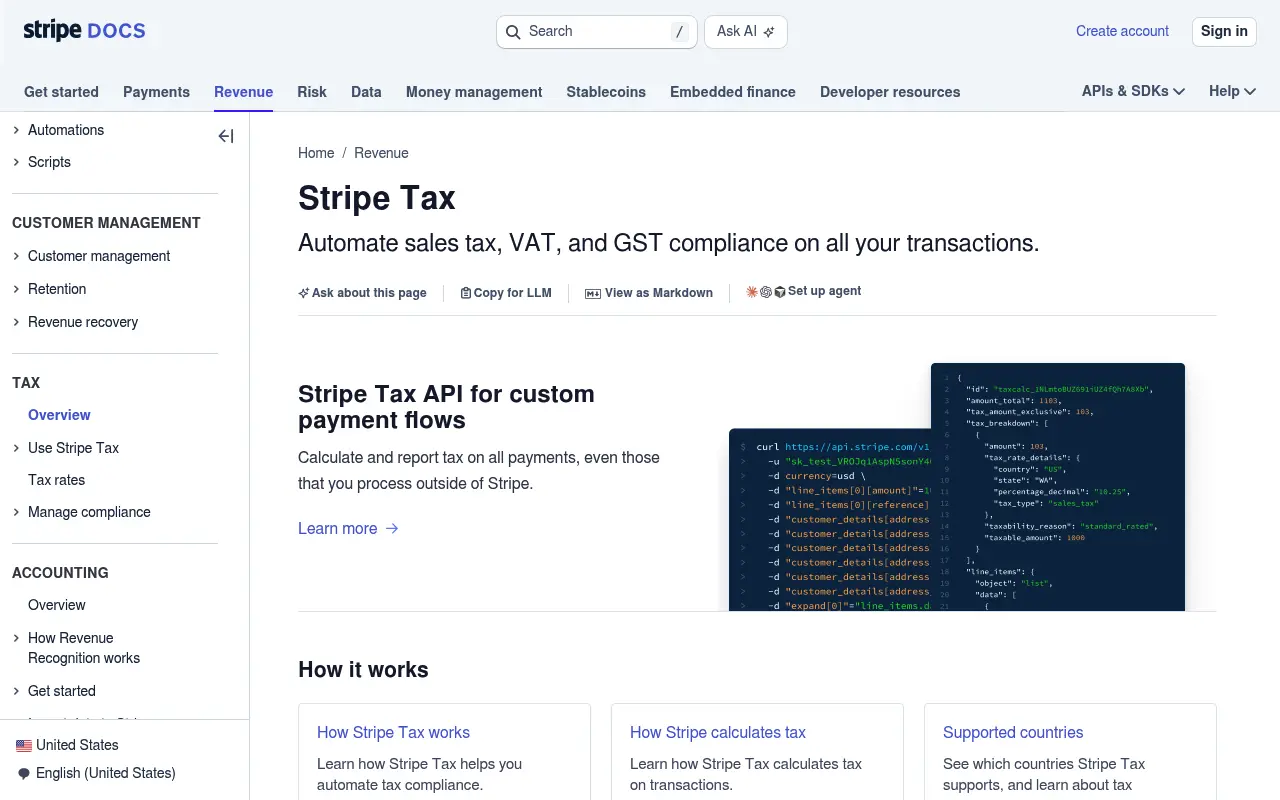
- Automatic calculation. A tax engine such as Stripe Tax works out the rate from the customer's address and can monitor your sales against thresholds. You still file the return, or hand that to your accountant.
- Calculation plus filing. Dedicated compliance services prepare and submit returns for you, for a monthly or per-filing fee.
How Your Next Store Handles VAT
Your Next Store lets you choose between automatic tax (calculated from the customer's location with Stripe Tax) and manual tax rates that you define by country or region. You can also decide per store whether prices are tax-inclusive or tax-exclusive, which matters for EU consumers who expect to see the final price. The setup is described in the taxes help article, and invoices show the rate and tax amount per line.
The honest limit: YNS calculates and displays tax, but it does not register you for OSS or file returns. Registration and filing stay with you, your accountant or a filing service. Stripe Tax is optional, so automatic rates depend on you enabling it and checking that it covers the countries you sell to.
A Simple EU VAT OSS Checklist
- Total your B2C sales to other EU countries for the current calendar year
- Compare the total to the €10,000 threshold, and flag yourself at about €8,000
- Register for the Union OSS (or IOSS if you ship from outside the EU) with your tax authority
- Set up destination-country rates at checkout, with VAT-inclusive consumer prices
- Check invoices show the rate, the VAT amount and your VAT ID
- Put the quarterly deadlines (30 April, 31 July, 31 October, 31 January) in your calendar
- Keep order and invoice records for ten years
- Ask your carrier how the €3 customs duty is handled on parcels from outside the EU
FAQ
Do I have to use the OSS?
No. The scheme is optional. Without it, you would need to register for VAT in each EU country where you owe tax, and file a separate return in each. For small sellers, that is rarely worth it.
What happens if I sell under €10,000 across the EU?
If your cross-border B2C sales stay below €10,000 a year in total, and you are established in only one EU country, you can charge your home country's VAT. Once you pass the limit, destination VAT applies from that sale onward, so track your total during the year.
Does OSS cover digital products and services?
Yes. B2C digital services, such as downloads, software and streaming, fall under the same €10,000 threshold and the same scheme. For digital goods the customer's location is usually proven with two pieces of non-contradictory evidence, such as billing address and IP location, so keep that data.
Can a non-EU store use the EU VAT OSS?
Yes. Non-EU sellers can use IOSS for goods shipped from outside the EU in consignments up to €150 (usually through an EU intermediary), the Non-Union scheme for B2C services, and the Union scheme for goods sent from EU stock.
Final Takeaway
Cross-border VAT is a bookkeeping problem, not a legal one. Track your EU-wide B2C sales against €10,000, register once for the OSS, let software charge the right rate per country, and put four dates in your calendar. The stores that get caught are not the ones that pay the VAT, they are the ones that never noticed they crossed the line.