How to Sell Online in Germany: A Guide for Foreign Stores
 Jakub Neander
Nov 23, 202615 min read
Germany is the easiest big EU market to sell into and the easiest one to get wrong. Shoppers there spent €83.1 billion on goods online in 2025, up 3.2% on the year, and they buy from foreign stores happily. But if you want to sell online in Germany, the rules that catch outsiders are not the ones in a generic EU guide: a legal notice on every page, a packaging register that changed in August 2026, an electronics register with its own number on every listing, and a withdrawal button that became mandatory in June 2026. This guide covers what a foreign store needs before the first German order, in the order you should deal with it.
Why Selling Online in Germany Is Different
Most of what applies in Germany is EU law: the 14-day right of withdrawal, VAT on the customer's side of the border, GDPR, product safety. If you already sell to France or the Netherlands, you have done half the work.
The other half is German, and it has three features that surprise foreign sellers:
- Registers before you sell. Germany runs national registers for packaging (LUCID) and for electrical equipment and batteries (stiftung ear). Marketplaces check them, and an unregistered product may not legally be offered.
- Private enforcement. Competitors and trade associations can send a formal warning letter (an Abmahnung) for a missing legal notice or a sloppy price display. It comes with a demand to sign a cease-and-desist declaration backed by a contractual penalty, and that is often costlier than the original mistake.
- Payment habits. German shoppers pay with PayPal and on invoice more than with cards. A card-only checkout loses German shoppers before any law comes into it.
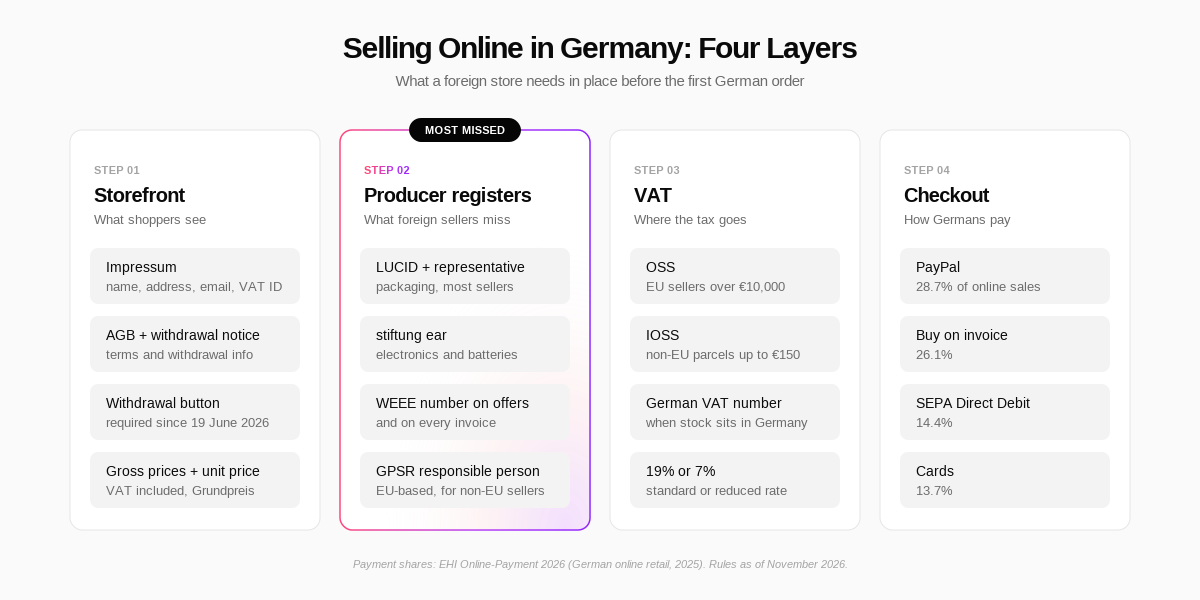
Here is the whole picture on one page. The rest of this guide walks through each layer.
Step 1: Make Your Storefront Legal for Germany
The Impressum (legal notice)
Every commercial website aimed at German users needs an Impressum: a page, one click from anywhere on the site, that says who runs it. Since May 2024 the rule sits in § 5 of Germany's Digital Services Act (Digitale-Dienste-Gesetz, DDG), which replaced the old Telemedia Act with almost no change in content. For a company, it covers:
- The full legal name and legal form (Inc., Ltd., GmbH) and who can represent it, usually the directors
- A street address (not a PO box)
- An email address and a second fast way to reach you, in practice a phone number
- The company register and registration number, if you have one
- Your VAT ID, if you have one
Strictly, EU-based sellers follow their home country's version of the same EU rule, and German courts have applied the Impressum duty to non-EU sellers who target German customers. Either way, German shoppers expect the link labeled "Impressum" in the footer, and its absence is a classic trigger for a warning letter. Put it there.
Terms, withdrawal notice and the order button
German consumer law is EU consumer law with German details. The parts that matter for an online store:
- Withdrawal notice (Widerrufsbelehrung). Consumers have 14 days from delivery to withdraw from a purchase without a reason. You must explain the right before the order and provide the model withdrawal form. If you skip it or get it wrong, the withdrawal period is extended by up to 12 months. We cover the EU-wide rules in our return policy guide.
- Terms (AGB). Not mandatory, but almost every German store has them, because they set delivery, payment and warranty rules. A two-year statutory warranty for consumers applies whatever your terms say.
- The order button. The final button has to make clear the customer is committing to pay. German law names "zahlungspflichtig bestellen" ("order with obligation to pay") as the standard wording. "Continue" or "Submit" does not count, and without a correct label no contract is formed.
- The ODR link is gone. The EU shut down its online dispute resolution platform on 20 July 2025, and the duty to link to it was repealed. Remove old links from your footer and terms. Businesses with more than ten employees still have to state whether they take part in consumer arbitration.
Use a German legal text service rather than translating your English terms. German stores typically buy their Impressum, terms, withdrawal notice and privacy policy from specialist providers or trade associations that update the texts when the law changes. A literal translation of US-style terms tends to contain clauses that are invalid under German law, and invalid clauses are one more thing a competitor can warn you about.
The withdrawal button (since 19 June 2026)
This is the newest rule and the one most foreign stores have not caught up with. Directive (EU) 2023/2673 requires an electronic withdrawal function for online consumer contracts, and Germany implemented it in a new § 356a of the Civil Code (BGB). According to Germany's consumer advice centers (Verbraucherzentrale), the function must:
- Carry a clear label such as "Vertrag widerrufen" ("withdraw from contract"). "Contact" or "Service request" is not enough. A clearly labeled link is fine. It does not have to be a styled button.
- Be easy to find for the entire withdrawal period, and not hidden behind a login unless the purchase itself required one.
- Work in two steps: the customer identifies the order (for example by order number or email), then confirms with a second button such as "Widerruf bestätigen" ("confirm withdrawal").
- Trigger an electronic acknowledgement of receipt, by email for example, that states the date and time of the withdrawal.
The button does not replace other channels. Customers can still withdraw by email or letter.
Prices, unit prices and discounts
Germany's Price Indication Ordinance (PAngV) shapes how a product page must look:
- Show gross prices. Consumer prices include VAT, and the page has to say so ("inkl. MwSt.") and say whether shipping costs extra.
- Show a unit price (Grundpreis) for goods sold by weight, volume, length or area, such as coffee, cosmetics or fabric. It is the price per kilogram, liter or metre, shown right next to the total price and not hidden behind a link.
- Show the 30-day lowest price when you advertise a discount. This is the EU Omnibus rule. Our Omnibus pricing guide has the details.
- Don't add payment surcharges for SEPA transfers, SEPA direct debits or consumer cards. German law bans them.
Cookies, privacy and accessibility
Cookie consent in Germany follows § 25 of the TDDDG (the renamed TTDSG): no non-essential cookies or tracking pixels before the visitor opts in. Privacy is GDPR, which applies to any store that targets EU customers, wherever it is based. Since 28 June 2025, Germany's Accessibility Strengthening Act (BFSG) requires accessible online shops for consumers, with an exemption for microenterprises (fewer than 10 employees and no more than €2 million in turnover). The details are in our European Accessibility Act guide.
Step 2: Register Before You Ship (the Part Foreign Sellers Miss)
Packaging: LUCID and, since August 2026, an authorized representative
If you ship goods to German consumers in a box, an envelope or with filler, you are almost certainly a packaging producer under German law. That has meant three duties for years: register in the LUCID packaging register, pay a licensed take-back scheme (a "dual system") for the packaging you put on the market, and report your volumes.
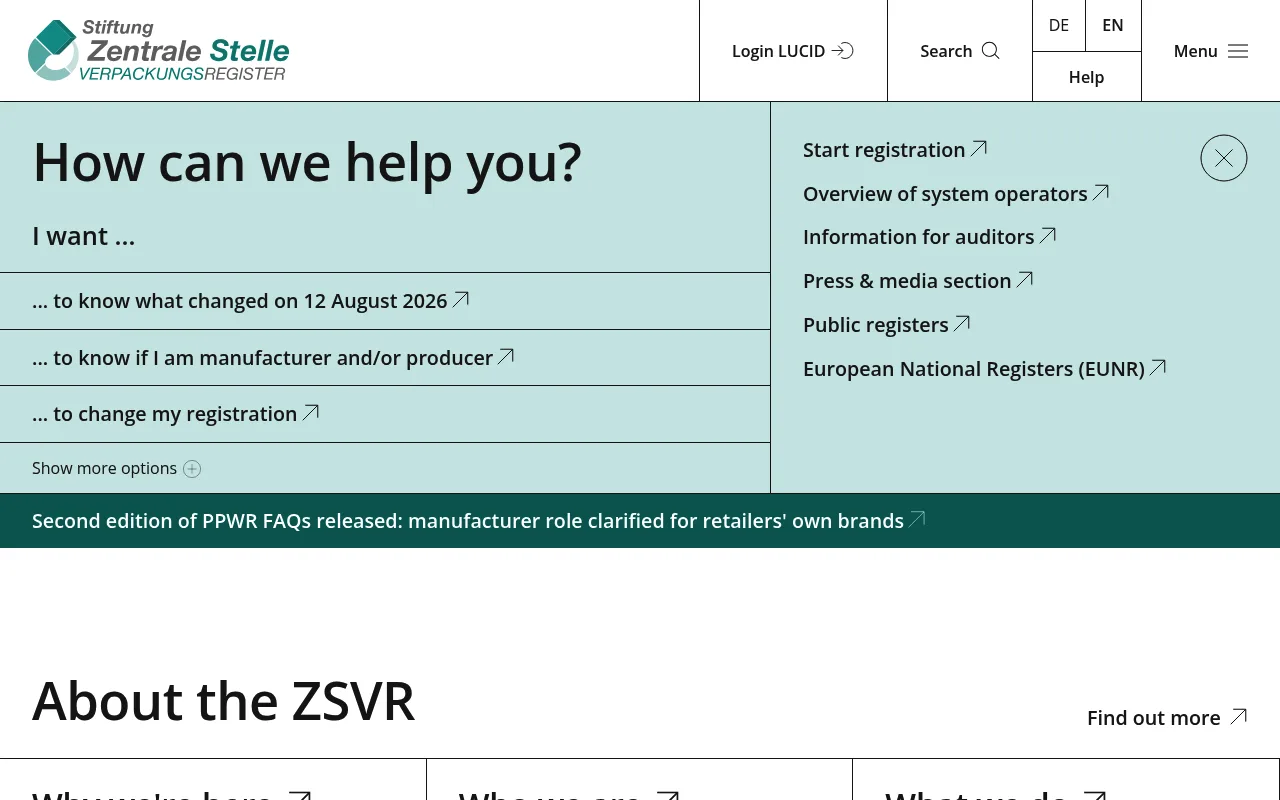
On 12 August 2026, the EU Packaging and Packaging Waste Regulation (PPWR) and Germany's new Packaging Law Implementation Act (VerpackDG) replaced the old Packaging Act (VerpackG). Registration, system participation and reporting stay, but one change hits foreign stores directly:
- Foreign sellers must now appoint an authorized representative. A company with no German branch that ships packaged goods directly to German end users has to appoint a representative based in Germany. It used to be optional. There is no exemption.
- The representative takes over the extended producer responsibility work: system participation, volume reports and the other duties under the PPWR and VerpackDG.
- The LUCID registration stays with you. You register yourself and name the representative in LUCID before your first shipment. The appointment is a written contract in German, and it only takes effect once the representative confirms it in LUCID.
- Sellers already registered before August got a transition period to add a representative. Log in to LUCID and check: the register flags a missing authorization.
Registration in LUCID is free. The representative and the dual system charge fees, which scale with your packaging volumes.
Marketplaces check this, your own store does not. Amazon, eBay and other marketplaces have had to verify sellers' LUCID registration since July 2022, so most sellers learn about it there. On your own website nobody stops you, which is exactly why direct-to-consumer stores from abroad are the ones that end up unregistered. Selling packaged goods without a registration has long meant a sales ban and heavy fines.
Electronics and batteries: stiftung ear
If you sell anything with a plug or a battery, from headphones to LED candles, Germany's Electrical and Electronic Equipment Act (ElektroG) applies. Registration runs through stiftung ear, the national register for electrical equipment and batteries.
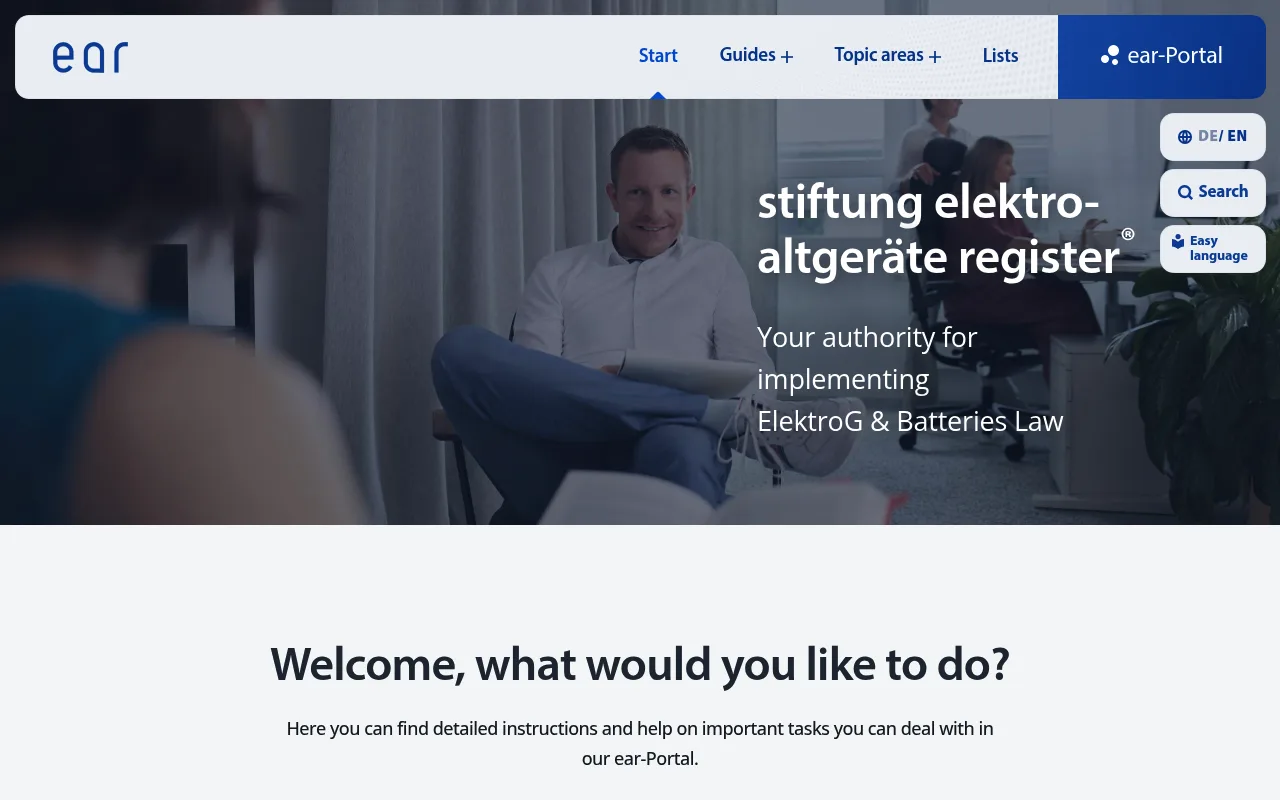
- Foreign sellers need an authorized representative. A producer with no German branch must appoint one under § 8 ElektroG, who registers on your behalf.
- The registration number goes on your offers. You must show your WEEE registration number (it starts with "DE") when you offer the equipment and on your invoices. The German Environment Agency lists the missing number as an offence.
- Batteries follow the same pattern. Germany's new Battery Law Implementation Act (BattDG) took effect on 7 October 2025, alongside the EU Battery Regulation. Distance sellers without a German establishment that ship batteries, including batteries built into devices, must appoint an authorized representative and register through stiftung ear.
A few product categories have their own regime on top: single-use plastic items such as food containers, cups or wet wipes fall under the single-use plastics fund law (EWKFondsG), for example. Check your category before you launch, not after the first warning letter.
Product safety: an EU responsible person
Since 13 December 2024, the EU's General Product Safety Regulation (GPSR) requires an economic operator established in the EU for every consumer product sold into the EU. If you are a non-EU brand without an EU importer, that means appointing an EU responsible person. Online listings must also show the manufacturer's name and address, the EU responsible person if there is one, product identifiers and any warnings or safety information.
Step 3: Get VAT Right for German Customers
Germany's standard VAT rate is 19%, and 7% applies to items such as most food and books. Which VAT route you take depends on where you are and where your stock sits.
| Your situation | What applies | Where you file |
|---|---|---|
| EU business, cross-border B2C sales to all EU countries under €10,000 a year | Your home country's VAT | Your home VAT return |
| EU business above €10,000 | German VAT (19% or 7%) on German orders | One quarterly return via the EU VAT OSS |
| Non-EU business shipping parcels worth up to €150 from abroad | German VAT collected at checkout | Monthly IOSS return, usually through an EU intermediary |
| Non-EU business shipping parcels over €150 from abroad | Import VAT and customs duty at the border | Paid at import by you (DDP) or the customer (DAP) |
| Anyone holding stock in Germany (3PL, Amazon FBA) | German VAT on domestic sales | German VAT registration from the first sale |
Two details for sellers from outside the EU:
- Your tax office depends on your home country. A US business registers with the Finanzamt Bonn-Innenstadt, a UK business with the Finanzamt Hannover-Nord, and most other non-EU businesses, including those from China, with the Finanzamt Berlin International, per the VAT jurisdiction ordinance.
- Low-value parcels now pay customs duty too. Since 1 July 2026, a temporary €3 duty per item applies to parcels up to €150 entering the EU. Ask your carrier how it is collected before you promise "no extra fees at the door".
Always check the current rules where you sell. This guide summarizes German and EU rules for online stores selling to German consumers as of November 2026: legal notice, consumer law, price display, packaging, electrical equipment and battery registration, product safety and VAT. Rules change, transition periods expire, and your duties depend on your products and where your business is established, so confirm the details with the competent German authority (ZSVR, stiftung ear, your Finanzamt), a German lawyer or a tax advisor before you sell. This is general information, not legal or tax advice.
Step 4: Offer the Payment Methods Germans Use
Germany is not a card market. The EHI Online-Payment 2026 study, based on 172 retailers, puts the share of German online revenue in 2025 at:
| Payment method | Share of online revenue (2025) |
|---|---|
| PayPal | 28.7% |
| Buy on invoice (Rechnungskauf) | 26.1% |
| SEPA Direct Debit | 14.4% |
| Credit and debit cards | 13.7% |
| Installments | 4.7% |
| Prepayment (bank transfer) | 3.5% |
| Apple Pay | 1.3% |
A checkout that offers cards, PayPal and an invoice or pay-later option covers the large majority of German buyers. For invoice, most stores do not carry the credit risk themselves: a pay-later provider such as Klarna pays you upfront and collects from the customer in 30 days.
Here is the catch for foreign stores: which methods you can offer depends on where your payment account is, not where your customer is. On Stripe, for example:
- PayPal through Stripe is only available to businesses in supported European countries. A US Stripe account has to integrate PayPal separately.
- Klarna through Stripe lets a European business present euro payments to German shoppers, but a business in the US can only accept Klarna from customers in its own country.
- SEPA Direct Debit is open to Stripe accounts in many countries, including the US, Canada and Australia, for euro payments from German bank accounts.
Check this before you plan your launch. For a non-EU brand, setting up an EU entity is sometimes as much about unlocking PayPal and pay-later as about tax. For the wider European picture, see our guide to European payment methods.
Step 5: Shipping, Returns and Trust
German shoppers are used to fast domestic delivery, tracking and easy returns. A few practical points:
- Ship from inside the EU if you can. A parcel from the US or Asia meets customs, possible import VAT and the €3 duty. With stock in an EU warehouse you clear customs once, on the bulk shipment, and your customers never meet a bill at the door. The cost is a VAT registration where the stock sits.
- Support Packstations. DHL's parcel lockers are widely used, so your address form should accept a Packstation number and a customer ID instead of a street.
- Write the return process down. Under EU rules the customer pays return postage if you told them so in advance. Many German stores offer free returns anyway, because shoppers compare. Whatever you choose, state it clearly.
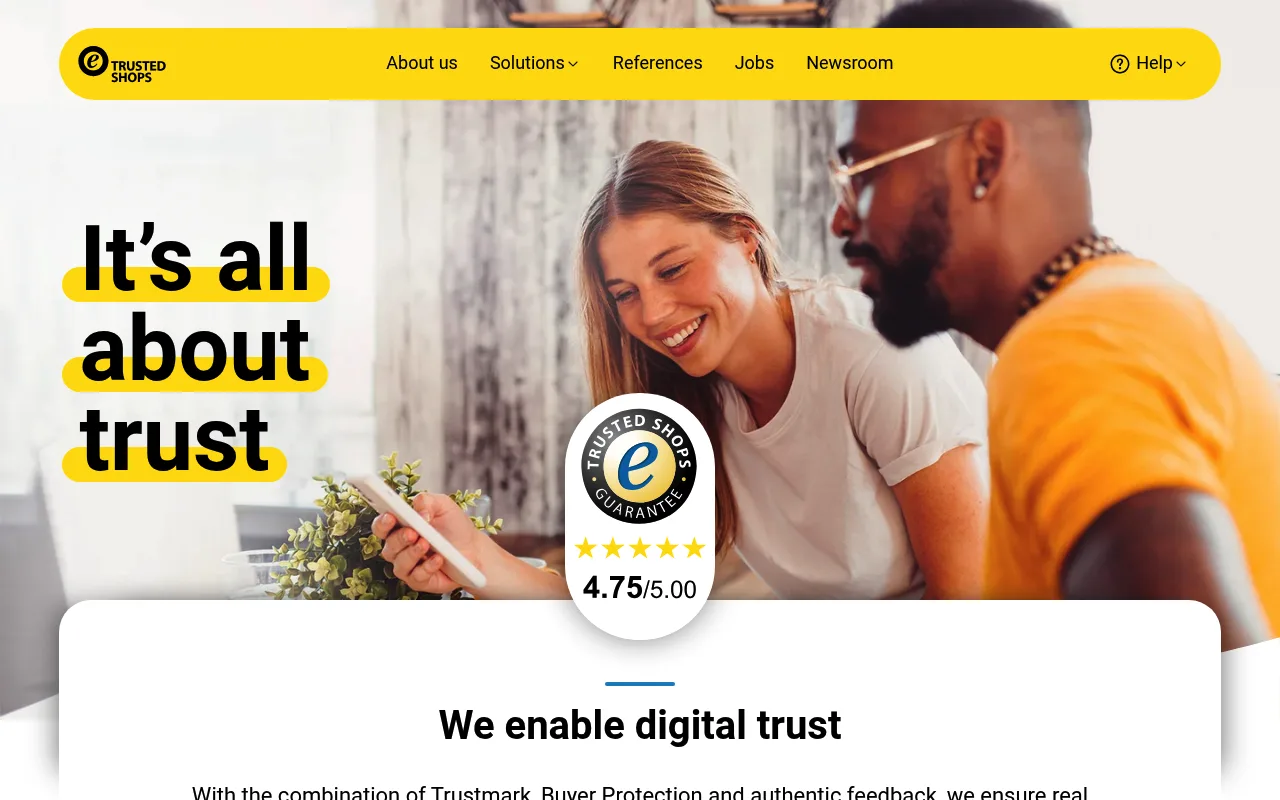
- Use German trust signals. Trustmarks with buyer protection and reviews, such as Trusted Shops, are familiar to German shoppers. They are a commercial choice, not a legal requirement, but a foreign store with no German reviews needs every trust signal it can get.
Language matters too. No law requires a German-language store, but a store in English sells to a fraction of German shoppers, and if you sell in German, your terms, withdrawal notice and Impressum should be in German as well.
Marketplace or Your Own Store?
More than half of German online revenue goes through marketplaces: 56%, or €46.2 billion, in 2025 according to the bevh. Amazon.de, OTTO and Zalando are the big names. A marketplace solves payment methods and much of the trust problem, and it forces you through LUCID and WEEE checks before you can list.
Your own store gives you the margin, the customer relationship and the data, but every compliance step in this guide is yours to get right. Many brands do both. We compare the trade-offs in marketplace vs own website.
How Your Next Store Helps You Sell in Germany
Your Next Store builds several of the German storefront requirements into the platform, under Settings → Legal & Compliance:
- Withdrawal Button. A module that adds a withdrawal action to eligible orders, available to guests as well, links it from the order confirmation email and sends the customer an order withdrawal email. It is switched on automatically for EU merchants. See Meet EU compliance requirements.
- Omnibus price history. The store records prices and calculates the lowest price of the previous 30 days for your discounts.
- Cookie consent. A consent banner that holds back tracking pixels until the visitor accepts, and can be limited to visitors from the EU, EEA, UK and Switzerland.
- German storefront and legal pages. German is a supported language. Products, collections, blog posts and each legal page have their own translations, so your Impressum, terms and withdrawal notice can exist in German next to English. See Sell in multiple languages.
- Tax-inclusive prices. Automatic tax with Stripe Tax or manual rates per country, and a store-wide choice to show prices including VAT, as German consumers expect. See Set up taxes.
- Payment methods come from your Stripe account and can be switched on in the dashboard, so PayPal, Klarna or SEPA Direct Debit show up for German shoppers when your Stripe account supports them.
The honest limits: YNS does not register you in LUCID or with stiftung ear, does not appoint authorized representatives, does not write your legal texts and does not file VAT returns. Those stay with you, your representatives and your advisors. The platform gives you the storefront mechanics, and the AI Assistant can help you draft and place pages, but the content of your Impressum and terms is your responsibility. YNS plans start at $30 a month with 0% platform transaction fees; Stripe's processing fees apply. The storefront is open source on GitHub if you want to customize the checkout in code.
Checklist: Selling Online in Germany
Storefront
- Impressum linked from every page, with address, email, phone, register number and VAT ID
- German terms, withdrawal notice and model withdrawal form, from a legal text provider
- Order button labeled "zahlungspflichtig bestellen"
- Withdrawal button live, two-step, with a dated acknowledgement email
- Gross prices with "inkl. MwSt.", shipping costs stated, unit prices where needed
- 30-day lowest price shown on every discount
- Old ODR platform links removed
Registers
- LUCID registration, dual system contract and, for foreign sellers, an authorized representative
- stiftung ear registration and WEEE number on offers and invoices, if you sell electronics or batteries
- EU responsible person for product safety, if you are outside the EU
Tax and payments
- VAT route chosen: home VAT, OSS, IOSS or German VAT registration
- PayPal, invoice or pay-later, SEPA Direct Debit and cards available at checkout
- No surcharges for SEPA or consumer card payments
FAQ
Can a US company sell online in Germany without a German entity?
Yes. You can sell to German consumers from a US company. You will need an Impressum, German consumer-law texts, a LUCID registration with a German authorized representative, a WEEE representative if you sell electronics, an EU responsible person for product safety, and a VAT route (IOSS for parcels up to €150, or German VAT registration if you hold stock in Germany). What you may miss without an EU entity are some payment methods, such as PayPal and Klarna through Stripe.
Do I need a German VAT number to sell online in Germany?
Not always. EU sellers usually report German VAT through the OSS once they pass €10,000 in cross-border sales. Non-EU sellers shipping low-value parcels from abroad can use IOSS. You need a German VAT registration when your goods are stored in Germany, for example in a 3PL warehouse or with Amazon FBA.
Does my online store have to be in German?
No law requires it, but most German shoppers prefer to buy in German, and if you sell in German your legal texts should be in German too. Start by translating the product pages, checkout, Impressum, terms and withdrawal notice.
Final Takeaway
Selling online in Germany is not hard, it is just front-loaded. Register in LUCID with a representative, sort out stiftung ear if you sell anything electrical, put up a proper Impressum and withdrawal button, pick your VAT route and offer PayPal and invoice. Do that before your first German order, and the rest is the same work as any other market. Skip it, and your first German customer might be a competitor's lawyer.
Related Blog Posts
Before you spend more on ads,
check your store.
Get a free 25-point checklist to find what could be holding back your sales, from product pages to checkout.