Social Proof in Ecommerce: What Works and What Backfires
 Jakub Neander
Nov 20, 202612 min read
A shopper on your store for the first time has no reason to believe you. Social proof is how other people vouch for you when you can't. Done well, social proof in ecommerce is the quiet layer of reviews, customer photos, ratings and press mentions that answers "is this real, and is it right for me?" before the shopper has to ask. Done badly, it is a fake "23 people are viewing this" popup that makes careful buyers leave and, under rules now in force in the US, the EU and the UK, can break consumer law. This guide covers the signals that work, where each one belongs, what backfires, and the rules you have to follow.
What Social Proof in Ecommerce Actually Is
Social proof is the habit of looking at what other people did when we are unsure what to do ourselves. Online, uncertainty is the default: the shopper can't touch the product, doesn't know your brand and can't ask a sales assistant. So they look for evidence from people like them.
The research on reviews is the clearest. Northwestern's Spiegel Research Center found that a product with five reviews is 270% more likely to be bought than one with none, with the effect larger for expensive items (380%) than cheap ones (190%). In a 2021 PowerReviews survey of more than 6,500 US shoppers, 44% said they won't buy a product that has no ratings or reviews at all.
Not every signal pulls its weight, though. Here is how the common types compare:
| Signal | The doubt it answers | Strength | Main risk |
|---|---|---|---|
| Reviews and star ratings | "Is this product good?" | Very high | Fake or filtered reviews |
| Customer photos and video (UGC) | "What does it really look like?" | High | Using content without permission |
| Expert and press proof | "Do people who know agree?" | High for considered buys | Outdated or invented quotes |
| Trust badges and payment logos | "Is it safe to pay here?" | Medium, mostly at checkout | Fake or unrecognized seals |
| Popularity: bestseller, "X bought" | "Do other people buy this?" | Medium | Fabricated numbers |
| Follower and share counts | "Is this brand popular?" | Low on a product page | Low numbers signal the opposite |
Types of Ecommerce Social Proof, Ranked
1. Reviews and star ratings
Reviews do more work than any other signal because they answer product questions the shopper actually has: does it run small, does the color match the photos, does it survive a dishwasher. A few patterns separate useful review sections from decorative ones:
- Show the rating and count next to the title. It is the first thing many shoppers look for, and a count of zero is information too.
- Show the distribution, not just the average. A 4.4 with a visible tail of one-star reviews reads as honest.
- Let shoppers filter by rating, size, use case or "with photos".
- Label verified buyers. Spiegel found verified-buyer labels raised the odds of purchase by 15%.
- Keep the negative ones. In the same PowerReviews survey, 96% of shoppers said they seek out negative reviews at least sometimes. They want to know the worst case before they commit.
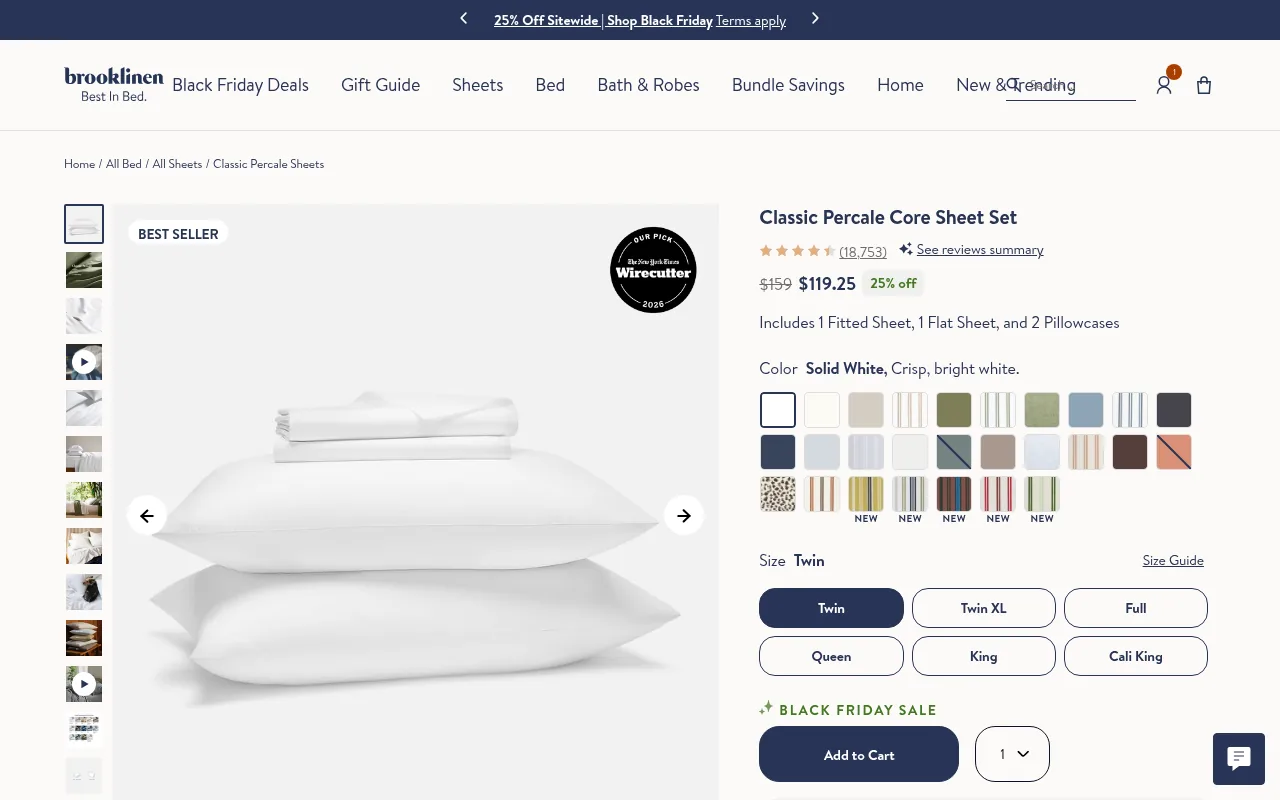
Brooklinen's sheet set page is a good example of stacking proof without clutter: the star rating and review count sit directly under the title, a "Best Seller" label marks popularity, and a Wirecutter "Our Pick" badge adds expert proof on the product image. Nothing moves, nothing pops up.
The perfect score is not the goal. Spiegel found purchase likelihood peaks at an average of 4.0 to 4.7 stars and drops as ratings approach 5.0, because a flawless score starts to look too good to be true. More on that in our product page design guide, which covers where reviews sit in the layout.
2. Customer photos, video and other UGC
A review tells the shopper what someone thought. A customer photo shows them. For apparel, beauty, furniture and anything where size, texture or color matters, customer imagery answers questions that studio shots can't. In the 2021 PowerReviews survey, 52% of shoppers said imagery from previous buyers influenced their purchase decisions, slightly more than the 46% who said the same of brand photos.
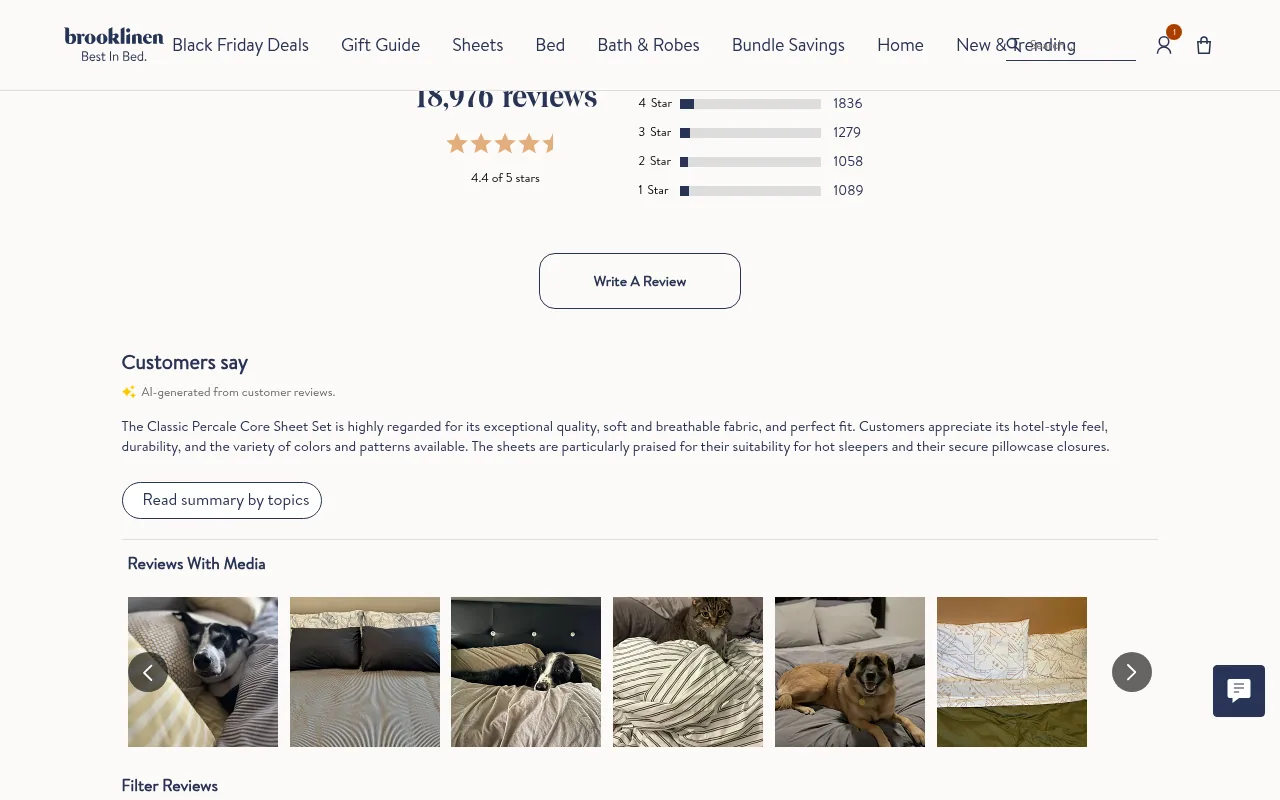
Further down the same page, the review block shows the full star distribution, an AI-generated summary clearly labeled as such, and a carousel of "Reviews With Media" (including several dogs and a cat in bed, which tells you more about how people use sheets than any lifestyle shoot). Two rules for UGC:
- Get permission before you reuse a customer's photo in ads, emails or on the homepage. A photo attached to a review on your site is one thing; the same photo in a paid Instagram ad is another use.
- Don't cherry-pick only flattering shots. The value of UGC is that it isn't styled.
3. Expert and press proof
"As seen in" logos, awards, certifications and quotes from reviewers matter most for considered purchases (mattresses, skincare, coffee machines) where shoppers trust specialists more than strangers. Use the specific claim rather than a logo wall: "Best budget espresso machine, [publication], 2026", linked to the article, beats six faded media logos. Link to the source where you can, and remove the badge when the award expires. An "Award winner" badge from five years ago is a liability, not proof.
4. Trust badges and payment logos
Trust badges are not about the product; they reassure the shopper that paying you is safe. That doubt is real: in Baymard's checkout research, 19% of shoppers had abandoned an order because they didn't trust the site with their card details.
What works is recognition. In Baymard's survey on site seals, shoppers picked seals from brands they knew, such as Norton and McAfee, ahead of most technical SSL seals they had never heard of. In practice, the most effective "badges" for a small store are usually the payment method logos the shopper already uses (Visa, Apple Pay, PayPal, Klarna), a clear returns promise and a real phone number or address. Put them near the card fields and the add to cart button, not in a row of icons in the footer.
Never invent a badge. A homemade "100% Secure Checkout" shield with no organization behind it can backfire, and in the EU and UK, displaying a trust or quality mark without authorization is on the list of practices banned outright. Our checkout optimization guide covers the rest of the payment step.
5. Popularity signals: bestsellers, "X bought" and live counters
"Bestseller", "Back in stock, 1,200 on the waitlist" and "312 bought in the last month" all lean on the same instinct: if many people chose it, it is probably a safe choice. They work when they are true and specific. They destroy trust when shoppers notice they are generated.
And shoppers do notice. Princeton researchers who crawled about 11,000 shopping sites found 313 "activity messages" across 264 sites, including notices that kept showing products as "just saved" long after they had sold, and countdown timers whose offer stayed valid after the clock hit zero. They also found third-party tools selling these widgets as a plugin. If your "Sarah from Ohio just bought this" popup comes from a script that picks random names, that is exactly the pattern regulators now call fake.
Rules of thumb:
- Use real numbers from your own orders, over a stated period ("bought 140 times this month").
- Label genuine bestsellers in collections; it helps shoppers who can't decide.
- Skip live "people viewing now" counters unless your traffic is large and the count is real. On a small store, "2 people are viewing this" is not persuasive anyway.
6. Follower counts and share buttons
Follower counts and social share counts belong on your social profiles, not your product pages. If the numbers are small, they actively hurt. In a test run with VWO, Finnish retailer Taloon saw add to cart clicks rise by 11.9% after removing share buttons that showed counts of zero or close to it. One test on one store, but the lesson generalizes: a visible zero is proof that nobody cares.
Where Social Proof Belongs on Your Store
Social proof in ecommerce works when the signal matches the question the shopper has at that moment. A security badge on a product photo answers nothing; a five-paragraph review on the checkout page is a distraction.
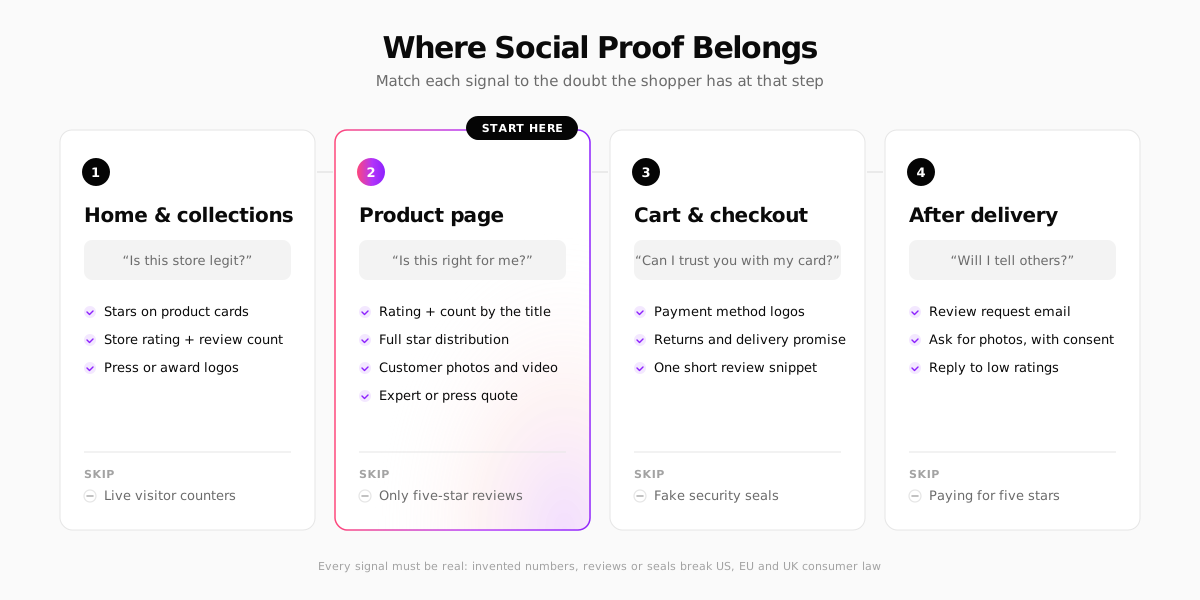
Start with the product page. It is where most purchase decisions are made, and it is where reviews, customer photos and expert quotes have the most to say. Then add star ratings to product cards in collections, so shoppers can compare at a glance, and keep checkout calm: payment logos, a returns line and, at most, one short review snippet. After delivery, the job flips from showing proof to collecting it.
When Social Proof Backfires
Every signal above has a failure mode. These are the common ones:
- Low numbers in public. A review count of 1, a share count of 0, "2 people bought this". If the number isn't impressive, hide the number and show the content.
- A wall of five stars. Perfect scores look curated, and with good reason: many of them are.
- Normalizing the wrong thing. In a classic study at Petrified Forest National Park, a sign saying that many visitors take wood from the park made theft more likely, not less, because it told people that taking wood was normal. "70% of shoppers abandon their cart" on your own site sends the same message.
- Fake urgency. Countdown timers that reset on reload and stock warnings that never change train shoppers to ignore everything else on the page.
- Anonymous testimonials. "Great product! – J." proves nothing. Real first names, a location or a verified-buyer label make a quote believable.
- Clutter. Six badges, a review carousel, a "bought recently" toast and a chat bubble all competing with the add to cart button. Pick the strongest two signals per page.
The safest test for any signal: would you be comfortable if a shopper asked "how do you know?" If the honest answer is "a plugin makes it up", remove it.
Collecting Reviews Without Gaming Them
You can't show reviews you don't have, so a short word on collection. The basics:
- Ask after delivery, not after payment. Give customers a few days with the product so the review is about the product, not the shipping.
- Make it one click from the email to the rating.
- Ask everyone, not just happy customers. Inviting only buyers you expect to be positive (review gating) skews your rating, and the rules below against misrepresenting reviews make it a legal risk, not just a statistical one.
- Incentives are allowed only with care. A discount or loyalty points for leaving any review, positive or negative, can be fine if it is disclosed. Rewarding only positive reviews is not.
- Reply to critical reviews. A calm, specific reply often persuades the next reader more than the complaint dissuades them.
Fake Reviews and the Law: US, EU and UK
Fake social proof used to be a reputational risk. It is now a legal one in all three major markets.
United States: the FTC rule on reviews and testimonials
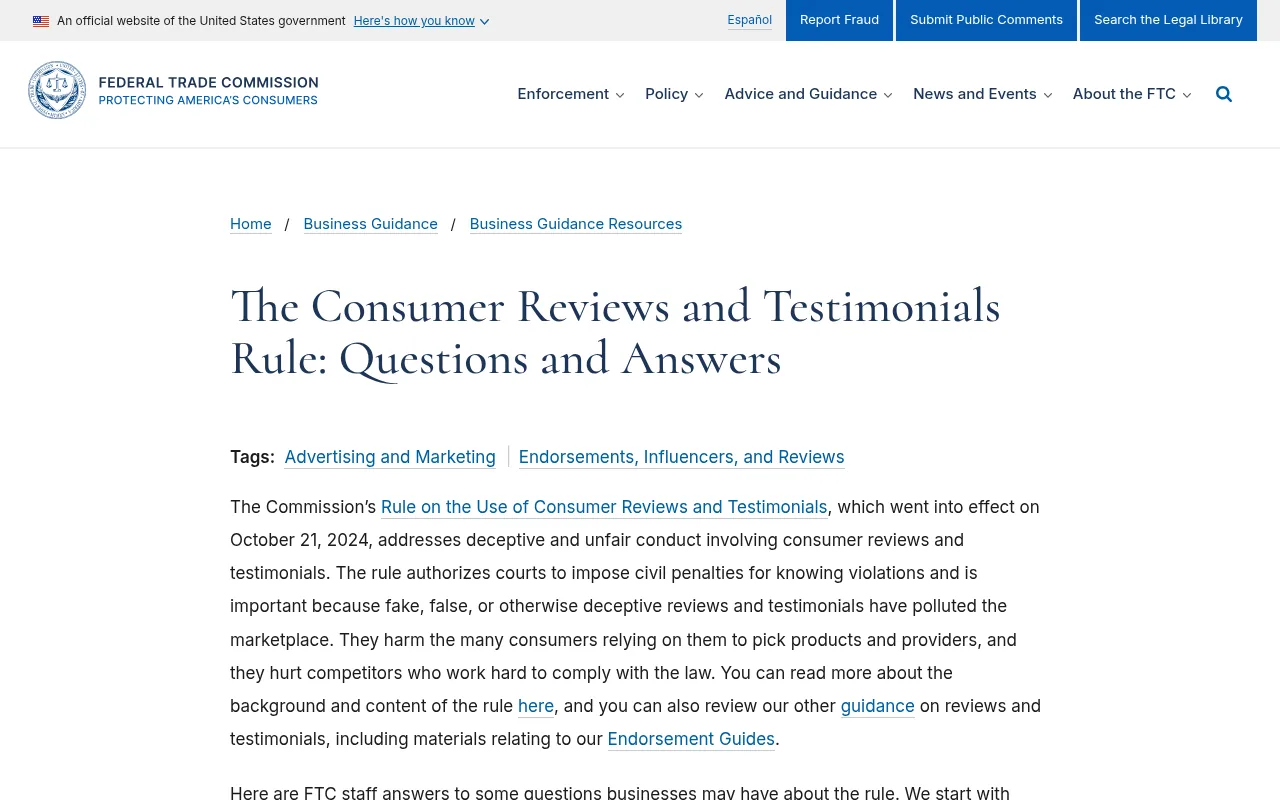
The FTC's Rule on the Use of Consumer Reviews and Testimonials took effect on October 21, 2024. It bans:
- Fake reviews and testimonials, including AI-generated ones and reviews from people who never used the product, and buying or spreading them when you knew or should have known they were fake.
- Paying for a particular sentiment: any incentive, stated or implied, conditioned on a positive (or negative) review.
- Undisclosed insider reviews from employees, managers or their relatives.
- Company-controlled "independent" review sites that rank your own products.
- Review suppression: threats or intimidation to remove negative reviews, and claiming your review section shows all reviews when some were hidden because of their rating.
- Fake social media indicators such as bought followers or views used to misrepresent influence.
Knowing violations can bring civil penalties per violation, which is what changed the stakes. The FTC's own Q&A for businesses is the clearest plain-English explanation.
European Union: Omnibus Directive duties
Since May 2022, the Omnibus Directive (EU) 2019/2161 has added review rules to EU consumer law:
- Disclose how you handle reviews. If you show consumer reviews, you must tell shoppers whether and how you check that they come from people who actually bought or used the product.
- Don't claim verification you don't do. Saying reviews come from real customers without taking reasonable and proportionate steps to check is banned.
- No fake or misrepresented reviews. Submitting fake reviews, commissioning them, or misrepresenting reviews (for example, showing only the positive ones as if they were all of them) is banned outright.
Enforcement is real: in an EU-wide screening of 223 websites, authorities had doubts about the reliability of reviews on 144 of them, and 104 didn't tell consumers how reviews were collected. A one-paragraph "How we handle reviews" note on your product pages or FAQ covers the disclosure duty. Our Omnibus Directive guide covers the pricing rules from the same law.
United Kingdom: the DMCC Act ban
Since 6 April 2025, Schedule 20 of the Digital Markets, Competition and Consumers Act 2024 bans submitting or commissioning fake reviews, hiding that a review was incentivised, and publishing reviews or ratings in a misleading way, such as suppressing negative ones. The CMA's fake reviews guidance adds that any business publishing reviews must take reasonable and proportionate steps to prevent and remove fake ones: a published policy, risk checks, detection and a way to act on suspicious reviews. The CMA can now fine businesses directly, up to 10% of global turnover.
Google's rules on review stars
Separate from the law, Google won't show stars for everything. Its review snippet guidelines exclude "self-serving" reviews that a business publishes about itself on its own site for its organization or local business, and review markup must match reviews that are visible on the page. Product reviews from your customers are fine. Our guide to product schema markup shows the JSON-LD.
Always check the current rules where you sell. This guide summarizes US, EU and UK rules on consumer reviews and testimonials as of November 2026. Rules change and national enforcement varies, so confirm the details with your local consumer protection authority or a legal adviser before you change how you collect, incentivise or display reviews. This is general information, not legal advice.
How to Measure Whether Your Social Proof Works
Social proof is a hypothesis, not a law of nature. Test it like one:
- Pick one page type and one signal, for example star ratings on collection cards.
- Measure the right metric. Product page changes show up in add to cart rate; checkout changes in checkout completion.
- Run a proper A/B test with enough traffic to reach a result. Our ecommerce A/B testing guide covers sample sizes and the mistakes that produce fake wins.
- Check the downside too. Did returns or support tickets change? Social proof that oversells creates its own costs.
Small stores often don't have the traffic for clean tests. In that case, add the high-confidence signals (real reviews, ratings near the title, payment logos at checkout) and skip the speculative ones.
Building Social Proof on Your Next Store
Most of the work above is about trust in the reviews themselves, and that is where the platform matters. On Your Next Store, product reviews are a built-in module you switch on from the dashboard, not a third-party script:
- Verified purchases only. Only customers who bought and received the product can review it, so every review written in your store carries a verified-purchase status.
- Independent moderation. New reviews arrive unpublished, and YNS (not the merchant) decides which are published or removed. You can read every review and filter by star rating to reply to low ones quickly, but you can't quietly delete a bad one. That is a constraint by design, and it lines up with the anti-suppression rules above.
- Review requests built in. When reviews are on, the "Your order was delivered" email links each product to its review page.
- Bring your history. Reviews exported from Judge.me, Yotpo or Shopify Product Reviews can be imported from a CSV. They keep their original dates and are shown as unverified, since there is no order behind them.
- Structured data. Stores output JSON-LD automatically, so product pages are ready for rich results.
If your shop runs elsewhere, YNS's Review Hub can collect verified reviews and show them on your existing site through an embeddable widget. The details are in the product reviews help article, and developers can use the Reviews API.
For comparison, dedicated review platforms such as Yotpo, Okendo and Judge.me add features YNS's built-in module doesn't aim to match, such as review syndication across retailers, Q&A and deep UGC campaign tooling. If you run a large catalog with heavy UGC marketing, one of them may still be the better fit.
Whichever tool you pick, the principle is the same: the best social proof is the kind you never have to defend.
FAQ
What are the best examples of social proof in ecommerce?
Customer reviews with star ratings, customer photos and videos, expert or press endorsements, genuine bestseller labels and recognized payment logos at checkout. Reviews have the strongest evidence behind them. Live visitor counters and follower counts are the weakest and the most likely to backfire.
Do trust badges increase conversions?
They can at checkout, where the shopper's doubt is about payment safety, but only if shoppers recognize them. Payment method logos and a clear returns policy usually do more than generic "secure checkout" shields. Test before and after adding them, and never display a seal you aren't entitled to.
Is it legal to offer a discount for a product review?
In the US, UK and EU, incentives are generally allowed if they don't depend on the review being positive and the incentive is disclosed. Offering a reward only for five-star reviews, or hiding that a review was incentivised, is banned under the FTC rule and the UK DMCC Act. Check the details for each market you sell into.
Related Blog Posts
Before you spend more on ads,
check your store.
Get a free 25-point checklist to find what could be holding back your sales, from product pages to checkout.