
Best Ecommerce Platform for Developers in 2026
 Jakub Neander
Apr 14, 202612 min read
Most "best ecommerce platform" lists rank platforms for marketers. This one ranks them for the people who actually have to build, deploy, and maintain them. If you write code for a living and you are choosing a commerce stack in 2026, the question is not "which platform has the prettiest admin?" It is "which platform will still make sense in two years, when the CEO asks for a custom checkout, a B2B portal, and an AI assistant on the product page?" Here is the short list, the long answer, and the honest tradeoffs.
TL;DR: The Developer Ranking
If you do not want to read 3,000 words, here is the summary. We will defend each pick below.
- Best overall for modern developers: Your Next Store. Next.js 16, TypeScript, typed REST SDK, Elliot AI builder, open-source storefront template.
- Best for owning the full backend: Medusa. TypeScript, Node, Postgres, plugin architecture, self-host or Medusa Cloud.
- Best GraphQL-native platform: Saleor. Python/Django core, GraphQL API, strong multi-channel and multi-currency.
- Best if you are already in the Shopify ecosystem: Hydrogen. React Router, Remix-style data loading, Oxygen deploy.
- Best for headless with a clean TS API: Vendure. NestJS, GraphQL, mature plugin system.
- Best for content-heavy commerce: Payload CMS + Stripe. TypeScript CMS with a commerce plugin.
- Best if you live inside WordPress: WooCommerce. Not "modern," but the biggest ecosystem on the internet.
- Worth knowing about, mostly for enterprise: BigCommerce, commercetools, Adobe Commerce.
What "Best for Developers" Actually Means
Before we compare, we need to agree on the rubric. "Developer-friendly" is the most abused phrase in commerce. Every platform claims it. Most do not earn it. Here is what we actually measure. (If you want the APIs compared on their own, stripped of the surrounding platform, see our best ecommerce APIs for developers breakdown.)
| Criterion | Why It Matters |
|---|---|
| API shape | Are you calling a typed SDK, or stringing together REST calls with any? Typed SDKs catch 80% of integration bugs at compile time. |
| Tech stack you will live inside | Next.js, React, TypeScript, Node, Postgres are the defaults of the ecosystem in 2026. PHP and Ruby are valid, but the talent pool and tooling around modern JS is deeper. |
| Local dev experience | Can you bun install && bun dev and see a store in under five minutes? Or do you need Docker, a license file, and a VPN? |
| Customization ceiling | When the product manager asks for something weird, can you do it? Or do you have to wait for the vendor's roadmap? |
| Total cost of ownership | Monthly fees, transaction fees, app fees, hosting, and the biggest one: engineering hours. |
| Escape hatches | If the vendor raises prices or goes sideways, can you take your data and ship? |
| AI readiness | In 2026, AI is no longer a demo. Can agents read and write to your catalog? Is there a typed MCP server or at least a clean REST surface? |
| Performance defaults | Does the platform ship fast by default, or does every store need three weeks of tuning to hit a Lighthouse 90? |
Fair warning: the "best" platform for a developer depends heavily on what you are building. A solo founder shipping a D2C brand has different needs than an agency migrating a 5,000-SKU marketplace. We will flag which profile each pick fits.
Quick Comparison Table
| Platform | Primary Stack | API | Self-Host | Starting Price | Transaction Fee | AI Builder | Best Use Case |
|---|---|---|---|---|---|---|---|
| Your Next Store | Next.js 16, TS, Postgres | Typed REST SDK | Storefront: yes. Backend: managed | $30/mo | 0% | Yes | Fast launch on a modern stack |
| Medusa | Node, TS, Postgres | REST + admin SDK | Yes | Free self-host. Cloud: custom | Stripe fees only | No | Full backend ownership |
| Saleor | Python/Django, TS frontend | GraphQL | Yes | Free self-host. Cloud: enterprise pricing | Stripe fees only | No | Enterprise, multi-channel |
| Shopify Hydrogen | React Router, TS | Storefront API (GraphQL) | No (Oxygen deploy) | From $39/mo Shopify plan | 0.5-2% unless Shopify Payments | No | Shopify customers going headless |
| Vendure | NestJS, TS, Postgres | GraphQL | Yes | Free | Stripe fees only | No | Clean headless API, plugin-first |
| WooCommerce | PHP, WordPress | REST (PHP) | Yes | Free + WP hosting | WooPayments/Stripe fees | No | WordPress-first stores |
| BigCommerce | SaaS (proprietary) | REST + Storefront GraphQL | No | From ~$39/mo | None (uses BigCommerce or Stripe) | No | API-heavy SaaS without self-host |
A note on pricing transparency: the "from" prices above are what the vendor advertises publicly as of April 2026 and always climb once you need real features. We are not in the business of publishing outdated numbers; check the vendor's pricing page before signing a contract.
Proof: What These Platforms Actually Feel Like
Feature tables lie. Code does not. Here is the same "fetch the first twelve products in a category" query on four of the platforms above, so you can judge the DX for yourself.
Your Next Store (typed REST SDK generated from OpenAPI):
Medusa (typed JS SDK on top of REST):
Saleor (GraphQL with codegen for types):
Shopify Hydrogen (Storefront API query inside a loader):
All four are typed. The differences show up in the shape of each ecosystem: YNS and Medusa feel like calling a library, Saleor feels like speaking GraphQL with codegen underneath, and Hydrogen expects you to live inside its loader pattern. There is no wrong answer, only a fit.
Performance: the numbers that matter
The fastest platform is the one that ships the least JavaScript and renders on the server. In practice, a clean Next.js storefront with Partial Prerendering and Server Components will outperform most off-the-shelf Shopify themes on mobile Core Web Vitals, often by a significant margin on Largest Contentful Paint. Google has documented the business impact of Core Web Vitals on retail; small LCP improvements correlate with real revenue. We walked through the methodology in our ecommerce site speed optimization guide and the architectural reasons in how YNS renders so fast.
You do not have to trust us: million.yournextstore.com is a live YNS deployment serving one million products. Run it through PageSpeed Insights yourself and compare it against your current storefront.

1. Your Next Store: Best Overall for Modern Developers
Best for: Teams building on Next.js who want the commerce layer solved without giving up control of the storefront code.
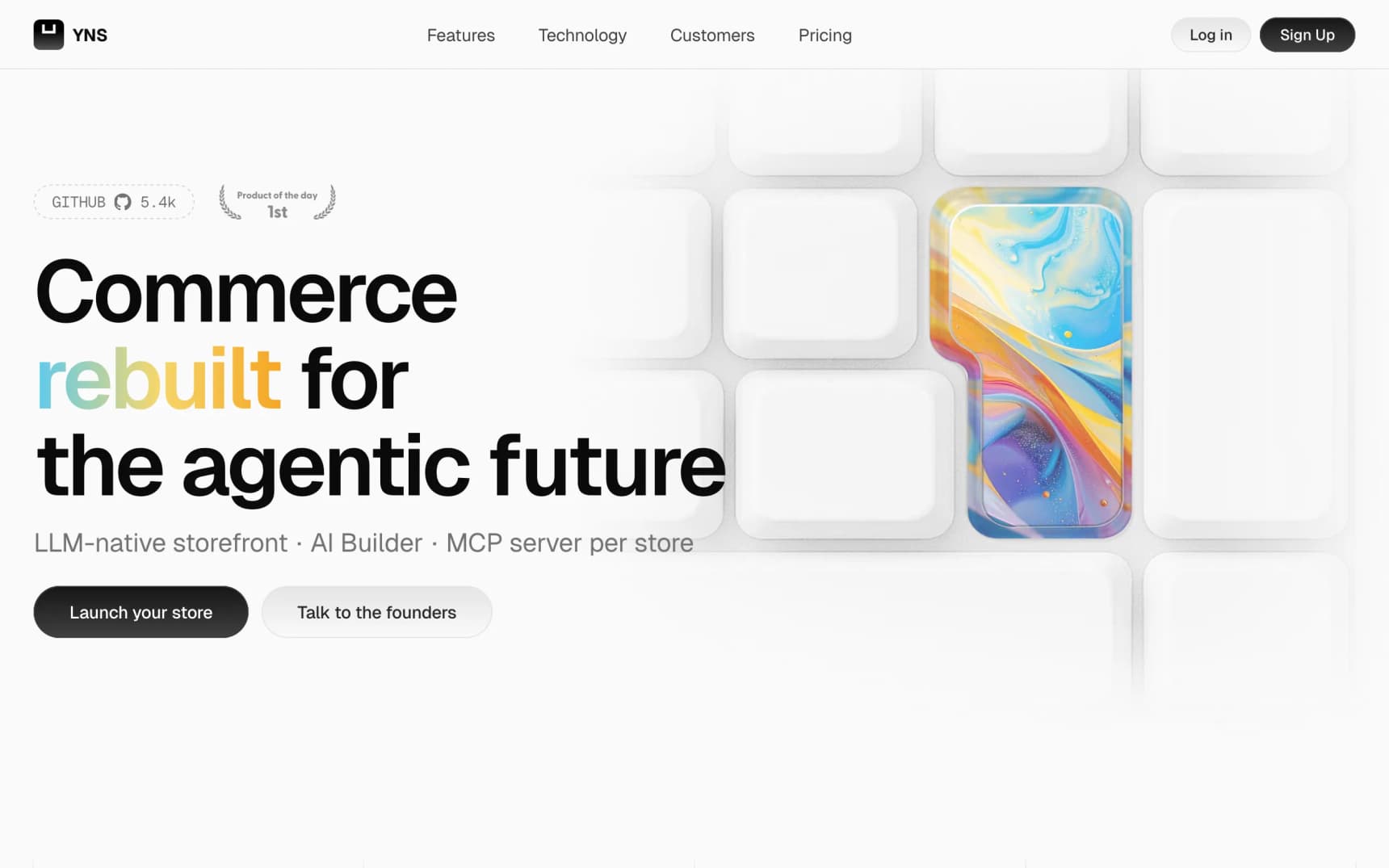
Full disclosure: we build Your Next Store. We will tell you where it wins, and we will tell you where it does not.
YNS ships as two things: an open-source Next.js storefront template and a managed commerce backend you call over a typed REST SDK. The storefront is Next.js 16 with the App Router, React Server Components, and Partial Prerendering. The backend handles products, carts, orders, inventory, customers, blog, search, and translations in Postgres (Drizzle ORM). Stripe handles payment processing. You can poke a live instance at demo.yournextstore.com before you read further.
Where it wins for developers:
- Modern stack by default. Next.js 16, React 19, TypeScript 6, Tailwind v4, Drizzle. Nothing in the template is older than the current generation of tools. For a deep dive on why that matters for speed, we wrote up how YNS renders so fast.
- PPR and RSC used correctly. The template is a real showcase of Partial Prerendering, not a brochure that claims to use it.
- Typed server actions. Every mutation on the storefront goes through type-safe server actions with Zod validation. No more wiring up
/api/*routes by hand. - Elliot, the AI Builder. The managed dashboard includes an AI-powered builder at
/designwhere you describe what you want and an agent edits your storefront repo. The agent runs in an isolated Vercel Sandbox per store, commits to GitHub, and triggers Vercel deploys. For the wider context, see our post on agentic commerce. - Open-source escape hatch. If you outgrow the managed platform, fork the template and keep shipping. You do not lose your storefront code.
- Partner program for agencies. If you're an agency evaluating platforms for multiple clients, the YNS Partner Program offers revenue share, priority support, and co-marketing.
Where it does not win:
- No free plan. The storefront template is free, but it requires a managed backend subscription ($30/mo Starter) to run in production. If you want truly zero-dollar software, Medusa or Vendure are better picks.
- Younger ecosystem. Shopify has fifteen years of apps. YNS has a growing integration library and the Commerce Kit SDK, but you may hit cases where you need to build an integration yourself.
- Multi-tenancy lives in the managed platform, not the template. The open-source template is single-store. If you want to host many storefronts, you are buying the managed platform.
Real pricing: Starter $30/mo, Growth $60/mo, Pro $360/mo. 0% transaction fees on every plan – only Stripe's standard processing applies. We broke down the math vs Shopify in Shopify transaction fees: the real cost.
Next.js 16, typed SDK, Elliot, 0% platform fees. Clone the template and ship a store today.
2. Medusa: Best for Owning the Full Backend
Best for: Teams that need to deeply customize the commerce engine itself, not just the storefront.
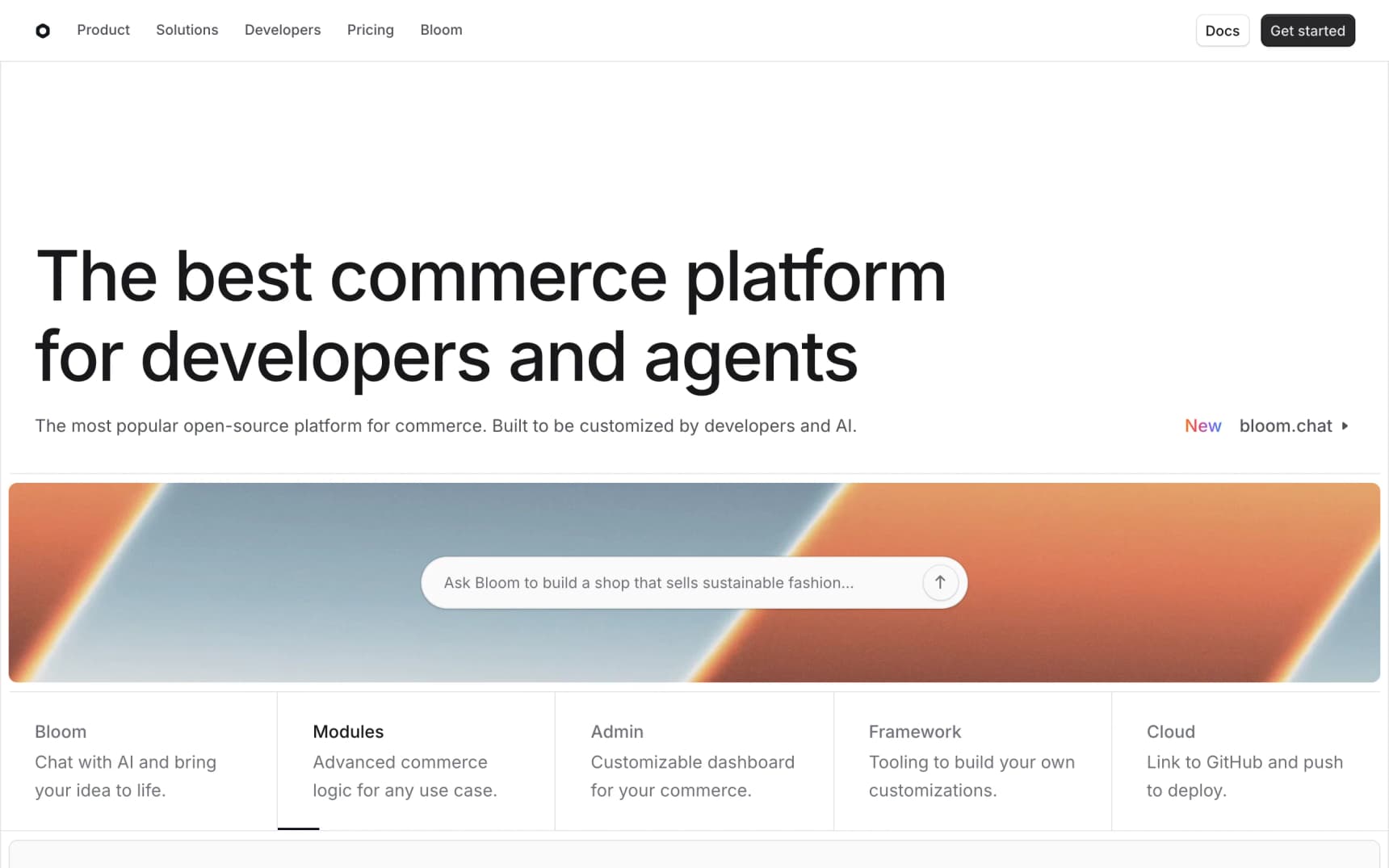
Medusa is a headless commerce engine written in TypeScript on Node. You install it with npx create-medusa-app@latest, point it at a Postgres database (Redis is optional in v2), and you have a full admin dashboard and REST API in one afternoon.
Where it wins for developers:
- Plugin architecture. Medusa's modules are first-class. You can swap out the payment provider, inventory model, or tax engine with custom code without forking the core.
- TypeScript end-to-end. Admin, API, and storefront SDK are all typed.
- Owns the data model. Products, orders, customers, and inventory live in your Postgres, not a black box.
- Medusa Cloud exists. If you do not want to run infrastructure, the hosted option removes the DevOps burden without removing the ability to self-host later.
Where it is less friendly:
- You still have to run it. Self-hosting Medusa means a Node service, a Postgres database, a Redis instance, and a storefront. The "ten-minute install" does not include production deployment.
- Admin UI is functional, not delightful. The admin is a big step up from Magento, but it is built for operators who do not mind clicking through forms.
- The storefront is up to you. Medusa ships a Next.js starter, but it is a starter, not a maintained production storefront. The polish gap between Medusa's starter and YNS or Shopify's themes is real.
3. Saleor: Best GraphQL-Native Platform
Best for: Large catalogs, multi-channel sellers, or teams that prefer GraphQL over REST.
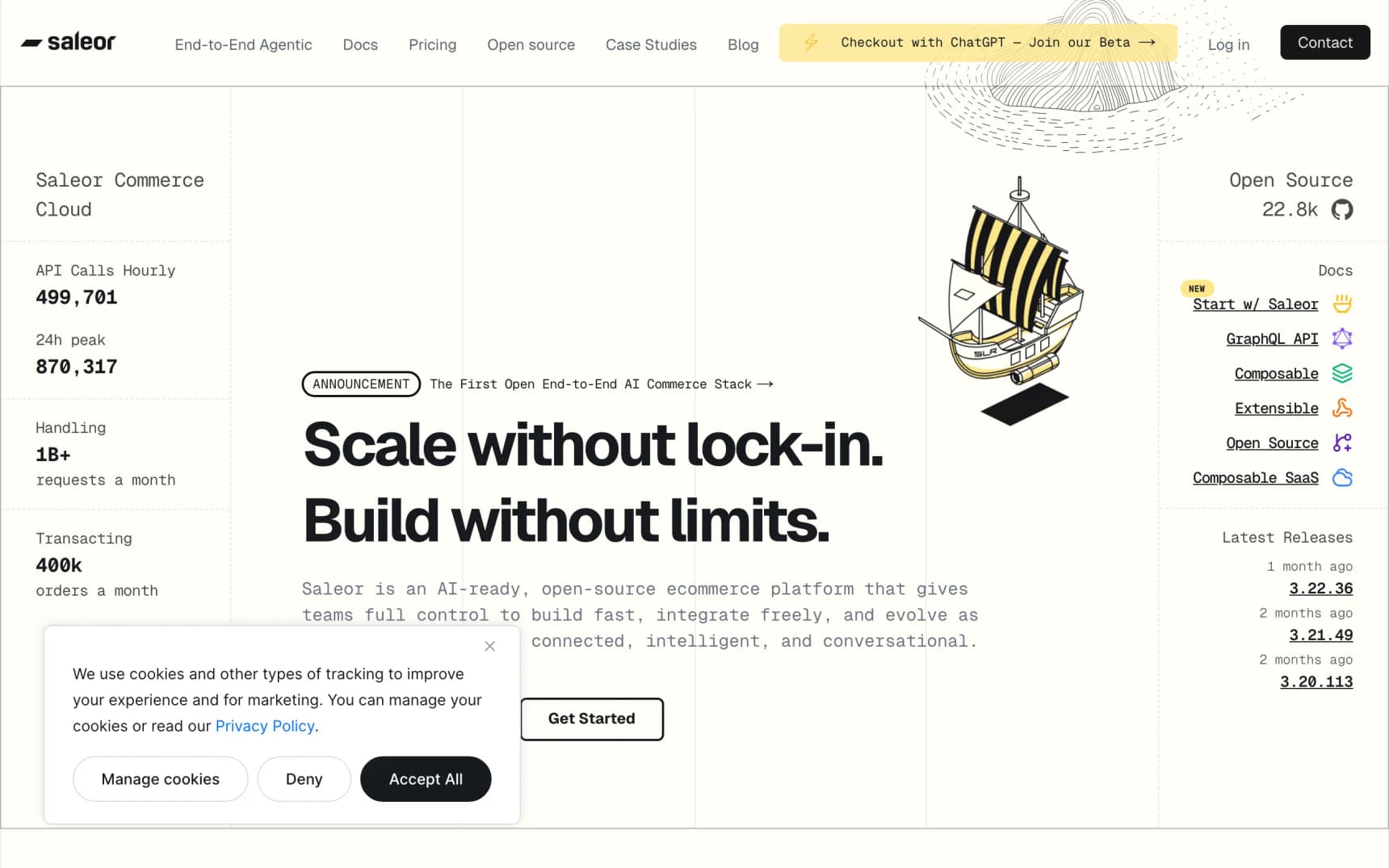
Saleor is an open-source headless commerce platform built on Python and Django with a GraphQL API. It is the platform most often picked by enterprises that outgrow Shopify Plus and do not want to move to Adobe Commerce.
Where it wins for developers:
- GraphQL is the entire surface area. Every query is typed, introspectable, and fits naturally into tools like Apollo, URQL, or TanStack Query.
- Multi-channel is a first-class concept. Stores, warehouses, currencies, and price lists are modeled in the core, not bolted on with apps.
- Saleor Cloud is a real option. If you do not want to run Python infrastructure, the managed plan handles it.
Where it is less friendly:
- The storefront layer is bring-your-own. Saleor offers a Next.js storefront, but plan to build or heavily customize it.
- Python + Django + GraphQL is a three-skill hire. If your team is a JavaScript shop, Saleor means learning a new stack or hiring for it.
- Cloud pricing starts high. Saleor Cloud is enterprise-priced – check their pricing page for current tiers, but expect it to be an order of magnitude above Shopify or YNS entry plans. Self-hosted is free, but see the point above.
4. Shopify Hydrogen: Best If You Are Already on Shopify
Best for: Teams whose merchant already has a Shopify store and wants a custom React frontend on top.
Hydrogen is Shopify's React framework for building custom storefronts against the Shopify Storefront API. It is built on React Router (the successor to Remix), uses React Server Components, and deploys to Shopify's Oxygen runtime.
Where it wins:
- Tight integration with Shopify. All the checkout, inventory, and payment logic you already have in Shopify is there via the Storefront API.
- The docs are good. Hydrogen's tutorials and examples are well maintained.
- Oxygen deploy is one command. If you are in the Shopify ecosystem, you do not have to think about hosting.
Where it is less friendly:
- You are still on Shopify. Platform fees, app marketplace pricing, and Shopify's transaction fees (0.5-2% if you do not use Shopify Payments) still apply.
- Hydrogen locks you into Oxygen for the best DX. You can deploy elsewhere, but the tooling assumes Oxygen.
- Storefront API has rate limits. For high-traffic or complex catalogs, you will hit them.
If you are already shipping on Shopify and you want React, Hydrogen is the path of least resistance. If you are starting fresh, our head-to-head on Next.js vs Shopify digs into the architectural tradeoffs, and if Hydrogen itself is the sticking point, our Shopify Hydrogen alternatives guide compares nine platforms against it.
5. Vendure: Best Clean Headless API
Best for: Engineers who want a plugin-first TypeScript backend without opinions on the storefront.
Vendure is NestJS + GraphQL + Postgres. The architecture is very clean: plugins encapsulate features, and the core stays small. It has been around since 2018 and is used in production by mid-market brands.
Where it wins:
- Plugin-first design. Writing a Vendure plugin is the canonical way to add features, and the docs are clear.
- GraphQL admin and shop APIs. Separated by default, so you do not have to worry about admin scope leaking into the customer surface.
- TypeScript throughout. The whole codebase is typed.
Where it is less friendly:
- No managed cloud. Vendure is self-host or nothing. You run the Node service and Postgres.
- Storefront is your job. There is a Remix starter and a few community starters, but no flagship storefront template.
- Smaller ecosystem than Medusa. Fewer plugins, fewer community integrations.
6. Payload CMS + Stripe: Best for Content-Heavy Commerce
Best for: Editorial, magazine, or content-led stores where the CMS matters as much as the commerce.
Payload is a TypeScript-native CMS with a first-party commerce plugin wiring up Stripe, products, and orders. It is not a full commerce engine – tax, shipping, and inventory are lighter than Medusa or Saleor – but if your product catalog is really a content catalog with prices, Payload's schema-driven admin beats bolting a CMS onto a commerce platform. Self-host or Payload Cloud.
7. WooCommerce: Best If You Live in WordPress
Best for: WordPress-first teams and agencies with deep PHP expertise.
WooCommerce runs more stores than any other ecommerce platform on the planet. The ecosystem is unmatched, hosting is cheap, and PHP talent is everywhere. The tradeoff: server-rendered PHP is a different paradigm from modern JavaScript, plugin sprawl (a 30-plugin store is a performance and security liability), and a WordPress-era admin. Fine if you already know it; a significant retrain if you do not. If you are specifically looking to leave WooCommerce behind, our ranking of WooCommerce alternatives for developers digs into the migration path.
8. BigCommerce, commercetools, Adobe Commerce: The Enterprise Tier
These three deserve a mention, not a deep dive. They are only the right answer if you already have an RFP with them on it.
- BigCommerce: SaaS with strong REST and GraphQL APIs and no platform transaction fees, though revenue-banded pricing forces tier upgrades as you grow – see our breakdown of BigCommerce alternatives for the math. Not self-hostable.
- commercetools: API-first composable commerce. Six-figure contracts.
- Adobe Commerce: Magento under new management. Powerful, customizable, and a lift to run.
The Tradeoffs Nobody Tells You About
Most "best platform" lists stop at feature tables. Here is what actually trips up developers six months into a project.
Migration cost is real, and it is always worse than you think. Moving products, orders, customers, and content between platforms is an engineering project, not a weekend. If you pick wrong, you will pay twice. Prototype with the real data before you commit.
The "free" platforms are not free. Self-hosted Medusa, Saleor, and Vendure all need infrastructure, monitoring, backups, and someone on call. A realistic TCO on a self-hosted open-source platform in production is a meaningful engineering cost per year. The managed tier of these platforms often costs less than doing it yourself badly.
App marketplaces are a tax. Shopify's app ecosystem is a superpower and a trap. A typical store runs 5-10 paid apps at $200-$500/month. Before you pick a platform, list the features you need and check whether they are core or sold separately.
Vendor lock-in hides in the admin, not the storefront. Storefront code is usually portable because storefronts are just HTTP clients. The real lock-in is in the admin: your merchandising workflows, your customer support tools, your reporting dashboards. Those are what your non-technical team uses every day, and rebuilding them is expensive.
AI readiness will matter in 2027. In 2026 it is still an edge. By 2027, if a customer or an agent cannot query your catalog in a typed, predictable way, you will be behind. Platforms with typed APIs and documented MCP servers will have a head start. For where this is going, see our AI ecommerce and agentic commerce posts.
How to Choose in Five Minutes
A rough decision tree:
- Shipping a storefront on Next.js this quarter? Start with Your Next Store. Modern stack, low setup cost, open-source escape hatch.
- Need to deeply customize the commerce backend itself? Medusa or Vendure.
- Large catalog, multi-channel, or your team is Python-first? Saleor.
- Already on Shopify and the merchant is not moving? Hydrogen.
- Content-led brand where the CMS is the product? Payload + Stripe.
- Deep in the WordPress ecosystem already? WooCommerce.
- Enterprise with seven-figure GMV and an RFP? BigCommerce, commercetools, or Adobe Commerce.
FAQ
Which ecommerce platform is most developer-friendly?
The honest answer depends on your stack. For JavaScript and TypeScript developers in 2026, Your Next Store, Medusa, and Vendure are the top picks because they share the language, tooling, and deployment model of modern web apps. For Python developers, Saleor. For PHP and WordPress developers, WooCommerce.
Is open-source always better for developers?
No. Open-source gives you control and an escape hatch, but it also gives you an infrastructure bill and an on-call rotation. For many teams, a managed platform with a clean API (like Your Next Store, BigCommerce, or Shopify Hydrogen on Shopify) is faster to ship and cheaper to run than a self-hosted open-source stack.
What is the best platform for a solo developer building a D2C store?
Your Next Store if you want a managed backend with an open-source storefront and Elliot. Medusa if you are willing to run your own infrastructure. Hydrogen if you are already inside the Shopify ecosystem.
How important is a typed SDK?
For a production application, very. Untyped REST calls are the single biggest source of shipping bugs in commerce integrations. A typed SDK catches shape mismatches, renamed fields, and missing required parameters at compile time.
Can I migrate between these platforms later?
Yes, but it is a real project. The portable parts are your storefront code (because storefronts are HTTP clients) and your raw data (products, orders, customers). The hard parts are your integrations, your admin workflows, and your content. Plan migrations the way you plan major version upgrades, not the way you plan plugin installs.
The One-Line Summary
The best ecommerce platform for developers in 2026 is the one whose API you can still read in two years without opening the docs. Pick for the shape of the code, not the shine of the admin.
Related Blog Posts
- Compare all ecommerce platforms side-by-side – every major platform, one table
- Open Source Shopify Alternatives for Developers
- Next.js vs Shopify: Which Should Developers Choose?
- How to Build an E-commerce Website with Next.js
- Ecommerce Site Speed Optimization: The 2026 Guide
- What Is Headless Commerce?
- WooCommerce Alternatives (2026)
- Best Squarespace Commerce Alternatives
- Best Wix Ecommerce Alternatives
Your Next Store is open-source. Star the repo on GitHub:
github.com/yournextstore/yournextstore