
Best BigCommerce Alternatives & Competitors in 2026
 Jakub Neander
Updated Sep 18, 202613 min read
The honest reason most stores look for BigCommerce alternatives isn't the product. It's the meter. On June 1, 2026 BigCommerce renamed its plans and tightened them: the entry plan now tops out at $30K in trailing-twelve-month sales (down from $50K), the next one at $100K (down from $180K), and the Scale plan adds 0.9% on sales above $33,333 a month. A new Open Payment Provider fee of up to 2% applies to orders that don't go through BigCommerce's approved payment providers, including offline and purchase-order payments. If you're growing, or selling B2B, your bill can jump without you changing anything. This guide ranks the best BigCommerce alternatives and competitors by what they actually cost you, with prices checked in September 2026.
Bias disclosure: We build Your Next Store, one of the tools on this list. We flag it every time, name its weak spots (B2B is one of them), and credit competitors where they genuinely win. BigCommerce's own strengths are covered too.
BigCommerce Alternatives at a Glance (September 2026)
| Platform | Price from | Revenue caps? | Best for |
|---|---|---|---|
| BigCommerce (for reference) | $29/mo Core (annual), $39 monthly | Yes: $30K, $100K, then 0.9% overage | Mid-market SaaS with strong catalog tools |
| Your Next Store | $30/mo | No, 0% platform fees | An AI-built, modern storefront at a flat price |
| Shopify | $29/mo (annual), $39 monthly | No (0.6–2% fee without Shopify Payments) | The biggest app ecosystem |
| WooCommerce | Free plugin + hosting | No | WordPress teams who want full control |
| Saleor | Free self-hosted; Cloud from $1,599/mo | Cloud plans are GMV-capped | GraphQL-first headless builds |
| Squarespace | $29/mo Core (annual) | No | Design-led brands with small catalogs |
| Wix | $29/mo Core (annual) | No | Visual no-code building |
| Shift4Shop | $0 (US, Shift4 Payments) | No | US merchants who want BigCommerce-style features for $0 |
| Adobe Commerce | Quote | Quote-based | Enterprise B2B |
What Changed at BigCommerce in June 2026
BigCommerce (whose parent company now trades as Commerce) announced the changes with 60 days' notice and applied them from June 1, 2026. Merchants on annual contracts move at renewal. Here's the new line-up from the official pricing page:
| New plan (old name) | Monthly | Billed annually | Sales limit (was) | Open Payment Provider fee |
|---|---|---|---|---|
| Core (Standard) | $39 | $29/mo | $30K TTM (was $50K) | 2.0% |
| Growth (Plus) | $105 | $79/mo | $100K TTM (was $180K) | 1.0% |
| Scale (Pro) | $399 | $299/mo | 0.9% on sales above $33,333/month (was $150/mo per extra $200K above $400K/yr) | 0.6% |
| Performance (Enterprise) | From $1,499, annual only | Contract | Custom; auto-upgrade from Scale at $2M TTM | Custom |
Three details matter more than the headline prices:
- "Inclusive GMV" is what's measured. BigCommerce counts your gross order value minus 10% (it used to be minus 3%), and eligible sales include taxes and shipping, not just product revenue.
- Upgrades are automatic. Cross a limit and you move up a plan whether or not you need its features.
- The Open Payment Provider fee is new. About 20 providers are "embedded" and fee-free, including Stripe, PayPal, Adyen and Klarna. Any other gateway pays 0.6–2% of order value to BigCommerce, on top of the processor's own fee. BigCommerce states the fee also covers "orders placed through manual or offline payment methods, such as purchase orders."
What this means in practice. A store doing $150K a year was on Plus at $79/month before June. Its inclusive GMV ($135K) is now above Growth's $100K limit, so it auto-upgrades to Scale at $299/month, nearly 4× the platform bill for the same business. Stores above roughly $1M a year can actually pay a little less than before, because the old $150 blocks were replaced by a 0.9% rate. The squeeze lands on small and mid-sized stores.
Why People Leave BigCommerce in 2026
BigCommerce is a competent platform with a real product team, strong catalog tools and good native multi-storefront support. These are the reasons that keep showing up when merchants shop around:
- Revenue-based plan upgrades. The limits dropped in June 2026 ($30K → $100K → 0.9% overage). The bill grows with revenue even when your needs don't. "No transaction fees" is technically true on embedded providers, but the revenue bands behave like one.
- The Open Payment Provider fee. If your processor isn't on BigCommerce's embedded list, you now pay up to 2% of those orders to BigCommerce. Merchants on regional gateways, specialist high-risk processors or invoice-based B2B payments feel this most.
- B2B costs extra. Customer groups start on Growth, and price lists (the core of customer-specific pricing) are only on Performance, per the plan comparison. B2B Edition has no public list price and is sold through contracted terms (Elogic, September 2026). Purchase-order payments are subject to the new Open Payment Provider fee on self-serve plans.
- The 600-variant ceiling. BigCommerce allows up to 600 SKUs per product. It's invisible until you try to launch a product with size × color × material × fit. Modifiers are the workaround, but modifiers don't carry their own inventory row the way variants do.
- The theme stack. Stencil themes use Handlebars and the Stencil CLI. The modern React path is Catalyst, BigCommerce's Next.js storefront, which you deploy and maintain yourself. That's a fine option for developer teams, but it's a second codebase, not a theme setting.
If two or more of those describe your situation, you're in the right post.
Real Monthly Cost at $50K, $250K and $1M in Sales
The migration math nobody runs. Platform fees only; card processing, apps and ops costs are separate.
| Platform | $50K/yr | $250K/yr | $1M/yr |
|---|---|---|---|
| BigCommerce (annual billing, embedded payments) | $79 (Growth: $45K inclusive GMV is over Core's $30K) | $299 (Scale) | $299 + 0.9% overage ≈ $674/mo |
| BigCommerce, before June 2026 | $29 (Standard) | $299 (Pro) | $299 + 3 × $150 = $749/mo |
| Your Next Store | $30 (Starter) | $30–$60 | $30–$60 (upgrade for team seats and AI credits, not sales) |
| Shopify with Shopify Payments | $29 (Basic) | $29–$79 | $29–$299 (pick by features) |
| Shopify without Shopify Payments | $29 + 2% ≈ $112 | $79 + 1% ≈ $287 (Grow) | $299 + 0.6% ≈ $799 (Advanced) |
| WooCommerce | ~$25 (hosting) | ~$50 | ~$150 |
| Shift4Shop End-to-End (US) | $0 | $0 | $0 |
The $1M BigCommerce row: $1M gross is $900K inclusive GMV, or $75K a month. The $41,667 above the Scale limit × 0.9% ≈ $375/month in overage. Add up to 0.6% more if you use a non-embedded gateway. On Shopify, if you don't use Shopify Payments (it isn't available in every country), the per-sale fee usually costs more than BigCommerce's bands, so run your own numbers before assuming Shopify is the cheaper exit.
The 8 Best BigCommerce Alternatives
1. Your Next Store
Best for: Brands who want a modern AI-built storefront and don't want to pay more every time they grow.
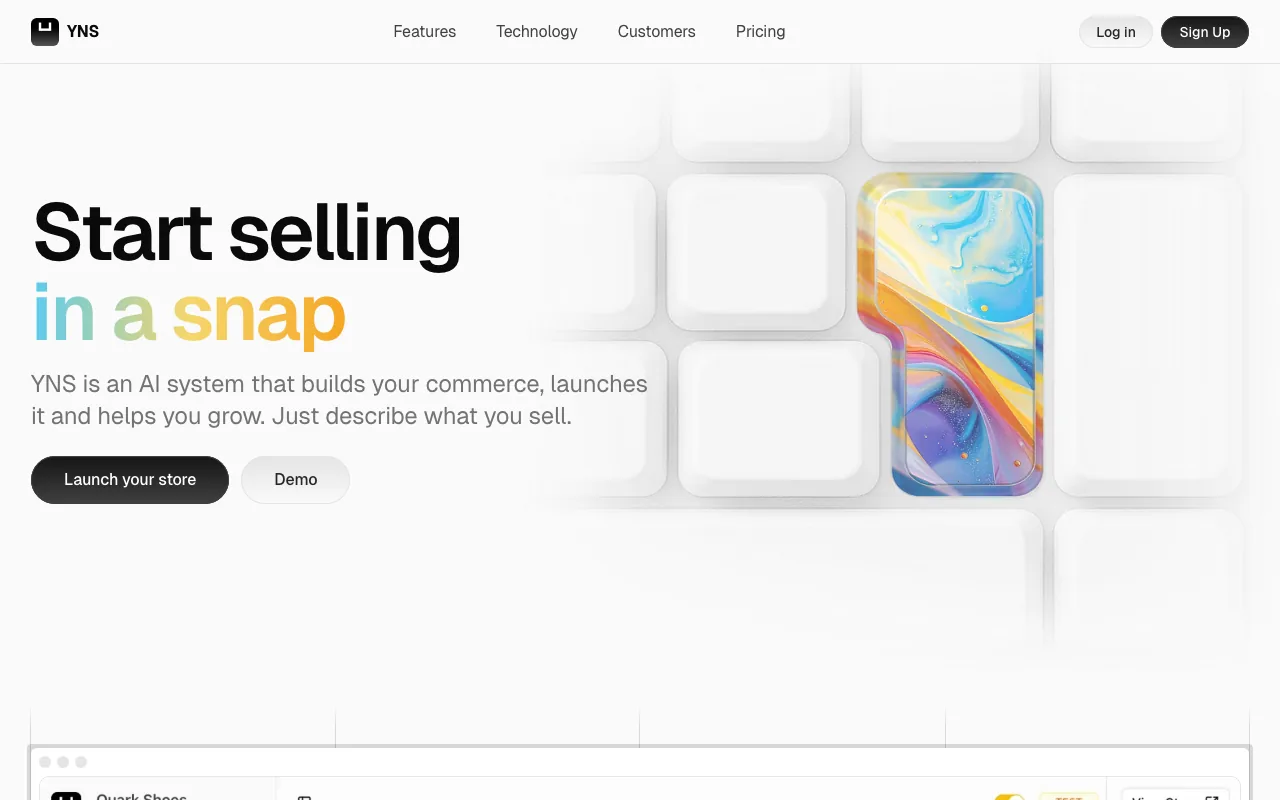
Your Next Store is an AI store builder on top of a modern commerce backend. You describe your store in plain English ("technical apparel for ultrarunners, minimal, performance-led") and the AI generates a working storefront: layout, product cards, copy, navigation. You keep editing by chat, or drop into the visual builder.
For people leaving BigCommerce, the pitch isn't the AI. It's the math. 0% platform transaction fees on every plan, no revenue bands, no overages. Starter is $30/mo flat. Pro is $360/mo flat. You choose a plan by team size and AI credits, never by how much you sell.
The stack is a generation newer: Next.js 16, React Server Components, Partial Prerendering. Vibe-code customizations through Elliot, or fork the open-source storefront, which talks to the YNS backend through the Commerce Kit SDK.
Standouts: AI store builder that ships a working store, flat pricing, no revenue caps, GEO-ready (structured data, llms.txt, AI discoverability audit).
Tradeoffs, honestly: No free plan; Starter is $30/mo. The app marketplace is much smaller than BigCommerce's, so if you need a niche industry app, check first. Payments are Stripe-only today (Apple Pay, Google Pay, Klarna and Afterpay all work through Stripe). B2B features are lighter than BigCommerce B2B Edition: if quotes, purchase-order approvals and buyer portals are central to your business, look at the B2B section below.
Pricing: Starter $30, Growth $60, Pro $360 per month. 0% platform fees on every plan.
Tired of the meter? Describe your store in plain English and watch it get built, at the same price whether you do $30K or $3M.
2. Shopify
Best for: Brands who want the deepest app ecosystem in ecommerce and can use Shopify Payments.

Shopify is BigCommerce's biggest competitor and the default migration target. Unlike BigCommerce, Shopify doesn't move you up a plan because you sold more: a $1M store can stay on Basic if the features are enough. The catch is the per-sale fee (2% on Basic, 1% on Grow, 0.6% on Advanced) if you use a payment provider other than Shopify Payments.
With Shopify Payments, Shopify is often cheaper than post-June BigCommerce for growing stores. Without it, the percentages usually cost more than BigCommerce's bands. The admin is mature, Shop Pay converts well, and the app store solves almost every niche use case.
Standouts: Largest app store in ecommerce, Shopify Payments + Shop Pay, multi-channel (TikTok Shop, Instagram, Amazon, Walmart), real POS, B2B features on Shopify Plus.
Tradeoffs: Theme customization beyond settings means Liquid or a Shopify developer. 0.6–2% per-sale fee without Shopify Payments. Headless requires Hydrogen or a custom Storefront API build. See our Shopify transaction fees post for the breakdown.
Pricing: Basic $29, Grow $79, Advanced $299 per month billed annually ($39, $105 and $399 monthly). Plus from about $2,300–$2,500/mo depending on term.
3. WooCommerce
Best for: Teams who already run WordPress, want full data ownership, and have a developer on hand.
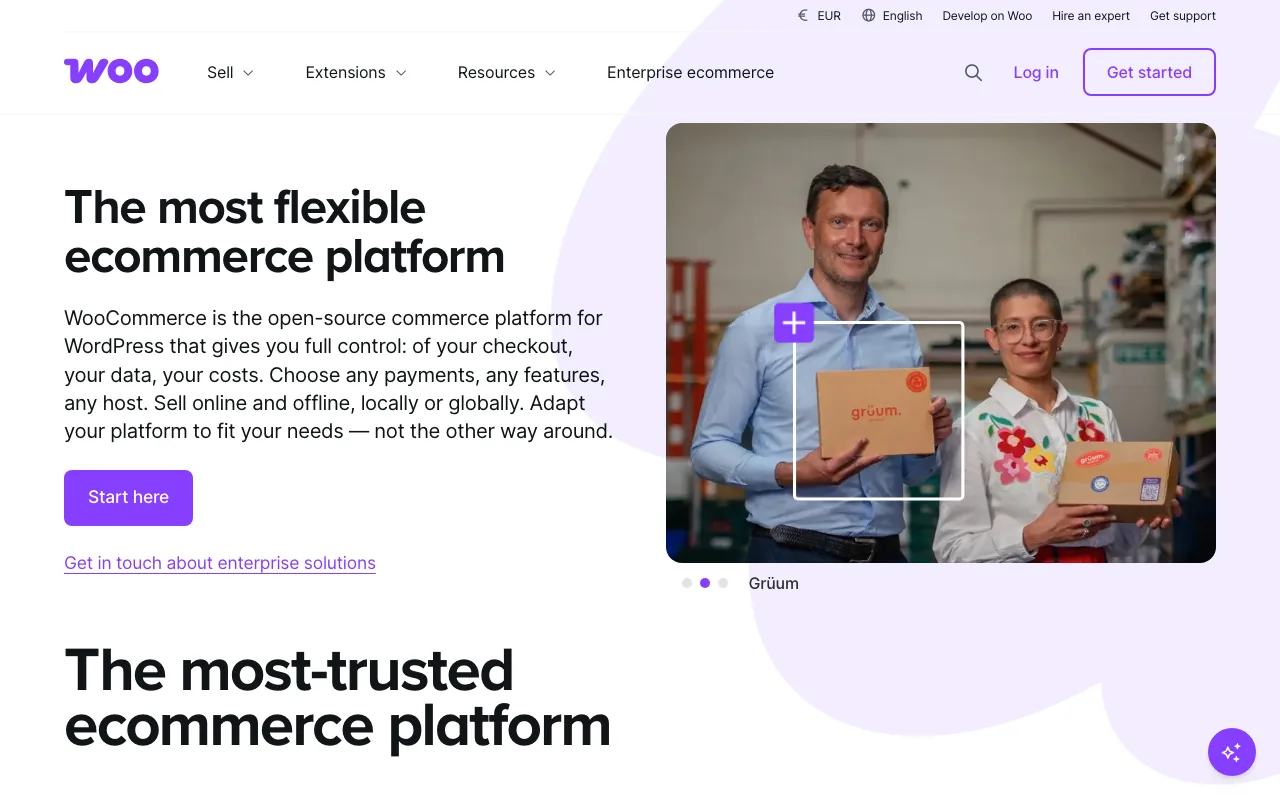
WooCommerce is the free, open-source plugin that turns WordPress into a store. No plan to outgrow, no revenue band, and no fee for choosing your own payment gateway. You pay for hosting (~$10–50/mo), payment processing, and any premium extensions you need.
For brands frustrated by BigCommerce's metered pricing, WooCommerce is the most direct architectural escape: you own the database, the hosting, and the upgrade schedule. The tradeoff is everything else: security patches, plugin compatibility, backup strategy, PCI scope. For a team with WordPress experience, that's freedom. For one without, it's a second job.
Standouts: Free plugin, massive plugin ecosystem (including B2B and wholesale extensions), full data ownership, content-marketing-native.
Tradeoffs: Performance depends entirely on hosting and caching. PHP-based, server-rendered architecture is a different paradigm from React/Next.js platforms. Headless WooCommerce works via the Store API but takes engineering work; see WooCommerce vs Next.js and our WooCommerce alternatives guide.
Pricing: Plugin is free. Real cost: $10–50/mo hosting, $100–500/yr extensions for a typical store.
4. Saleor
Best for: Engineering teams that want a GraphQL-first, open-source headless commerce engine.
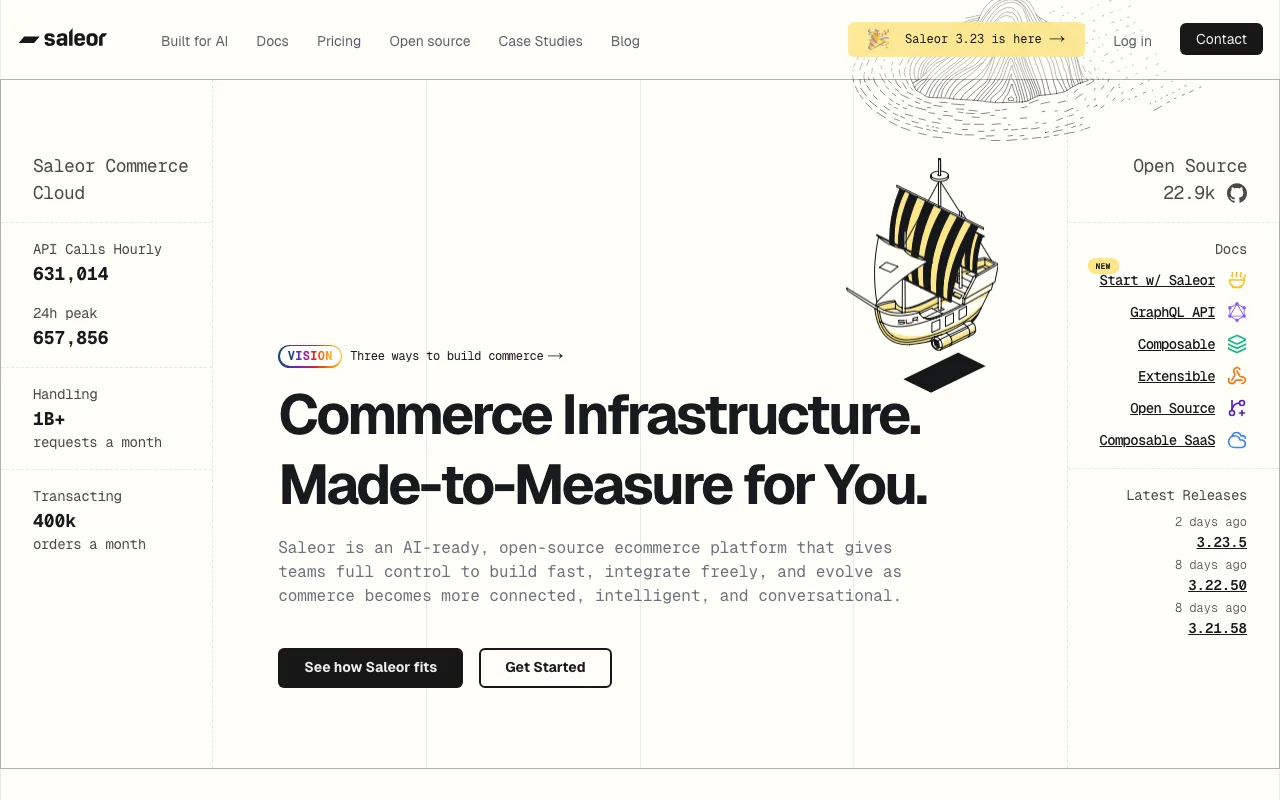
Saleor is an open-source, GraphQL-first commerce platform written in Python. The defining difference from BigCommerce: one GraphQL query returns exactly the fields you need, and you own the backend code. For frontend teams (especially Next.js or React Native), that's a meaningful DX upgrade.
Native multi-channel, multi-warehouse and multi-currency ship in the box, and channel-aware pricing covers a lot of B2B needs without an add-on.
Standouts: GraphQL-first API, native multi-channel (B2C + B2B from one backend), channel-aware pricing, free to self-host.
Tradeoffs: Self-hosting means running Python, Postgres, Redis and background workers. Saleor Cloud is priced for mid-market and enterprise, and its plans are GMV-capped too, so it doesn't escape revenue-based pricing. The free Cloud sandboxes are for prototyping only, not production.
Pricing: Self-host free. Saleor Cloud: Select $1,599/mo up to $200K/month GMV (0.8% above), Volume $3,999/mo up to $1M/month (0.4% above), Enterprise on quote.
5. Squarespace
Best for: Brands where the site, blog, and store are all part of one polished brand experience.

Squarespace sits one notch below BigCommerce on ecommerce depth and one notch above on default design quality. Templates look polished out of the box, the editor is drag-and-drop, and the CMS, scheduling, email and store live in one tool.
If your roadmap includes wholesale, segmented pricing, or 1,000+ SKUs with deep variant attributes, you'll hit the ceiling. For tens to a few hundred SKUs where the site is a brand experience as much as a checkout, it's the natural alternative.
Standouts: Best default templates on this list, 0% transaction fees on product sales on Core and above, no revenue caps, built-in blog and email.
Tradeoffs: Inventory tools are shallow, no native multi-location, no real B2B. Basic can sell but adds a 2% transaction fee. See our Squarespace Commerce alternatives guide for the reverse comparison.
Pricing (annual, per Tech.co, July 2026): Basic $19, Core $29, Plus $49, Advanced $99.
6. Wix
Best for: Non-technical owners who want the most visual no-code editor and a big template library.
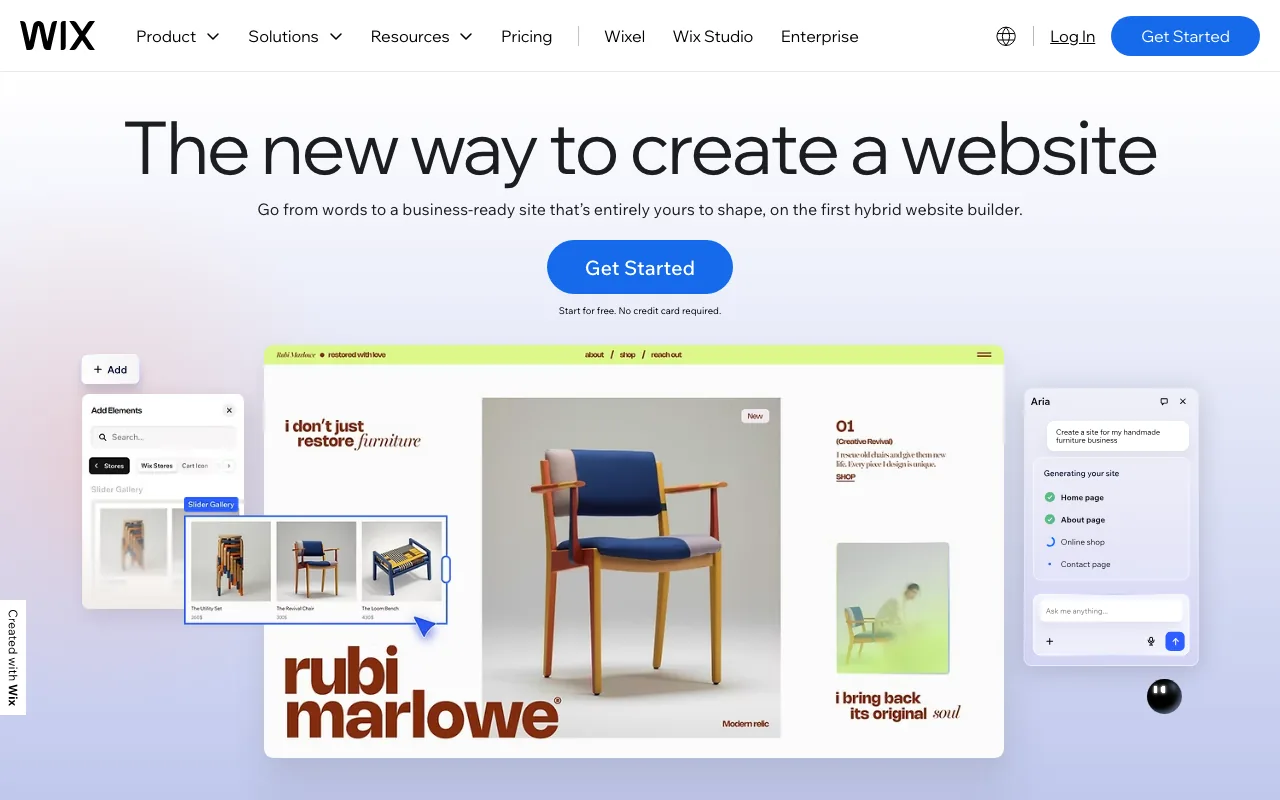
Wix is the largest pure visual builder for sites and stores. Broader than Squarespace in features (apps, AI site generator, scheduling, restaurants, members) and deeper than Big Cartel or Ecwid on ecommerce. For people leaving BigCommerce who want to leave Handlebars and Stencil behind and never touch theme code again, Wix is the closest "anti-code" replacement.
Standouts: Pixel-level visual editor, AI site generator, bundled scheduling, restaurant and members features, no revenue caps.
Tradeoffs: You can't swap templates after launch without rebuilding. Renewal pricing often rises after year one. Performance defaults are heavier than Next.js-based platforms, and catalog depth is well below BigCommerce's. See Wix ecommerce alternatives for deeper coverage.
Pricing (annual, US): Light $17 (no commerce), Core $29, Business $39, Business Elite $159. Confirm on Wix's pricing page for your country.
7. Shift4Shop
Best for: US merchants who want a feature-rich, BigCommerce-style platform for $0/mo using Shift4 as the processor.

Shift4Shop (formerly 3dcart) is the closest like-for-like BigCommerce alternative on features: built-in CRM, blog, return management, advanced shipping rules and wholesale tools. The hook is the End-to-End plan: $0/mo for US merchants who process through Shift4 Payments. It's a real plan, not a trial.
Standouts: $0/mo End-to-End plan (US only, Shift4 Payments), a broad built-in feature set, no revenue caps, no additional transaction fees.
Tradeoffs: Processor lock-in on the free plan. The theme system and admin feel dated next to modern builders. Outside the US, you're on paid plans.
Pricing (Shift4Shop plans): End-to-End $0/mo (US + Shift4 Payments). Paid: Basic Store $29, Plus Store $79, Pro Store $229 per month.
8. Adobe Commerce (Magento)
Best for: Enterprise B2B and high-complexity catalogs where BigCommerce B2B Edition runs out of room.
Adobe Commerce (commercial Magento) is the heavyweight. Native B2B with shared catalogs, requisition lists, quote workflows, segmented pricing, and the most flexible product modeling in this category. The trade is operational cost: many teams spend thousands of dollars a month all-in once they add license, hosting and an agency retainer.
It's overkill for a $250K/yr DTC brand and the right call for a large B2B distributor. Pick it because you have the catalog complexity and the team to operate it, not because it's "the BigCommerce upgrade."
Standouts: Native B2B suite, flexible product modeling (configurable, bundle, virtual, downloadable, grouped), multi-store / multi-currency / multi-warehouse standard.
Tradeoffs: Enterprise-level total cost. Performance requires careful hosting and caching. PHP, server-rendered, a different paradigm from React/Next.js. The free Magento Open Source edition means your own hosting and dev costs.
Pricing: Adobe Commerce on quote. Magento Open Source free.
Honorable Mentions
VTEX: Enterprise commerce, strong in Latin America. Quote pricing.
commercetools: API-first composable commerce with enterprise contracts. A real alternative to BigCommerce Performance.
Shopware: German open-source/SaaS hybrid, strong in DACH and with solid B2B components. Symfony-based.
Best BigCommerce Alternatives for B2B
B2B is where the June 2026 changes bite hardest: price lists sit on Performance, B2B Edition is quote-only, and purchase-order payments count toward the Open Payment Provider fee on self-serve plans. If wholesale is a big part of your business, compare these first:
| If you need | Look at | Why |
|---|---|---|
| Quotes, requisition lists, company accounts at enterprise scale | Adobe Commerce | The deepest native B2B suite on this list |
| B2B and DTC on one platform with a big ecosystem | Shopify Plus | Native B2B (company profiles, catalogs, payment terms) on Plus, plus apps |
| B2B via your own storefront and API | Saleor or commercetools | Channel-aware pricing and API-first design |
| Wholesale on a budget | WooCommerce + a B2B extension, or Shift4Shop | Free or cheap, no revenue bands, no fee for invoice payments |
| European B2B | Shopware | Strong B2B components and agency network in DACH |
Test the exact workflows you rely on (approval chains, net terms, per-customer catalogs, ERP sync) in a trial before you commit. Every platform's "B2B" means something slightly different.
What Actually Bites at Month Six
Migration posts list features. These are the things you learn after the honeymoon.
"Shopify saves money" depends on Shopify Payments. Take a $150K-a-year store. On BigCommerce it now lands on Scale: $3,588 a year. On Shopify Basic with Shopify Payments it's $348 a year in plan fees. On Shopify Basic without Shopify Payments, the 2% per-sale fee adds $3,000, for $3,348 in total, roughly the same as BigCommerce. Run the row for your processor before you move.
The 600-variant limit is silent until you hit it. Audit your worst-case product (size × color × material × fit) before committing anywhere. Most destinations have their own limits, just at different numbers.
BigCommerce's CSV export doesn't carry modifier values cleanly. Modifiers don't get their own SKU or inventory row, so they don't fully round-trip through the standard CSV. If you've used modifiers to get past 600 variants, budget engineering time to re-model on the new platform.
"0% transaction fees" almost always has a footnote. BigCommerce's 0% now depends on revenue bands and an embedded payment provider. Shopify's 0% requires Shopify Payments. Squarespace's 0% starts on Core. The platforms with unconditional 0% platform fees here: YNS, WooCommerce, self-hosted Saleor, and Shift4Shop. Always read the asterisk.
Order, customer and gift card data rarely migrate cleanly. Product CSV importers are mature; everything else is bring-your-own-script. Export the lot from BigCommerce to your own storage before you cancel. You may need it for chargeback disputes or compliance a year later.
How to Migrate from BigCommerce
The shape is the same for every destination:
- Export products as CSV. Audit variants, modifiers, custom fields, and images before importing anywhere.
- Export orders, customers, and gift cards separately. Each has its own export path.
- Download all product images as files, not URLs.
- Map URLs. BigCommerce's
/products/{slug}/rarely matches the destination. Build a 301 map for your top 100 URLs from Google Search Console. - Reconnect payments and run a $1 test order. Stripe, PayPal, Shift4, Adyen: none of these accounts move with you.
- Verify tax and shipping on a real order before cutover. EU and UK sellers should confirm VAT handling (OSS for cross-border EU sales) on the new platform.
- Cut DNS only after end-to-end testing, including email confirmation.
- Check your BigCommerce renewal date. Annual contracts move to the new plans at renewal, so time the switch to avoid paying for a year you won't use.
Budget one weekend for under 100 SKUs, one to three weeks for a typical mid-market migration with a design refresh.
FAQ
What are the best BigCommerce alternatives?
It depends on why you're leaving. For flat pricing with no revenue caps and a modern AI-built storefront: Your Next Store. For the biggest ecosystem: Shopify (best with Shopify Payments). For full control: WooCommerce. For a $0 plan in the US: Shift4Shop. For enterprise B2B: Adobe Commerce. For GraphQL headless: Saleor.
Who are BigCommerce's main competitors?
Shopify is the biggest, followed by WooCommerce, Adobe Commerce (Magento), Wix and Squarespace for smaller stores, and commercetools, VTEX and Salesforce Commerce Cloud at the enterprise end. Open-source engines like Saleor and Medusa compete for headless projects.
Did BigCommerce change its pricing in 2026?
Yes. From June 1, 2026, Standard, Plus, Pro and Enterprise became Core, Growth, Scale and Performance. The sales limits dropped to $30K (Core) and $100K (Growth), Scale charges 0.9% on sales above $33,333 a month, and a new Open Payment Provider fee (2% on Core, 1% on Growth, 0.6% on Scale) applies to orders that don't use an embedded payment provider. Annual-contract merchants switch at renewal.
What's the cheapest BigCommerce alternative?
Shift4Shop End-to-End is $0/mo if you're a US merchant using Shift4 Payments. WooCommerce is free as a plugin but you pay $10–50/mo in hosting. Among hosted platforms without revenue caps, Your Next Store at $30/mo flat and Shopify Basic at $29/mo (annual, with Shopify Payments) are the cheapest.
What's the best BigCommerce alternative for B2B?
Adobe Commerce for heavyweight B2B with shared catalogs and quote workflows. Shopify Plus for B2B on the same platform as DTC. Saleor or commercetools for API-first B2B. WooCommerce with a B2B extension if budget matters most. BigCommerce B2B Edition is competent; people usually leave for cost (price lists need Performance, and purchase orders now count toward the Open Payment Provider fee on self-serve plans), not because the features are broken.
Is Shopify cheaper than BigCommerce now?
Often, if you use Shopify Payments: Shopify never moves you up a plan because of revenue. If you can't use Shopify Payments, Shopify's 0.6–2% per-sale fee usually costs more than BigCommerce. Check both at your real annual sales, and see our Shopify transaction fees guide.
Can I run headless commerce as a BigCommerce alternative?
Yes. Saleor is headless-native. Your Next Store ships an open-source Next.js storefront talking to the YNS backend via the Commerce Kit SDK. WooCommerce can run headless via the Store API. Shopify offers Hydrogen. If headless is your main reason to switch, our best headless commerce platforms comparison goes deeper; this page is about leaving BigCommerce itself.
Will I lose SEO if I migrate from BigCommerce?
Not with a careful 301 map. The biggest risk is URL structure changes: /products/{slug}/, /products/{slug} and /{slug} count as three different URLs to Google. Export your top 200 pages from Google Search Console, map them, verify redirects in staging, and expect a 2–6 week dip even on a clean migration.
Related Blog Posts
- Best Headless Commerce Platforms
- Best AI Store Builders of 2026
- Best Ecommerce Platform for Developers
- Shopify Transaction Fees Explained
- WooCommerce Alternatives
- How Much Does an Ecommerce Website Cost?
BigCommerce charges you more for growing, and since June 2026 it starts charging sooner. The platforms above charge you for using the product. Pick the platform whose pricing logic matches the next three years of your business, not the one with the longest feature list. And before you move to Shopify because everyone said so, run the per-sale math at your actual sales and with your actual payment provider.
Ready to leave the meter behind? Try Your Next Store. Flat pricing, 0% platform fees, Elliot included.