Best Wix Ecommerce Alternatives in 2026 (Honest Picks)
 Jakub Neander
Apr 17, 202611 min read
Wix is great for building a quick brochure site. As an ecommerce platform, it runs into walls fast: you can't swap templates after launch without rebuilding every page, renewal prices have a habit of jumping on year two, transaction features lag behind ecommerce-first platforms, and Wix Payments adds fee layers that are easy to miss until they show up on your statement. If you're selling online and outgrowing Wix, here are the eight alternatives worth looking at in 2026, honestly compared.
For a side-by-side product comparison, see our Wix alternative page.
TL;DR: The Best Wix Ecommerce Alternatives
- Best AI-powered builder: Your Next Store. Describe your store in plain English, AI builds it, then tweak it visually. 0% transaction fees.
- Best for scaling ecommerce: Shopify. The obvious answer if ecommerce is your whole business. Pay the transaction fees, get the ecosystem.
- Best for design-led brands: Squarespace. Polished templates, great for service-plus-store businesses.
- Best for growth-stage stores: BigCommerce. Stronger native ecommerce features than Wix without the plugin sprawl.
- Best for adding a store to an existing site: Ecwid by Lightspeed. Drop-in store widget that works on any site.
- Best budget AI builder: Hostinger Website Builder. Cheap entry price, AI-generated starter sites.
- Best for design freedom: Webflow. Visual editor with real design control.
- Best for free entry: Square Online. Free plan, tight POS integration if you also sell in person.
Why People Are Leaving Wix in 2026
Before you pick an alternative, it helps to pin down what's actually bothering you. The complaints cluster into a few buckets:
Template lock-in. Wix will not let you switch templates after you publish. If your brand evolves, or you just want a cleaner look, you rebuild every page by hand. Most other platforms on this list let you switch themes in a few clicks.
Renewal pricing shock. Introductory plans are cheap. Renewals can be much less cheap. Wix's own community forum has long threads from merchants describing year-two prices "doubling" or more. Always check the renewal rate, not the promo rate.
Transaction-level ecommerce features. Wix has ecommerce, but inventory management, multi-location stock, gift cards, advanced discounts, and marketplace syndication all feel bolted on compared with platforms where ecommerce is the core product.
Slow-ish performance. Wix sites post mid-pack Core Web Vitals scores, trailing Webflow and modern headless stacks on mobile. The gap isn't catastrophic, but Google's own data shows that faster sites convert better. Every second of delay at checkout is a tangible revenue leak.
Fee layers on payments. Wix Payments charges 2.9% + $0.30, plus cross-border fees, currency conversion fees, and higher rates for AmEx. Not unique to Wix, but combined with platform renewal hikes it stings.
Content limits. The 100-page static-content cap on lower plans surprises merchants who want a real blog, landing pages, and a catalog on the same site.
If one or more of these sounds like your week, you're in the right post.
How We Ranked These
Honest ranking, not a feature checklist. For each alternative we looked at:
| Criterion | What we checked |
|---|---|
| Ecommerce features | Inventory, variants, discounts, tax, multi-currency, abandoned-cart recovery |
| Real cost | Monthly plan + transaction fees + required apps |
| Ease of use | Can a non-developer build and maintain it? |
| Design control | Can you switch themes? Edit without a designer? |
| Performance | Real-world speed, mobile Core Web Vitals |
| Migration path from Wix | Can you bring products, content, and domain across? |
Quick Comparison
| Platform | Starting Price | Transaction Fee | Free Plan | Best For |
|---|---|---|---|---|
| Your Next Store | $30/mo | 0% platform fee | No | AI-first store building |
| Shopify | $29/mo | 0.6-2% without Shopify Payments | 3-day trial | Pure ecommerce scaling |
| Squarespace | $16/mo (Core $23/mo) | 0% on Core+ plans | 14-day trial | Design-led brands |
| BigCommerce | $29/mo | 0% | 15-day trial | Growth-stage stores |
| Ecwid | From $5/mo (Starter) | 0% | No | Store widget on any site |
| Hostinger | ~$2.99/mo intro | 0% | No | Budget AI builder |
| Webflow | Ecommerce from $29/mo | 2% on Standard plan | Free builder tier | Design freedom |
| Square Online | Free; paid from $49/mo | 3.3% + $0.30 online on free plan | Yes | Free entry, in-person selling |
Prices as of 2026 and commonly reflect introductory rates. Always check renewal pricing before committing.
At a Glance: Where Each Alternative Sits
Before the detailed entries, here's how the eight options map against the two things that matter most when leaving Wix: setup effort and ecommerce depth.
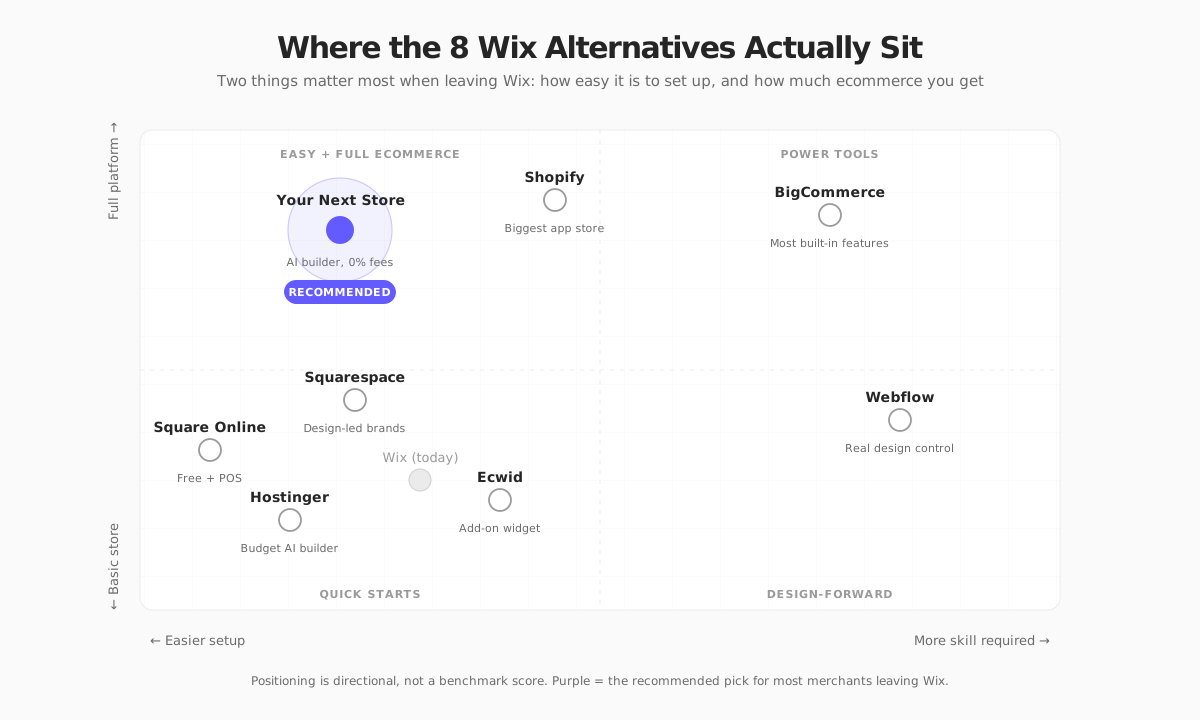
The upper-left quadrant is where most former Wix merchants land: you want real ecommerce features without having to learn a design tool or hire a developer. That's where Elliot, Your Next Store's AI builder, lives, and it's why we've marked it as the recommended starting point for this audience.
The 8 Best Wix Ecommerce Alternatives
1. Your Next Store
Best for: People who want to describe their store in plain English and have AI build it.
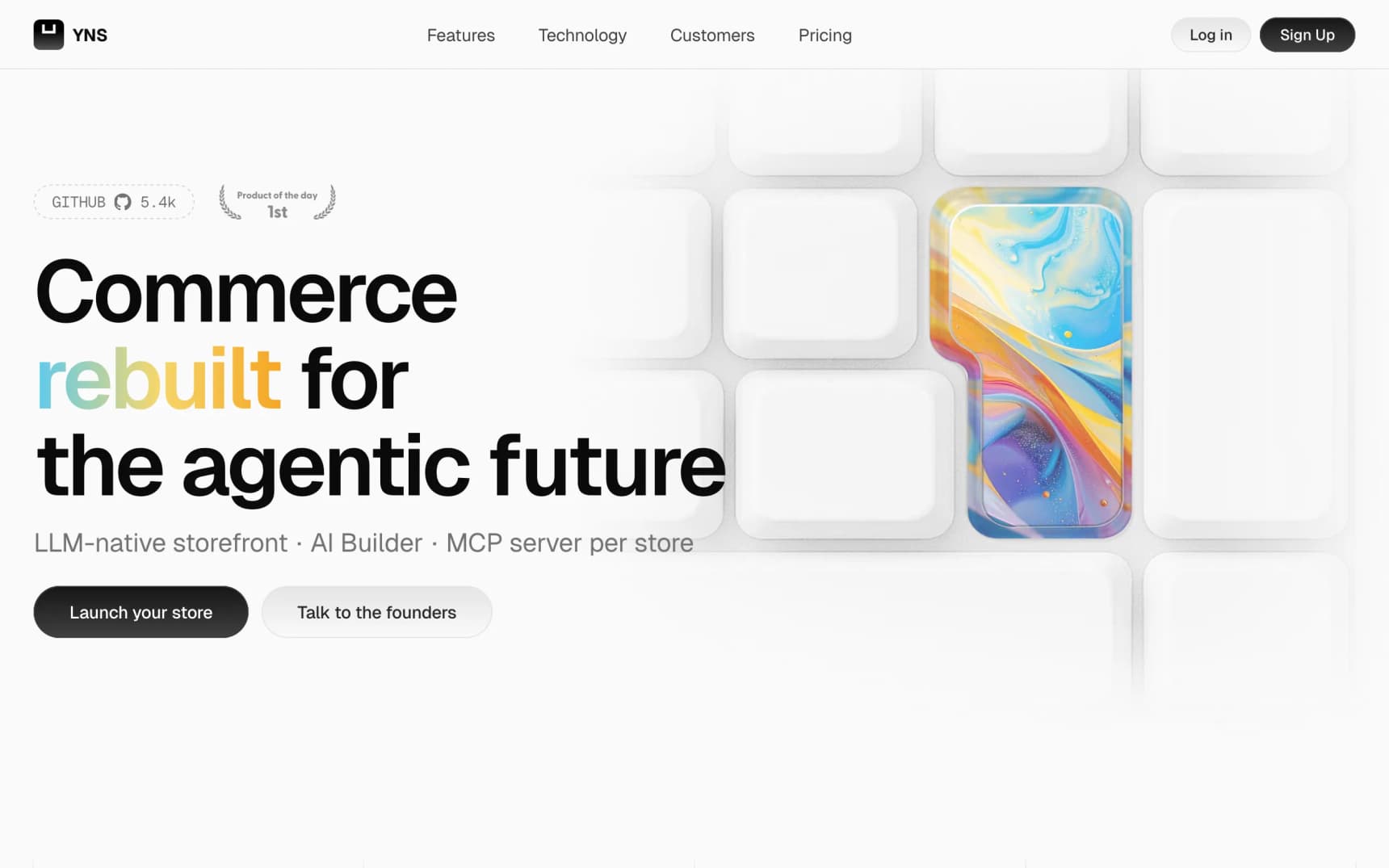
Your Next Store is built around an AI store builder. You open a chat, say what you sell, what vibe you want ("clean, Scandinavian, minimal"), and the AI generates a working store, complete with layout, copy, and product cards. You can then edit anything with another chat message, or tweak things by hand.
It's the closest thing on this list to "Wix if Wix had been built in 2026." You don't need to learn a template language, you don't get locked into a theme, and you can change the entire look of the store by asking.
What makes it stand out:
- AI store builder that actually ships a working store, not a demo
- 0% platform transaction fees on every plan. You pay Stripe's standard processing fee, nothing on top
- Modern performance by default: Next.js 16, Partial Prerendering, mobile-first. Lighthouse scores in the high 90s without tuning
- GEO-ready out of the box: structured data, sitemaps, and an AI discoverability audit so your products show up when shoppers search with AI assistants
- Custom domain from the $30/month Starter plan
Tradeoffs: No free plan. Starter is $30/month. Payments are Stripe-only (no PayPal-native, though you can add Klarna, Afterpay, and Apple/Google Pay through Stripe). The app ecosystem is newer than Shopify's; if you need a niche plugin, check first.
Pricing: Starter $30/mo, Growth $60/mo, Pro $360/mo. All plans have 0% platform transaction fees.
Ready to leave Wix? Try Elliot – describe your store in plain English and watch it get built.
2. Shopify
Best for: Merchants who want the largest ecommerce app ecosystem and are building ecommerce as their main business.

Shopify is the default answer if someone asks "where should I sell online?" and that reputation is earned. The platform is ecommerce-first, the app store is enormous, the admin is familiar, and Shopify Payments handles almost anything you throw at it.
Compared to Wix, Shopify wins on inventory management, multi-location stock, discount flexibility, analytics, and the sheer number of third-party integrations. If you're serious about ecommerce and your budget can absorb the app costs, Shopify is the safe pick.
What makes it stand out:
- Biggest app store in ecommerce. Anything you need (reviews, subscriptions, loyalty, shipping) has five apps competing for it
- Shopify Payments and Shop Pay give you a one-click checkout many shoppers already recognize
- Multi-channel selling built in: Amazon, Walmart, TikTok Shop, Instagram, Google
- Mature POS for merchants who sell in person as well as online
Tradeoffs: Real costs add up. Shopify charges 0.6%-2% on each sale if you don't use Shopify Payments, on top of plan fees (2% on Basic, 1% on Grow, 0.6% on Advanced). Most merchants also run 3-10 paid apps, which can easily be $200+/month. Theme customization past the built-in settings often means touching Liquid or hiring a Shopify developer. For a full math-of-ownership breakdown, see our Shopify transaction fees deep dive.
Pricing: Basic $29/mo, Grow $79/mo, Advanced $299/mo. Plus and Enterprise by quote.
3. Squarespace
Best for: Design-led brands, service businesses with a small store, creators selling a handful of products alongside content.
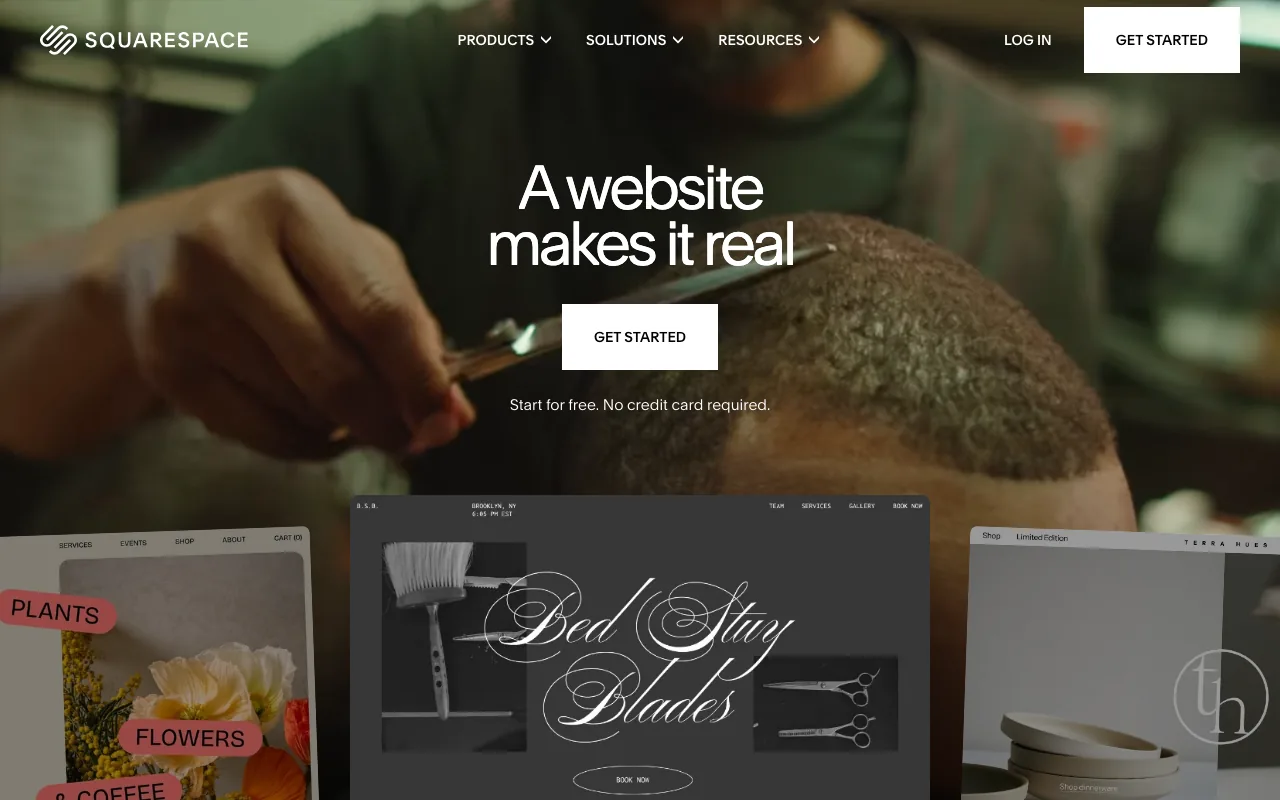
Squarespace is the most direct stylistic alternative to Wix. The templates look polished out of the box, the drag-and-drop editor is close enough to Wix's that you won't be lost, and unlike Wix you can switch templates later (though it still involves moving content).
Where Squarespace shines is design and content. If your store is an extension of a portfolio, blog, or service business (photographers selling prints, yoga studios selling classes, cafes selling beans), it hits a sweeter spot than Wix. It's less strong as a pure ecommerce engine than Shopify or BigCommerce.
What makes it stand out:
- Beautiful default templates, less pressure to hire a designer
- Strong content tools: blog, galleries, scheduling, email campaigns all first-party
- 0% transaction fees on the Core, Plus, and Advanced plans
- Templates can be changed (with caveats) unlike Wix
Tradeoffs: Ecommerce features are thinner than Shopify or BigCommerce. Inventory is basic, no native multi-location, and the plugin ecosystem is limited by comparison. Reporting is shallow on lower plans. Personal is content-only: you need Core ($23/mo) or above to actually sell. If you're cross-shopping in the other direction, our Squarespace Commerce alternatives guide covers the same comparison from Squarespace's side.
Pricing (billed annually): Personal $16/mo (no ecommerce), Core $23/mo, Plus $39/mo, Advanced $99/mo. All of Core, Plus, and Advanced have 0% Squarespace transaction fees.
4. BigCommerce
Best for: Stores outgrowing Wix or Squarespace that want ecommerce features without going full Shopify-plus-apps.
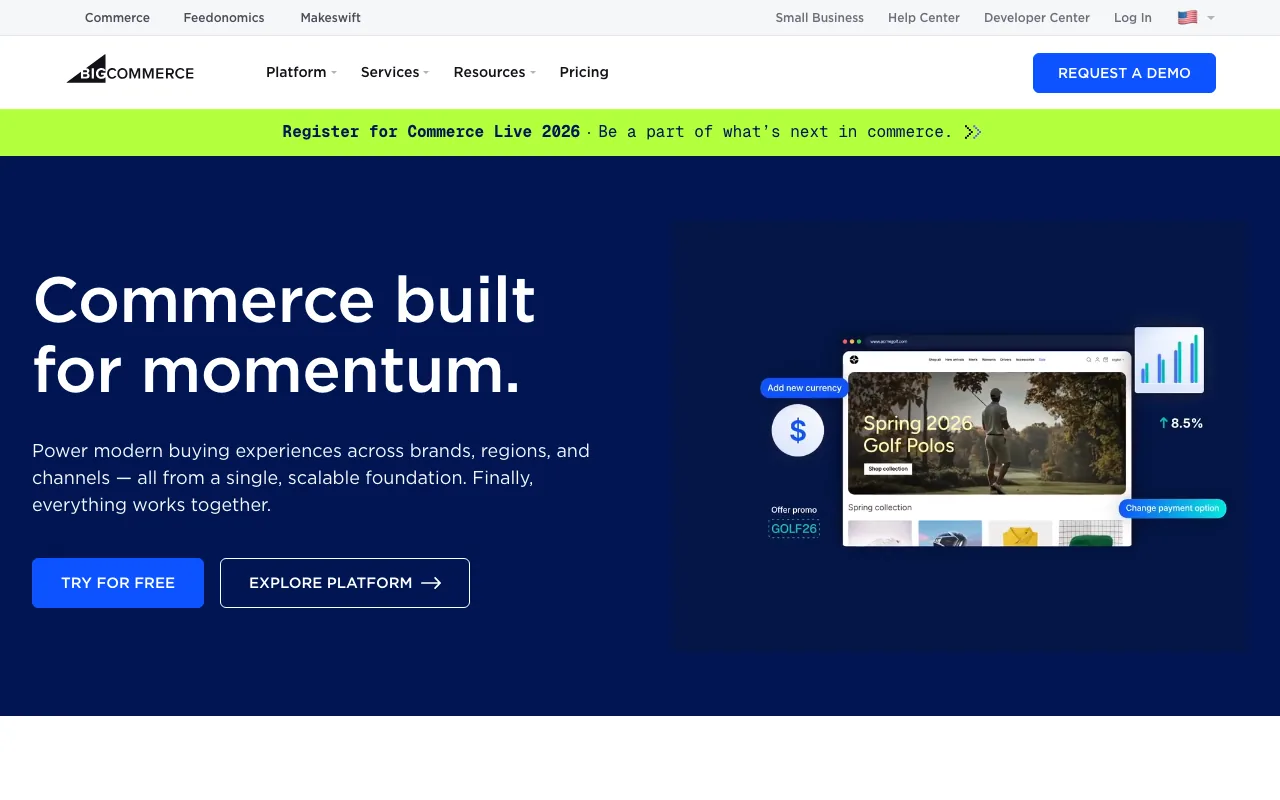
BigCommerce has been in the shadow of Shopify for years, but it quietly includes features that Shopify charges extra for. B2B price lists, unlimited product variants, gift cards, advanced ratings, multi-currency: all in the plan, not in an app.
The bet BigCommerce is making: you shouldn't need 10 apps to run a real store. For merchants who hate plugin sprawl (and anyone migrating from Wix with bigger ambitions), that's attractive.
What makes it stand out:
- 0% platform transaction fees on every plan
- More built-in features (B2B, multi-currency, advanced product options) than any other SaaS here
- Strong headless support if you later want to split admin from storefront
- Scales with revenue: plan tiers go up with your sales volume, not with feature unlocks
Tradeoffs: Revenue-tiered plans mean if you cross a threshold (currently $50K, $180K, $400K/year), you're bumped up a plan whether you want new features or not. The admin UI feels dated compared to Shopify and newer platforms. App store is smaller. If you're already weighing BigCommerce, our BigCommerce alternatives guide covers the revenue-band math in detail.
Pricing: Standard $29/mo, Plus $79/mo, Pro $299/mo, Enterprise by quote.
5. Ecwid by Lightspeed
Best for: Merchants who already have a site (Wix, WordPress, Squarespace, or plain HTML) and want to bolt on a real store without rebuilding.
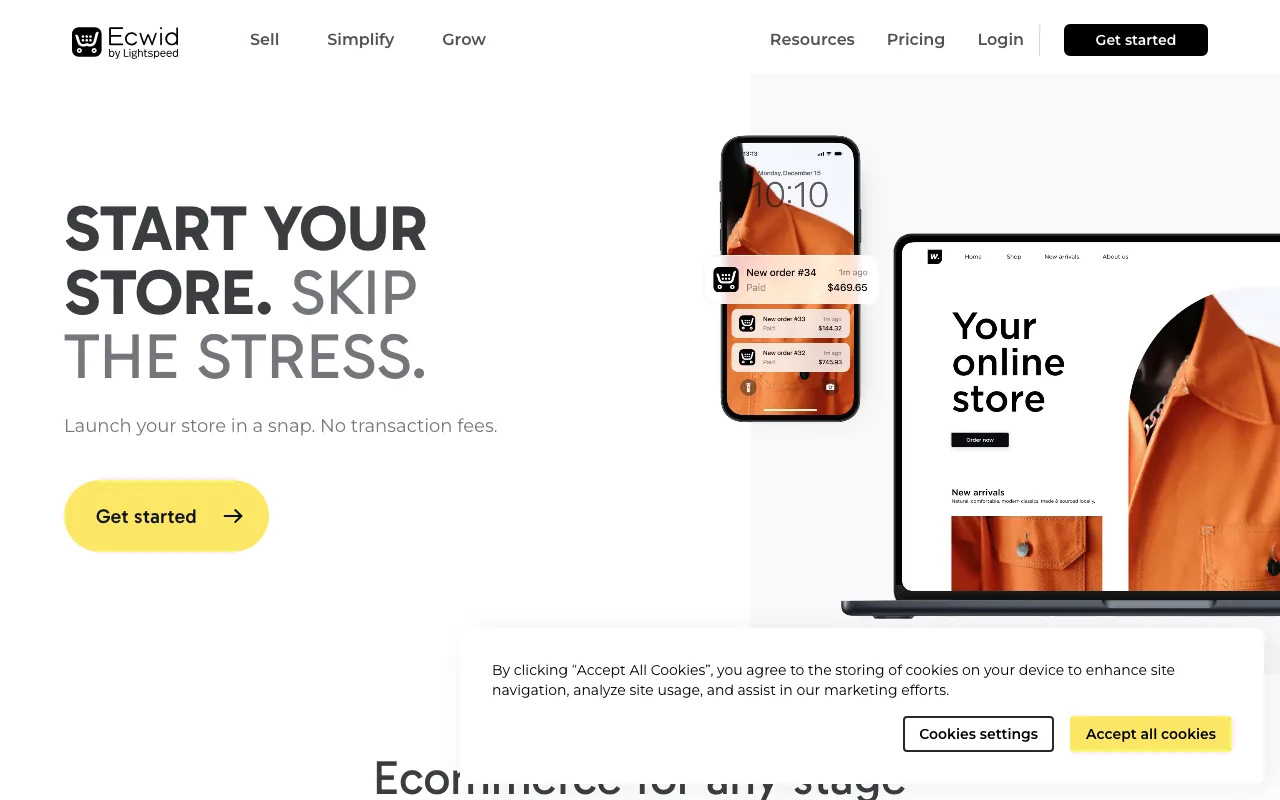
Ecwid, now owned by Lightspeed, is a different shape of product than the others. Instead of replacing your site, Ecwid drops an embeddable store onto whatever site you already have. Same products, same cart, on a Wix-built blog, an Instagram profile, a Facebook page, or a WordPress site, all kept in sync.
That makes it an interesting "half-switch" from Wix: keep your existing Wix site for now, add Ecwid for the ecommerce layer, and migrate the rest later if you want.
What makes it stand out:
- Cheap entry tier: Starter at $5/month for small catalogs
- Embed anywhere: widgets for WordPress, Wix, Weebly, Joomla, raw HTML
- Multi-channel: syncs catalog to Facebook, Instagram, Google, Amazon, eBay
- Real POS via Lightspeed integration
Tradeoffs: The storefront experience is a widget inside your host site, not a purpose-built store layout. Customization is limited compared to Shopify or BigCommerce. Ecwid retired its free plan; the cheapest option is now $5/month. If you outgrow the embed-everywhere model, you'll eventually migrate to a full platform anyway.
Pricing: Starter $5/mo (up to 10 products), Venture $35/mo ($29/mo billed annually), Business $65/mo, Unlimited $149/mo.
6. Hostinger Website Builder
Best for: Cost-conscious first-time sellers who want AI to do most of the setup.
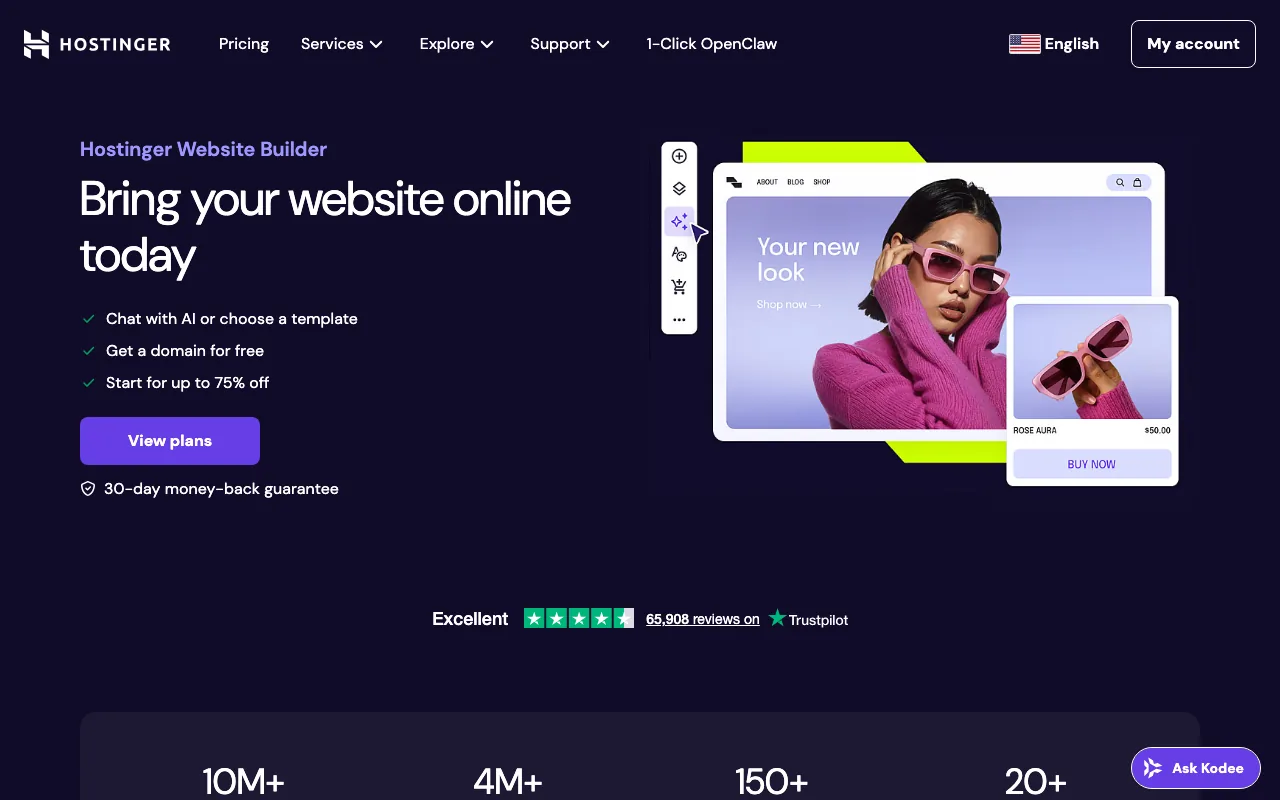
Hostinger's Website Builder is the cheapest serious option on this list. Introductory pricing dips well below $5/month. It includes an AI site generator that spins up a starter site from a short description, plus a built-in AI writer, image generator, and SEO assistant.
For someone opening a small store on a tight budget, especially if they're nervous about the Wix vs. Shopify price gap, it's a legitimate option. Just be aware of the renewal price, which is several times the intro rate.
What makes it stand out:
- Very low intro price (well under $5/month on long commitments)
- AI-first setup: short description, working starter site, editable from there
- Bundled hosting, domain, email, useful if this is your first site
- Surprisingly decent ecommerce for the price tier
Tradeoffs: Renewal pricing can more than double. Ecommerce features are lean compared to dedicated platforms. Best for small catalogs; you'll outgrow it if your business takes off.
Pricing: Varies heavily by promo and contract length. Budget for 2-3x the intro price at renewal.
7. Webflow
Best for: Brands that care about design above all and want their ecommerce site to feel bespoke.
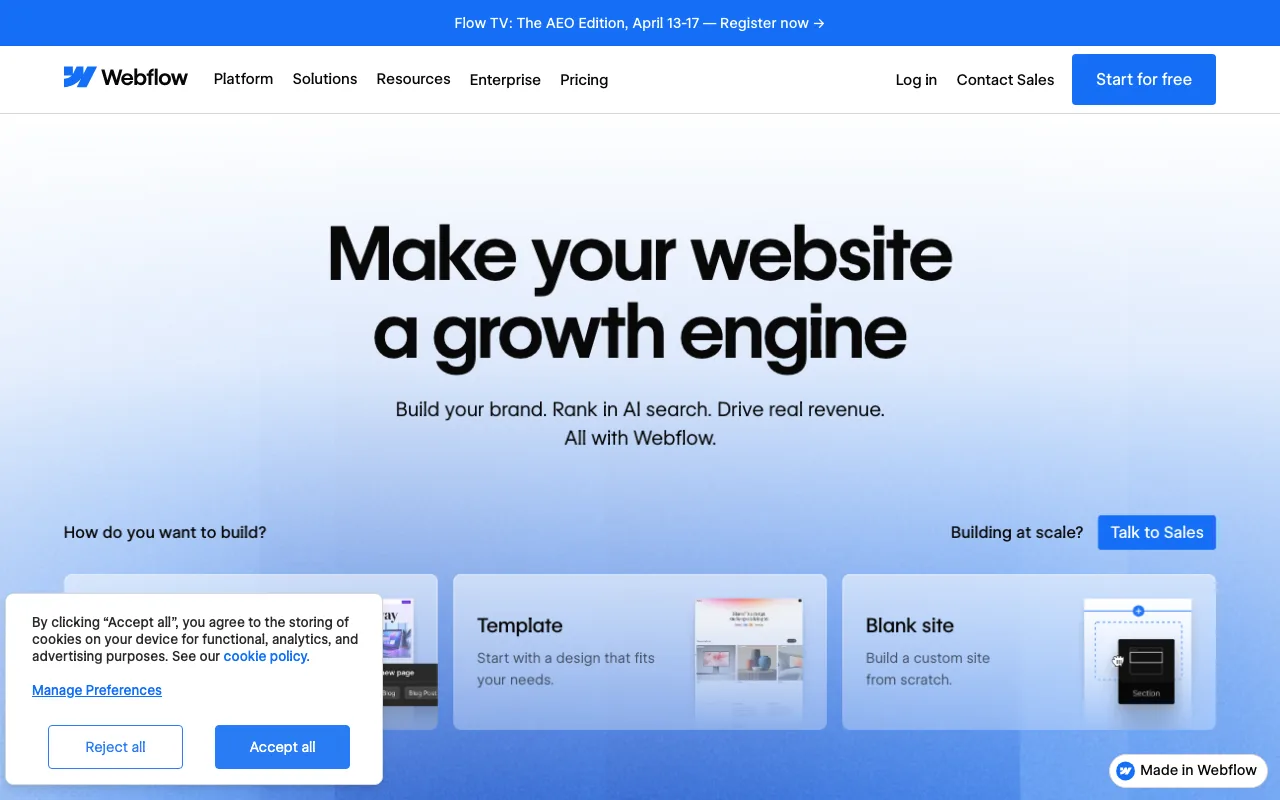
Webflow is the platform designers reach for when Wix feels limiting. The visual editor gives you real control over every element on the page, the output is clean HTML/CSS, and pages load fast. If your Wix frustration is "I can't make it look the way I want," Webflow is the answer.
Ecommerce is a smaller part of Webflow's story than its CMS and design features. It works well for boutique stores (10-500 SKUs) where design is a differentiator, less well for inventory-heavy catalogs.
What makes it stand out:
- Real design control without writing code
- Clean output, fast pages, strong Core Web Vitals
- Powerful CMS for content-heavy stores
- Animations and interactions that would require a developer on Wix
Tradeoffs: Steeper learning curve than Wix or Squarespace. Ecommerce features are thinner than Shopify or BigCommerce (no native multi-currency, limited shipping rules, smaller app ecosystem). 2% transaction fee on the Standard Ecommerce plan.
Pricing: Standard Ecommerce $29/mo (2% fee), Plus $74/mo, Advanced $212/mo.
8. Square Online
Best for: Merchants who also sell in person with Square, or anyone who wants a free starter plan with real ecommerce.
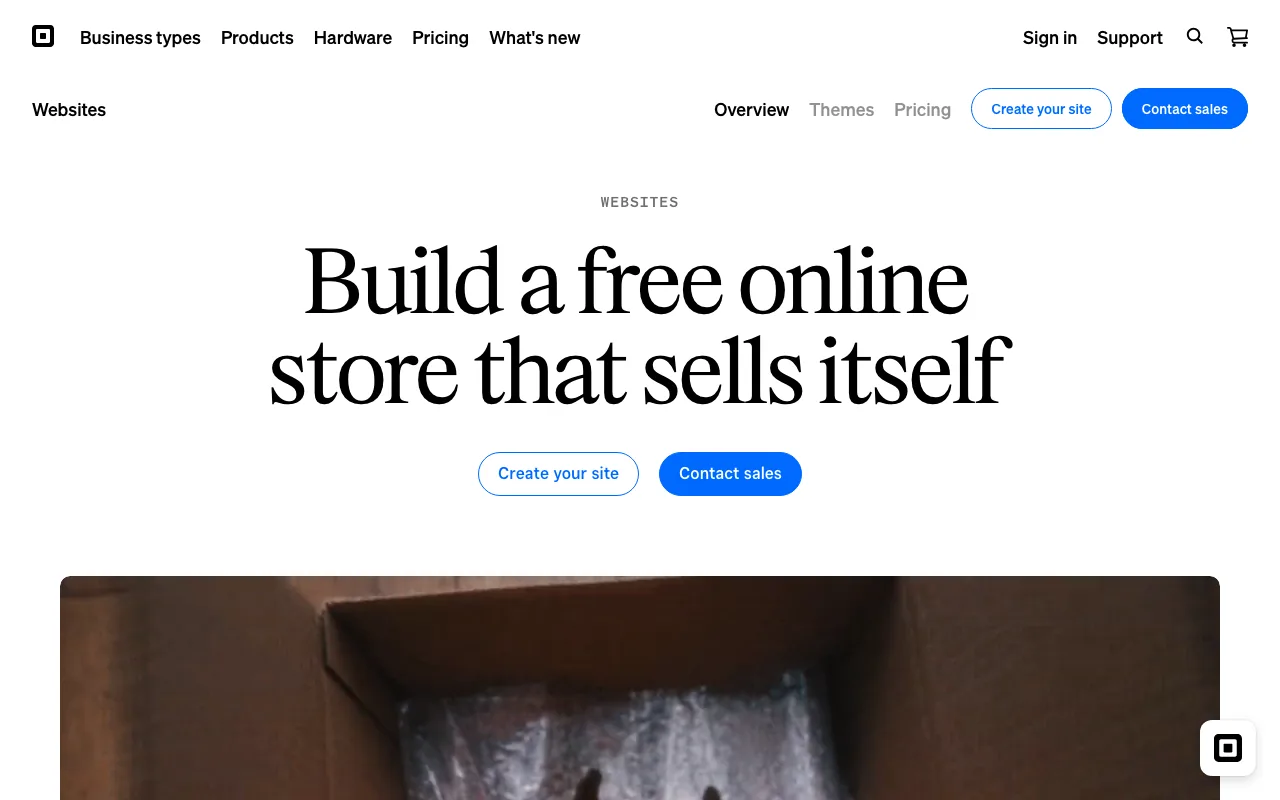
Square Online is the web storefront that comes with the Square ecosystem. If you already use Square for in-person payments, the online store syncs inventory, customers, and orders automatically, which is genuinely useful for hybrid retail and food-and-beverage businesses.
The free plan is real: unlimited products, a Square-branded domain, and the ability to take orders. You pay Square's online processing rate (3.3% + $0.30 per card-not-present transaction on the free plan) but no monthly fee at the entry level.
What makes it stand out:
- Free plan with unlimited products
- Tight POS integration if you also sell in person
- Order-ahead, pickup, and local delivery built in, useful for cafes and restaurants
- No setup complexity, fast to launch
Tradeoffs: Design flexibility is limited. Branding on the free plan shows "Powered by Square." Ecommerce features are basic compared to Shopify or BigCommerce. Best if Square's POS is part of your setup anyway.
Pricing: Free (processing fees only), Plus $49/mo, Premium $149/mo. Square overhauled its pricing in late 2025 into these three unified tiers.
Honorable Mentions
GoDaddy Website Builder: Fast-setup builder with a free tier and the cheapest domain bundling in the industry. Ecommerce is thinner than this list; fine for micro-stores.
Jimdo: German-made builder with a strong AI setup flow. Great for very small catalogs and multilingual sites. Lower ceiling than Shopify or BigCommerce.
WooCommerce: If you want WordPress, it's the answer. Plugin-heavy, not for the non-technical. We cover it in depth in our WooCommerce alternatives guide.
Lovable: AI app builder that can generate a storefront. Impressive demos, but no store engine underneath – you still wire up products, checkout, and admin yourself. If you're considering Shopify with an AI-built frontend, see our review of the Lovable Shopify integration.
How to Choose: A Simple Decision Framework
If you're unsure which of these to pick, three questions usually settle it:
"How much is ecommerce your main business?"
All of it: Shopify, BigCommerce, or Your Next Store. These are ecommerce-first.
Half of it (content plus store): Squarespace or Webflow.
A side of it (main site exists, want to add selling): Ecwid, Square Online.
"How much do you care about design?"
A lot: Webflow, Squarespace, or Your Next Store's Elliot AI builder (which lets you iterate on design with prompts, not templates).
Enough to not embarrass yourself: Shopify or BigCommerce, both ship strong default themes.
Just need it to work: Hostinger, Square Online.
"What's your honest monthly budget?"
Under $10: Hostinger, Ecwid Starter ($5/mo), Square Online Free. Accept tradeoffs.
$20-50: Squarespace, Shopify Basic, BigCommerce Standard, Your Next Store Starter, Webflow Standard Ecommerce.
$50-150: Shopify, BigCommerce Plus, Your Next Store Growth, Webflow Plus.
$300+: You're at a scale where headless commerce and custom builds become rational.
How to Migrate from Wix
The actual mechanics vary by destination, but the shape is the same:
- Export your products. Wix lets you export products as CSV from the Store Products panel. Double-check images, variants, and prices in the CSV before import.
- Export customers and orders. Available as CSV from the Wix dashboard. Some platforms (Shopify, BigCommerce) have official Wix importers that handle this for you.
- Point your domain. Most alternatives walk you through moving the domain or setting up a CNAME. Keep your Wix site live until the new one is ready, to avoid downtime.
- Set up 301 redirects. Wix uses its own URL structure. Map your top URLs to the new platform's URLs and set up redirects to preserve SEO.
- Re-configure payments. Your Wix Payments account doesn't transfer. Set up Stripe, Shopify Payments, or whichever processor the new platform uses.
- Test checkout end-to-end before cutting over DNS. Place a real order, including shipping and tax calculation.
Budget one to two weekends for a small catalog, one to two weeks if you have hundreds of SKUs and want to also rework the design.
FAQ
Is there a Wix alternative that's actually free?
Yes, a few. Square Online has a real free plan with unlimited products (you pay payment processing). Webflow has a free builder tier, though ecommerce requires a paid plan. Ecwid retired its free plan, but its Starter tier is only $5/month for catalogs up to 10 products. For ecommerce specifically, free-forever plans are rare, and they usually charge higher transaction fees to make up for the missing subscription.
Which Wix alternative is easiest to use for a non-technical owner?
Your Next Store if you like describing things in plain English and having AI build them. Squarespace if you want the closest drag-and-drop experience to Wix. Shopify if you want the largest community and support network to lean on. All three can be set up by a non-developer in a weekend.
What's the cheapest Wix alternative with no transaction fees?
BigCommerce and Your Next Store both charge 0% platform transaction fees on every plan. Squarespace Commerce also has 0% fees on Commerce tiers. Shopify charges 0.5-2% unless you use Shopify Payments. Webflow charges 2% on the Standard Ecommerce plan.
Will I lose my SEO if I switch from Wix?
Not if you migrate carefully. The biggest risk is changing URLs without setting up 301 redirects, which can drop rankings for weeks. Most alternatives support custom URLs and redirect rules. Export your top-performing pages from Google Search Console first so you know which URLs absolutely must redirect.
Can I keep my domain when I leave Wix?
Yes. If you bought the domain through Wix, transfer it to a registrar (GoDaddy, Namecheap, Cloudflare) before cancelling your Wix plan, or point it via DNS to the new platform. If you bought it elsewhere, just update the DNS records.
Related Blog Posts
- Wix Payments: Every Fee They Don't Show You
- Shopify Transaction Fees: The Real Math
- Best AI Store Builders of 2026
- Best Ecommerce Platform for Developers
- WooCommerce Alternatives (2026)
- Open Source Shopify Alternatives
- Lovable Shopify Integration: How It Works
The right alternative to Wix depends less on which platform has the longest feature list and more on what kind of merchant you are. Pick the one that fits the way you actually sell, not the one with the flashiest homepage, and you'll thank yourself at renewal time.
Ready to leave Wix? Try Your Next Store or see the full Wix alternative comparison.