Lovable Alternatives for Ecommerce in 2026
 Jakub Neander
May 21, 202616 min read
Lovable can build you a website in ten minutes. It cannot build you a store. The difference is the part nobody talks about: a store is not a webpage with a buy button, it's a system of products, variants, inventory, carts, taxes, refunds, and a checkout that has to keep working at 2am on Black Friday. This post is about what to use instead of Lovable when what you're actually building is ecommerce.
Bias disclosure: We build Your Next Store, an AI-native commerce platform that competes directly with Lovable for ecommerce use cases. We'll flag where our bias might color the analysis, link to every competitor's docs so you can verify, and tell you where each alternative (including ours) genuinely falls short.
The Short Answer
- Use Lovable if you want a marketing site, landing page, or web app that happens to have a Stripe button on it. It's excellent at that.
- Use Your Next Store if you want an AI builder that knows what a product variant, a cart, and an order are, with commerce baked in instead of bolted on.
- Use Bolt.new, v0, or Cursor if you're a developer who wants AI-assisted coding but expects to wire up the commerce backend yourself with Stripe, Medusa, or Saleor.
- Use Shopify or Wix if you want zero AI assistance and a mature, conventional store builder.
The rest of this post explains how to choose between these, what each one actually does, and where each one breaks.
Why Lovable Falls Short for Ecommerce
Lovable is an AI app builder. You describe an app in a chat box, an agent writes React and TypeScript, and you can deploy it. That's a real, useful product. It's also not a commerce engine.
Lovable has no native product catalog. No native cart. No native inventory tracking. No order state machine. No refund handling. No tax engine. No fulfillment workflows. No customer accounts. No subscriptions. No discount codes. No shipping rate calculations. When you ask Lovable to build a "store," it generates a frontend and tells you to bolt on Shopify, Stripe, or Supabase to get the actual commerce.
That works for the demo. It breaks for the business. Three concrete reasons:
1. The agent forgets context after the first build
Here's the pattern, from a hands-on review by Jakub Łoginow that we and most other reviewers have reproduced. Prompt 1 generates a beautiful storefront. Prompts 2 through 10 add real value: a hero section, a product grid, a cart drawer. Around prompt 18, the agent rewrites your cart component using useState even though three prompts ago you converted it to a context provider, because that change is no longer in the active window. By prompt 25, you're spending more time re-prompting things you already fixed than building anything new.
For a marketing site you ship and forget, this is fine. For a store you edit every week (new products, new categories, new promos, new tax rules), context drift isn't a quirk, it's the cost structure of the platform.
2. Commerce data lives outside the AI's reach
When Lovable connects to Shopify, the AI can edit your storefront's React code. It cannot edit your products, your inventory, your tax rules, or your shipping zones. Those live in Shopify's admin. You end up with two control surfaces, two subscriptions, and an AI that can rewrite your hero section but can't fix the variant pricing it just broke.
This is the part most "X vs Y" posts skip. Lovable + Shopify is a four-actor system: you, the Lovable AI, the Shopify admin, and a human who has to keep them in sync. The "AI builds your store" promise is really "AI builds your store's UI; you still operate the store."
3. The Stripe-only path skips the hard parts
Some Lovable tutorials skip Shopify entirely and wire products straight to Stripe Products and Prices. This works for a small catalog with no variants and no inventory; Stripe Products has no concept of variants, so a t-shirt with three sizes becomes three separate "products" with no shared identity. The moment you have a size-small-medium-large t-shirt, an out-of-stock state, a discount code, or a tax-inclusive market, you're rebuilding what Shopify, WooCommerce, and YNS already shipped years ago. We've written about the tradeoffs of building directly on Stripe if you want the long version.
The point is not that Lovable is bad. It's that "build me a store" is a different problem from "build me an app," and the alternatives below take that seriously.
The Best Lovable Alternatives for Ecommerce
1. Your Next Store (YNS): AI-Native, Commerce Built In
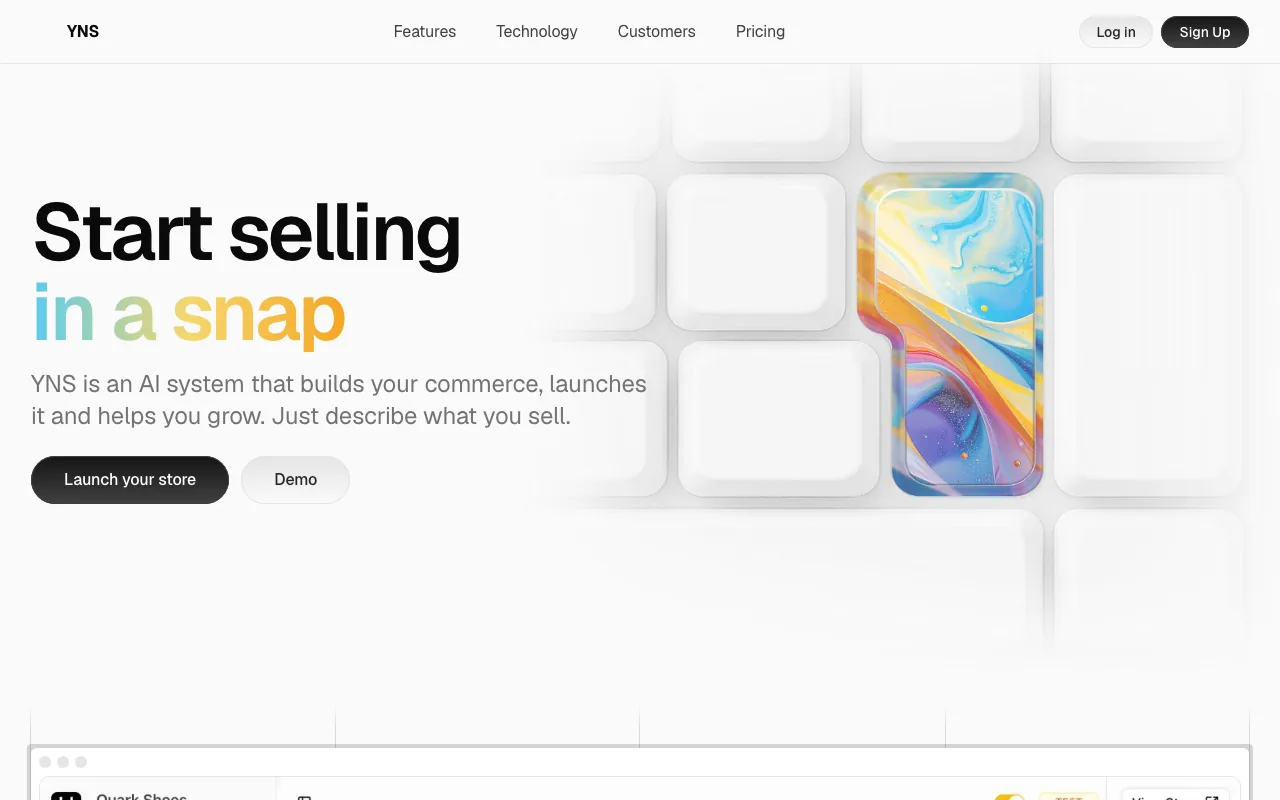
Best for: Founders who want Lovable-style "chat with an AI to build my store" but with products, carts, orders, inventory, and tax handled natively.
Your Next Store is what happens when you start with the commerce engine and add the AI on top, rather than the other way around. Elliot, the AI Builder at /design, is a chat interface, the same shape as Lovable's, except it knows about products, collections, categories, variants, inventory, and the cart. It edits your storefront's React in a Vercel Sandbox, commits to GitHub, and triggers a deploy. The commerce data lives in a managed PostgreSQL backend that you reach through a REST API and the open-source commerce-kit SDK.
Why it beats Lovable for ecommerce:
- Native catalog with variants, collections, categories, attributes, translations, and CSV import.
- Native cart, checkout, orders, refunds, subscriptions, and fulfillment workflows.
- 0% platform transaction fees on every plan (Stripe processing fees still apply).
- Open-source storefront template you can fork on GitHub, so you're never locked into the managed UI.
- Real proof of scale: million.yournextstore.com runs a million products on the platform.
Where it falls short: No free plan. Starter is $30/mo, while Lovable has a free tier (5 daily credits) and a $25/mo Pro plan. Elliot ships fewer raw "design templates" than Lovable for non-commerce sites, because we optimize for stores, not landing pages.
Pricing: Starter $30/mo, Growth $60/mo, Pro $360/mo. See pricing.
2. Bolt.new: Best AI Coder if You're Wiring Commerce Yourself
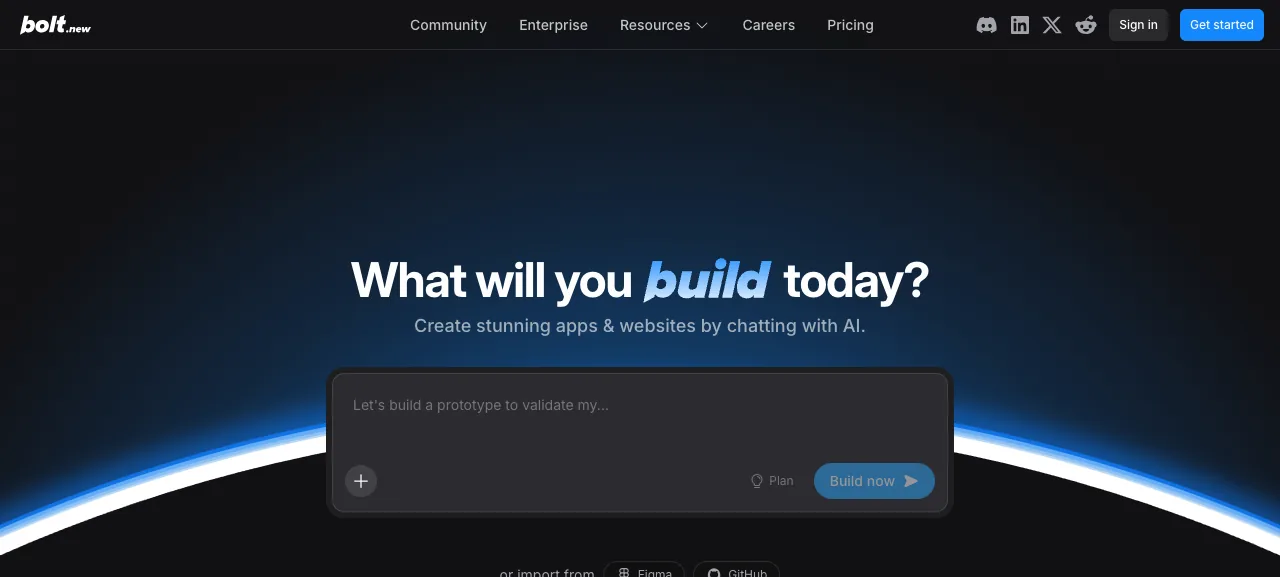
Best for: Developers who want the "prompt-to-running-app" speed of Lovable, with a stronger code editor and more control over the stack.
Bolt.new is the closest like-for-like Lovable competitor in the AI app-builder space. It generates full-stack apps from prompts, runs them in a WebContainer in the browser, and gives you direct access to the file tree. For ecommerce specifically, you'll still be doing the integration work yourself: usually Stripe for payments, Supabase or Neon for the database, and your own product/cart/order schema.
Why people pick it over Lovable: Better code visibility, in-browser terminal, more flexibility on the stack. The community has produced templates for Stripe-based stores (see our Bolt.new ecommerce prompt template for one we maintain).
Where it falls short for ecommerce: No commerce primitives. You will build (or import) a product catalog, cart logic, and order management from scratch or by gluing together libraries. Fine for a developer who enjoys this. Not fine for a non-technical founder who just wants to sell things.
Pricing: Free tier (1M tokens/mo). Pro $25/mo (10M tokens). Teams $30/user/mo.
3. v0 by Vercel: Best for UI Generation, Not Full Apps
Best for: Developers who already have a backend and want AI to scaffold the storefront UI quickly.
v0 generates React components and full pages styled with shadcn/ui and Tailwind. It's narrower than Lovable on purpose: it doesn't try to be your hosting, your backend, or your deploy pipeline. For ecommerce, the typical pattern is to use v0 to generate product cards, cart drawers, and checkout pages, then drop them into a Next.js project that talks to Vercel Commerce, Shopify, or YNS.
Why it beats Lovable for ecommerce UI: Output quality is consistently high. The shadcn/Tailwind aesthetic matches what most modern stores already use. You get clean components instead of an opinionated app.
Where it falls short: It is not a builder, it's a component generator. You need a developer to take the output and integrate it. There is no admin dashboard, no commerce backend, no products, no orders.
Pricing: Free tier ($5 in monthly credits). Premium $20/mo. Team $30/user/mo.
4. Cursor and Claude Code: Best for Developers Who Want Full Control
Best for: Engineers building a custom ecommerce stack who want AI pair-programming inside a real IDE.
Cursor and Claude Code are not website builders. They're AI-powered code editors that sit on top of your existing repo. For ecommerce, the typical setup is: fork an open-source storefront (Vercel Commerce, Medusa Next.js Starter, or the YNS storefront), open it in Cursor, and tell the AI what to build.
Why it beats Lovable for ecommerce: No black box. The agent works inside your codebase, your CI, your deploys, your testing. You can run the project for ten years without depending on a single vendor staying alive.
Where it falls short: You need to be a developer or hire one. There is no admin dashboard, no managed hosting, no in-app preview. The AI helps you write code; you still ship the product.
Pricing: Cursor $20/mo. Claude Code from $20/mo (included in Claude Pro / Max plans).
5. Shopify with Sidekick: The Mature, Conventional Choice

Best for: Founders who want the most mature commerce platform on earth and are happy with theme-based design rather than AI-generated custom code.
Shopify is not an AI builder, but it ships two flavors of built-in AI: Shopify Magic (embedded tools for generating product descriptions, marketing copy, and product imagery) and Sidekick (a conversational assistant that answers questions and runs multi-step admin tasks across your store data). For most non-technical merchants, Shopify is still the path of least resistance to a working store. We've written extensively about its tradeoffs in Next.js vs Shopify and Shopify vs WooCommerce.
Why it's still a real option: App ecosystem, payment coverage, multi-channel selling, hardware POS, the works. Magic and Sidekick together cover the admin-side AI workflow Lovable can't touch.
Where it falls short: No AI-generated custom storefront. Your design lives inside a theme, and customization beyond what the theme allows means hiring a Shopify dev or going headless. Higher transaction fees than YNS unless you use Shopify Payments.
Pricing: Basic $39/mo, Grow $105/mo, Advanced $399/mo, plus transaction fees on third-party payment processors. A $5/mo Starter plan also exists for social-only selling.
6. Medusa: Open-Source Headless, No AI Builder
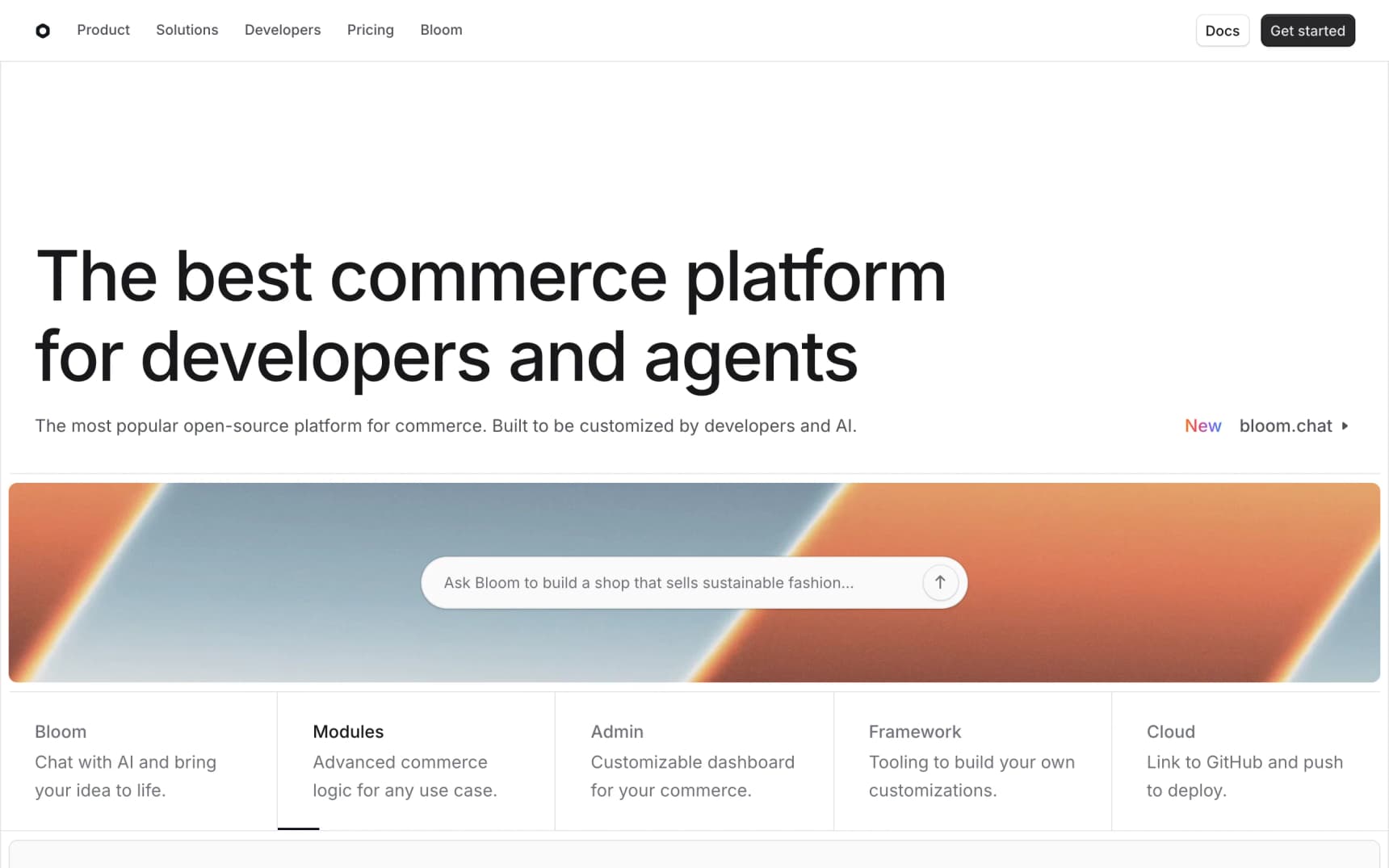
Best for: Developers who want a fully open-source commerce engine and are willing to host it themselves (or use Medusa Cloud).
Medusa is a Node.js commerce engine you self-host (or run on Medusa Cloud, which went self-serve in 2026). It has a real product catalog, cart, order, and fulfillment system, plus a separate admin dashboard. There is no AI builder; you write the storefront yourself or use the Next.js starter and pair it with Cursor/v0 for AI assistance.
Why it beats Lovable for ecommerce: Actual commerce primitives. Fully open-source. You own the database, the API, and the deploy.
Where it falls short: No AI builder. Self-hosting takes infra work (Cloud removes that, but at a price). No admin templates as polished as Shopify's.
Pricing: Free (self-hosted). Medusa Cloud: Develop from $29/mo, Launch from $99/mo, Scale from $299/mo.
7. Replit Agent: Full-Stack AI, Still No Commerce Primitives
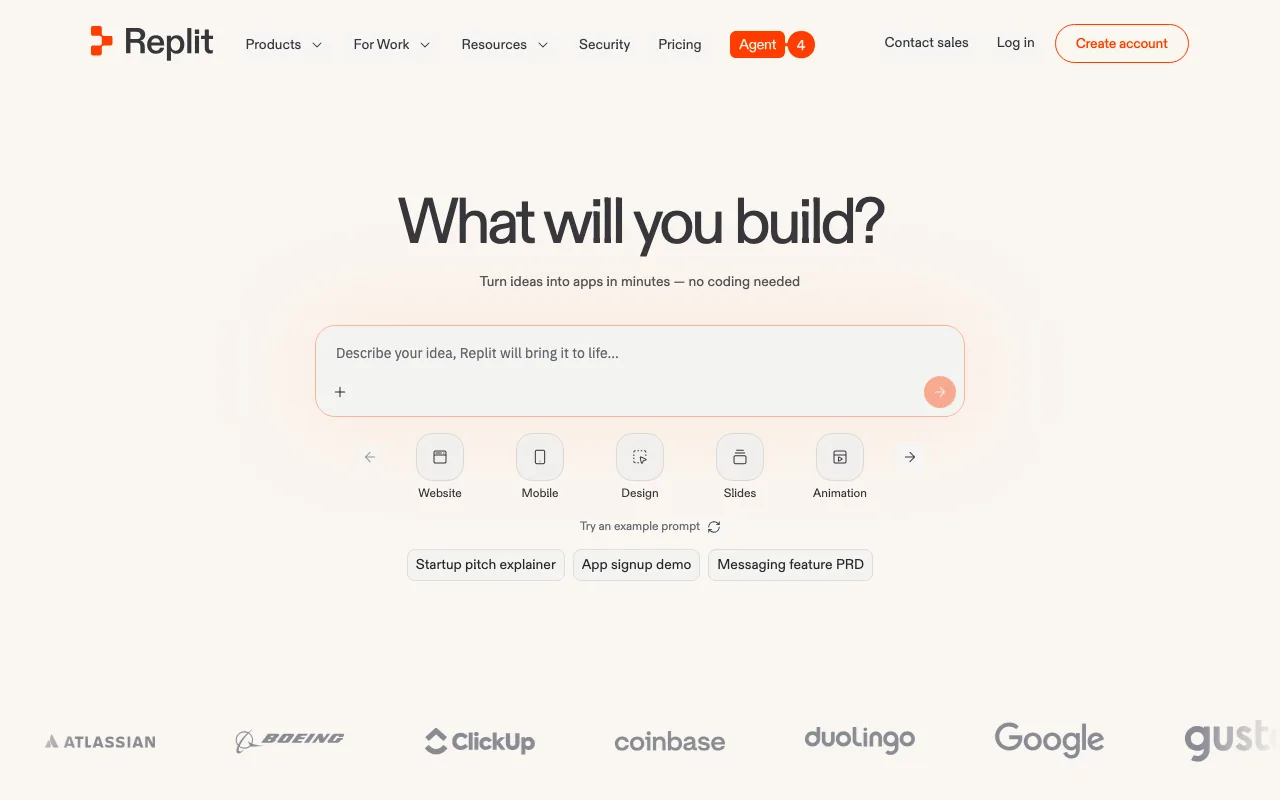
Best for: Builders who want a full cloud IDE plus AI generation, and are willing to assemble commerce themselves.
Replit Agent generates full-stack apps end-to-end and runs them inside Replit's cloud workspace. Compared to Lovable, you get more developer surface area (a terminal, package management, databases, deploys) but the same fundamental gap for ecommerce: no native catalog, cart, or order system. You'd typically wire Replit Agent's output to Stripe directly or to a headless backend like Medusa or YNS via the API.
Why people pick it over Lovable: Genuinely full-stack output, persistent cloud environment, multiplayer collaboration, faster iteration on backend code.
Where it falls short: Same as Bolt for ecommerce: you're rebuilding catalog and cart logic each time, or gluing to a backend.
Pricing: Free tier. Replit Core $20/mo annual ($25/mo monthly), includes $25 of credits. Agent operations billed at $0.25 per checkpoint, which can exceed your monthly credits quickly.
What Nobody Tells You
Every comparison post lists features. Here are the gotchas you only find after a week of building:
Lovable + Shopify: Your Lovable account email and the Shopify store owner email have to match exactly. Sign up for Lovable with you@gmail.com and own the Shopify store from team@company.com and you'll hit a "verification required" screen with no obvious escape. It's the most common support ticket on the integration.
Bolt.new: Bolt runs your project inside a WebContainer in the browser, which doesn't support every Node API. Stripe webhook patterns that work locally fail in the preview environment, and you'll discover this the day before launch. Plan to host outside Bolt for anything that touches webhooks.
v0: The components v0 generates import from shadcn/ui, but v0 doesn't run npx shadcn add button for you. Paste a generated component into a fresh Next.js project and TypeScript errors light up until you install every shadcn dependency by hand.
Cursor / Claude Code: Large monorepos overflow the context window. The agent will confidently rewrite a server action that imports from a file it can't see, then introduce a regression you don't catch until production. The fix is aggressive .cursorignore / context hints, which most teams set up only after the first incident.
Shopify: The "$5/mo Starter plan" only sells through social channels and links, not a full storefront. If you read "$5/mo Shopify" and assumed full ecommerce, that plan won't do what you think it will.
Medusa: Self-hosting is free, but production-grade self-hosting (Postgres, Redis, file storage, observability, security patches) is a part-time DevOps job. Medusa Cloud is now self-serve and starts at $29/mo if you want to skip that work.
Replit Agent: Agent operations are billed at $0.25 per checkpoint, regardless of whether they succeed. A bug fix that takes the agent 20 checkpoints to land costs you $5 even before you've shipped anything.
Your Next Store (bias check): YNS bills AI usage in credits per plan (25 / 100 / 500). A heavy design week can burn through your Starter credits in a day, after which Elliot rate-limits you. Pricier than Lovable for casual use, fairer if you're shipping every week.
Comparison Table
| Tool | AI Builder | Native Commerce | Open Source | Starting Price |
|---|---|---|---|---|
| Your Next Store | Yes | Yes (catalog, cart, orders, inventory, tax) | Storefront only | $30/mo |
| Lovable | Yes | No (bolts on Shopify/Stripe) | No | Free / $25/mo Pro |
| Bolt.new | Yes | No | No | Free / $25/mo Pro |
| v0 | UI only | No | No | Free / $20/mo |
| Cursor | IDE-based | No | No | $20/mo |
| Shopify | Magic + Sidekick | Yes | No | $39/mo (Basic) |
| Medusa | No | Yes | Yes (full stack) | Free / Cloud $29/mo |
| Replit Agent | Yes | No | No | $20/mo annual |
The Real 12-Month Cost
Every alternatives post compares monthly subscription prices. Almost none do the actual math for a working store. Here it is for a hypothetical store doing $10,000/mo in revenue (small DTC brand, 50 SKUs, modest traffic), over a full year:
| Stack | Subscriptions | Transaction fees | Hosting | Year 1 total |
|---|---|---|---|---|
| YNS Starter | $30/mo × 12 = $360 | 0% platform (Stripe 2.9% + 30¢ only) | Included | ~$360 + Stripe fees |
| Lovable Pro + Shopify Basic | ($25 + $39) × 12 = $768 | Shopify 2.0% on third-party PSP, or Shopify Payments included | Included | ~$768 + processing |
| Bolt Pro + Stripe direct + Vercel | ($25 + $20) × 12 = $540 | Stripe 2.9% + 30¢ only | Vercel Hobby free or Pro $20/mo | $540–$780 + Stripe fees |
| Cursor + Medusa Cloud Develop | ($20 + $29) × 12 = $588 | Stripe 2.9% + 30¢ only | Cloud included; storefront on Vercel | $588 + Stripe fees |
| Shopify Basic alone | $39 × 12 = $468 | 2.0% on third-party PSP, or Shopify Payments | Included | ~$468 + processing |
A few things this makes obvious that the headline-price comparisons hide:
- YNS undercuts Lovable + Shopify by ~$400/yr despite costing more on the sticker, because there's no second subscription.
- Shopify alone is the cheapest "managed everything" path if you don't care about AI-generated custom design. The premium for AI is real.
- Bolt + Stripe direct looks cheap on paper but doesn't include the cost of you rebuilding cart, inventory, and tax. If you cost out engineering time, this stack only wins for developers.
For higher revenue tiers, Shopify's transaction fees scale linearly while YNS stays flat, which is why our Shopify transaction fees breakdown recommends YNS or WooCommerce alternatives once you cross ~$50k/mo.
How to Choose
Three questions decide this for almost everyone:
1. Are you a developer or a founder who can't code?
If you can code, Bolt.new, v0, Cursor, and Medusa all become serious options. If you can't, the field narrows to YNS, Lovable, Shopify, and Wix.
2. Do you want one platform that handles design AND commerce, or are you OK gluing two together?
YNS, Shopify, and Wix handle both in one place. Lovable + Shopify, Bolt + Stripe, and v0 + Vercel Commerce mean two control surfaces, two subscriptions, and one extra integration to maintain.
3. How much will you change after launch?
If you'll edit your storefront weekly (new categories, new promos, new design), an AI builder that integrates with your commerce data (YNS) saves real time. If you'll set it and forget it, Shopify or Wix is fine.
A Note on Other "Lovable Alternatives" Lists
Most of the articles that rank for "Lovable alternatives" today list Bubble, Webflow, Squarespace, and Wix. Those are real products, but calling them Lovable alternatives is misleading. They're not AI app builders; they're conventional no-code site builders, which is a different category entirely. We've left them out of this list except where the comparison is genuinely useful (Shopify, because of Magic + Sidekick). The closest direct peer to Lovable in the AI app builder space is Base44, now owned by Wix; we've broken down Base44 alternatives for ecommerce separately, since the same "great app builder, not a store" gap applies.
If you want a deeper look at the no-code/AI site-builder space, see our Best AI Store Builders post.
The Bottom Line
Lovable can build the storefront in ten minutes. Then you spend the next ten months building everything it doesn't: the catalog, the cart, the orders, the inventory, the taxes, the refunds, the discounts, the shipping, the customer accounts, the admin. That's not an AI win. That's an AI demo with a long invoice underneath.
The honest version: AI is great at the part of ecommerce that's already easy (UI). Pick a stack where AI is also good at the part that's hard (commerce), and spend the saved months on what only you can build, your products, your brand, your customers.
FAQ
Can Lovable build a real ecommerce store?
Lovable can generate a storefront UI and connect it to Shopify or Stripe via the integration. It does not include a native product catalog, cart, order, or inventory system. For a working store, you'll always be pairing Lovable with a separate commerce backend.
What's the cheapest Lovable alternative for ecommerce?
Self-hosted Medusa is technically free, but you'll pay for hosting and maintenance. The cheapest managed option with AI + native commerce is Your Next Store Starter at $30/mo, which includes 0% transaction fees, 25 AI credits, and a custom domain.
Is YNS a Lovable competitor?
For ecommerce, yes. Both let you describe a store in a chat box and have an AI generate the storefront. The difference is that YNS includes the commerce backend (products, cart, orders, inventory) as part of the platform, while Lovable expects you to bolt on Shopify or Stripe for the commerce layer.
Can I use Lovable and YNS together?
You can. The pattern is to use Lovable for marketing pages or landing pages, and use YNS for the actual store. The YNS storefront is also fully customizable in code, so if you want one builder doing everything, YNS handles both ends.