AI Ecommerce: The Two Revolutions Nobody's Connecting
 Jakub Neander
Apr 3, 202610 min read
Every article about AI in ecommerce tells the same story: AI helps you write product descriptions, personalize recommendations, and answer customer questions. That story is real but boring. The interesting one is happening underneath it. Two parallel revolutions are restructuring who can sell online and how buyers find what they need. One is about AI agents that shop. The other is about AI agents that build. Most people only see the first.
Bias disclosure: We build Your Next Store, an e-commerce platform with an AI-powered store builder. We're deep in the "AI that builds" side. We'll flag where our experience colors the analysis.
Revolution 1: AI That Shops
Google's "Buy for me" feature lets AI agents complete purchases on your behalf. ChatGPT browses stores and handles checkout through Instant Checkout. Perplexity Shopping compares products across retailers and processes transactions. Visa and Mastercard are building payment rails for agent-to-agent commerce. JPMorgan published a framework for it.
This isn't next year's problem. Traffic from generative AI sources to retail sites grew 1,300% year-over-year in the 2024 holiday season, according to Adobe. McKinsey projects AI agents will mediate $3 to $5 trillion in online commerce by 2030. 39% of shoppers already use AI in their purchase journey, and that number hits 54% for Gen Z.
What This Means for Your Store
An AI agent doesn't see your homepage. It doesn't admire your hero banner or feel your brand's vibe. It reads your structured data, queries your API, compares your product attributes against competitors, and makes a decision in milliseconds.
The stores that AI agents recommend will be the ones with:
Rich structured data. Most stores expose 5-8 product attributes in their Schema.org markup. AI agents need 20-30+ to make confident recommendations. The difference:
Clean APIs. Agents interact with stores through APIs, not browsers. If your product data, inventory, and checkout are only accessible through rendered web pages, agents can't use them. Modern frameworks like Next.js produce API layers alongside your pages. Platforms that render everything server-side and rely on session-based browsing are at a structural disadvantage.
Open crawler access. Check your robots.txt right now. If GPTBot, ClaudeBot, and PerplexityBot are blocked, you're invisible to a growing share of potential customers. Consider adding an llms.txt file, the emerging standard for telling AI models about your site's structure. It's part of the same technical foundation as ecommerce SEO, not a separate discipline.
We wrote a full deep dive on preparing for this: Agentic Commerce: What Store Owners Need to Know.
Revolution 2: AI That Builds
This is the one nobody's connecting to the first revolution, and it's the one that changes who can compete.
If AI can autonomously shop for consumers, scanning hundreds of stores, comparing specs, processing payments, it can also autonomously build storefronts for merchants. Same pattern: give an AI agent a goal, provide it with tools, let it execute. The goal is just different. Instead of "find me the best coffee dripper under $50," it's "build me a store that sells handmade ceramics with a warm, minimalist aesthetic."
Why This Matters More Than AI Product Descriptions
Every "AI ecommerce" article talks about AI writing product descriptions, or one of the dozen other point tools catalogued in our AI tools for ecommerce roundup. That saves time. It's useful. It's also a rounding error compared to what AI store builders eliminate.
The biggest barrier to starting an online store was never the monthly fee or the product sourcing. It was the weeks or months of learning a platform, choosing a theme, customizing layouts, configuring settings, wrestling with CSS, debugging checkout flows, and optimizing for mobile. A solo founder who wanted a professional store either learned to code, hired someone, or spent weeks fighting a drag-and-drop builder.
AI store builders compress that to minutes. Not "faster." Categorically different.
The Landscape (Honest Assessment)
Not all AI store builders work the same way. The differences matter: we broke down the full landscape in our guide to the best AI store builders.
| Builder | What the AI does | Depth of control |
|---|---|---|
| Your Next Store | Full ecommerce platform with Elliot, the AI Builder. Chat with AI to design your storefront, it writes real Next.js code and deploys. | High: AI works in the actual codebase, not templates. (Bias: this is us.) |
| Genstore | AI platform that generates full stores with dedicated agents for design, products, and marketing. (We compared it to the closest alternatives.) | Medium-High: capable, but proprietary platform. |
| BuildYourStore.ai | Generates complete Shopify dropshipping stores with products and apps pre-installed. | Medium: full generation, but dropshipping-focused. |
| Shopify Sidekick | AI assistant inside Shopify admin. Writes descriptions, generates images, helps with campaigns. | Low: assists your workflow, doesn't build stores. |
The key differentiator is what the AI has access to. An AI that operates within a template system can swap colors and fonts. An AI that operates within a full codebase can make architectural decisions: "this product category needs a comparison table, not a grid," or "the mobile checkout should show a sticky cart summary."
For context on the underlying platform differences, see Next.js vs Shopify: An Honest Take.
The Catch
AI builders produce generic results without strong direction. The prompt matters enormously.
"Build me a store" gives you a generic store. Every time.
"Build me a store that sells Japanese kitchen knives. The target customer is a home cook who cares about craftsmanship. Each product page needs steel composition details, a comparison with similar knives, and close-up photography of the blade edge. The homepage should lead with a single hero knife, not a grid. Shipping is from Seki, Japan, 7-14 days." That gives you something worth using.
The skill isn't learning the platform anymore. It's learning to brief an AI well. That's a lower bar, but it's still a bar.
Why These Two Revolutions Are Connected
Here's what nobody else is writing about: these two revolutions aren't parallel. They're converging.
If AI agents are going to mediate trillions in commerce, the stores they recommend need to be built for agent consumption: rich structured data, clean APIs, machine-readable everything. The old way of building stores (pick a pretty theme, write some marketing copy, hope people find you on Google) doesn't work in a world where the "customer" is an algorithm reading your JSON-LD.
AI store builders that understand this can produce agent-ready stores by default. They generate the structured data, expose the API endpoints, configure the crawler access, and set up the product feeds as part of the build process. A merchant doesn't need to know what Schema.org is. The AI does.
This creates a flywheel:
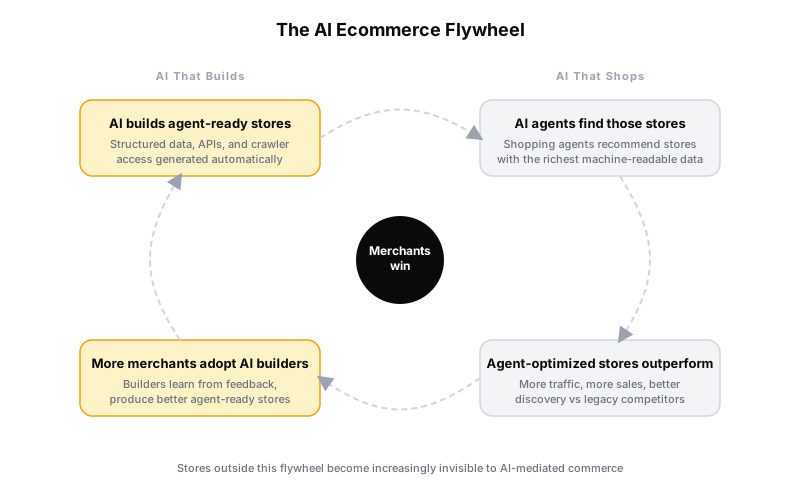
The merchants who don't enter this flywheel, the ones on legacy platforms with thin product data and no API access, become increasingly invisible to the growing share of commerce that AI agents mediate.
What to Do About It
If you already have a store: Start with structured data. Run Google's Rich Results Test on your product pages. Count your machine-readable attributes. If it's under 15, you have work to do. Then check your robots.txt for blocked AI crawlers. These two actions take an afternoon and have more impact than any AI tool you could buy.
If you're starting a new store: Choose a platform that's agent-ready by default. That means structured data generated automatically, a real API (not just rendered pages), and architecture that AI crawlers can parse. This matters more than the theme gallery.
If you're a developer or technical founder: The open-source angle is underrated. When AI agents mediate all product discovery, your platform's openness becomes strategic. You can implement new agent protocols the day they launch instead of waiting for your platform vendor's roadmap. (See Open Source Shopify Alternatives for Developers for the full landscape.)
Your Next Store
We built Your Next Store around both revolutions.
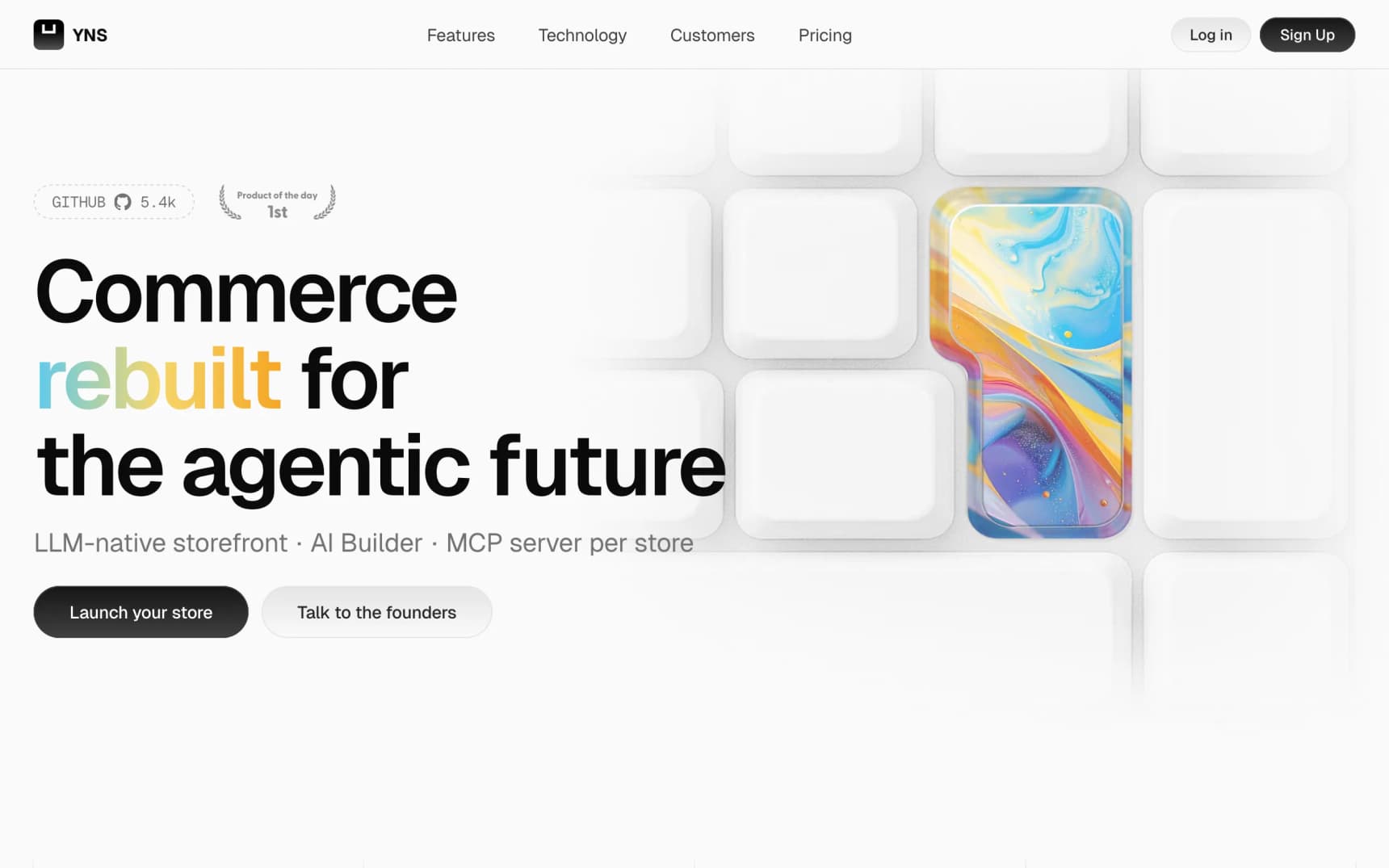
The AI store builder is the merchant-side revolution in practice. Describe what you want, watch an AI agent design, code, and deploy your store in a live preview. It has access to the full Next.js codebase, not a template picker. (See it in action: Design an E-Commerce Store in 15 Minutes.)
Every store it builds is agent-ready by default: JSON-LD structured data on all pages, a REST API for products, carts, orders, collections, and inventory, and a Next.js architecture that AI crawlers parse efficiently.
And the storefront template is fully open source. Add custom agent endpoints, implement new commerce protocols, extend the structured data schema. Don't wait for a platform update.
Build an agent-ready store today. Spin up an AI-built, open-source Next.js storefront in minutes.
Star the repo on GitHub: github.com/yournextstore/yournextstore
FAQ
Can AI actually build a good ecommerce store?
Yes. The quality depends on two things: how much access the AI has (template-only vs full codebase) and how specific your brief is. A detailed prompt with clear audience, product details, and design preferences produces a store that would take a human developer days. A vague prompt produces a generic template.
Is the "AI shopping agent" thing real or just demos?
Real and accelerating. Google, OpenAI, Perplexity, Visa, Mastercard, and JPMorgan are all investing in agent commerce infrastructure. The protocols exist (UCP, ACP, A2A, MCP). The volume is still small relative to traditional search, but AI-sourced traffic grew 1,200% year-over-year. The trajectory is clear.
What's the single most important thing I can do right now?
Enrich your structured data. Everything else, AI crawlers, APIs, product feeds, matters, but structured data is the foundation. If AI agents can't read your product attributes, nothing else helps.