Agentic Commerce: What Store Owners Need to Know
 Jakub Neander
Apr 3, 202612 min read
McKinsey projects that AI agents will mediate $3 to $5 trillion in online commerce by 2030. AI-sourced retail traffic grew 1,300% year-over-year in the 2024 holiday season alone. If your store isn't ready for agentic commerce, you're not just behind on a trend: you're invisible to a growing share of buyers who will never visit your homepage.
Every major article about agentic commerce focuses on one side of the story: AI that shops for consumers. But there's a second side nobody's talking about: AI that builds and manages stores for merchants. Both sides are part of the same shift, and both matter for your business.
Bias disclosure: We build Your Next Store, an e-commerce platform with an AI-powered store builder. We'll flag where our experience colors the analysis. If we get something wrong, tell us on GitHub.
What Is Agentic Commerce?
Agentic commerce is what happens when AI agents can autonomously act on behalf of humans in commercial transactions. Not chatbots that answer FAQs. Not recommendation engines that suggest products. Agents that can browse, evaluate, negotiate, purchase, return, and reorder without human intervention at every step.
The difference from traditional e-commerce AI:
| Traditional E-commerce AI | Agentic Commerce | |
|---|---|---|
| Role | Assists humans | Acts for humans |
| Scope | Single task (recommend, search) | End-to-end workflows |
| Decision-making | Suggests options | Makes choices |
| Integration | Within one platform | Across platforms and stores |
| Examples | "You might also like..." | "I found, compared, and bought the best option for you" |
This isn't speculative. Google's "Buy for me" feature lets AI agents complete purchases on your behalf. ChatGPT can browse stores and place orders through Instant Checkout. Perplexity Shopping already compares products across retailers and handles transactions. Visa, Mastercard, and JPMorgan are building payment rails specifically for agent-to-agent commerce.
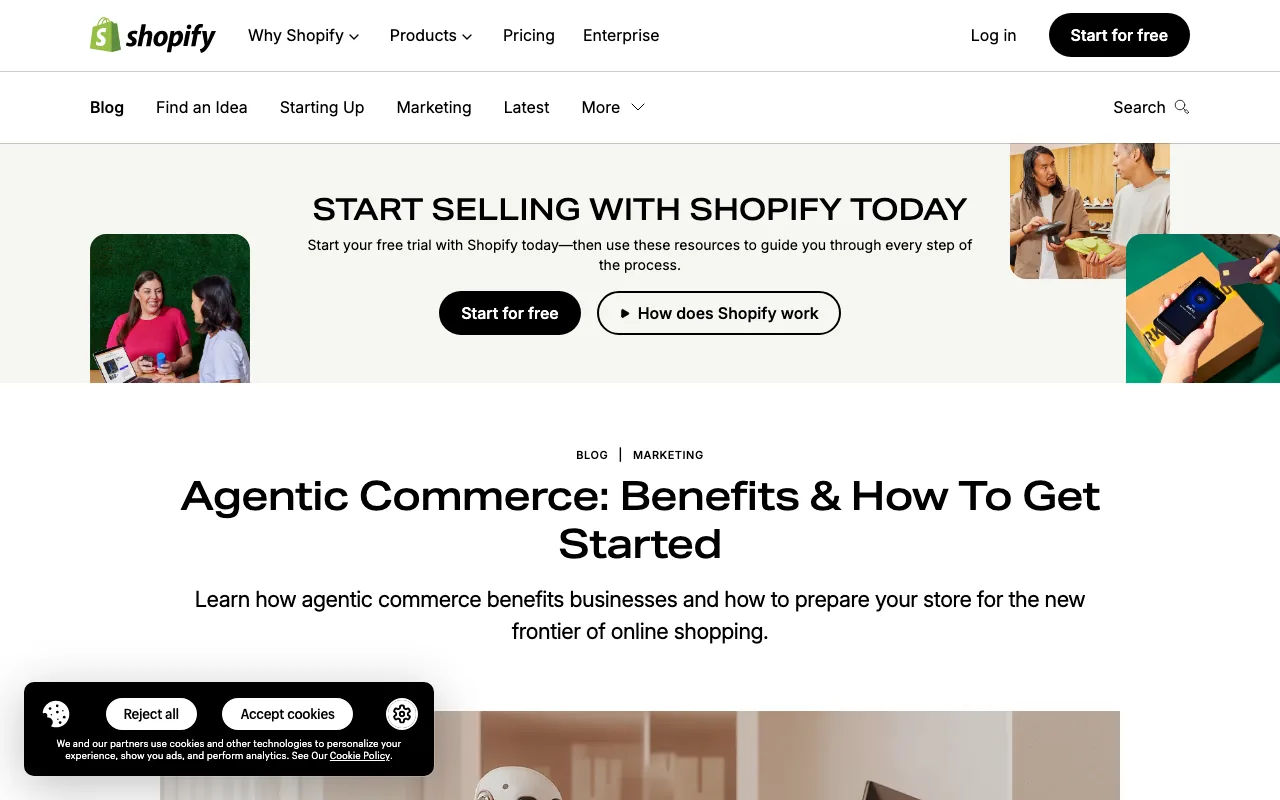
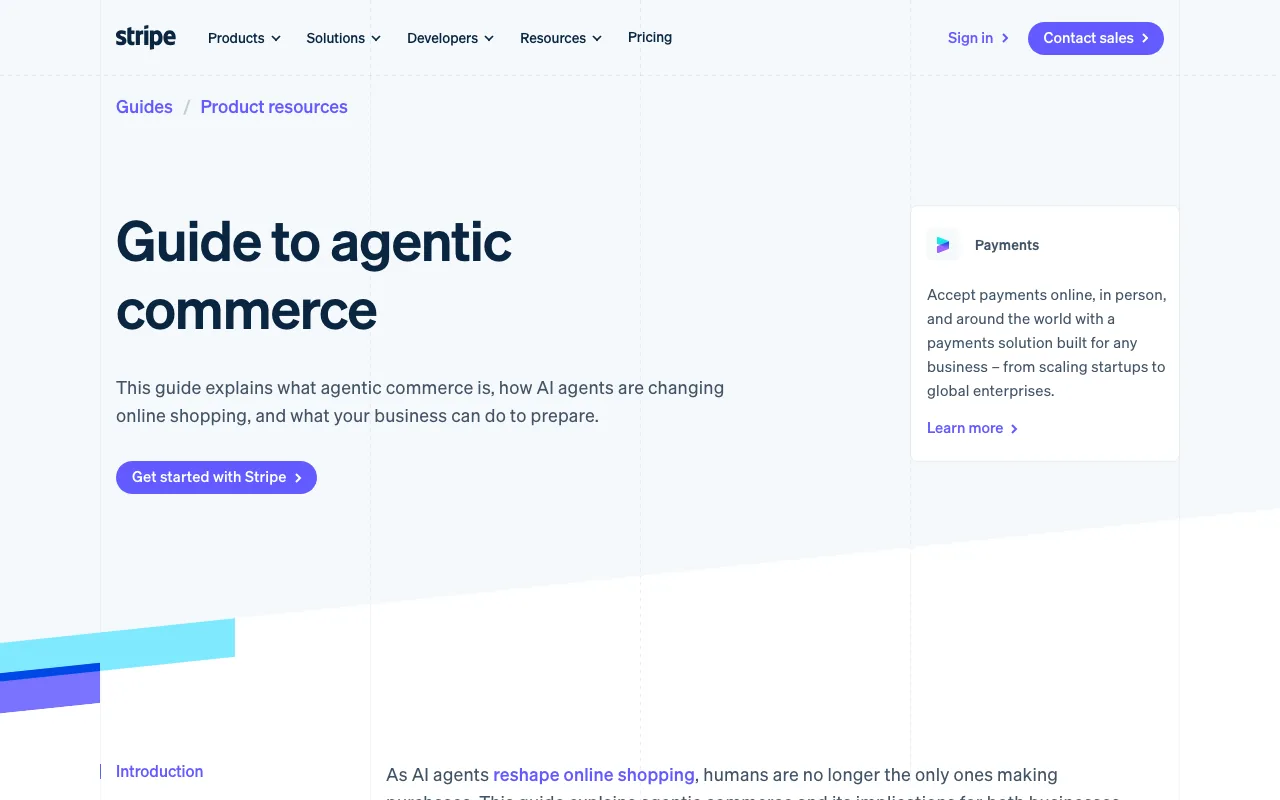
Major platforms have already published comprehensive guides, signaling how seriously the industry is taking this shift.
Why 2026 Is the Inflection Point
Three things converged this year to make agentic commerce real, not theoretical:
Protocols emerged. Google and Shopify co-developed the Universal Commerce Protocol (UCP) with Walmart, Target, and Etsy. OpenAI and Stripe launched the Agent Commerce Protocol (ACP). Google released Agent-to-Agent (A2A). These protocols give AI agents a standardized way to discover products, check inventory, and process payments across stores.
Consumer adoption hit critical mass. 39% of shoppers now use AI in their purchase journey, rising to 54% for Gen Z, according to Salesforce. That number was under 10% two years ago. AI isn't a novelty anymore: it's infrastructure.
The economics work. Deloitte estimates that AI shopping agents reduce customer acquisition costs by 30-40% for stores that are optimized for agent discovery. Stores that aren't optimized see the opposite effect: agents route buyers elsewhere.
How AI Agents Are Reshaping the Shopping Funnel
The traditional funnel (discover, evaluate, purchase, retain) still exists, but agents compress it dramatically.
Discovery: From Search to Agent-Mediated Recommendations
In traditional e-commerce, discovery means SEO, paid ads, and social media. In agentic commerce, discovery means an AI agent scanning hundreds of stores in seconds, comparing prices, reading reviews, and checking shipping times.
Your store's homepage design doesn't matter to an agent. What matters is your structured data: Schema.org markup, clean product feeds, machine-readable inventory, and well-organized API endpoints. An agent can't "see" your beautiful hero banner. It reads your JSON-LD.
Evaluation and Purchase: Structured Data Over Storefront Browsing
When a human shops, they browse product pages, read descriptions, zoom into images, and compare tabs. An agent skips all of that. It pulls structured product attributes (dimensions, materials, compatibility, shipping speed, return policy) and compares them programmatically.
The problem: most stores provide 5 to 8 structured product attributes. AI agents need 30 or more to make confident recommendations. If your product data is thin, agents will recommend competitors with richer data, even if your product is better.
Post-Purchase: Automated Returns, Reordering, and Loyalty
Agents don't just buy. They track shipments, initiate returns when products don't match expectations, set up reorder schedules for consumables, and aggregate loyalty rewards across stores. The post-purchase experience becomes a competitive differentiator because agents remember everything and optimize relentlessly.
The Other Side: AI That Builds and Manages Stores
Every competitor article about agentic commerce misses this: AI agents aren't just changing how people shop. They're changing how stores get built and operated.
Think about it. If AI can autonomously shop for consumers, it can also autonomously build storefronts for merchants. The same agentic pattern applies: give an AI agent a goal ("build me a store that sells handmade ceramics"), provide it with tools (code editor, design system, deployment pipeline), and let it execute.
This is already happening:
AI Store Builders
Instead of hiring a developer or spending weeks learning a platform, a merchant describes what they want in natural language. An AI agent designs the layout, writes the code, configures the products, optimizes for SEO, and deploys. The merchant reviews, gives feedback, and the agent iterates.
This isn't a template picker with AI sprinkled on top. It's an autonomous agent with access to the full codebase, making real architectural decisions: choosing component layouts, configuring responsive breakpoints, writing product descriptions, generating structured data.
AI-Powered Store Operations
Beyond building, AI agents handle ongoing operations:
- Product catalog management: generating descriptions, optimizing images, setting pricing based on competitor analysis
- Content creation: writing blog posts, social media copy, and email campaigns
- Customer service: handling inquiries with context about order history, inventory, and policies
- Analytics: identifying trends, flagging issues, suggesting optimizations
The merchant-side of agentic commerce is arguably more impactful than the consumer-side. Consumer agents affect how buyers find you. Merchant agents affect whether you can even compete. We go deeper on this specific shift, including which of these tasks are safe to hand over today and which still need a human, in how AI is replacing ecommerce admin panels.
Making Your Store Agent-Ready
Whether agents are shopping for your customers or building your store, the technical requirements converge on the same principles.
Structured Data and Schema.org
This is the single highest-impact thing you can do today. AI agents rely on structured data to understand your products.
Notice the depth: material, weight, shipping times, additional properties. This is what separates a store that agents recommend from one they skip.
API-First Architecture
Agents interact with stores through APIs, not browsers. If your product data, inventory, and checkout are only accessible through a rendered webpage, agents can't use them efficiently.
A headless or API-first architecture exposes clean endpoints that agents can call directly:
GET /api/productswith filtering, sorting, and paginationGET /api/products/:idwith full structured attributesPOST /api/cartfor programmatic cart managementPOST /api/checkoutfor agent-initiated purchases
Stores built on modern frameworks like Next.js naturally produce these API layers. Platforms that render everything server-side and rely on session-based browsing are at a structural disadvantage.
Machine-Readable Product Feeds
Beyond Schema.org on your pages, agents consume product feeds: Google Merchant Center, Facebook Product Catalog, and increasingly, direct API integrations. Keep your feeds current, complete, and rich with attributes. Stale or sparse feeds mean agents work with outdated or incomplete information.
The Protocols You Should Know About
Four protocols are shaping how agents and stores communicate:
| Protocol | Backed By | Purpose |
|---|---|---|
| UCP (Universal Commerce Protocol) | Google, Shopify, Walmart, Target, Etsy | Standard for product discovery, inventory, and checkout across stores |
| ACP (Agent Commerce Protocol) | OpenAI, Stripe | Secure payment and identity for agent transactions |
| A2A (Agent-to-Agent) | Agents communicating with other agents (e.g., shopping agent talks to shipping agent) | |
| MCP (Model Context Protocol) | Anthropic | Standard for AI models to interact with external tools and data sources |
These protocols are early but moving fast. The implication for store owners: the stores that adopt these standards first will be the ones agents find first. It's the same dynamic as early SEO adoption in the 2000s. For a developer-level walkthrough of the MCP side of this stack, see our guide to MCP servers for ecommerce.
Why Open Source Matters in an Agentic World
A perspective missing from the enterprise-focused articles about agentic commerce: when AI agents mediate all product discovery, your platform's openness becomes a strategic decision.
On a proprietary platform, your store's agent-readiness depends on when and how the platform decides to implement agent protocols. You can't add custom API endpoints, modify structured data schemas, or integrate with new agent protocols ahead of the platform's roadmap.
With an open-source or developer-first architecture, you control the integration points. You can implement UCP endpoints, add rich Schema.org markup, expose custom API surfaces, and adopt new protocols the day they launch. In a world where agent compatibility is a competitive advantage, that flexibility matters.
This isn't anti-platform: Shopify's Agentic Storefronts are impressive, and their UCP work benefits the entire ecosystem. But if you're a developer or technical founder, you should understand the trade-off between convenience and control, especially when the rules of discovery are being rewritten in real time.
Your Next Store and Agentic Commerce
We built Your Next Store as an AI-native e-commerce platform before "agentic commerce" was a buzzword.
The AI store builder is merchant-side agentic commerce in practice. You describe what you want in a chat interface, and an AI agent designs, codes, and deploys your storefront. It has access to the full codebase: layout components, styling, product configuration, SEO settings. It makes real architectural decisions, and you review the results in a live preview.
This is fundamentally different from a drag-and-drop builder with AI suggestions. (See our walkthrough: Design an E-Commerce Store in 15 Minutes.) The agent operates autonomously within your codebase, the same pattern as a consumer agent operating autonomously across stores.
On the consumer side, YNS stores are agent-ready by default:
- Structured data: JSON-LD Schema.org markup generated automatically for all products, collections, and pages
- API-first: REST API with endpoints for products, carts, orders, collections, categories, search, and inventory
- Modern architecture: Next.js with React Server Components and Partial Prerendering means your content is fast and crawlable
- Open source: the storefront template is fully open, so you can add custom agent endpoints and protocol integrations without waiting for a platform update
Your Next Store is open source. Star the repo on GitHub: github.com/yournextstore/yournextstore
Risks and Challenges
Agentic commerce isn't all upside. Here's what to watch:
Brand erosion. When agents compare products programmatically, brand storytelling loses its edge. An agent doesn't care about your brand narrative. It cares about price, specs, reviews, and shipping speed. Stores that compete on brand alone will struggle in an agent-mediated world.
Price commoditization. Agents are ruthless comparison shoppers. If your product is identical to a competitor's, agents will route buyers to the cheapest option. Differentiation through unique products, better data, and faster shipping becomes critical.
Data privacy. Agents acting on behalf of consumers need access to purchase history, preferences, and payment information. The security and privacy implications are significant, and consumer trust will be earned slowly.
Agent bias. Which stores do agents recommend? The ones with the best structured data, yes. But also the ones whose platforms have partnerships with agent providers. Store owners need to understand and monitor how different agents discover and rank their products.
Over-reliance on third-party agents. Building your entire acquisition strategy around agent traffic is risky. Agents can change their algorithms, protocols, or preferred data formats. Diversify your discovery channels.
What to Do Now
A practical timeline for preparing your store:
Immediate (This Week)
- Audit your structured data. Run Google's Rich Results Test on your product pages. Count how many product attributes are machine-readable. If it's under 15, you have work to do.
- Check your robots.txt. Make sure AI crawlers (GPTBot, ClaudeBot, PerplexityBot) aren't blocked. These crawlers are how AI agents discover your store.
- Review your product feeds. Are your Google Merchant Center and Facebook Product Catalog feeds current and complete?
Short-Term (This Quarter)
- Enrich your product data. Add detailed attributes: materials, dimensions, compatibility, care instructions, certifications. The more structured data, the more confidently agents recommend your products.
- Implement or verify API endpoints. If your store doesn't have a clean REST or GraphQL API, plan for one. Agent traffic will increasingly come through APIs, not browsers.
- Add an llms.txt file. This emerging standard (similar to robots.txt) tells AI models about your site's structure and content. Learn more about llms.txt.
Medium-Term (This Year)
- Monitor agent traffic. Track how much of your traffic comes from AI agents and which products they recommend. This data will inform your optimization strategy.
- Evaluate your platform's agent readiness. Does your e-commerce platform support UCP, ACP, or similar protocols? If not, consider whether you need to migrate or supplement.
- Consider AI for store operations. The merchant side of agentic commerce can reduce your operational costs. AI-powered product descriptions, automated catalog management, and AI-assisted design are available now.
The Bottom Line
The stores that win in an agentic world won't be the ones with the prettiest homepage. They'll be the ones with the richest data, the cleanest APIs, and the flexibility to adopt new protocols fast. SEO made "be findable by Google" table stakes. Agentic commerce is doing the same for AI. The question isn't whether to prepare. It's whether you'll be ready before your competitors are.
Launch an agent-ready store. YNS ships structured data, a typed REST API, and an open-source Next.js storefront by default.
FAQ
Will agentic commerce replace traditional online shopping?
Not entirely, at least not soon. Agentic commerce will coexist with traditional browsing. High-consideration purchases (luxury goods, custom products, experience-driven brands) will still involve human browsing and brand engagement. Commodity purchases, repeat orders, and comparison-heavy categories will shift to agents fastest.
Do I need to rebuild my store for agentic commerce?
No. The most impactful changes (structured data, API endpoints, product feed enrichment) are additive. You can layer them onto your existing store without a full rebuild. If your current platform makes these changes difficult, that's a signal to evaluate your architecture.
How do AI agents find my store?
Through structured data on your pages (Schema.org), product feeds (Google Merchant Center), API endpoints, and AI crawler indexing. Agents also use commerce protocols like UCP and ACP to discover and interact with stores programmatically. Think of it as SEO for AI: the same principles (be discoverable, be structured, be fast) applied to a new kind of "search engine."