MCP Servers for Ecommerce: The 2026 Developer's Guide
 Michał Miszczyszyn
Apr 22, 202612 min read
In November 2024, Anthropic released the Model Context Protocol. A year and a half later, it's on every major ecommerce platform: Your Next Store exposes a live MCP endpoint at /api/mcp on every store, Stripe runs a remote one at mcp.stripe.com, PayPal rolled out its own in 2025, Shopify ships four official servers, and WooCommerce has community builds that agents use to edit products, refund charges, and print shipping labels. If you're building for agentic commerce in 2026, MCP isn't an optional integration. It's the wire.
Most articles on this topic are catalog dumps: 30 servers, one-line descriptions, no opinion on which are production-ready, which are read-only toys, or how any of this fits with UCP, ACP, and the other three-letter acronyms that landed last quarter. This one's the guide we wish we'd had when we started shipping MCP for our own store.
Bias disclosure: We build Your Next Store, a Next.js-based commerce platform with an AI-powered store builder. We'll flag where that colors the analysis. If we get something wrong, tell us on GitHub.
What Is an MCP Server, and Why Do You Care?
The Model Context Protocol (MCP) is an open standard Anthropic introduced in November 2024. It gives AI models a shared way to discover and invoke external tools instead of every agent framework reinventing its own adapter. An MCP server is the thing on the other end of that wire: it exposes capabilities (tools, resources, prompts) that any MCP-speaking client (Claude, Cursor, ChatGPT, your own agent) can call.
For ecommerce, that means a merchant can let an agent run their backend, a shopping agent like ChatGPT can call your storefront directly, and a developer can compose agents across catalog, payments, shipping, and analytics without writing a client per system. MCP matters because Google, OpenAI, Microsoft, Anthropic, and every major commerce platform shipped it. Consensus on a protocol is rare; it's why MCP is where the agentic commerce work is actually happening in 2026.
MCP vs UCP vs ACP vs A2A: The Protocol Stack
If you're confused by the acronym soup, you're not alone. Here's how the four protocols relate:
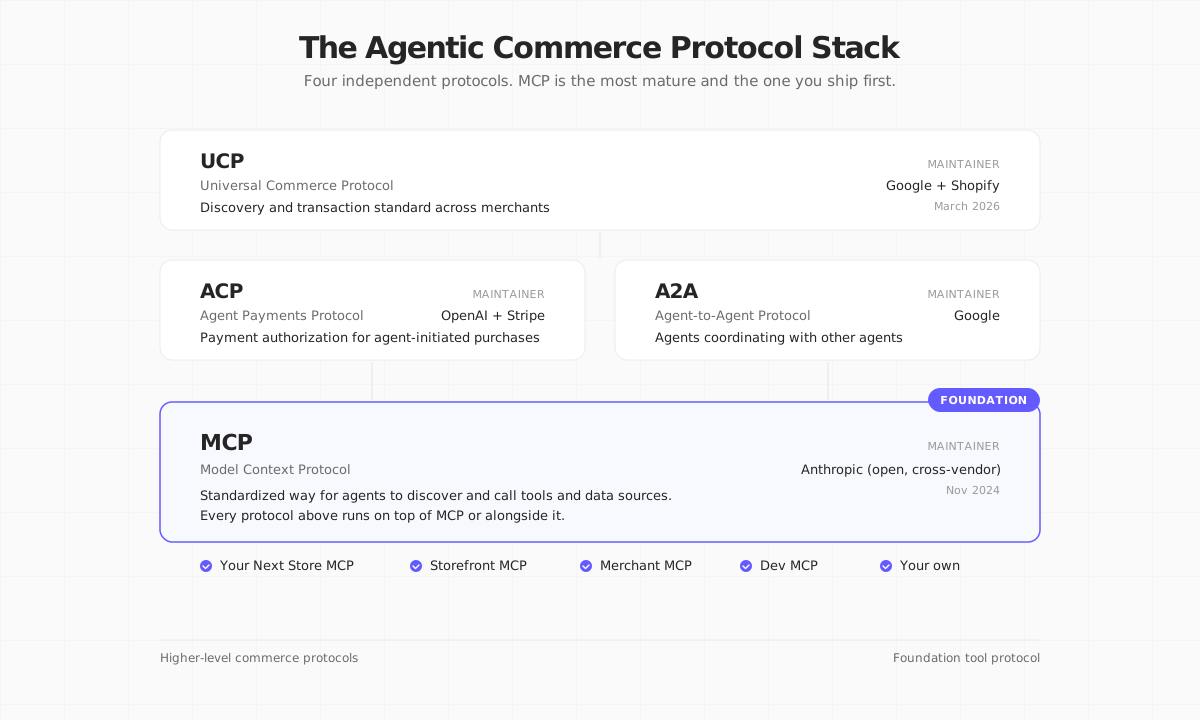
The four protocols are independent but complementary. MCP is the most mature: a tool-calling primitive that any agent can use to invoke any capability. UCP layers a commerce-specific vocabulary on top (and uses MCP as one of its transports). ACP handles payment authorization when an agent decides to transact. A2A coordinates between agents once multiple agents are involved in the same workflow.
In practice, MCP is the one you'll ship first. The others assume an agent ecosystem that's still forming.
Two Sides of MCP for Ecommerce
Every ecommerce MCP server falls into one of two categories, and conflating them is the most common mistake in articles on this topic.
Consumer-side MCP is what a shopping agent calls when a user says "find me a pour-over dripper under $50 and buy it." It's scoped to one store, read-heavy with cart writes, authenticated per customer session, and tuned for agent-readability. This is what ChatGPT and Perplexity actually hit.
Merchant-side MCP is what Claude Desktop calls when a solo operator says "refund the last 10 orders from France due to the shipping delay." It's scoped to a merchant account, write-heavy with full CRUD, authenticated with admin credentials, and usually runs locally against the merchant's own keys. This is the side of MCP that's actually replacing clicks in the admin panel, not just the storefront.
Most platforms now ship both. YNS exposes a native consumer-side endpoint plus a Code Mode merchant MCP. Stripe packs both into one server. Shopify splits them across multiple endpoints. Any list of "ecommerce MCP servers" that doesn't distinguish these sides is going to waste your time.
The Ecommerce MCP Servers That Actually Matter
Here are the servers worth knowing about in 2026, grouped by what they do. For each, we note whether it's consumer-side, merchant-side, or both, and whether it's official or community-built.
Storefront and catalog
Your Next Store MCP (official, consumer-side). Every YNS store exposes a live MCP endpoint at {store-url}/api/mcp. It ships two tools, search and fetch, that return product id, title, summary, direct-buy URL, and image in the shape ChatGPT and Claude expect. No install, no app to wire up: the moment a store goes live, the endpoint is there. Because the storefront template is open source, you can also fork it and register additional tools (loyalty, B2B pricing, custom search) without waiting on a platform roadmap.
Shopify Storefront, Customer Account, Checkout, and Dev MCP servers (official). Shopify ships the largest MCP surface area in the market, split across four servers: Storefront (catalog and cart), Customer Account (orders, returns), Checkout (purchase completion, in preview for select partners), and Dev (docs and schemas for building apps). For merchant-side admin tasks, Shopify relies on community wraps of its Admin API rather than a first-party MCP. Useful if you're already on Shopify; not something you can adopt without migrating the rest of your stack.
Payments
Stripe MCP (Agent Toolkit) (official, both sides). Stripe hosts a remote server at https://mcp.stripe.com with OAuth, plus a local option via npx -y @stripe/mcp --api-key=YOUR_STRIPE_SECRET_KEY. Tools span payments, customers, products, prices, invoices, subscriptions, refunds, and payment links. Permissions are controlled by Stripe restricted API keys, which is the right pattern: scope the key, scope the agent.
PayPal MCP (official, both sides). Announced April 2025 and expanded since, PayPal's remote MCP server covers orders, invoices, disputes, subscriptions, catalog products, and shipment tracking. The underlying Agent Toolkit ships in both TypeScript and Python.
Headless and open-source platforms
WooCommerce MCP servers (community, merchant-side). Several community projects expose the WooCommerce REST API via MCP. Because WooCommerce is self-hosted, agents can do more here than on hosted platforms (theme file edits, plugin config via SSH-based tools) but you're also responsible for the security perimeter.
Medusa, Saleor, and other headless platforms have community MCP servers of varying maturity. Check the Awesome MCP Servers registry, the PulseMCP directory, or the Glama registry for the current state.
Everything around commerce
The rest of the stack has MCP servers of varying quality: ShipStation and Shippo for fulfillment, QuickBooks and Xero for accounting, PostHog and GA4 for analytics, plus cross-channel marketing wrappers like GoMarble. None of these are the point of an ecommerce MCP strategy, but they're the servers your agents will reach for once the core shopping and merchant loops work. Check the PulseMCP and Glama registries for current options; quality and coverage move monthly.
Building Your Own MCP Server for an Ecommerce Backend
If you're on a platform without a good MCP server, or you're building a custom commerce stack, writing your own is not hard. The official TypeScript SDK is the fastest path.
A minimal merchant-side server that exposes a search_products tool over your existing REST API looks like this:
That's the skeleton. In production you'll want to:
- Return rich Schema.org-shaped responses so agents can recommend confidently
- Add write tools carefully, scoped to narrowly defined API keys
- Implement rate limiting at the MCP layer, not just the upstream API
- Publish prompt hints (MCP's
prompts/feature) for the tasks your server is best at - Ship a local stdio variant and a remote HTTP/SSE variant so both Claude Desktop and remote agents can use it
Code Mode: why rich ecommerce APIs shouldn't be 30 tools
The naive pattern above works for five or ten tools. For a real commerce backend (products, variants, inventory, orders, customers, subscriptions, coupons, shipping rates, tax, webhooks) it falls apart. Exposing every endpoint as its own tool consumes thousands of tokens of context before the agent has done anything. Cloudflare reported that their Code Mode pattern cuts the token footprint of interacting with 2,500+ API endpoints from over 1.17 million tokens to roughly 1,000, a 99.9% reduction.
Code Mode exposes two tools instead of many:
search: the agent writes JavaScript that navigates your OpenAPI spec to discover endpointsexecute: the agent writes JavaScript that calls the API through a pre-authenticated client, composing multiple calls in one round trip
It works because LLMs are trained on millions of lines of real code and relatively few handcrafted tool-calling examples. Giving them an API client and letting them write a loop is often more reliable than forcing them through a flat list of single-purpose tools.
For a commerce API with dozens of endpoints, this is the right default. It's the pattern YNS uses in its merchant MCP (under the names search_api and execute_api to avoid collision with store-search tools), and it's where most vendors with large tool surfaces will end up.
What Nobody Tells You About MCP for Ecommerce
Six months in, here's what surprised us and the teams we've compared notes with.
Most public MCP servers are read-only. A huge share of community WooCommerce, platform Admin, and marketplace MCP servers can list and fetch but not mutate. If your agent needs to actually do things (refund, ship, edit), audit this before you build.
Rate limits hit earlier than you'd expect. Agents are chatty. A shopping session with five search_products calls, three get_cart calls, and a policy_questions call is typical. Stores that handle a few hundred agent-led sessions a day will bump into API tier limits faster than a human-traffic equivalent.
Auth scopes and MCP tools don't line up cleanly. Admin APIs tend to have dozens of OAuth scopes. An MCP server that exposes update_product without also scoping to write_products will fail at runtime in ways the agent can't recover from. Expect to spend real time mapping scopes to tools, especially on multi-tenant platforms.
Data freshness is a design choice, not a given. Some MCP servers read from caches and can be stale by minutes. For cart and checkout flows that's a bug. Read the docs for each server's data guarantees, and for custom servers, bypass caches on cart reads.
Local vs remote matters for security. A local stdio MCP server (running on the merchant's machine) has access to whatever credentials are in the shell environment. A remote HTTP server exposes a new network surface. Neither is automatically safer; pick based on threat model.
"MCP server" isn't the same as "agent-ready." An MCP server is necessary but not sufficient for agentic commerce. If your product pages lack structured data, your catalog isn't machine-indexable, and your policies are trapped in PDFs, agents will struggle even with a perfect server.
Your Next Store's MCP Stack
We run Your Next Store in the open, so it's only fair to show exactly what it ships today.
Live storefront MCP on every store (native, zero install)
Every YNS store has a public MCP endpoint at {store-url}/api/mcp, on by default, no app to install. It exposes two tools:
search: full-text product search. Returnsid,title,text,url, andimageUrlfor each variant, in the shape ChatGPT and Claude already expect for shopping results.fetch: get a specific product variant by id. Returns the same shape for rendering a detail view or adding to cart.
Point ChatGPT, Claude, Perplexity, or any MCP client at the endpoint and the shopping loop just works:
Combined with the rich JSON-LD the open-source storefront template emits on every product page, your store is agent-readable two ways: via MCP for agents that can call tools, and via structured data for agents that crawl.
Merchant MCP: the full API surface in two tools
For merchant-side operations, YNS's builder ships a Code Mode MCP over the entire typed REST API. Same search_api / execute_api pattern described above: an agent composes real workflows ("find products under 5 units of stock, generate a discount code, draft an email to customers who bought them") in one invocation instead of a chain of twelve.
We started with the naive per-endpoint pattern. YNS's API has 35+ endpoints, and the tool list alone blew past what we could afford in an agent's context window before the agent had done any work. Switching to Code Mode replaced that with two tools and a spec fetched lazily on first call. The agent's context now starts near empty and fills with the calls it actually makes.
Because the storefront template is open source, registering a new tool for something YNS doesn't ship (B2B pricing, loyalty, a custom tax lookup) is a pull request, not a support ticket.
YNS's storefront template is open source. Star the repo on GitHub: github.com/yournextstore/yournextstore
A Practical Starting Point
If you're a merchant or a developer deciding where to begin with MCP in ecommerce, here's the short version:
- Audit your catalog's agent-readiness first. Structured data, clean APIs, and machine-readable policies matter more than which MCP server you pick. Start with Rich Results Test and your robots.txt.
- If your platform ships an official MCP (YNS, Stripe, PayPal, Shopify), turn it on, point Claude Desktop at it, and spend an afternoon seeing what tasks actually work end-to-end.
- If you're on WooCommerce or a headless platform, install a community MCP server, but assume you'll need to supplement with writes.
- If you're building custom, write a thin MCP wrapper over your API. The code above is a 30-minute starting point.
- Design for two sides. Decide which servers are for customer agents and which are for your own operations. Don't merge them.
MCP is just HTTP with a haircut. The stores that treat it that way (boring, early, extensible) will beat the ones waiting for their platform to declare it ready.
Ship an agent-ready store. Every YNS store gets a live MCP endpoint on day one.
FAQ
What is an MCP server in ecommerce?
An MCP server is a service that exposes ecommerce tools (search products, manage carts, process refunds) to AI agents through the Model Context Protocol. It lets a single agent (Claude, ChatGPT, Cursor, a custom LLM) interact with commerce platforms without a custom integration per platform.
Which ecommerce platforms have official MCP servers?
As of April 2026, Your Next Store exposes a native MCP endpoint at /api/mcp on every store, Stripe runs an official remote MCP server at mcp.stripe.com, PayPal ships one through its Agent Toolkit, and Shopify ships four official servers (Storefront, Customer Account, Checkout in preview, and Dev). WooCommerce, Medusa, and most headless platforms have community-built MCP servers rather than first-party implementations.
Do I need MCP if my platform already has an API?
Yes, if you want AI agents to use it without custom plumbing. MCP is the standardized envelope around your API that lets Claude, ChatGPT, and other agents discover and call your tools consistently. Without MCP, every agent framework reinvents its own adapter.
How is MCP different from UCP, ACP, and A2A?
They're independent but complementary protocols. MCP is the tool-calling primitive any agent can use. UCP (Universal Commerce Protocol) is a commerce-specific vocabulary for discovery and checkout across merchants and often rides on top of MCP. ACP (Agent Payments Protocol) handles payment authorization when an agent transacts. A2A coordinates between multiple agents. MCP is the most mature and the one you ship first; the others assume an ecosystem that's still forming.
Can I build my own MCP server for my ecommerce store?
Yes, and it's the right move if your platform doesn't have a good first-party or community server. The official MCP TypeScript SDK gets you to a working local server in a few dozen lines of code.