14 Best Headless Ecommerce Platforms (2026), Compared
 Michał Miszczyszyn
Updated Sep 18, 202619 min read
"Headless" has become the most overused word in ecommerce marketing. Every platform now claims to be "API-first," "composable," or "headless-ready," which often means a JSON endpoint and a press release. This guide compares the 14 headless ecommerce platforms worth shortlisting in 2026: pricing checked against each vendor's own page in September 2026, which ones are open source, and which kind of team each one actually fits. If you have already decided to build your own storefront and are now shopping for the commerce engine underneath, start with the table.
Headless Ecommerce Platforms Compared (September 2026)
Prices are the public list prices as of September 2026 (US dollars unless noted). "Custom" means the vendor only quotes on request. Always confirm the current number with the vendor before you sign.
| Platform | Open source? | Pricing model (Sep 2026) | Best for |
|---|---|---|---|
| Your Next Store | Storefront template yes (MIT); backend is managed | Flat plans: $30, $90 or $360/mo, 0% platform transaction fees | Next.js teams who want the backend solved and the storefront code owned |
| Medusa | Yes (MIT) | Free to self-host; Medusa Cloud from $29/mo, no GMV fees | TypeScript teams who want to own and extend the backend |
| Saleor | Yes (BSD-3-Clause) | Free to self-host; Saleor Cloud from $1,599/mo (GMV-capped), free sandboxes | GraphQL-first, multi-channel catalogs |
| Vendure | Yes (GPLv3 core) | Free core; commercial Platform license and Vendure Cloud quoted per project | Plugin-first TypeScript backend, B2B builds |
| Shopify Hydrogen | Framework yes, commerce engine no | Shopify plan from $29/mo (annual, US); Oxygen hosting included on all plans except Starter | Merchants staying on Shopify who want a custom React storefront |
| BigCommerce | No | From $29/mo (annual) up to Performance at $1,499/mo, GMV thresholds per plan | Mid-market SaaS without server ops |
| Swell | No | From $29/mo (annual), revenue ceilings with overage fees | Subscriptions and custom data models |
| Commerce Layer | No | Free Developer plan (100 live orders/mo); Enterprise custom | Multi-market pricing and inventory behind any frontend |
| commercetools | No | Custom annual contracts, not published | Enterprise composable programs |
| VTEX | No | Custom: fixed fee plus a percentage of GMV | Enterprise retail, marketplaces, Latin America |
| Adobe Commerce | Magento Open Source yes (OSL-3.0); Adobe Commerce no | Custom license tiered by GMV/AOV | Enterprises already invested in Adobe |
| Spree Commerce | Yes (BSD-3-Clause) | Free; paid enterprise options | Ruby teams, marketplaces and B2B |
| Sylius | Yes (MIT) | Free; paid Sylius Plus edition | PHP/Symfony teams |
| Shopware | Community Edition yes (MIT) | Free under €1M GMV/yr; paid plans above that | European mid-market on PHP |
Sources for every price are linked in each platform's section below.
What Counts as a Headless Commerce Platform
If you want the longer primer on what headless commerce is, start there. The short version: a headless commerce platform is one where
- The storefront is not bundled with the admin. You build and deploy the storefront separately.
- The API is the contract. Whatever the admin does to products, orders and customers, your code can do through the same API.
- The storefront can live anywhere. Vercel, Cloudflare, your own Kubernetes, a native app, an AI agent. The backend does not care.
By that definition, Shopify with a Liquid theme is not headless. Shopify with a Hydrogen storefront calling the Storefront API is. WooCommerce with a PHP theme is not headless. WooCommerce with a decoupled Next.js frontend and the Store API is.
That matters because many "best headless commerce platforms" lists include monolithic tools that happen to have REST endpoints. The REST endpoint is not the feature. The architectural separation is.
The Three Kinds of Headless Commerce Software
Three categories, not one. Mixing them is where most comparison posts go wrong: they rank a Node framework you self-host against an enterprise contract as if they were points on the same curve.
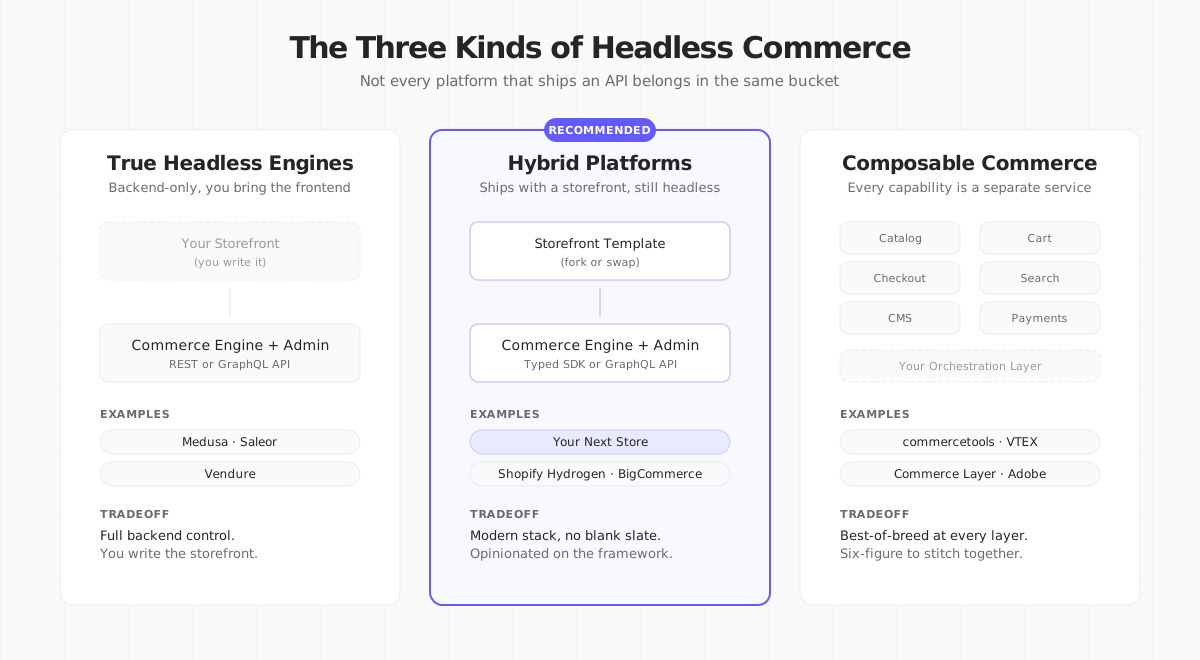
Category 1: True headless engines (backend only, bring your own storefront)
- Medusa: Node, TypeScript, Postgres. Module-based architecture, mature admin, Medusa Cloud available. The team's AI chat layer, Bloom, generates a Medusa store from a prompt; see Bloom alternatives for that comparison.
- Saleor: Python/Django, GraphQL-first. Multi-channel in the core, Saleor Cloud available.
- Vendure: NestJS, GraphQL. Small core, clean plugin API, self-host or Vendure Cloud.
- Spree and Sylius: the Ruby and PHP answers to the same question, covered in the open source section below.
Category 2: Headless-capable hybrid platforms (ship with a storefront or template, also work headlessly)
- Your Next Store: Next.js storefront template + managed backend + typed SDK.
- Shopify Hydrogen: React Router framework on top of the Shopify Storefront API. Uses Shopify's commerce engine underneath.
- BigCommerce (headless mode): SaaS with Storefront GraphQL, Catalog and Checkout APIs.
- Swell: SaaS commerce API with flexible data modeling, subscription-friendly.
- Shopware: PHP platform with a theme storefront and a separate Store API for headless builds.
Category 3: Composable and enterprise commerce
- commercetools: API-first composable commerce for enterprise.
- Commerce Layer: pricing, inventory, cart and checkout APIs you combine with a CMS and frontend, with an operations dashboard included.
- Adobe Commerce: Magento heritage, GraphQL APIs, and since 2025 a SaaS edition (Adobe Commerce as a Cloud Service).
- VTEX: enterprise commerce with FastStore for headless frontends. Stepped away from the MACH Alliance in 2025 and now positions itself as pragmatic composable.
How to Choose a Headless Ecommerce Platform
The questions that actually matter, in the order they should be asked:
| Question | Why it matters |
|---|---|
| Own the backend code, or just call an API? | Engines (Category 1) give you control at the cost of running infrastructure, unless you buy their cloud. Hybrid and composable platforms give you an API and remove the infrastructure burden. |
| What stack does your frontend team actually write? | The best headless backend is the one whose SDK types match your stack. A GraphQL-first platform in a REST-first team is friction for life. |
| Multi-channel and multi-currency needs? | Saleor, commercetools and VTEX model multi-channel in the core. Others model it as regions, markets or duplicated stores. The wrong choice gets expensive. |
| Payment provider, and can you swap it? | Stripe, Adyen, PayPal, local gateways. Check which providers are supported out of the box and what fees apply when you use a third-party gateway. |
| How important is the admin UI to non-technical teammates? | Medusa, Saleor, Shopify, BigCommerce and YNS ship full admin dashboards. Vendure's is functional and extensible. Commerce Layer's dashboard covers operations; merchandising often lives in your CMS. |
| Can you self-host if you need to? | Medusa, Saleor, Vendure, Spree, Sylius and Shopware: yes. Shopify, BigCommerce, Swell, commercetools and Commerce Layer: no. YNS: the storefront yes, the backend is managed. |
| Typed SDK or codegen-ready GraphQL schema? | Untyped REST is 2015. A 2026 headless platform without typed client tooling is telling you something. |
Stack and API Comparison
| Platform | Category | Stack | API | Self-host | Managed option |
|---|---|---|---|---|---|
| Your Next Store | Hybrid | Next.js 16, TS, Postgres | Typed REST SDK | Storefront only | Yes (the backend) |
| Medusa | Engine | Node, TS, Postgres | REST + JS SDK | Yes | Medusa Cloud |
| Saleor | Engine | Python/Django | GraphQL | Yes | Saleor Cloud |
| Vendure | Engine | NestJS, TS | GraphQL | Yes | Vendure Cloud |
| Shopify Hydrogen | Hybrid | React Router, TS | Storefront GraphQL | Storefront only | Oxygen |
| BigCommerce | Hybrid | SaaS | GraphQL + REST | No | Yes |
| Swell | Hybrid | SaaS | REST + GraphQL | No | Yes |
| Commerce Layer | Composable | SaaS | REST + JS SDK | No | Yes |
| commercetools | Composable | SaaS | GraphQL + REST | No | Yes |
| VTEX | Composable | SaaS | REST + GraphQL | No | Yes |
The Code Test: What Headless Actually Feels Like
Feature tables lie. Here is the same query, "12 products in the t-shirts category," in five headless platforms, so you can judge the developer experience yourself.
Your Next Store (typed REST SDK, generated from OpenAPI):
Medusa (typed JS SDK on top of REST):
Saleor (GraphQL with codegen):
Vendure (GraphQL, shop API separated from admin API):
Shopify Hydrogen (Storefront API inside a React Router loader):
Five headless platforms, five feels. YNS and Medusa read like calling a library. Saleor and Vendure assume a GraphQL codegen step. Hydrogen expects you to live inside its loader model. There is no wrong answer, only a fit for your team.
1. Your Next Store: Best Headless Platform for Next.js Teams
Best for: teams building on Next.js who want the commerce layer solved without giving up ownership of the storefront code.
Full disclosure: we build Your Next Store. We will say where it wins and where it does not.
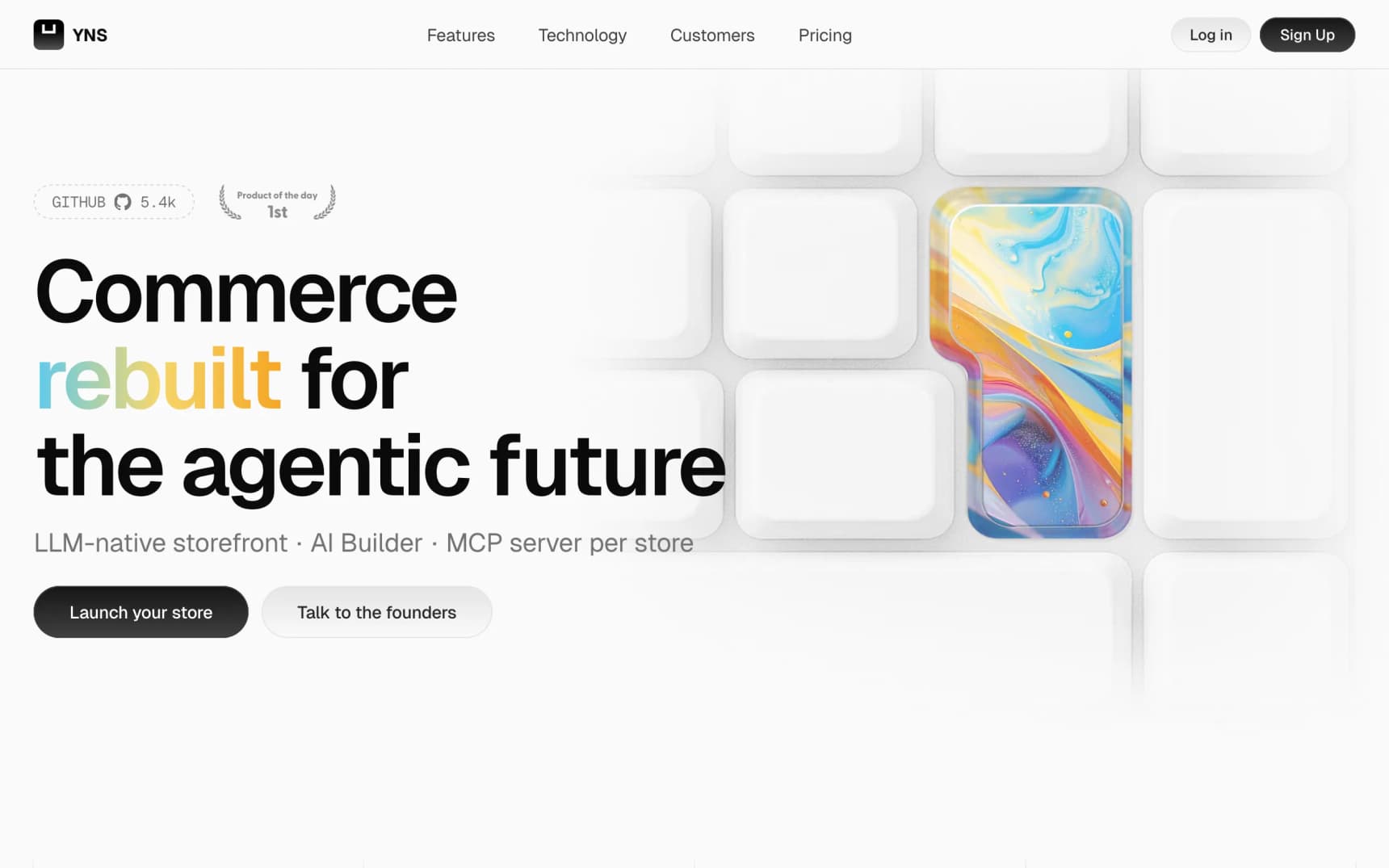
YNS is technically hybrid: it ships an open-source Next.js storefront template (MIT) and a managed commerce backend you call through a typed REST SDK. Most teams deploy the template on Vercel and point it at the managed backend. If you want a different frontend (a native app, a Remix site, an agent), the same SDK and REST API work. The template is storefront only: products, carts, orders and the admin live in the managed backend, so it needs a YNS API key to run.
Why it fits the headless conversation: the backend exposes products, variants, carts, orders, inventory, customers, blog, search and translations as typed REST endpoints, all stored in PostgreSQL. Stripe handles payment processing only. Nothing in the template is load-bearing for the backend: swap the storefront for anything, and the admin, inventory, AI builder and analytics keep working.
Pricing (October 2026): Starter $30/mo, Growth $90/mo, Pro $360/mo (or $25, $75 and $300/mo billed yearly). 0% platform transaction fees on every plan; only Stripe's processing fees apply.
Where it wins:
- Modern storefront ready to fork. You do not spend two months writing a Next.js storefront from scratch before you ship.
- Typed SDK. Products and orders have real types, not
any. - AI builder on the managed platform. The
/designworkspace lets an AI agent edit your storefront code, commit it to GitHub and trigger a Vercel deploy. None of the pure engines ship this in the admin. - Live proof. million.yournextstore.com serves a million-product catalog from the same backend you would use, and a default YNS storefront lands Lighthouse mobile scores in the high 90s:

Where it falls short:
- No free plan. Starter is $30/mo. Medusa, Saleor and Vendure are free to self-host.
- Younger than Shopify or Magento. Fewer third-party integrations today.
- The backend is not self-hostable. The storefront is open source; the commerce backend is a managed service.
Skip the two-month storefront build. Fork the Next.js template, point it at YNS's typed SDK, and you're shipping.
2. Medusa: Best Open Source TypeScript Engine
Best for: teams that want to deeply customize the commerce engine itself, in Node, with Postgres.
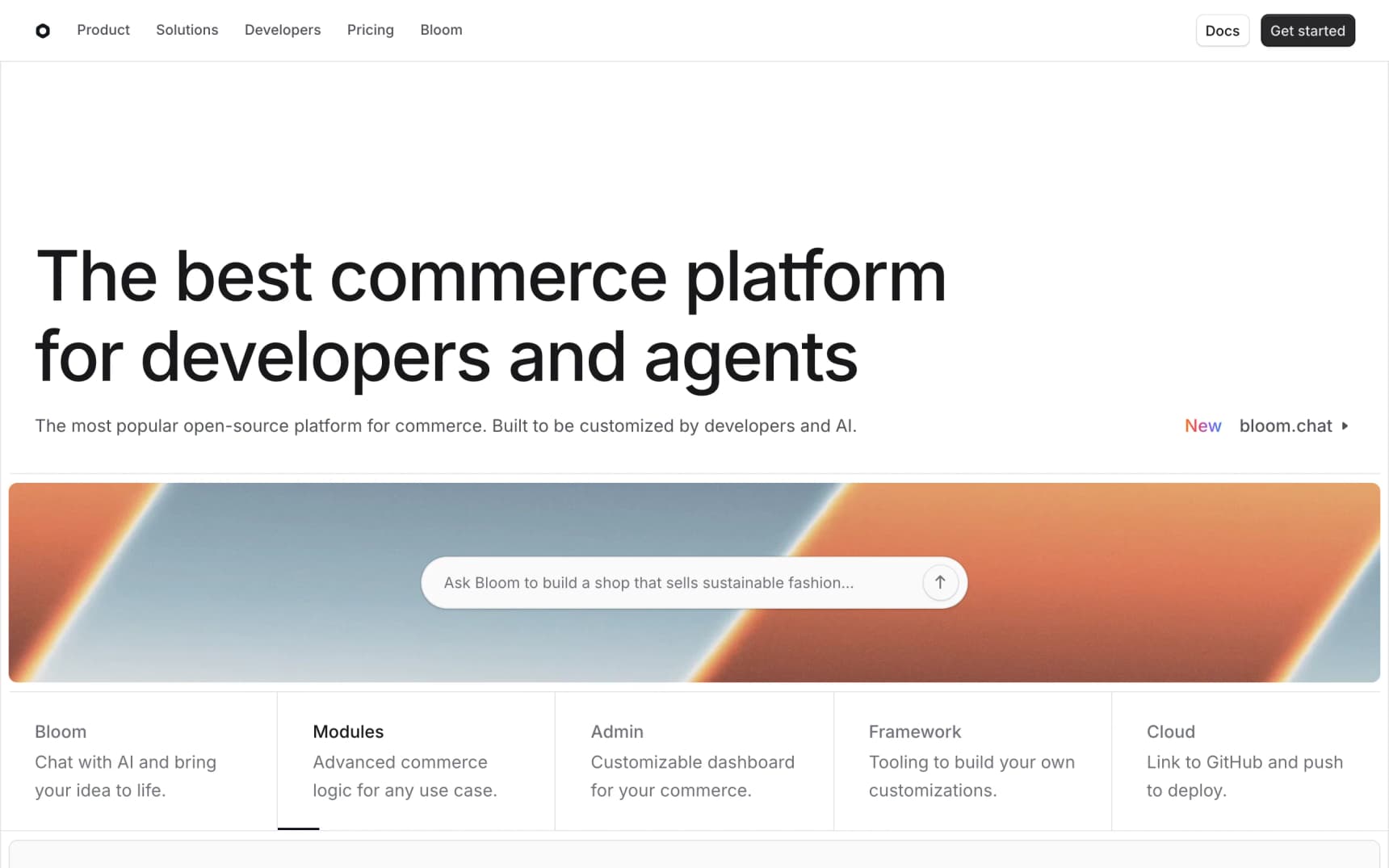
Medusa is the default choice when the conversation is "we want to own the backend in TypeScript." npx create-medusa-app@latest, point it at Postgres, and you have an admin dashboard and REST API running locally in minutes. The core is MIT-licensed.
Why it fits: a module system where payment, tax, inventory and fulfillment are swappable, TypeScript end to end, and an admin non-technical operators can use. The storefront is on you: the Medusa Next.js starter is a good starting point, and you own everything after the fork.
Pricing (September 2026): free to self-host. Medusa Cloud starts at $29/mo (Develop), $99/mo (Launch) and $299/mo (Scale), with custom Enterprise plans and no GMV fees.
3. Saleor: Best GraphQL-Native Engine
Best for: large catalogs, multi-channel sellers, or teams where GraphQL is the native interface.
Saleor is open-source headless commerce built on Python and Django (BSD-3-Clause), with a GraphQL API as the entire surface area. The multi-channel model (channels, warehouses, currencies, price lists) is first-class in the core, not a plugin. It is a common pick for brands that have outgrown a SaaS monolith and want an open-source core.
Pricing (September 2026): free to self-host. Saleor Cloud has free sandboxes for prototyping; production plans start at $1,599/mo (Select, up to $200k monthly GMV) and $3,999/mo (Volume, up to $1M monthly GMV), plus custom Enterprise.
If the GraphQL-only API or the Python stack is the actual blocker, our dedicated Saleor alternatives guide compares nine options side by side.
Tradeoff: Python, Django and GraphQL are three skills to hire for if your team is JavaScript-first.
4. Vendure: Best Plugin-First TypeScript Backend
Best for: engineers who want a small, opinionated TypeScript core with a clean plugin API, including B2B builds.
Vendure is NestJS + GraphQL + Postgres. Small core, plugin architecture, admin and shop GraphQL APIs separated by default. It has been in production since around 2020 with mid-market and B2B brands.
Pricing (September 2026): Vendure Core is free under GPLv3, with a plugin exception so your own plugins can use any license. The commercial Vendure Platform (B2B, search and other capabilities, plus a commercial license) is a flat annual subscription quoted per project, and managed hosting is available through Vendure Cloud. Older comparisons that call Vendure "self-host only" are out of date.
5. Shopify Hydrogen: Best If You Are Staying on Shopify
Best for: teams whose merchant already runs on Shopify and wants a custom React storefront instead of a Liquid theme.
Hydrogen is Shopify's React framework for the Storefront API. Since the 2025.5 release it runs on React Router 7 (Remix's successor). The admin, checkout, inventory and apps all stay in Shopify. The storefront is custom.
Pricing (September 2026): Hydrogen itself is free. You pay for a Shopify plan: in the US, Basic is $39/mo ($29/mo billed annually), Grow $105/mo ($79), Advanced $399/mo ($299), and Plus from $2,300/mo. Oxygen hosting is included at no extra cost on every plan except Starter, and you can deploy Hydrogen elsewhere if you prefer.
Why it is here: if you are not moving off Shopify's commerce engine, this is the most supported path to a modern frontend. Why it is not #1 on this list: you keep Shopify's platform costs and, if you use a payment provider other than Shopify Payments, a third-party transaction fee from 2% on Basic down to 0.2% on Plus (see Shopify transaction fees: the real cost). For a head-to-head, see Next.js vs Shopify.
6. BigCommerce and Swell: SaaS Headless Commerce Software
Two SaaS platforms that give you a hosted backend, an admin and headless APIs without any servers to run.
- BigCommerce has strong Storefront GraphQL, Catalog and Checkout APIs and an official Next.js starter (Catalyst). Its parent company now trades as Commerce (commerce.com), but the product keeps the BigCommerce name. Current plans are Core ($39/mo, $29 annual), Growth ($105/mo, $79 annual), Scale ($399/mo, $299 annual) and Performance from $1,499/mo, each with a trailing-twelve-month GMV threshold. If you are cross-shopping from BigCommerce, our BigCommerce alternatives breakdown ranks the headless options against it.
- Swell is a headless-first SaaS with flexible data models and native subscriptions. Plans (billed annually) run Starter $29/mo (up to $50k revenue), Basic $79/mo ($250k), Standard $299/mo ($1M) and Unlimited $2,250/mo ($5M), with a percentage overage fee if you pass the ceiling.
7. The Enterprise Tier: commercetools, Commerce Layer, VTEX, Adobe Commerce
Platforms worth knowing about, but not the right answer for most readers of this post:
- commercetools: the reference composable commerce platform. Pricing is not published; contracts are annual and negotiated, typically on GMV. If you are reading a public blog post to decide, this is probably not your platform yet; see our commercetools alternatives guide for options with a published price.
- Commerce Layer: API-first pricing, inventory, cart and checkout for multi-market brands, with a dashboard for operations. The Developer plan is free with no time limit (1,000 SKUs, 100 live orders a month); Enterprise is custom.
- VTEX: enterprise commerce with FastStore for headless frontends, large in Latin America and physical retail. Pricing combines a fixed subscription with a percentage of GMV.
- Adobe Commerce: GraphQL on the Magento core, now also offered as a SaaS with an Edge Delivery storefront. Licensing is custom and tiered by GMV or order volume. Magento Open Source remains free if you want the engine without the Adobe license.
Most teams will do better with Medusa, Saleor, YNS, Vendure or Hydrogen unless a specific enterprise feature above is load-bearing.
Open Source Headless Ecommerce Platforms
If "open source" is the hard requirement, this is the shortlist. All of them can run headless with the storefront of your choice.
| Platform | License | Stack | API | Managed option |
|---|---|---|---|---|
| Medusa | MIT | Node, TypeScript | REST + JS SDK | Medusa Cloud |
| Saleor | BSD-3-Clause | Python, Django | GraphQL | Saleor Cloud |
| Vendure | GPLv3 (plugin exception) | NestJS, TypeScript | GraphQL | Vendure Cloud |
| Spree | BSD-3-Clause (Next.js storefront MIT) | Ruby on Rails | REST + TypeScript SDK | Enterprise support |
| Sylius | MIT | PHP, Symfony, API Platform | REST | Sylius Plus (paid) |
| Shopware | MIT (Community Edition) | PHP, Symfony, Vue | Store API + Admin API | Paid Shopware plans |
A few things the license column does not tell you:
- Open source does not mean free to run. You pay for hosting, the database, upgrades and on-call, or you pay the vendor's cloud to do it.
- Shopware's Community Edition stays MIT, but since March 2025 its fair usage policy requires merchants above €1M annual GMV to move to a paid plan to keep access to the Shopware Account and Store.
- Spree 5 ships a REST API, a typed TypeScript SDK and an MIT-licensed Next.js storefront, which makes it one of the more complete open-source headless kits outside the JavaScript backends.
- Your Next Store is open source on the storefront side only. The template is MIT, and it runs against the managed YNS backend. If you need an open-source backend too, pick one of the engines above. We compare more of them in open source Shopify alternatives.
Adjacent Decisions: CMS, B2B, Composable, Checkout
These come up in almost every headless evaluation. Each deserves its own guide, so here is only the short version.
Headless CMS for ecommerce. Most headless stores pair the commerce backend with a CMS (Sanity, Contentful, Storyblok, Payload and similar) for landing pages and editorial content; see our best headless CMS for ecommerce comparison for how they stack up. Pick the commerce platform first, then check that the CMS has a maintained integration with it, or keep content in the commerce admin if your needs are simple.
B2B headless commerce. Company accounts, negotiated price lists, quotes and purchase orders are where platforms differ most. Vendure's commercial Platform, Spree, commercetools, BigCommerce and Shopify Plus all market B2B features; test the exact workflows (approvals, net terms, per-customer catalogs) before you commit. We go deeper on that architecture and how the platforms compare specifically for B2B in B2B Headless Commerce: Platforms & How to Choose.
Composable commerce. Headless decouples the storefront. Composable goes further and splits the backend into separate services (catalog, cart, search, OMS) you assemble. commercetools and Commerce Layer are built for it. Most teams get the benefit they want from headless alone.
Headless checkout. Some platforms let you build the checkout yourself; others (Shopify, many SaaS platforms) keep checkout hosted and only let you customize it. If checkout conversion is your main reason for going headless, check this first.
Shopify Hydrogen alternatives. If you like the Hydrogen model but not the Shopify dependency, the closest equivalents are a Next.js storefront on Medusa, Saleor or YNS, or BigCommerce's Catalyst. Our dedicated Shopify Hydrogen alternatives guide covers nine of them, including the option of just swapping Hydrogen's React Router for Next.js Commerce while staying on Shopify.
The Honest Cost of Headless
Every headless platform costs more than the monolith it replaces. Not just in license fees: in engineering hours, infrastructure and cognitive load. Be honest about the bill.
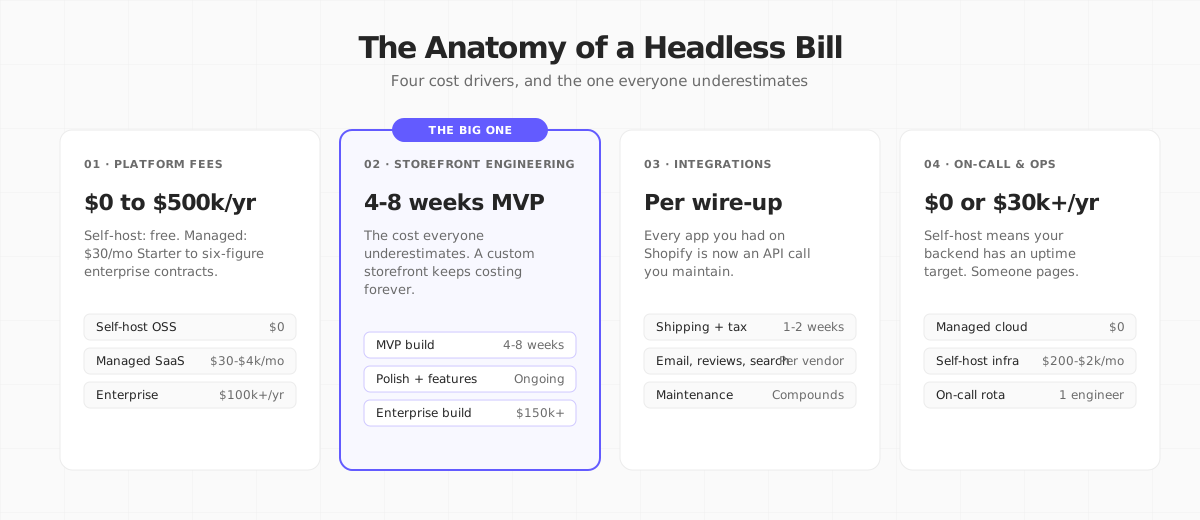
The one teams underestimate every single time is storefront engineering. Platform fees are a line item. Integrations are scoped per vendor. On-call is a rota. Storefront engineering is an ongoing commitment to a living codebase that keeps needing your best developers. Budget for it.
The payoff: speed, flexibility, ownership of the customer experience, and the ability to sell anywhere an API reaches. Worth it for the right team. Expensive theater for the wrong one.
Migration Reality Check
Most headless migrations fail for the same three reasons, and none of them are about the platform you pick. They are about what the platform does not migrate for you.
Subscriptions rarely move cleanly. Active recurring charges carry payment method tokens and cycle state. Moving them often means re-authorizing subscribers on the new platform's billing. Plan a transition email, a re-auth flow and support cover for the cutover week.
Order history is harder than it looks. Historical orders carry payment metadata, refund state, shipping labels and tax records. Every platform models these differently. The pragmatic play: migrate the last 60 to 90 days into the new platform and keep the rest read-only in the old system for legal and support lookups. In the EU and UK, check your record retention obligations for invoices and VAT before you switch anything off.
URL redirects decide whether your SEO survives. Your indexed /product/slug, /category/slug and /collections/slug URLs are ranking today. Every platform uses different URL shapes. A complete 301 redirect map generated from your old sitemap is not optional. Our ecommerce SEO guide covers structured data and crawl budget too.
Budget the migration like a major version upgrade, not a plugin install. A clean small-catalog move can land in 4 to 8 weeks. Subscriptions, B2B flows and a lot of content push it to 3 to 6 months. If you are coming off Shopify, our migration guide breaks the process into six phases, including Storefront API limits and app-replacement traps.
When Headless Is the Wrong Call
Say it out loud:
- You have no frontend engineers. A headless stack without someone who owns the storefront becomes a half-built site that never improves. Stay on a themed platform.
- You are pre-launch and iterating fast. Premature headless is how teams spend three months building the stack and zero months finding product-market fit.
- Your differentiation is your brand, not your UX. If a theme gets you to 95%, headless is a tax you do not need to pay.
- Your catalog is small and your scale is regional. The ROI on headless shows up at scale. Below a few hundred SKUs and a few thousand orders a month, the cost curve is usually unfavourable.
None of these are failures. They are just the wrong shape for this architecture. For a broader take on when the monolith wins, see when not to leave WooCommerce.
FAQ
What is a headless ecommerce platform?
A headless ecommerce platform is commerce software (products, carts, orders, customers, checkout) that exposes everything through an API and lets you build the storefront separately, in any framework. The platform is the "body"; your storefront, app or agent is the "head." Our primer on what headless commerce is covers the architecture in more detail.
What is the best headless commerce platform?
It depends on the kind of team you are. For TypeScript and Next.js teams: Your Next Store or Medusa. For GraphQL-first and multi-channel: Saleor. For a plugin-first self-hosted TypeScript backend: Vendure. For teams staying on Shopify: Hydrogen. For enterprise composable programs: commercetools.
Which headless ecommerce platforms are open source?
Medusa (MIT), Saleor (BSD-3-Clause), Vendure (GPLv3 core), Spree (BSD-3-Clause), Sylius (MIT) and Shopware Community Edition (MIT). Your Next Store's storefront template is MIT, but its backend is managed. Hydrogen is an open-source framework on top of Shopify's closed commerce engine.
What is SaaS headless commerce?
SaaS headless commerce software is a hosted backend you do not run yourself, with a subscription price and headless APIs: BigCommerce, Swell, Commerce Layer, commercetools, Shopify with Hydrogen, and the YNS managed backend. The alternative is an open-source engine you host (or pay its vendor's cloud to host). SaaS trades control of the backend code for zero server operations.
Is Shopify actually headless?
Not by default. Pair it with Hydrogen (or any framework calling the Storefront API) and it is. You get a headless storefront on Shopify's closed-source commerce engine.
Is Medusa better than Saleor?
Neither is objectively better. Medusa is TypeScript and Node; Saleor is Python/Django and GraphQL. Pick the one whose language and data model match your team. Medusa's module system is friendlier for custom commerce logic in TypeScript. Saleor's multi-channel modeling is stronger out of the box.
What is the difference between headless and composable commerce?
Headless decouples the storefront from the backend. Composable goes further: it decouples every commerce capability (catalog, cart, checkout, search, CMS, payments) into separate services you stitch together. All composable platforms are headless. Not all headless platforms are composable.
Do I need GraphQL to go headless?
No. REST with a typed SDK (YNS, Medusa, Commerce Layer, Spree) is fine for most teams. GraphQL shines when you have deeply nested queries or several frontends with different data needs.
How much does headless commerce cost?
It depends on scope. A small team on YNS or Medusa can stand up a headless store in 4 to 8 weeks. BigCommerce's estimate for a full headless implementation is $50,000 to $150,000 for mid-market businesses and more than $250,000 for enterprise builds, before ongoing engineering.
Can I move from one headless platform to another later?
Yes, but it is a similar size project to leaving a monolith. Storefront code is fairly portable. Admin workflows, integrations and content are not. Budget the migration; do not underestimate it.
The Real Answer
Most "best headless commerce platforms" lists mix true engines, hybrid platforms and composable SaaS into one ranking, so a Node framework you self-host ends up next to a six-figure enterprise contract. Figure out which of the three categories you are actually shopping in. Then pick the platform in that category whose API shape matches how your frontend team already writes code. Pricing tiers, branding and "AI-powered" taglines come after that decision.
Related Blog Posts
- Compare all ecommerce platforms side-by-side – every major platform in one table
- What Is Headless Commerce?
- Best Ecommerce Platform for Developers in 2026
- Open Source Shopify Alternatives
- Migrating from Shopify to Headless Commerce
- Next.js vs Shopify: An Honest Take from a Developer
- How to Build an E-commerce Website with Next.js
- WooCommerce Alternatives for Developers (2026)
Your Next Store is open-source. Star the repo on GitHub:
github.com/yournextstore/yournextstore