How to Start a Coloring Book Business in 2026
 Michał Miszczyszyn
Aug 24, 202615 min read
A coloring book is one of the cheapest products in publishing to start and one of the easiest to get wrong. There's no inventory to buy upfront, no factory minimum order, and the file itself is just black line art on white pages. But "coloring books" is also one of the most crowded categories on Amazon, which means most first-time creators publish one book, sell four copies, and quit. Here's how to start a coloring book business the honest way: how to pick a niche that actually sells, how to stay out of copyright trouble, what Amazon and Etsy really pay you, and when it's worth building your own website instead.
How to Start a Coloring Book Business, Step by Step
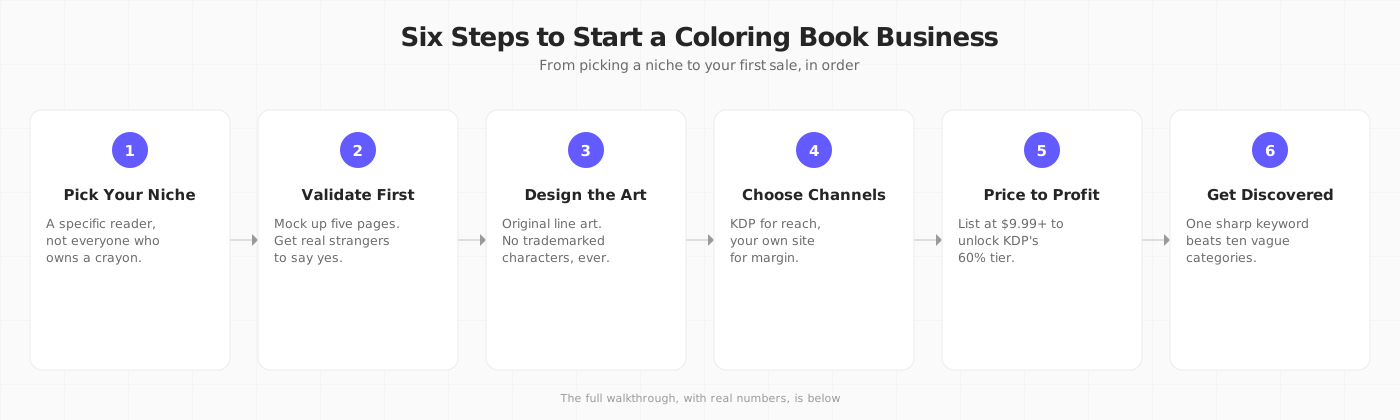
Step 1: Pick a Niche a Real Person Is Searching For
"I'm going to make a coloring book" is not a business idea. It's a hobby. The businesses that actually make money pick a specific reader and a specific occasion, not a broad category.
Search "coloring book" on Amazon and you'll find hundreds of thousands of nearly identical listings: generic mandalas, generic animals, generic flowers. Almost none of them stand out, because almost none of them were made for anyone in particular.
Good niche answers look like this:
- Bold, easy, large-print designs for seniors and people with low vision. Simple thick outlines, big pages, minimal detail. This audience is underserved and searches with clear intent ("easy coloring book for seniors").
- A specific profession or hobby. Nurses, teachers, dog groomers, plant parents, D&D players. Niche-specific books sell to gift-buyers as much as to the person themselves.
- A specific emotional need. Mindfulness and anxiety-relief coloring for adults, or a "calm down" coloring book aimed at parents of anxious kids.
- A specific aesthetic, like mystery mosaics (color-by-number puzzles that reveal a hidden image) or zentangle-style geometric patterns, both of which carry close to zero copyright risk because the patterns are original abstractions, not licensed characters.
The current trending niches, per publishing-focused research from KDP Easy and Accio's 2026 trend report, lean toward mandalas, color-by-number animals, mindfulness themes for adults, large-print "bold and easy" books for seniors, and profession or hobby-specific gift books. Treat any specific trend list as a starting point to research, not a guarantee. Niches move fast in low-content publishing, and what's hot this quarter can be saturated by next year.
The test: if a stranger could swap your cover for a competitor's and nobody would notice the difference, your niche isn't sharp enough yet. If you'd rather sell a physical product with a similarly low barrier to entry, we also wrote an honest playbook for starting a candle business that walks through the same kind of specificity test.
Step 2: Validate Before You Draw 50 Pages
The most common beginner mistake is spending three weeks illustrating a full 100-page book before finding out nobody wants it. Coloring books are cheap to test. Test before you commit.
Three ways to do it, cheapest first:
- Check the competition's sales rank. On Amazon, search your niche and look at the Best Sellers Rank of the top few listings (it's listed on the product page under "Product details"). A healthy, sellable niche usually has several books ranked well inside the top few hundred thousand in the Books category. If the top result in your niche is ranked in the millions, demand may be too thin.
- Mock up five pages and post them. Share your art style in a relevant Facebook group, subreddit, or your own social following before you finish the full book. Ask directly: "Would you buy a 50-page book like this?" Polite "cute!" comments don't count as validation. A stranger asking where to buy it does.
- Pre-sell a small batch. If you're planning to sell physical copies through your own site, list it as "coming soon" with a real price and see if anyone joins a waitlist or pre-orders. Ten real pre-orders beat a thousand likes.
This step costs you a weekend. Skipping it can cost you weeks of illustration work on a book in a niche nobody was searching for.
Step 3: Design the Interior (and Stay Out of Copyright Trouble)
Tools
You don't need to be a professional illustrator, but you do need consistent, clean line art. The common beginner setup:
- A drawing tablet. An entry-level Wacom or Huion tablet runs $50 to $200 and is enough to start.
- Design software. Adobe Illustrator is the industry standard but is a monthly subscription. Affinity Designer is a strong, cheaper alternative at a one-time cost of around $70. Many beginners start with Canva, which has coloring page templates but less fine control over line weight.
- AI-assisted art. AI image tools can speed up generating base line art, which you then clean up and make consistent by hand. Treat AI output the same way you'd treat a sketch: a starting point that needs real editing before it's ready to sell, not a finished page.
The copyright rules that actually matter
This is the step that gets careless creators banned, and it's more common than you'd think.
- Never use trademarked characters, franchises, or brand names, even in the title. Disney characters, superhero franchises, sports team logos, and named celebrities are off-limits without a license. Platforms actively scan for this and will suspend your account, not just the one listing.
- Public domain content needs real transformation. You can base pages on public-domain art (old botanical illustrations, historical architecture, classic fairy tale scenes), but Amazon KDP's own public domain publishing guidance requires meaningfully new work, not a straight re-upload of source material.
- Generic themes are safe. Named characters are not. A "gingerbread house in the snow" coloring page is fine. "The Grinch" is not, even if you drew it yourself.
- Your art has to be genuinely yours. Buying a commercial-use clipart pack and reselling it page-for-page as your own coloring book violates most clipart license terms, and marketplaces are increasingly checking for duplicate content across listings.
If you're ever unsure whether a theme is safe, the simplest test is: could you explain your inspiration to the original rights holder without them being upset? If not, pick a different theme.
Step 4: Choose Where to Sell It
This is the step where most first-timers only consider one option. You actually have three, and they solve different problems.
Option A: Amazon KDP (the default starting point)
Amazon KDP prints paperbacks on demand and ships them, so you never touch inventory or a printer. You upload a PDF interior and a cover, set a list price, and KDP handles printing, shipping, and customer service.
The royalty math, straight from KDP's own pricing pages: your royalty is your list price times a royalty rate, minus the printing cost. Since mid-2025, KDP pays a 60% royalty rate at a list price of $9.99 or higher, and 50% below that. Printing cost for a black-and-white coloring book depends on page count and trim size and is calculated by KDP's own printing cost tables rather than a flat number you can assume in advance, so always check the live rate for your exact page count before setting a price.
This matters more than it sounds: pricing at $9.98 instead of $9.99 can mean a meaningfully smaller royalty per copy, because you fall into the lower tier just under the line. Always price your coloring book at $9.99 or above unless you have a specific reason not to.
The tradeoff: Amazon owns the customer relationship, and the coloring book category is genuinely crowded, so discovery depends heavily on getting your categories and keywords right (more on that in Step 6).
Option B: Etsy (digital downloads or physical copies)
Etsy works two ways for coloring books: sell a printable PDF as an instant digital download, or list physical printed copies the way you would on Amazon.
Digital downloads are the lower-friction path. There's no printing, no shipping, and no per-unit cost after you've made the file once. Etsy charges a $0.20 listing fee, a 6.5% transaction fee, and roughly 3% + $0.25 in payment processing, according to Etsy's own fee page. On a $6 digital coloring book, that's a little over a dollar in combined fees, well under half the take rate you'd expect from a print royalty.
The catch is that "printable coloring pages" is an extremely saturated Etsy category, and buyers there are price-sensitive, often expecting bundles of 20 to 50 pages for a few dollars rather than a single premium book.
Option C: Your Own Website (full margin, your own brand)
If you want to sell finished copies directly, whether that's short-run copies from a print-on-demand book printer like Lulu or Prodigi, or digital downloads without giving a marketplace a cut, you need a website with a real checkout.
For pure digital downloads, a lightweight storefront built for file delivery, like Gumroad or Payhip, is the fastest way to start. Both charge a percentage per sale on top of payment processing, but setup takes minutes.
If your plan is bigger than one file, multiple titles, bundles, physical copies, merchandise tied to your niche, a proper store makes more sense than a download-only tool.
The honestly-ranked options for a creator in 2026:
- Your Next Store (us, to be upfront) is built for exactly this: a real storefront with product variants, search, and an AI-powered builder that sets it up with you, without needing to hire a developer. Plans start at $30/month ($25/month billed yearly) with 0% platform transaction fees on every plan; Stripe's standard processing fees still apply on each sale. Good fit once you're selling more than a single PDF and want a branded home for your catalog.
- Shopify is the well-trodden path, starting around $39/month, with a plug-in for almost anything you'd want, including print-on-demand book fulfillment apps. Costs climb as you add apps, and Shopify charges an extra fee per sale if a customer doesn't pay with Shop Pay.
- Squarespace or Wix are cheap, visual, and fine for a small catalog, especially if you're already leaning on strong page design to sell an aesthetic-driven niche like mandalas or botanical art.
- A simple payment link. If you're only selling one or two digital titles from an existing audience, a Stripe payment link is the $0-setup option. It's manual, but it works while you validate.
Honest recommendation for most first-time coloring book sellers: start on KDP, Etsy, or both, where the built-in search traffic does real work for a brand-new, unknown title. Add your own website once you have more than one book worth bundling, or once repeat buyers are worth owning the relationship with directly. Trying to drive cold traffic to your own site for a single unknown title is the hardest version of this business, not the easiest.
0% platform transaction fees. A real storefront for your coloring book catalog, set up with AI in minutes.
Step 5: Price So the Math Works
The temptation is to price low because "it's just a coloring book." Resist it. Low pricing is the single fastest way to make this not worth your time.
For a KDP paperback, the $9.99 royalty-tier line matters more than almost anything else in your pricing decision, as covered in Step 4. For most 50 to 100 page black-and-white coloring books, a list price of $8.99 to $12.99 is the realistic market range, in line with pricing data compiled by Book Bolt and KDP Easy. Bold, easy, large-print books aimed at seniors tend to sit at the higher end of that range because the format (fewer, simpler pages) justifies a premium price for the accessibility.
A rough illustration of the math on a 100-page coloring book listed at $9.99: at a 60% royalty rate, before printing cost is subtracted, that's about $6 of gross royalty per copy. Printing cost for a book that length is a few dollars, so your real take-home per sale lands in the $3 to $4.50 range depending on trim size, before you've spent anything on marketing. That's genuinely good margin for a product with zero physical inventory risk, but it also means volume matters: a handful of sales a month is a hobby, not a business.
For digital downloads sold directly (your own site or Etsy), your margin per sale is far higher since there's no print cost at all, but your price point is usually lower too, because buyers expect digital-only pricing to undercut a printed book.
Whatever the channel, don't price to match a rock-bottom competitor without checking whether they're actually profitable at that price. A lot of low-content publishing "gurus" have quietly stopped publishing at $4.99 because the math never worked once printing cost and ad spend were included.
Step 6: Get Discovered
New coloring book creators usually make one of two mistakes: they publish and wait, or they try to market on every platform at once and do none of them well. Neither works. Pick a primary discovery channel that fits your niche.
- Amazon keywords and categories (mandatory for KDP). Your book's discoverability lives almost entirely in the seven keyword phrases and up to three browse categories you choose at upload. Research the exact phrases your niche's buyers search, not generic terms like "coloring book." A tightly matched niche keyword beats a broad, high-volume one that puts you up against thousands of competitors.
- Pinterest. The single best organic channel for coloring pages, because the product is inherently visual and Pinterest users actively search "coloring page" and "printable" with buying intent. Pin sample pages linking back to your Amazon, Etsy, or own-site listing.
- Etsy SEO. If you're selling on Etsy, your listing title and tags matter as much as the product itself. Study top-ranking listings in your niche for the phrases they repeat.
- TikTok and Instagram Reels. Short videos of pages being colored (a "coloring ASMR" or satisfying-page-fill clip) perform well in this category and cost nothing but time.
- Email and bundles. Once you have a handful of titles, an email list of past buyers is the cheapest way to sell your next release. Bundle three related titles at a discount; bundles consistently outsell single titles in this category.
- Paid ads. Worth testing only after you have at least one title with organic sales, so you know your conversion rate before you pay for traffic.
Pick one primary channel, run it consistently for two to three months, and only add a second once the first is actually working.
What It Actually Costs to Start a Coloring Book Business in 2026
| Your approach | Upfront cost | What you get |
|---|---|---|
| Weekend side project | $0 to $100 | One book, mostly your own art or free tools, published on KDP with no ad spend |
| Serious first title | $200 to $500 | A drawing tablet or paid software, a professionally designed cover, and pages tested on real people before publishing |
| Small catalog business | $1,000 to $3,000 | 5 to 10 titles, a bundle offer, your own website, and a modest Pinterest or ad budget |
| Full publishing operation | $5,000+ | Hired illustrators, a large catalog across niches, paid ads across platforms, and a proper brand |
The good news specific to this business: unlike a physical product with inventory risk, the worst-case outcome of a coloring book that doesn't sell is a few wasted hours, not a garage full of unsold stock. That makes it one of the lowest-risk ways to test whether you can build an audience around a niche at all.
FAQ
How much does it cost to start a coloring book business?
As little as $0 to $100 if you use free or already-owned design tools and publish through Amazon KDP, which has no upfront printing or listing costs. A more serious setup with a drawing tablet, paid design software, and a professionally made cover runs $200 to $500 for your first title. Costs scale mainly with how many titles you publish and how much you spend on marketing, not with printing or inventory.
Is a coloring book business actually profitable?
It can be, especially per-hour compared to physical products, because there's no inventory risk. On a $9.99 KDP paperback, a 60% royalty minus printing cost typically nets $3 to $4.50 per copy. The challenge isn't margin, it's volume and discovery in a crowded category. Creators who publish a genuinely differentiated niche and build a small catalog tend to do far better than those who publish one generic book and stop.
Do I need to worry about copyright when making a coloring book?
Yes, more than most new sellers expect. Never use trademarked characters or franchise names, even hand-drawn ones. Public domain source material needs to be meaningfully transformed, not reused as-is. When in doubt, pick original or clearly generic themes (mandalas, geometric patterns, generic seasonal scenes) instead of anything tied to a specific franchise or brand.