Abandoned Cart Emails That Win Sales Back (3-Email Plan)
 Jakub Neander
Oct 5, 202611 min read
Roughly 7 in 10 shopping carts never become orders. Baymard's average across 50 studies is 70.22%, and abandoned cart emails are the cheapest way to claw some of that back. This guide gives you a three-email sequence, the timing, the subject lines, and the compliance rules for the US, EU and UK, so you can ship a flow that wins sales back without annoying people.
Why Abandoned Cart Emails Are Worth Setting Up First
Most of those abandoned carts are not lost sales. Baymard notes that a large share is window shopping, price comparison and saving items for later, which no email will fix. The rest is a distracted customer, a surprise shipping cost, or a question nobody answered.
That second group is where abandoned cart emails earn their keep. Klaviyo's abandoned cart benchmarks, drawn from more than 143,000 flows sent in 2023, put the typical flow at about a 50% open rate, 3.3% placed-order rate and $3.65 revenue per recipient. The top 10% of flows reach $28.89 per recipient. Treat those as a map of the range, not a promise: your numbers depend on your price point, list quality and traffic mix.
Two reasons to build this flow before newsletters or segmentation:
- The audience is already warm. They picked a product, added it, and often typed an email address. No other email you send starts that close to a sale.
- It runs forever. You write three emails once. After that, every abandoned cart triggers them without any extra work.
How Abandoned Cart Emails Work
An abandoned cart email is an automated message triggered when a shopper builds a cart, gives you their email address, and leaves without paying. Four things have to be true for it to fire:
- You captured an email. Usually at the checkout contact step, or because the visitor is a logged-in customer or a subscriber.
- You can see the cart. Your store tells your email tool which items were in the cart, so it can show them.
- A timer expires. Most tools wait 30 to 60 minutes after the last activity before starting the flow.
- No order arrives. The flow stops the moment the cart converts, so nobody gets "you forgot something" after they paid.
That last rule is the one stores break most often. Always exit the flow on purchase, and test it by placing an order mid-sequence.
The 3-Email Abandoned Cart Sequence
More emails is not better. Three emails over about three days covers the useful window, and each one has a single job.
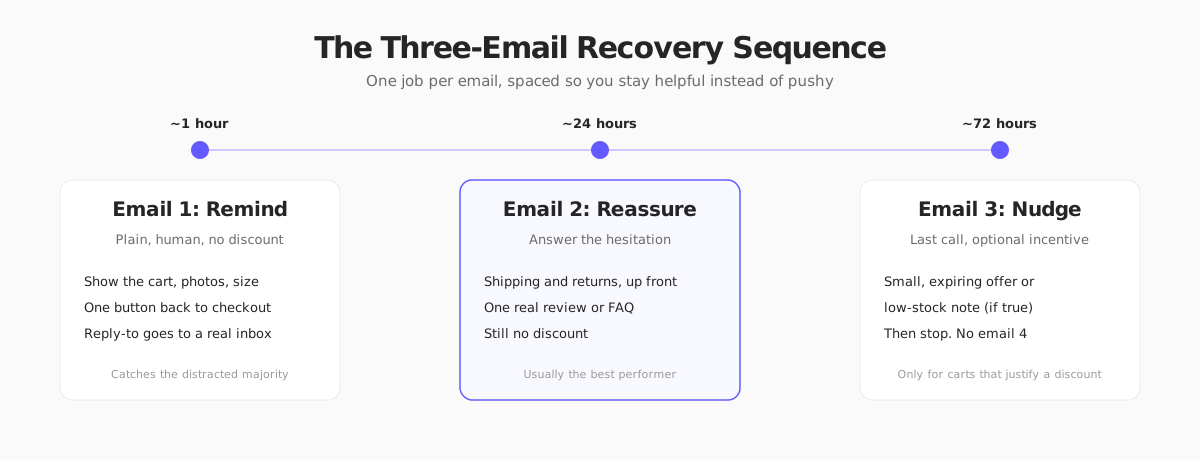
Email 1: Remind (about 1 hour)
This is a receipt for a purchase that did not happen. Keep it plain and fast.
- Show the exact items, photos, size and color.
- One clear button back to the cart, ideally restoring it with one click.
- No discount. Plenty of shoppers were interrupted and will happily finish on their own, and a discount here trains customers to abandon on purpose.
- Send it from a person or a recognizable brand name, and make replies go to a real inbox.
Email 2: Reassure (about 24 hours)
If the first email did not work, the shopper probably has a doubt. Name the common ones before they have to ask:
- Shipping time and cost, and your return policy, stated in one sentence each.
- One honest review, or a short answer to the most common product question.
- A way to reach a human.
In most stores this is the email that does the heavy lifting, because it addresses the reason people stopped. Test it against your own data before assuming it.
Email 3: Nudge (about 72 hours)
This is the only email where an incentive is on the table, and even here it is optional.
- A small, expiring offer such as free shipping or 5 to 10% off, or a truthful low-stock note if inventory really is limited.
- A clear last-call tone. Then stop. There is no fourth email.
- Skip the discount for low-value carts, where it would erase your margin, and for repeat buyers who convert on their own.
Gate the discount on cart value. A 10% coupon on a $20 cart is worth a few dollars of margin you may never recover. Many stores only attach an incentive above a cart-value threshold, and send email 3 as a plain reminder below it.
Timing and Subject Lines
Timing is a hypothesis, so test it. Start with 1 hour, 24 hours and 72 hours, then try moving the first email earlier or later and compare placed-order rate, not opens. Opens are noisy: Apple Mail Privacy Protection preloads images and inflates them, so judge a flow by clicks, orders and revenue per recipient.
Subject lines that tend to work are specific and calm:
| Weak | Better | |
|---|---|---|
| 1 | "You left something behind!!!" | "Your cart is saved: Linen Overshirt, size M" |
| 2 | "Still thinking?" | "Free returns on your order, and answers to common questions" |
| 3 | "LAST CHANCE: 10% OFF" | "Your cart expires tonight" |
Rules of thumb: name the product, avoid all caps and stacked exclamation points, and never fake urgency. A "your cart expires" line should be true. If you do not actually release the stock, say something else.
What to Put in the Email Body
Whatever tool sends it, every abandoned cart email should have the same skeleton:
- A product block. Image, name, variant, price. This is the part that makes it feel personal.
- One primary button. "Return to your cart" beats three competing links.
- A trust strip. Shipping, returns, payment methods, and your support address.
- A real unsubscribe link. Required by law in most markets, and good for deliverability.
Mobile first. Most of these emails are opened on a phone, so use a single column, large tap targets and short copy. A cart email that needs pinch-to-zoom is a lost sale.
Which Tool Should Send Them?
You do not need a custom system. The common choices:
- Klaviyo is the default for many ecommerce brands, with deep store integrations and strong segmentation.
- Omnisend bundles email and SMS with ecommerce-focused automation templates.
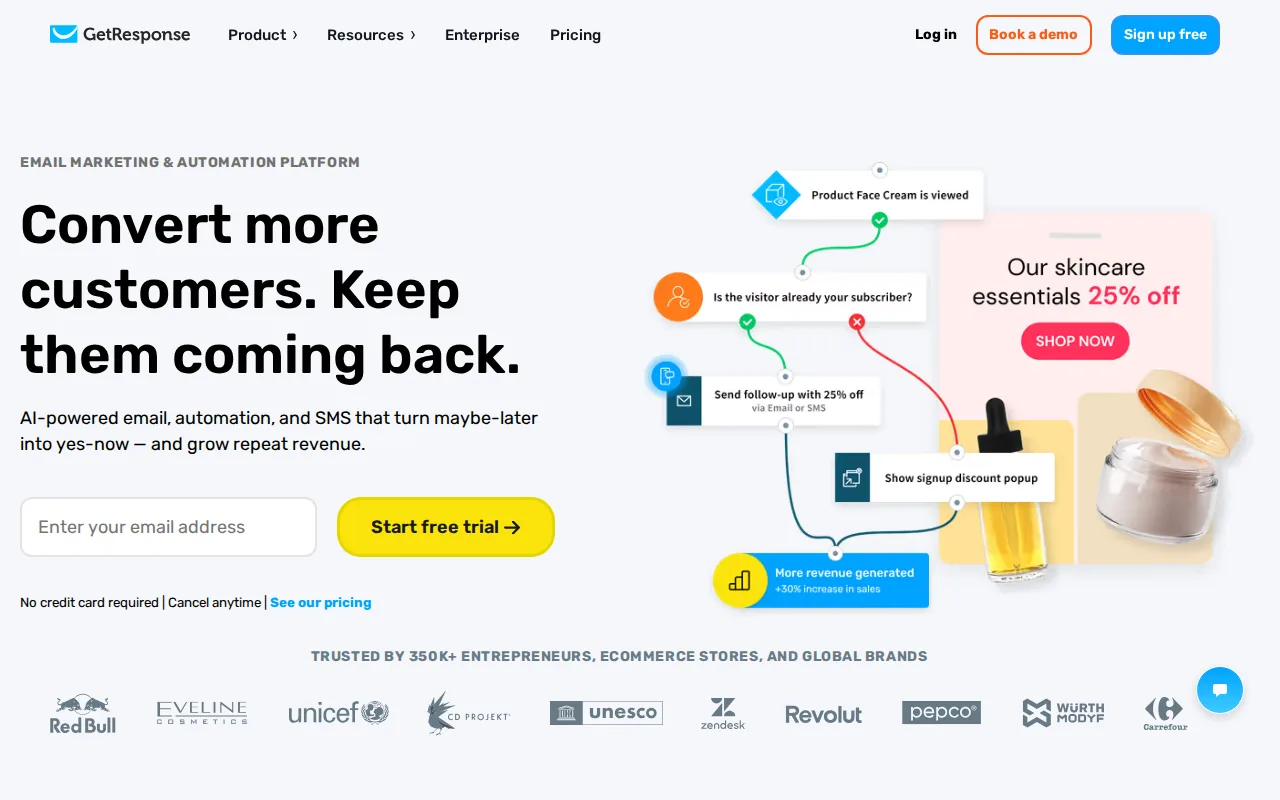
- GetResponse combines email, SMS and web push with ready-made ecommerce workflows, including abandoned cart and product-view follow-ups.
- Mailchimp is a familiar option for smaller lists, though its ecommerce automation is lighter than the specialists.

Pricing and features change often, so check each vendor's current plans before you commit. What matters more than the logo is the integration: your store has to pass the cart contents, the customer email and the order event to the tool reliably.
Where Your Store Platform Fits
On a hosted platform, abandoned checkout emails are often built in or one app away. On a headless or custom storefront you wire it yourself, which is more work but gives you control over the data.
With Your Next Store, carts, orders and customers live in the commerce backend and are available through the REST API, and checkout runs on Stripe. That means you can send cart and order events to the email tool you prefer rather than being tied to one.
The Abandoned Carts module sends one built-in reminder email. For the full three-email sequence, connect an email tool. The GetResponse add-on does this without custom code: when a shopper types their email at checkout, the cart appears in GetResponse, and the finished order is matched to it. GetResponse's abandoned cart workflow starts on its own and stops the moment they pay. Your catalog, customers and orders sync too, so the emails show the right products.
With any other tool, send the same cart and order events through the API. Either way, capture the shopper's email early in checkout. If you are weighing how much of the stack to own, our checkout optimization guide covers what to fix before you chase abandoned carts with email.
Beyond Email: SMS and Onsite Recovery
Email is the baseline, but it is not the only lever:
- SMS has high open rates, but consent rules are stricter. In the US, marketing texts need prior express written consent under the TCPA, so only text people who opted in to SMS specifically.
- Exit-intent and onsite messages catch visitors before they leave, though they only help if the offer is useful.
- Retargeting ads work for carts without an email address, but you pay for every click.
Start with email, get the flow healthy, then layer SMS for opted-in customers.
Fix the Reason They Left First
Email recovers carts. It does not fix why carts were abandoned. Baymard's checkout research repeatedly points to a familiar list: extra costs shown too late, forced account creation, a long or confusing checkout, and limited payment methods. If your abandonment rate is well above the benchmark, fix those first. The cheapest recovered sale is the one that never needed an email.
A quick audit:
- Show total cost, including shipping and tax, before the last step.
- Offer guest checkout.
- Offer the payment methods your customers actually use.
- Keep the page fast. Our speed optimization guide covers the biggest wins.
Compliance: US, EU and UK
Abandoned cart emails are marketing or transactional depending on how you write them, and the rules differ by region.
- United States. The CAN-SPAM Act requires a truthful sender and subject line, your physical postal address, and a working opt-out honored within 10 business days. It does not require prior opt-in for email.
- European Union. Under the ePrivacy Directive (Article 13) and GDPR, marketing email generally needs consent. Some member states allow a "soft opt-in" for existing customers, but a cart that never became an order often does not qualify, so many EU stores only email abandoned carts to shoppers who ticked a marketing box.
- United Kingdom. The ICO's rules on electronic marketing under PECR are similar to the EU, with consent usually required unless the soft opt-in applies.
Always check the current rules where you sell. This guide summarizes US, EU and UK email marketing rules as of October 2026. Regulations change and vary by country and member state, so confirm the details with your local regulator or a privacy specialist before you launch. This is general information, not legal advice.
How to Measure the Flow
Track these four numbers per email, and for the flow as a whole:
| Metric | What it tells you |
|---|---|
| Click rate | Whether the subject, product block and button are working |
| Placed-order rate | The real conversion rate of the flow |
| Revenue per recipient | The number to compare against the benchmarks above |
| Unsubscribe and complaint rate | Whether you are too aggressive |
Check the flow monthly. Expire old carts, watch for broken product images, and make sure the exit-on-purchase rule still works after any checkout change.
FAQ
How many abandoned cart emails should I send?
Three is a safe default: a reminder at about an hour, a reassurance email at about a day, and a final nudge at about three days. More than that often raises unsubscribes faster than it raises revenue, but test it against your own numbers.
Should I include a discount in abandoned cart emails?
Not in the first email. If you offer one, keep it to the last email and gate it on cart value so you do not train customers to abandon carts for a coupon.
When should I send the first abandoned cart email?
Roughly 30 to 60 minutes after the shopper leaves. Earlier risks emailing someone who is still deciding, and later lets the intent cool.
Do abandoned cart emails work if I don't have a shopper's email address?
No. The flow needs an email address, so capture it early in checkout. For anonymous carts, retargeting ads are the usual fallback.