
9 Best Saleor Alternatives for Headless Ecommerce (2026)
 Jakub Neander
Sep 25, 202614 min read
Saleor's GraphQL schema is one of the best-designed APIs in open-source commerce, and that is rarely why people go looking for a way off it. The real reasons show up after launch: Python and Django are a second stack for a JavaScript-first team, self-hosting means running Postgres, Redis, and Celery workers, and Saleor Cloud's pricing jumps straight from "free to self-host" to $1,599/mo with no smaller managed tier in between. This guide compares the best Saleor alternatives in 2026, organized by what's actually pushing you toward the door.
Bias disclosure: We build Your Next Store, one of the platforms on this list. We name where it's weaker than Saleor (no GraphQL API, no free self-hosted backend, no native multi-channel modeling), and we cover Saleor's real strengths, not a caricature of them.
Saleor Alternatives at a Glance (September 2026)
| Platform | Type | Starting price | Self-hosted option | Best for |
|---|---|---|---|---|
| Saleor (for reference) | Open-source engine (Python, GraphQL) | Free self-host; Cloud from $1,599/mo | Yes | GraphQL-first, multi-channel catalogs |
| Your Next Store | Managed backend + open-source storefront | $30/mo | Storefront only | An AI-built storefront on a backend you don't operate |
| Medusa | Open-source engine (Node, TS) | Free self-host; Medusa Cloud from $29/mo | Yes | TypeScript teams who want to own the backend |
| Vendure | Open-source engine (NestJS, GraphQL) | Free core (GPLv3); Platform on quote | Yes | Plugin-first TypeScript backend, B2B |
| Shopify | Managed SaaS (+ Hydrogen for headless) | $29/mo (annual) | No | Teams who'd rather not run infrastructure at all |
| BigCommerce | Managed SaaS (+ Catalyst for headless) | $29/mo (annual) | No | Mid-market with revenue caps they've accepted |
| commercetools | Composable commerce (enterprise) | Custom contract | No | Enterprise programs with a platform team |
| Sylius | Open-source engine (PHP, Symfony) | Free (MIT) | Yes | PHP teams who want the Saleor idea in Symfony |
| Swell | Managed headless SaaS | $29/mo (annual) | No | Subscriptions and digital + physical in one catalog |
| WooCommerce | Free plugin (PHP), Store API for headless | Free + hosting | Yes | Teams already committed to WordPress |
Prices are public list prices checked against each vendor's own pricing page in September 2026. Payment processing fees are separate from every number above.
What Saleor Actually Is (and Why People Look Elsewhere)
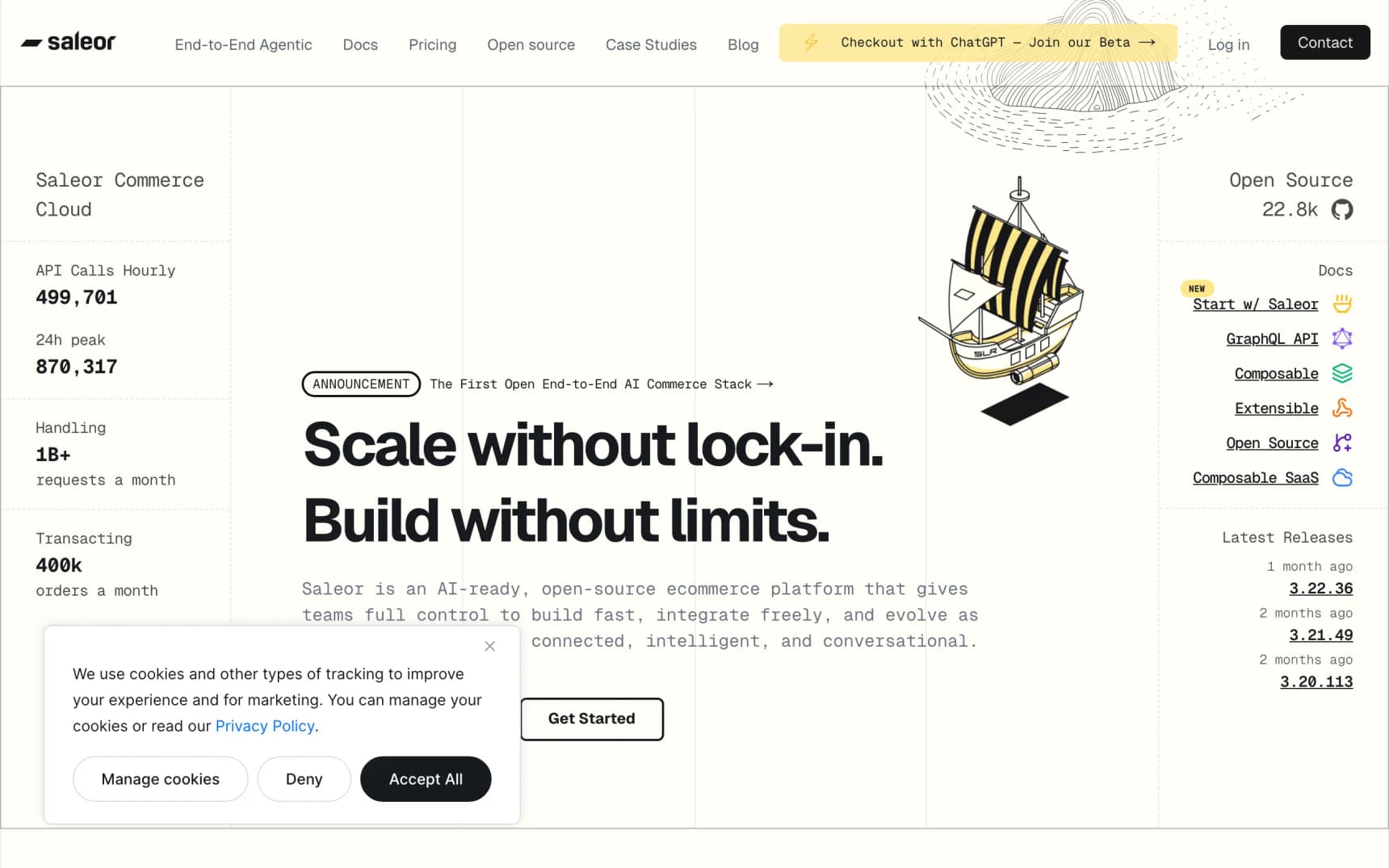
Saleor is open-source, BSD-3-Clause headless commerce built on Python, Django, and GraphQL. Where most engines bolt a GraphQL layer onto a REST core, Saleor was rebuilt around GraphQL as the only API surface: one typed, introspectable schema for products, orders, channels, and warehouses instead of a growing list of REST endpoints. The project has more than 23,000 stars on GitHub as of September 2026, and Saleor's own numbers put the platform at over 1 billion monthly API requests and 400,000 orders processed monthly across its customer base, with SOC 2, GDPR, and PCI-DSS compliance for the managed Cloud.
Saleor's 2026 homepage leads with "Commerce Infrastructure. Made-to-Measure for You." and a prominent "Built for AI" navigation link: the pitch has shifted toward agentic and conversational commerce, tech-agnostic client support (TypeScript, Python, PHP, Ruby, Go, .NET are all named as first-class GraphQL consumers), and positioning against vendor lock-in.
So why do people go looking for a Saleor alternative at all? A few honest, recurring reasons:
- Python, Django, and GraphQL is a three-skill hire. If your team is JavaScript or TypeScript end to end, adopting Saleor means either hiring for a second backend language or asking your frontend engineers to also own a Django codebase. That's a real cost, not a preference.
- Self-hosting means running four things, not one. Saleor's own docs call for PostgreSQL, Redis, Celery background workers, and object storage for media, on top of the API service itself. It's the same shape of operational load as self-hosted Medusa or Vendure, just with a Python toolchain instead of a Node one.
- There's no REST fallback. GraphQL as the entire surface area is a feature for teams that want it and friction for everyone else. A REST-first team adopting Saleor is adopting a codegen step, a client library like
graphql-requestor Apollo, and a new mental model for pagination and errors, not just a new base URL. - The storefront is bring-your-own. Saleor publishes a Next.js storefront example, but treat it as a reference implementation to heavily customize, not a finished theme. The gap between that starting point and a polished, AI-generated storefront is real, and closing it is your team's job.
- Cloud pricing has no small-team tier. Self-hosted is free. Saleor Cloud starts at $1,599/mo for the Select plan (up to $200,000 monthly GMV, with a 0.8% fee above that), and jumps to $3,999/mo for Volume (up to $1M GMV, 0.4% fee above that), with custom Enterprise pricing beyond it. There's a free sandbox for prototyping, but nothing priced for a small team that wants the ops handled without a five-figure annual commitment.
If one or two of those match your situation, the rest of this guide is for you. If you're comparing the full field of headless platforms rather than shortlisting a couple of names, our best headless commerce platforms roundup ranks 14 of them side by side.
The 9 Best Saleor Alternatives
1. Your Next Store
Best for: Teams who want a managed backend and an AI-built storefront instead of operating Saleor's Python stack themselves.
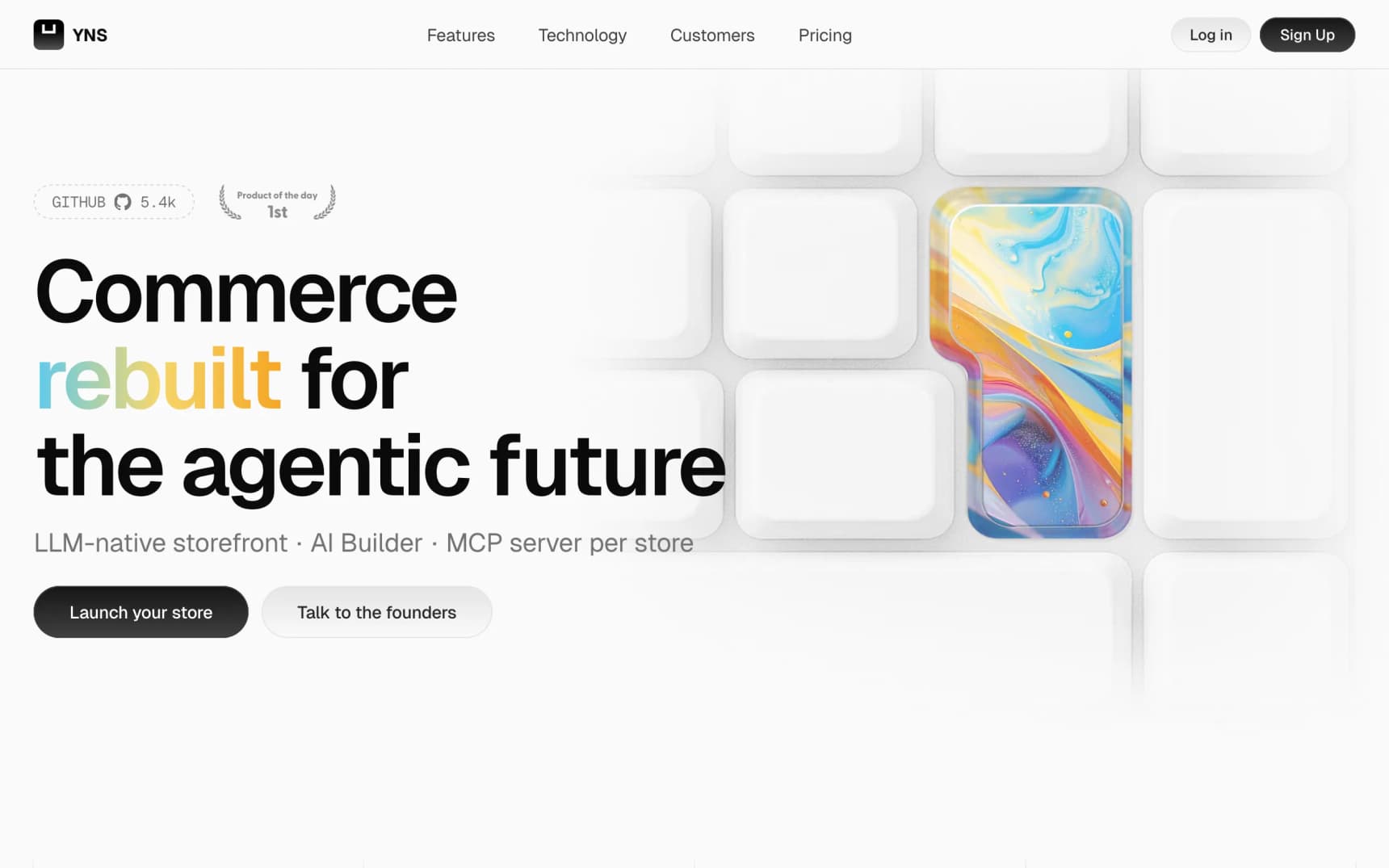
Your Next Store is a managed commerce backend (products, carts, orders, inventory, customers, blog, and search in Postgres, with an admin dashboard and an AI store builder) paired with a free, open-source Next.js storefront that talks to the backend through the typed Commerce Kit SDK. Stripe handles payment processing; there's no Postgres, Redis, or Celery cluster for your team to keep patched. A live storefront built this way runs at demo.yournextstore.com.
Mapped onto Saleor's specific gaps: the API is REST with a typed SDK instead of GraphQL, so a JavaScript-only team never touches a second language; the storefront ships closer to finished (AI-generated layout and copy, not a reference implementation you rebuild); and pricing is a flat monthly fee with no GMV-based jump between tiers.
Standouts: AI store builder that edits your live storefront by chat, 0% platform transaction fees on every plan, typed REST SDK generated from OpenAPI, GEO-ready structured data out of the box.
Tradeoffs, honestly: No GraphQL API, so teams that specifically want a single introspectable schema across products, orders, and channels won't find one here. No free plan (Starter is $30/mo). The backend is managed, not something you can self-host if you outgrow it, only the storefront is open-source. Multi-channel selling (separate currencies, warehouses, and price lists per channel) isn't a first-class concept the way it is in Saleor's core.
Pricing: Starter $30, Growth $60, Pro $360 per month. 0% platform fees on every plan.
Want the ops handled without giving up a typed API? Describe your store, get a working storefront, and skip the Postgres-plus-Redis-plus-Celery stack.
2. Medusa
Best for: Teams that want to leave Python behind entirely and own a TypeScript backend instead.
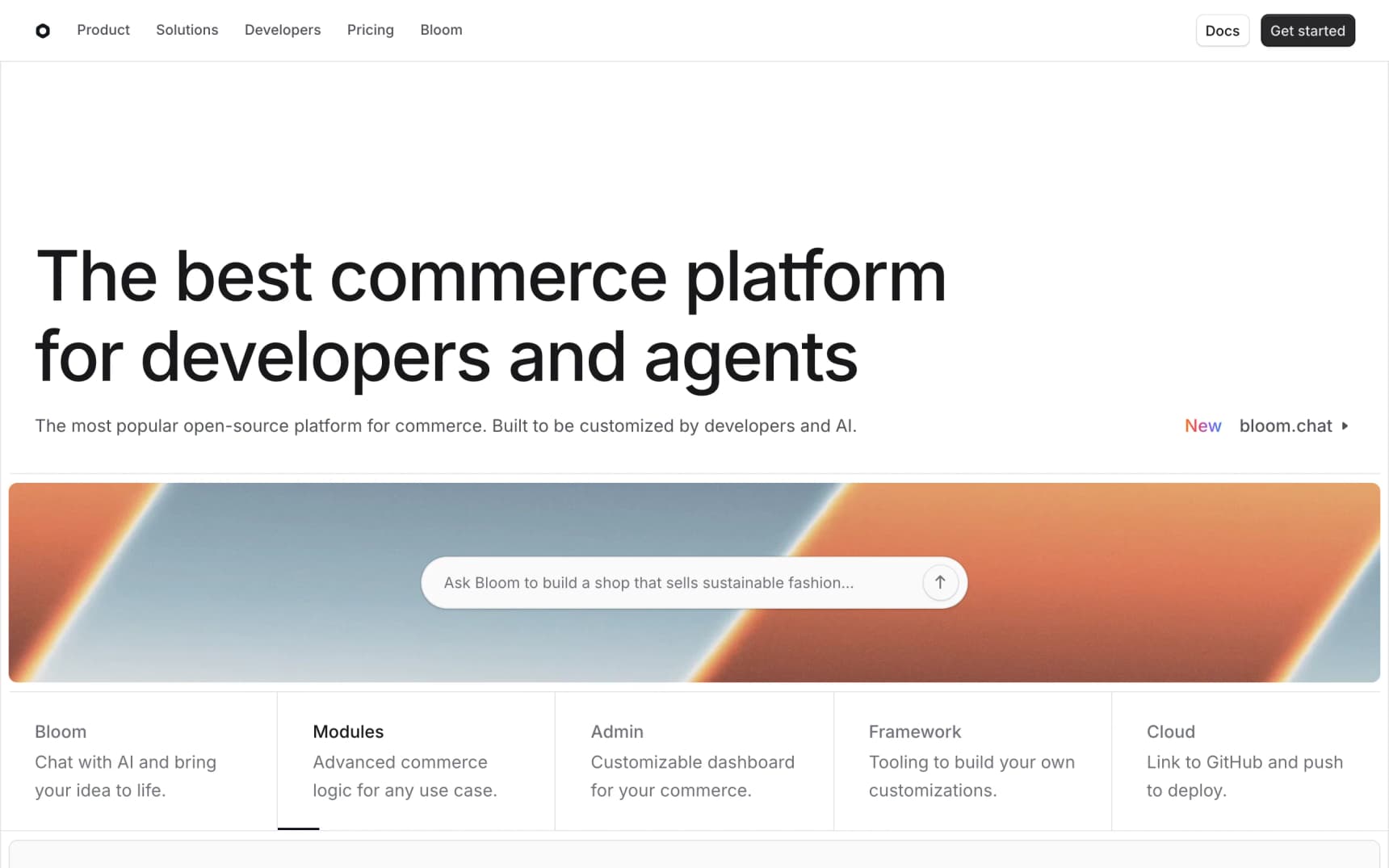
Medusa is the platform most often mentioned in the same breath as Saleor, because the comparison is close to a straight swap: both are open-source, self-hostable commerce engines built for developers who want to own the backend. The difference is the stack. Medusa is Node.js, TypeScript, and PostgreSQL with a REST API plus a typed JS SDK; Saleor is Python, Django, and GraphQL. If "I want out of Python" is the actual reason you're reading this, Medusa is the most direct answer, not just an alternative.
Medusa has more than 36,000 stars on GitHub as of September 2026, and npx create-medusa-app@latest gets a running admin dashboard and API locally in minutes. Medusa Cloud starts at $29/mo (Develop), with autoscaling at $99/mo (Launch) and background workers plus priority support at $299/mo (Scale), none of which charge a GMV fee, a real contrast with Saleor Cloud's revenue-based pricing.
Standouts: TypeScript end to end, module-based architecture (payments, tax, and fulfillment are swappable), Medusa Cloud with no GMV fees at any tier.
Tradeoffs, honestly: REST plus a JS SDK instead of GraphQL, the opposite tradeoff of leaving Medusa's own alternatives guide would name. No native multi-channel modeling as deep as Saleor's channels concept; multi-region setups lean more on custom module work. Self-hosting is still three deployables (backend, admin, storefront) with the same Postgres operational load, just without Saleor's additional Redis and Celery requirement.
Pricing: Free to self-host. Medusa Cloud from $29/mo, no GMV fees.
3. Vendure
Best for: Teams that want to stay on GraphQL but move to a TypeScript backend with a cleaner plugin system.
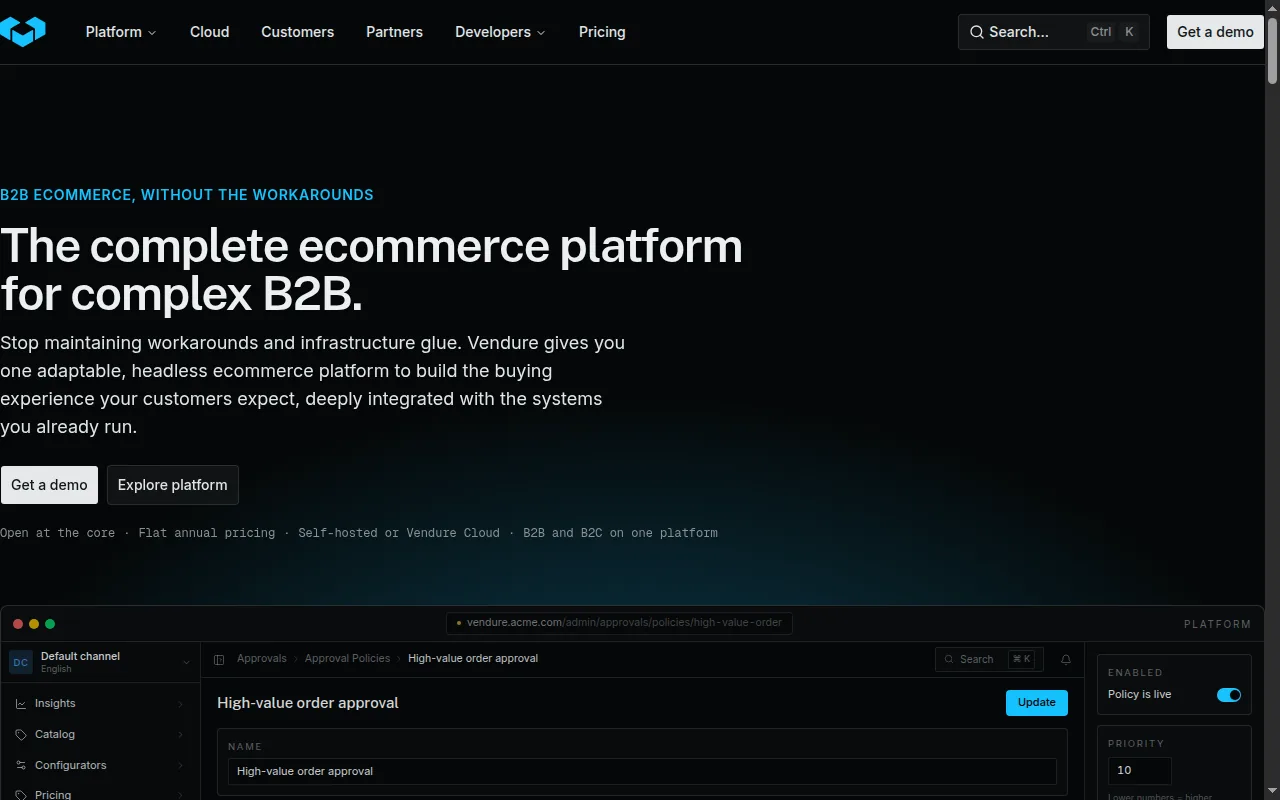
Vendure keeps the part of Saleor's architecture that GraphQL-first teams actually like (one typed, introspectable API) while swapping Python and Django for NestJS and TypeScript. Its admin and shop APIs are separate GraphQL schemas by default, which is a cleaner default than exposing a single graph to both internal tooling and public storefronts. Vendure's plugin architecture is widely regarded as the cleanest of any open-source commerce framework, with a small core and well-documented extension points.
Vendure Core is free under GPLv3 (with a plugin exception so commercial plugins don't have to open-source). The commercial Vendure Platform adds B2B features, support, and IP indemnification under a flat annual license, quoted per project, with no GMV, order, or user-based charges, a meaningfully different pricing shape than Saleor Cloud's revenue caps.
Standouts: GraphQL end to end like Saleor, but on a TypeScript stack; separate admin and shop schemas; flat quoted commercial pricing with no revenue scaling.
Tradeoffs, honestly: No published self-serve pricing for the Platform tier, you talk to sales even for the commercial layer. Smaller community than Saleor's, so fewer pre-built integrations. No official storefront template at all, where Saleor at least ships a reference Next.js example to start from.
Pricing: Core free (GPLv3). Vendure Platform and Vendure Cloud on quote.
4. Shopify
Best for: Teams that priced out self-hosted Saleor and decided they'd rather not run infrastructure, Python or otherwise, at all.

Shopify is the platform most people compare against Saleor once "should we even self-host anything" becomes the real question. It's the opposite bet: you give up backend ownership entirely and pay a subscription (plus a per-sale fee if you skip Shopify Payments) in exchange for zero ops. If your actual complaint about Saleor was "I don't want to run Postgres, Redis, and Celery workers," Shopify solves that completely, not partially, and without a five-figure Cloud contract.
For teams that specifically want headless on Shopify's data model, Hydrogen is the framework: a React storefront on Shopify's GraphQL Storefront API, deployed to Oxygen. Notably, Hydrogen keeps GraphQL as the query language, so a team leaving Saleor for Shopify doesn't have to give up typed GraphQL queries entirely, just the backend that serves them.
Standouts: Zero infrastructure to run, the largest app ecosystem in ecommerce, Hydrogen as a real GraphQL-based headless path if you stay in Shopify's data model.
Tradeoffs, honestly: You don't own the backend code the way you do with Saleor; there's no self-hosted option at any price. The per-sale fee (2% on Basic without Shopify Payments) adds up. Multi-channel selling across currencies and warehouses is handled through Shopify Markets and apps, not modeled in the core schema the way Saleor's channels are.
Pricing: Basic $29/mo (annual, $39 monthly), Grow $79/mo, Advanced $299/mo. Plus from roughly $2,300/mo.
5. BigCommerce
Best for: Teams that want more commerce logic built into the core than Shopify ships, with a maintained Next.js headless path.
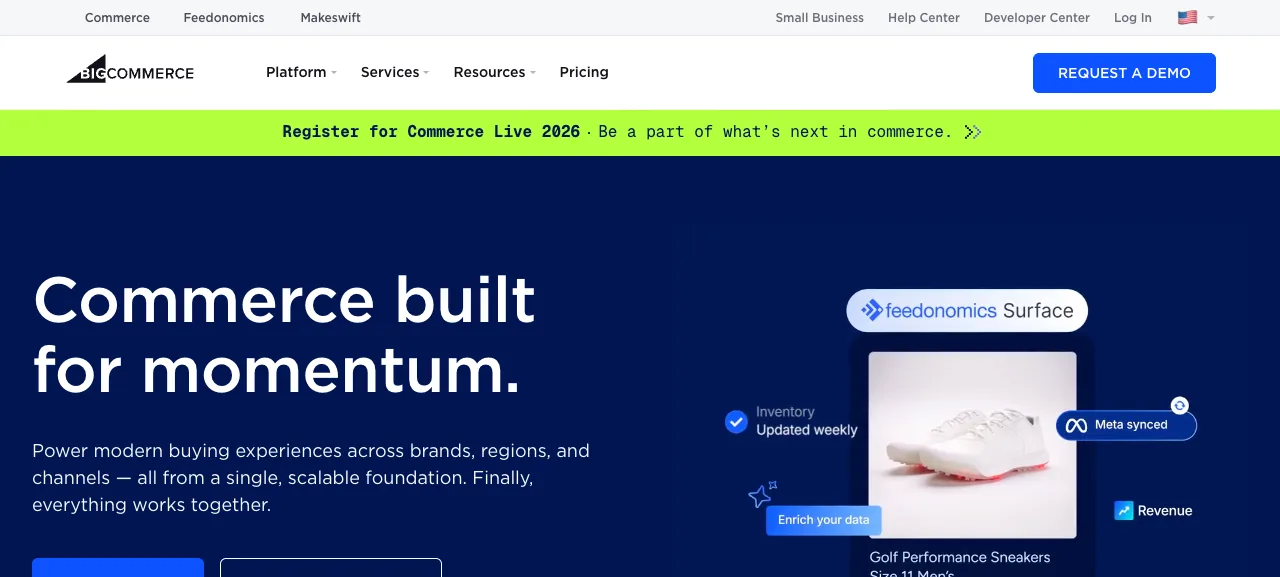
BigCommerce sits between Shopify's app-everything model and Saleor's build-everything model: more B2B, promotions, and multi-storefront capability shipped in the core than Shopify, but still a closed SaaS platform you don't self-host. Its headless story is Catalyst, a Next.js storefront framework BigCommerce maintains itself, which is the closest thing on this list to "Saleor's developer experience with the backend run for you."
Standouts: More built-in commerce logic than Shopify out of the box, Catalyst gives a maintained Next.js path, decent native B2B (customer groups, price lists on higher plans), multi-storefront support closer to Saleor's multi-channel modeling than Shopify's.
Tradeoffs, honestly: Every plan has a revenue cap (Core tops out around $30K in trailing-twelve-month sales), and using a payment provider outside its embedded list adds a fee. No self-hosted option if you want to own the backend the way Saleor lets you.
Pricing: Core $29/mo (annual), Growth $79/mo, Scale $299/mo, Performance from $1,499/mo.
6. commercetools
Best for: Enterprise programs already comparing Saleor Cloud's $1,599+/mo tier against a full composable platform.
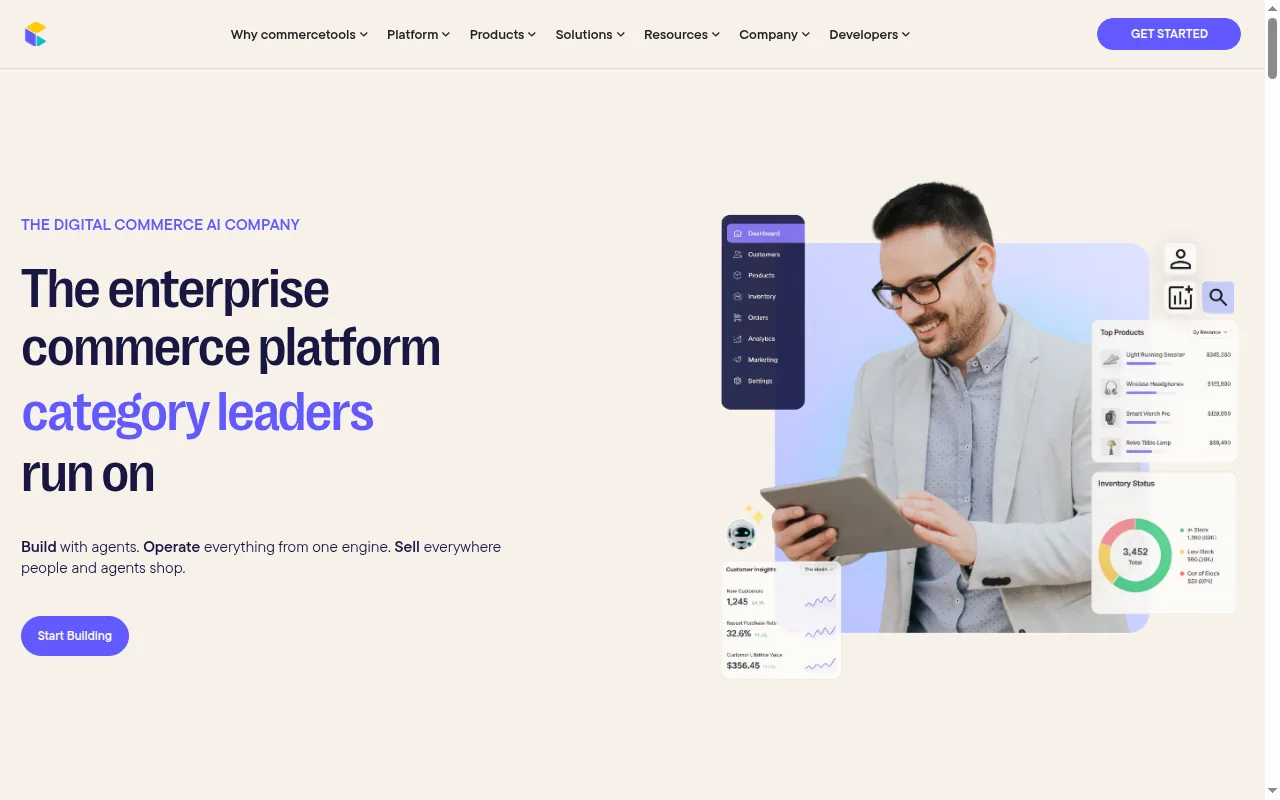
Once Saleor Cloud's pricing puts you in enterprise-budget territory anyway, it's worth comparing against the platform actually built for that tier. commercetools is API-first, composable commerce: catalog, cart, checkout, and order management as separate services you assemble, rather than a bundled engine with a GraphQL schema and a reference storefront included. Its customer list includes enterprises like L.L.Bean and Bang & Olufsen, running dozens of storefronts and brands from one backend, a scale most teams evaluating Saleor haven't hit yet. If you're comparing commercetools itself rather than arriving from Saleor, see our dedicated commercetools alternatives guide.
Standouts: Built for multi-brand, multi-region programs at a scale beyond what Saleor's channels concept targets, strong ecosystem of certified integration partners, an "order-based, not GMV-based" pricing model with a free trial.
Tradeoffs, honestly: No published price list even with the trial, you still negotiate a contract. No storefront, admin UI, or CMS included, composable means you (or a systems integrator) build and maintain all of it. Overkill for the team size that typically evaluates Saleor in the first place.
Pricing: Custom annual contracts. Free trial available.
7. Sylius
Best for: PHP and Symfony teams who want the Saleor idea (open-source, API-first, self-hosted) without leaving their language.
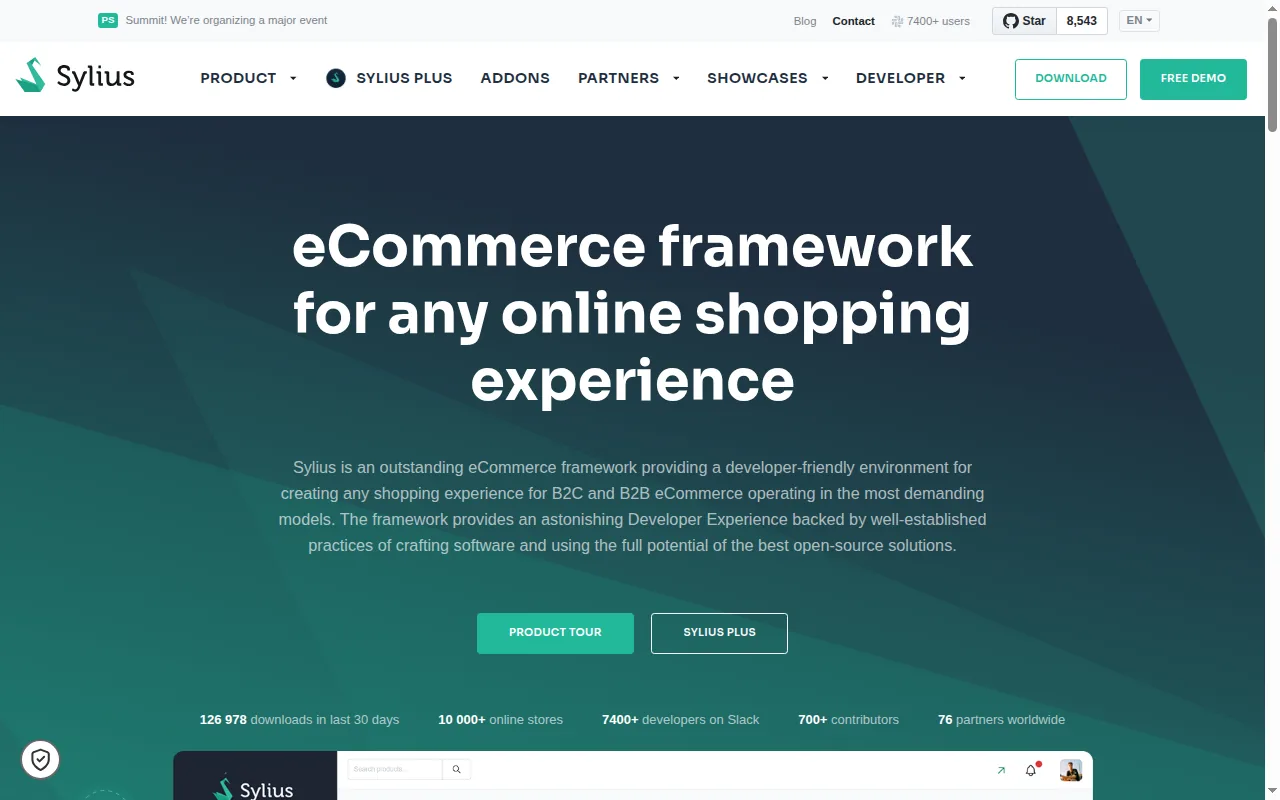
Sylius is the closest thing to a PHP-world Saleor: open-source under the MIT license, built on Symfony, with an API generated through API Platform that supports both REST and GraphQL. As of September 2026, Sylius reports more than 8,500 GitHub stars, 7,400+ developers on its Slack, 10,000+ online stores running on it, and 700+ contributors, a healthy, active community even if it's smaller than Saleor's. The commercial Sylius Plus edition adds B2B features (multi-store management, partial fulfillment, a loyalty system) under a quoted license, the same shape as Vendure's commercial tier.
Standouts: PHP and Symfony instead of Python and Django, useful if that's already your team's language; both REST and GraphQL available through API Platform rather than GraphQL-only; MIT license with no revenue-based Cloud pricing to negotiate.
Tradeoffs, honestly: Smaller ecosystem than Saleor's, and PHP is only a win here if it's genuinely your team's language, not a lateral move for a Python or JS shop. No managed cloud offering as mature as Saleor Cloud, self-hosting is the default path. Multi-channel modeling exists but isn't as deeply built into the core data model as Saleor's channels.
Pricing: Free to self-host (MIT). Sylius Plus on quote.
8. Swell
Best for: Teams that want Saleor's flexibility without the infrastructure, and need native subscriptions in the same catalog.
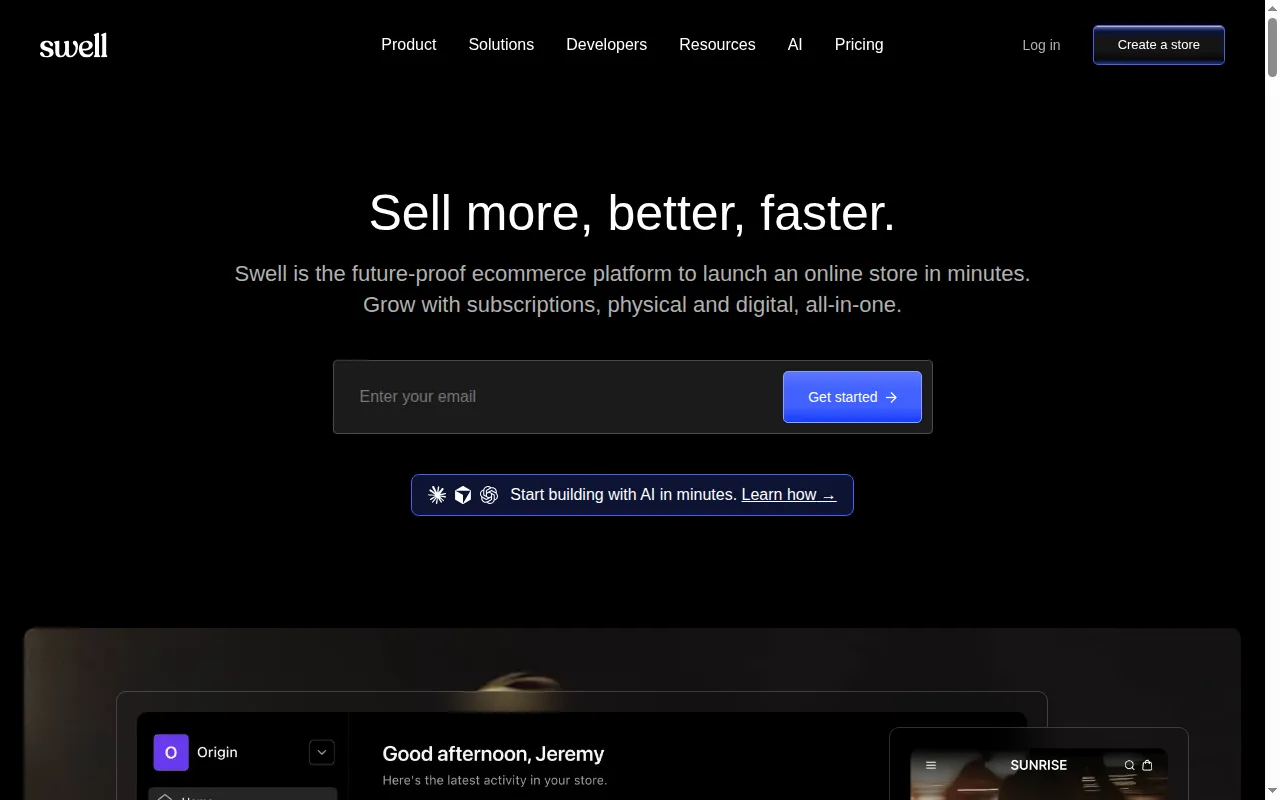
Swell is managed headless commerce built for a gap Saleor leaves open by design: subscriptions and mixed digital-plus-physical catalogs are native product types, not something you model yourself in a flexible schema. It's a reasonable fit for teams that liked Saleor's flexible data model in principle but don't want to run the infrastructure or write the subscription logic by hand.
The honest complication: Swell's own plans carry revenue ceilings with overage fees, a different pricing shape than Saleor Cloud's flat tiers plus overage rate, but a ceiling nonetheless. Starter ($29/mo) is capped at $50K/year, Basic ($79/mo) at $250K, and each tier above that raises the ceiling and lowers the overage rate.
Standouts: Native subscriptions and digital-plus-physical catalogs in one product model, managed infrastructure with no Python or Celery to run, flexible enough schema that it doesn't feel like a rigid SaaS box.
Tradeoffs, honestly: Revenue-based plan ceilings and overage fees, so a fast-growing store's platform bill grows with it. No GraphQL API. Smaller ecosystem and community than Saleor's.
Pricing (Swell pricing, annual): Starter $29/mo ($50K ceiling), Basic $79/mo ($250K), Standard $299/mo ($1M), Unlimited $2,250/mo ($5M), Custom above that.
9. WooCommerce
Best for: Teams whose actual complaint about Saleor is "we don't need this much backend for a WordPress-driven catalog."
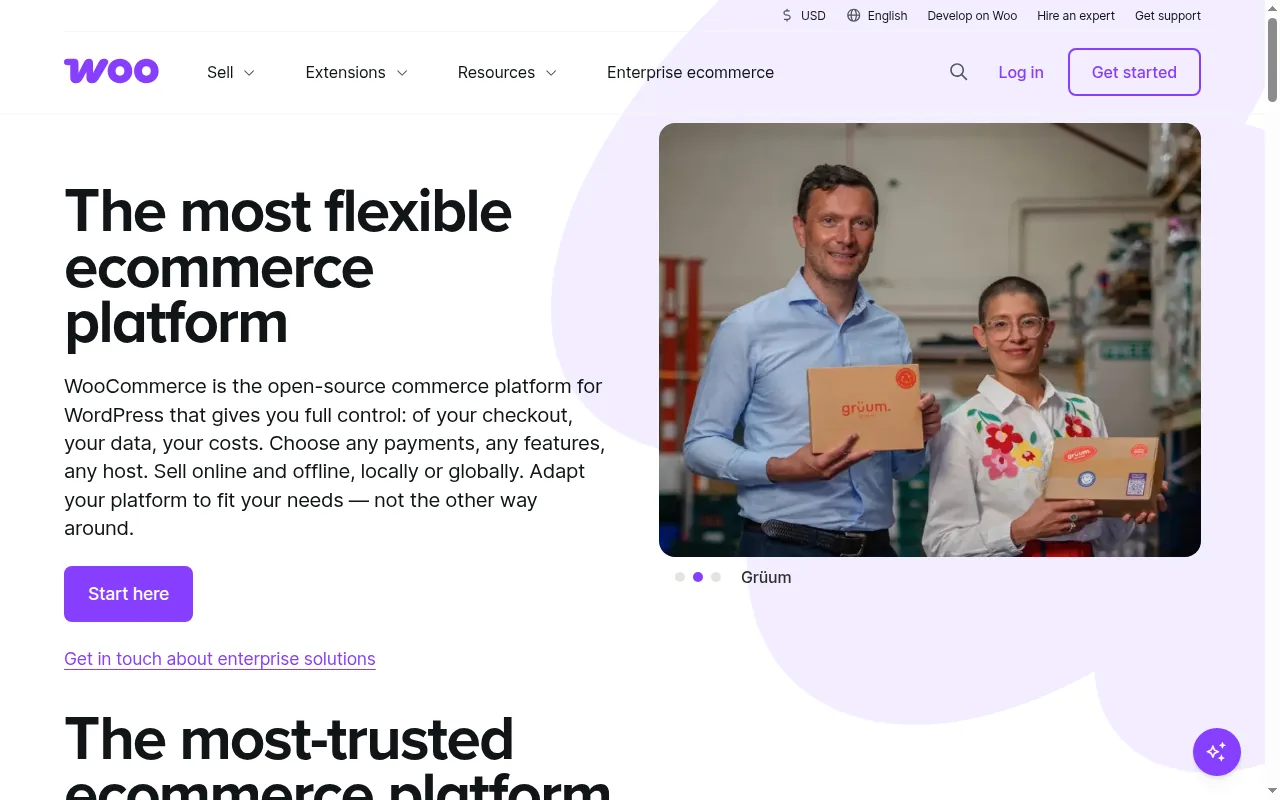
If your Saleor evaluation started because a non-technical stakeholder needs to manage content and products in one place, WooCommerce is worth a second look before committing to any GraphQL-native engine. It's free, runs on WordPress, and can go headless later through the Store API if performance becomes the actual issue rather than the plugin model. See our deeper WooCommerce vs Next.js comparison for what that headless path looks like in practice.
Standouts: Free plugin, unmatched ecosystem of themes and extensions, content and commerce in one CMS your marketing team can already use.
Tradeoffs, honestly: PHP, server-rendered architecture is a different paradigm from Saleor's Python/GraphQL stack, so this isn't a lateral move for a team that specifically wanted an API-first engine; it's a different kind of tradeoff entirely. No native GraphQL API, and no multi-channel modeling in the core. Plugin sprawl and update overhead are real operational costs of their own.
Pricing: Plugin free. Real cost: $10-50/mo hosting plus extensions.
Migrating from Saleor
The data model usually isn't the hard part: Saleor's products, variants, and orders map cleanly onto most alternatives here. The parts that take real time:
- Export your channel structure first, not just products. Saleor's channels (currencies, warehouses, price lists) don't have a direct equivalent on every platform. Audit which channels you actually use before mapping them to the new platform's regions, markets, or duplicated stores.
- Custom GraphQL resolvers and Django apps don't move with you. Any business logic you wrote against Saleor's plugin manager or as a custom Django app is Saleor-specific code. Budget real time to rebuild it against the new platform's extension points, not just re-point it.
- Orders, customers, and subscription state need their own export. Same rule as every commerce migration: pull this data into your own storage before you decommission anything, regardless of which platform you're moving to.
- Decide what happens to your storefront. If you built on Saleor's Next.js example, some of that frontend code (components, layout) can carry over even when the backend changes, since you're swapping GraphQL queries for the new platform's API, not necessarily the UI.
- Test checkout and webhooks end to end before cutting DNS. Payment webhook shapes differ between Saleor's payment app model and whatever the new platform uses, whether that's Stripe, Shopify Payments, or something else.
- If you're EU or UK based, confirm the new platform's VAT and returns handling before go-live. Saleor's multi-channel model made region-specific pricing and tax straightforward; check that the platform you're moving to handles it with the same clarity rather than assuming parity.
For Developers: The Same Query, Three Platforms
If you're not evaluating this technically, skip to the FAQ.
Here's "get the first 12 products in the t-shirts category" against Saleor, Your Next Store, and Medusa, side by side:
Saleor (GraphQL with codegen):
Your Next Store (typed REST SDK):
Medusa (typed JS SDK on top of REST):
All three are typed. The real difference shows up six months in, not on day one: YNS and Medusa read like calling a library and reading autocomplete; Saleor's payoff is in deeply nested, cross-entity queries, where one GraphQL round trip replaces several REST calls, and the codegen step means your frontend types update automatically when the schema changes. Pick based on the shape of your actual queries, not on which syntax looks cleaner in a blog post.
What nobody tells you about self-hosting Saleor at month six: the GraphQL schema itself doesn't get harder to work with, it stays genuinely pleasant. What eats time is the surface area around it: a Celery worker queue that needs its own monitoring separate from the API service, a Redis instance that becomes a second thing to size and back up, and a Django admin that's functional for internal tooling but isn't what you hand a merchandiser who expects a polished dashboard. None of that is a knock on Saleor's schema design, which is genuinely some of the best in the category. It's the standing cost of "you own four services instead of one," which is real whether you're running Saleor, Medusa, or Vendure self-hosted, just with a different toolchain attached.
FAQ
What is the best alternative to Saleor?
It depends on what's actually pushing you away from it. For a managed backend with an AI store builder and no infrastructure to run: Your Next Store. For staying open-source and self-hosted but swapping Python for TypeScript: Medusa. For keeping GraphQL but moving to a TypeScript backend with a cleaner plugin system: Vendure. For zero infrastructure and the biggest app ecosystem: Shopify.
Is Saleor still worth using in 2026?
Yes, for the team it's built for: Python and GraphQL-comfortable developers who want a genuinely well-designed schema and are prepared to run Postgres, Redis, and Celery in production, or who use Saleor Cloud to remove that operational load at enterprise pricing. It's the wrong fit if your team is JavaScript-first, you want a REST fallback, or you need a managed tier priced for a small team rather than an enterprise budget.
Is Medusa or Vendure more similar to Saleor?
Neither is a perfect match, since both trade away one of Saleor's two defining traits. Vendure keeps GraphQL as the entire API surface, the same shape as Saleor, but swaps Python and Django for NestJS and TypeScript. Medusa keeps the "open-source engine you self-host" model but trades GraphQL for REST plus a typed SDK. Pick based on which trait, the language or the API style, matters more to your team.
Related Blog Posts
- Best Headless Commerce Platforms of 2026
- Medusa Alternatives for Headless Ecommerce
- commercetools Alternatives for Growing Brands
- What Is Headless Commerce?
- Open Source Shopify Alternatives
Saleor earns its place in this category honestly: its GraphQL schema is some of the best API design in open-source commerce, and self-hosting it is a legitimate choice for a team that wants to own every layer and is comfortable in Python. The question this guide actually answers isn't "is Saleor good," it's "does your team want to run Postgres, Redis, and Celery workers behind a Python API, or would you rather that decision be made for you," and that answer should decide where you land, not which platform has the more elegant schema.
Want a typed API without running Postgres, Redis, and Celery yourself? Try Your Next Store. AI-built storefront, managed backend, 0% platform fees.