7 Best commercetools Alternatives for Growing Brands (2026)
 Jakub Neander
Sep 23, 202614 min read
commercetools doesn't publish a price list, and for a growing brand that's usually the first sign it's shopping in the wrong aisle. It's a genuinely powerful composable commerce platform, built for enterprises running dozens of storefronts across regions and brands. But "growing brand" and "enterprise procurement cycle" don't usually belong in the same sentence. This guide compares the best commercetools alternatives in 2026 for teams that want composable, API-first commerce (or something close to it) without the sales call, the systems integrator, and the custom contract.
Bias disclosure: We build Your Next Store, one of the platforms on this list. We name where it's weaker than commercetools (no multi-region, multi-brand composability, no self-hosted backend, a much smaller partner ecosystem), and we cover commercetools' real strengths, not a caricature of them.
commercetools Alternatives at a Glance (September 2026)
| Platform | Type | Starting price | Self-hosted option | Best for |
|---|---|---|---|---|
| commercetools (for reference) | Composable commerce (enterprise SaaS) | Custom contract; free trial available | No | Enterprise programs with a platform team |
| Your Next Store | Managed backend + open-source storefront | $30/mo | Storefront only | An AI-built storefront on a backend you don't operate |
| Shopify | Managed SaaS (+ Hydrogen for headless) | $29/mo (annual) | No | Fastest path to launch, biggest app ecosystem |
| BigCommerce | Managed SaaS (+ Catalyst for headless) | $29/mo (annual) | No | More commerce logic in the core, a maintained Next.js path |
| Saleor | Open-source engine (Python, GraphQL) | Free self-host; Cloud from $1,599/mo | Yes | GraphQL-first composability without the contract |
| Medusa | Open-source engine (Node, TS) | Free self-host; Medusa Cloud from $29/mo | Yes | TypeScript teams who want to own the backend |
| Vendure | Open-source engine (NestJS, GraphQL) | Free core (GPLv3); Platform on quote | Yes | Plugin-first TypeScript backend, strong B2B |
| Commerce Layer | Composable commerce APIs | Free Developer plan; Enterprise custom | No | commercetools' own category, with a free tier to start on |
Prices are public list prices checked against each vendor's own pricing page in September 2026. Payment processing fees are separate from every number above.
What commercetools Actually Is (and Why Growing Brands Look Elsewhere)
commercetools is API-first, composable commerce: a set of headless services (catalog, cart, checkout, order management, and more) that you assemble into a storefront, rather than a bundled platform with a storefront and admin UI included. Its own customer stories name enterprises like L.L.Bean and Bang & Olufsen, running commerce at a scale (dozens of storefronts, multiple brands, multiple regions from one platform) that most growing brands simply haven't reached yet.
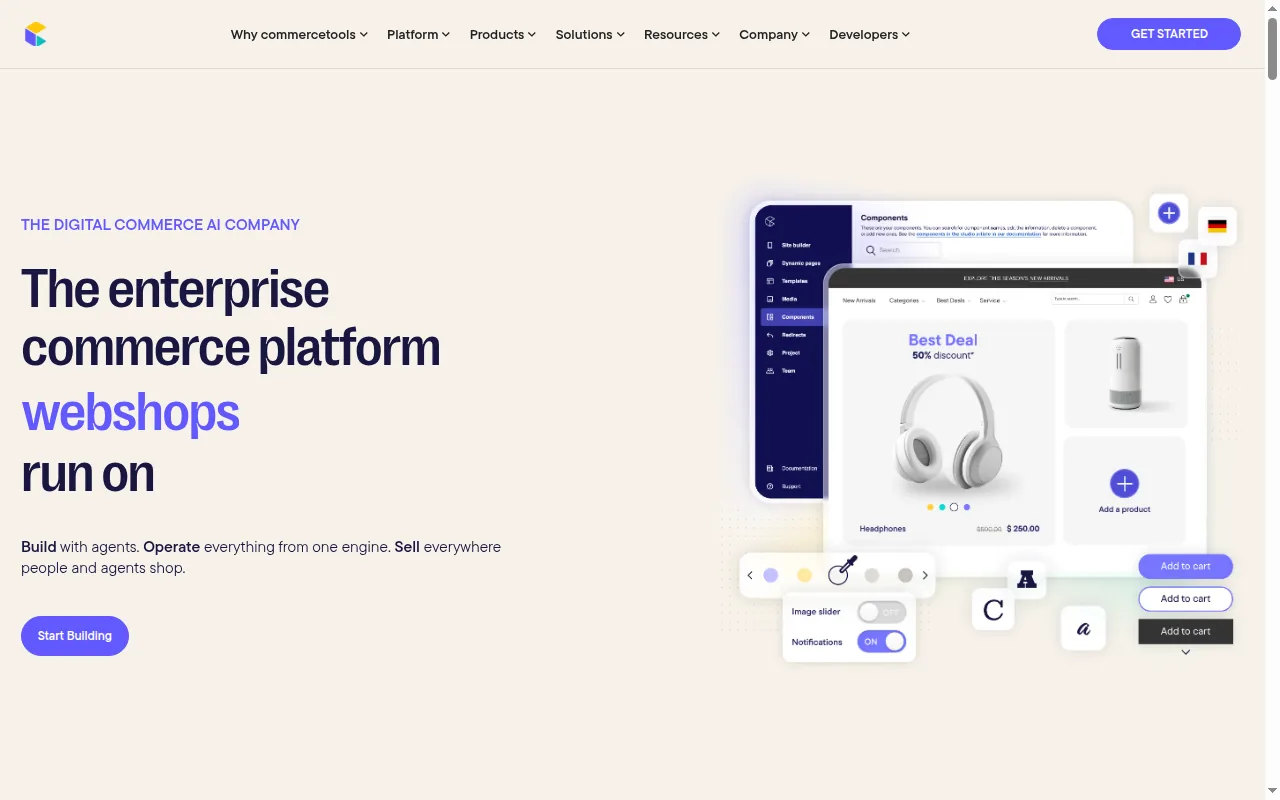
commercetools' 2026 positioning leans hard into agentic commerce: "Build with agents. Operate everything from one engine. Sell everywhere people and agents shop." That's a real, current shift in the platform's marketing, and it tells you who commercetools is actually building for: enterprises running AI-agent pilots across an existing multi-brand commerce stack, not a team shipping their first (or third) storefront.
So why do growing brands go looking for a commercetools alternative, or skip evaluating it in the first place? A few honest, recurring reasons:
- No published pricing, even with the free trial. commercetools now pitches an "order-based, not GMV-based" pricing model and offers a free trial, which is a real improvement over the pure black-box contract of a few years ago. But there's still no price list. The trial gets you into the product; the contract that follows is negotiated, which means a procurement cycle before you even know if it fits your budget.
- Composable means you assemble everything yourself. commercetools ships commerce APIs, not a finished storefront, admin UI, search, or CMS. You (or an integration partner) build and maintain the frontend, wire up search, and pick a CMS separately. That's the point of composable architecture, and it's real, ongoing engineering work that a bundled platform doesn't ask of you.
- It's built for a scale most growing brands haven't hit yet. Multi-brand, multi-region composability pays off once you're actually running several storefronts from one backend. Below that scale, you're paying for (and integrating) capability you're not using yet.
- Implementations commonly involve a systems integrator. Timelines vary a lot by scope, but a full composable rollout with a certified partner is realistically measured in months, not the days it takes to import a CSV into a SaaS platform.
- The AI-agent positioning is enterprise-grade too. "Agentic commerce" in commercetools' current pitch means large retailers piloting AI shopping agents across an existing stack, not a solo dev bolting an AI feature onto a first store.
If one or two of those match your situation, the rest of this guide is for you. If you're comparing the full field of headless platforms rather than shortlisting a couple of names, our best headless commerce platforms roundup ranks 14 of them side by side.
The 7 Best commercetools Alternatives
1. Your Next Store
Best for: Brands who want a managed backend and an AI-built storefront, with no procurement cycle to get started.
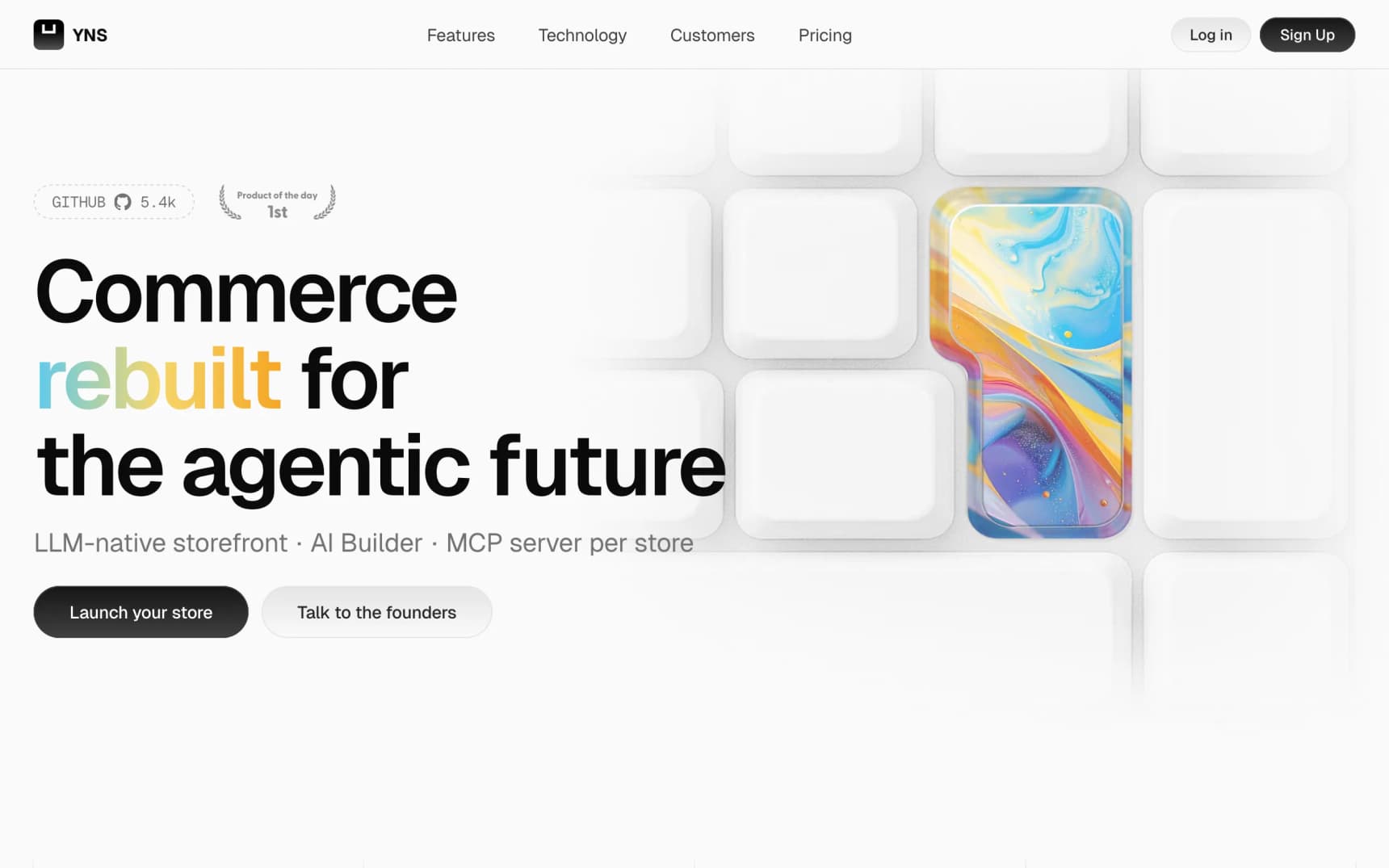
Your Next Store is a managed commerce backend (products, carts, orders, inventory, customers, blog, and search in Postgres, with an admin dashboard and an AI store builder) paired with a free, open-source Next.js storefront that talks to the backend through the typed Commerce Kit SDK. Stripe handles payment processing. A live storefront built this way runs at demo.yournextstore.com.
Mapped onto commercetools' specific gap for growing brands: there's a published price, a self-serve signup, and a storefront you can describe in plain English instead of assembling from separate composable services.
Standouts: AI store builder that edits your live storefront by chat, 0% platform transaction fees on every plan, typed REST SDK generated from OpenAPI, GEO-ready structured data out of the box.
Tradeoffs, honestly: This isn't composable commerce in commercetools' sense. There's one backend, not a set of services you swap independently, no multi-brand or multi-region modeling built in, and no self-hosted option for the backend; only the storefront is open-source. If you actually need commercetools' scale (dozens of storefronts, several brands, regional catalogs from one platform), YNS isn't there yet.
Pricing: Starter $30, Growth $60, Pro $360 per month. 0% platform fees on every plan.
Want an AI-built storefront instead of assembling one from composable services? Describe your store, get a working storefront, skip the RFP.
2. Shopify
Best for: Growing brands who want the biggest app ecosystem and zero infrastructure, with Hydrogen as a real headless path if you outgrow themes.

Shopify is the platform most growing brands are actually choosing between when they rule out commercetools: a bundled SaaS platform with a published price, thousands of apps, and (via Hydrogen) a legitimate headless path once you need more control over the frontend than a theme allows. It gives up the deep composability commercetools offers in exchange for a store you can launch this week, not this quarter.
Standouts: Zero infrastructure to run, the largest app ecosystem in ecommerce, Shopify Plus for brands that outgrow standard plans without a full composable rebuild.
Tradeoffs, honestly: You don't own the backend the way you do with a composable platform; there's no self-hosted option. Deep customization (multi-brand catalogs spanning regions, for instance) means fighting the platform or paying for Plus and a lot of app spend, not assembling exactly the services you need.
Pricing: Basic $29/mo (annual, $39 monthly), Grow $79/mo, Advanced $299/mo. Plus from roughly $2,300/mo.
3. BigCommerce
Best for: Teams that want more commerce logic built into the core than Shopify ships, with a maintained Next.js headless path and no custom sales contract.
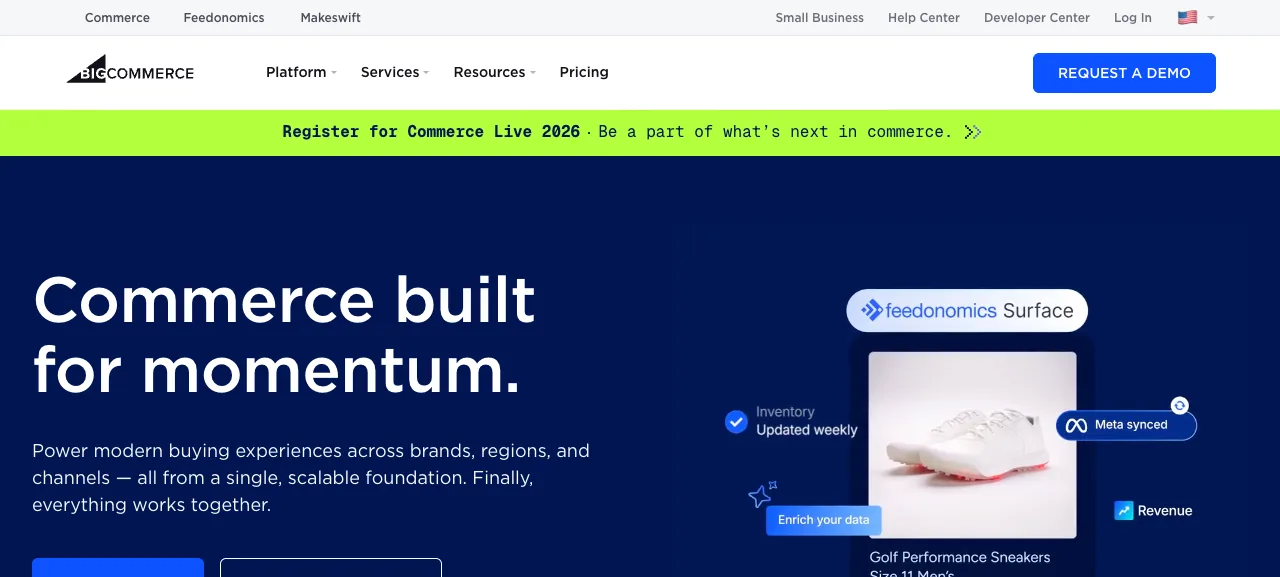
BigCommerce sits between Shopify's app-everything model and commercetools' build-everything model: real B2B features, multi-storefront capability, and promotions logic shipped in the core, on a published price, with Catalyst as a maintained Next.js storefront framework if you want a headless frontend. For a full breakdown of where BigCommerce's own pricing gets expensive, see our BigCommerce alternatives guide.
Standouts: More built-in commerce logic than Shopify out of the box, Catalyst gives a maintained Next.js path, native multi-storefront and B2B on higher plans.
Tradeoffs, honestly: Every plan has a revenue cap that forces upgrades as you grow, and it's still a closed SaaS platform, not something you self-host or reconfigure service-by-service the way commercetools' composable model allows.
Pricing: Core $29/mo (annual), Growth $79/mo, Scale $299/mo, Performance from $1,499/mo.
4. Saleor
Best for: Teams that want commercetools' GraphQL-first, API-driven feel without the enterprise contract.
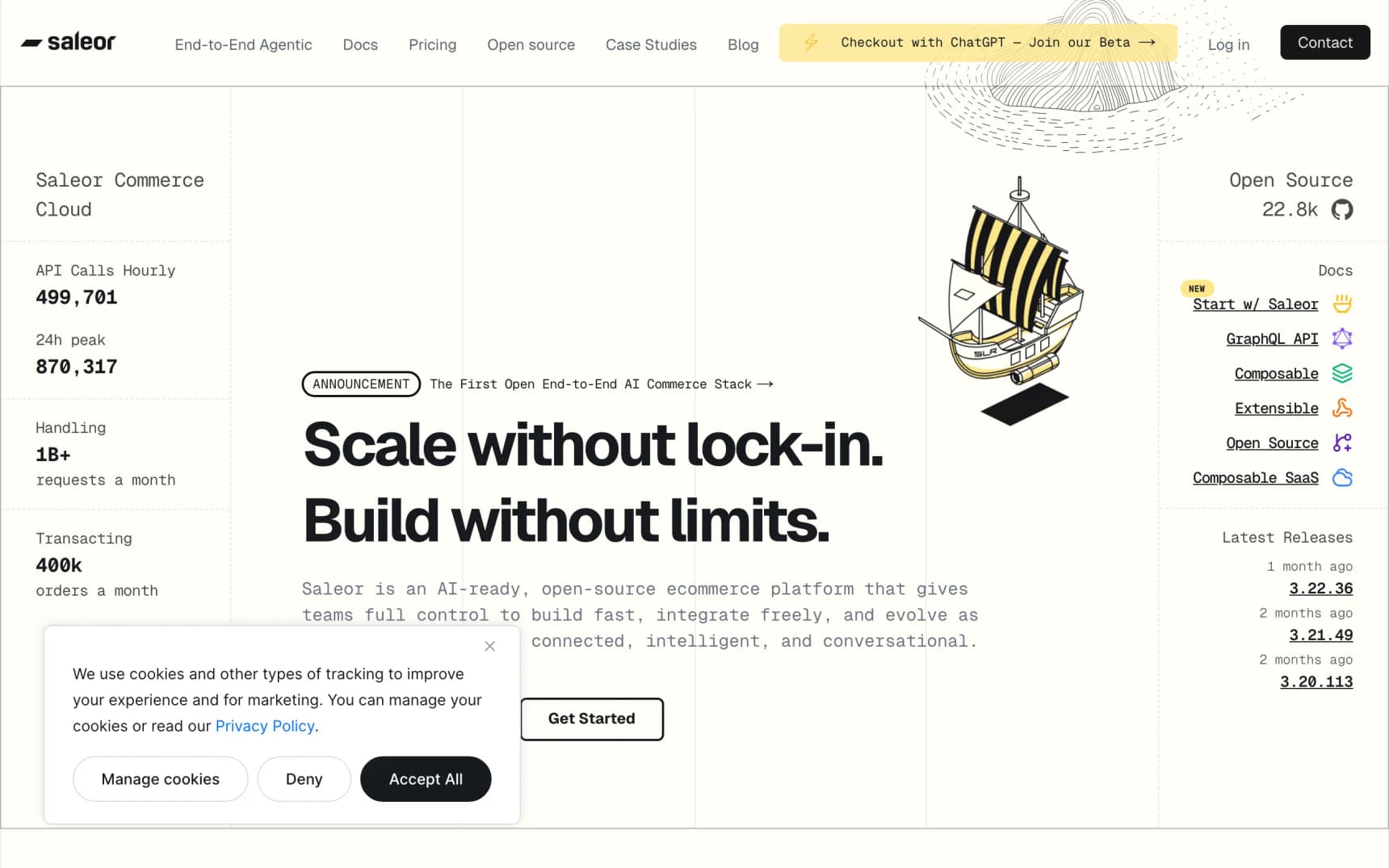
Saleor is the platform in this list closest to commercetools' own architecture: open-source, headless, GraphQL as the entire API surface, with native multi-channel modeling (separate currencies, warehouses, and price lists per channel from one backend). The difference is licensing and price: Saleor's core is free to self-host, and Saleor Cloud is a published, if enterprise-priced, alternative to negotiating a custom contract.
Standouts: GraphQL-first and fully introspectable, native multi-channel and multi-warehouse modeling, free sandbox environments for prototyping.
Tradeoffs, honestly: Python and Django is a specific stack to hire for. Self-hosting means running Postgres, Redis, and background workers yourself. Saleor Cloud starts at $1,599/mo, which is published (a real advantage over commercetools) but still priced for mid-market and up, not a first store.
Pricing: Free to self-host. Saleor Cloud from $1,599/mo, GMV-capped above that.
5. Medusa
Best for: TypeScript teams who want to own a modular commerce backend at a fraction of commercetools' cost.
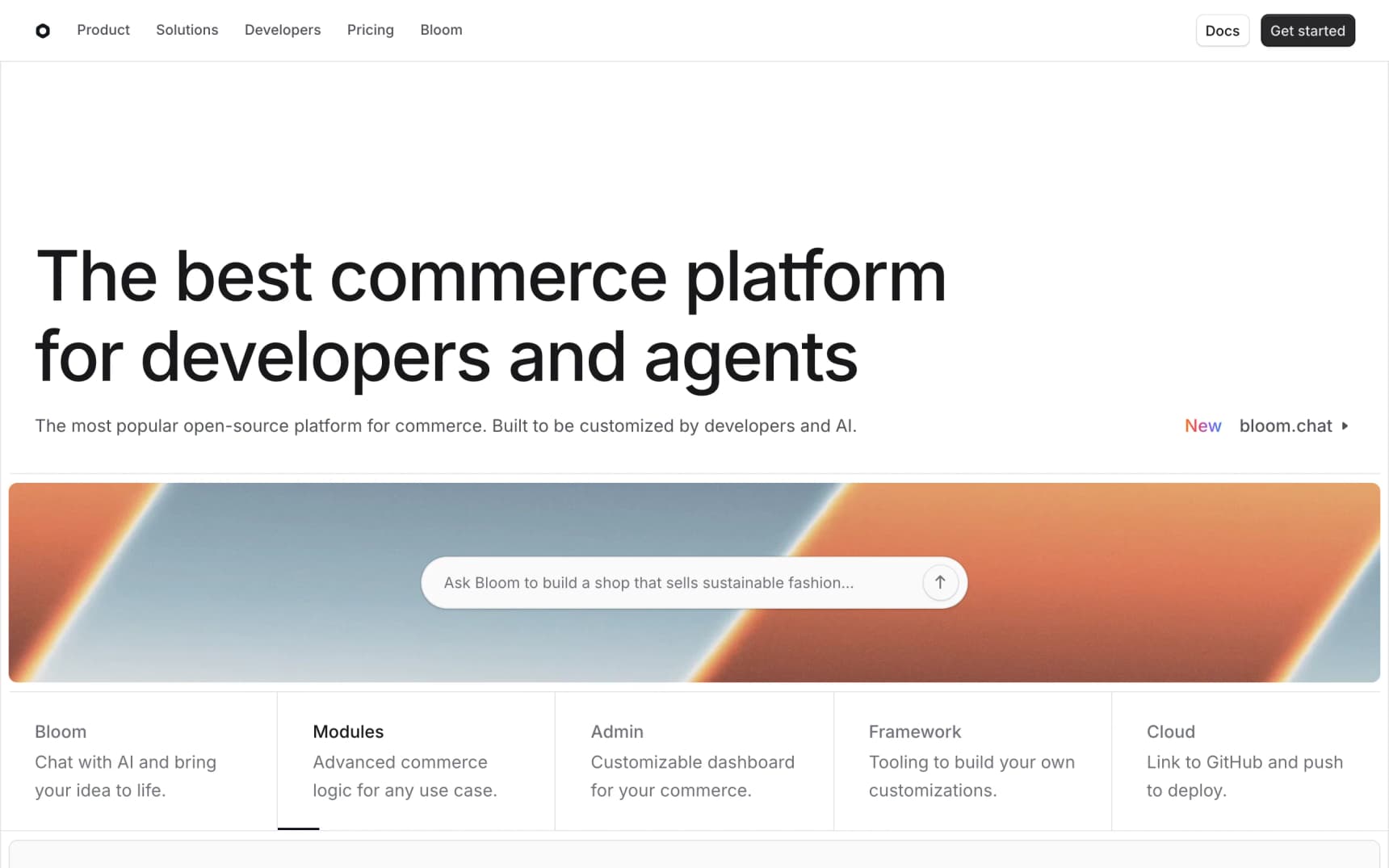
Medusa is open-source, MIT-licensed commerce on Node.js, TypeScript, and PostgreSQL, with more than 36,000 GitHub stars as of September 2026. Where commercetools gives you separately versioned composable services, Medusa gives you one modular backend: products, orders, and customers in a solid core, with payments, tax, and fulfillment as swappable modules. npx create-medusa-app@latest gets a running admin dashboard and API locally in minutes, no procurement required. We cover Medusa's own tradeoffs (and who leaves it) in more depth in our Medusa alternatives guide.
Standouts: Free and open-source core, typed JS SDK, Medusa Cloud if you'd rather not run the infrastructure yourself.
Tradeoffs, honestly: Self-hosting means running the backend, the admin, and a Postgres (and optionally Redis) instance yourself, real ops work commercetools' SaaS model removes. No native multi-region, multi-brand composability the way commercetools models it; you're building one backend, not assembling a set of enterprise services.
Pricing: Free to self-host. Medusa Cloud from $29/mo (Develop), $99/mo (Launch), $299/mo (Scale).
6. Vendure
Best for: Teams building B2B commerce who want commercetools-style composability with flat, quoted pricing instead of an order-based enterprise contract.
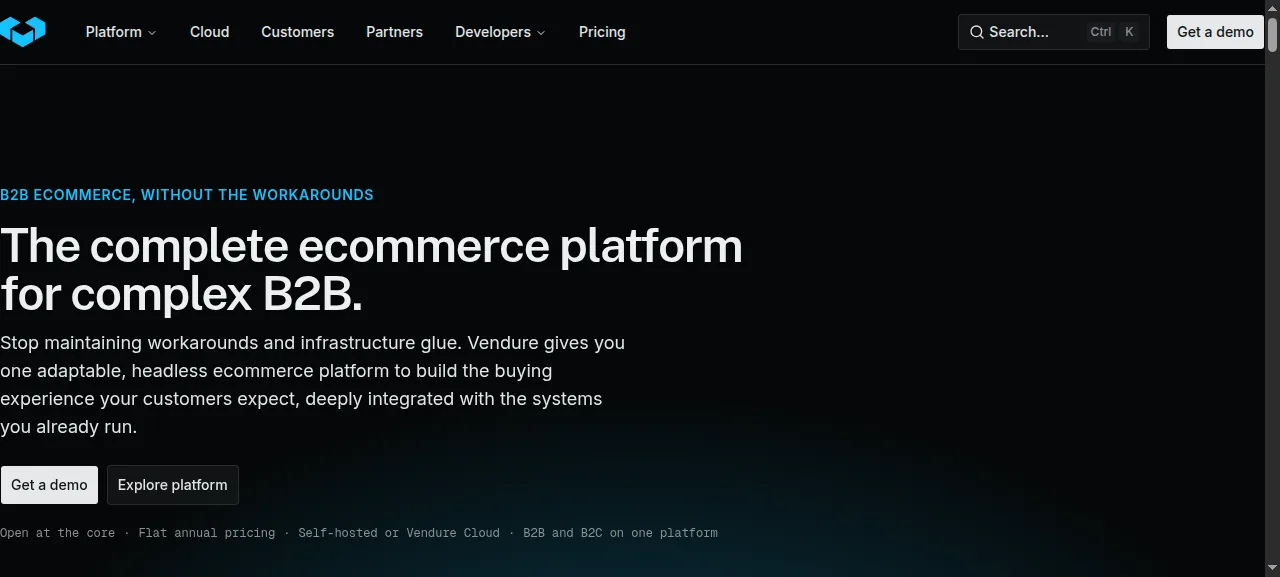
Vendure is a TypeScript, NestJS-based commerce engine with a genuinely clean plugin architecture and separate GraphQL schemas for admin and storefront. Vendure Core is free under GPLv3; the commercial Vendure Platform adds B2B features (company hierarchies, buyer roles, quote workflows), support, and IP indemnification under a flat annual license, quoted per project, that doesn't scale with order volume the way commercetools' pricing does.
Standouts: Cleanest plugin API of any open-source commerce framework here, flat quoted pricing with no revenue scaling, B2B data model as a first-class feature, not a bolt-on.
Tradeoffs, honestly: No published self-serve pricing, you still talk to sales for the commercial Platform tier, though the pricing shape itself (flat, not scaling with orders) is simpler than commercetools'. Smaller community and partner ecosystem than commercetools' certified network.
Pricing: Core free (GPLv3). Vendure Platform and Vendure Cloud on quote.
7. Commerce Layer
Best for: Teams that want commercetools' own category (composable, API-first commerce) with a free tier to actually start building on.
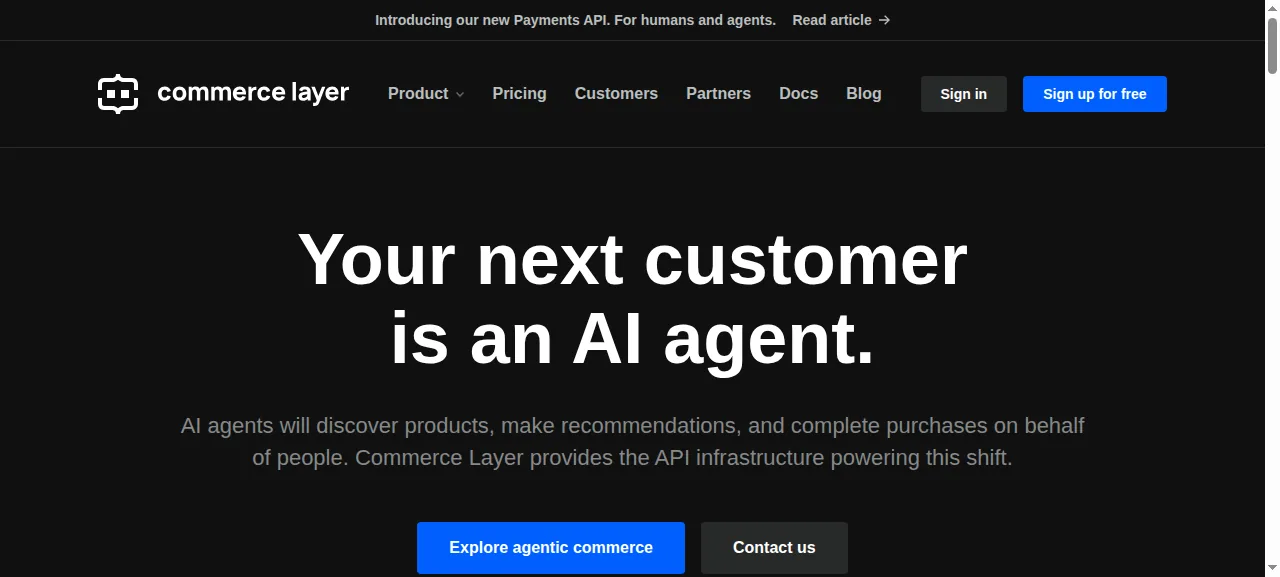
Commerce Layer is the platform on this list architecturally closest to what commercetools sells: composable pricing, inventory, cart, and checkout APIs you combine with your own frontend, search, and CMS, plus an operations dashboard. The meaningful difference for a growing brand is the entry point: the Developer plan is free with no time limit (1,000 SKUs, 100 live orders a month), so you can build against the real API before any sales conversation happens.
Standouts: Genuinely composable and API-first, a free self-serve tier with published limits, multi-market pricing and inventory built in.
Tradeoffs, honestly: No storefront or admin UI shipped, same as commercetools; you're assembling the frontend yourself either way. Enterprise pricing above the Developer plan is custom, not published. Smaller partner and integrator ecosystem than commercetools has built over a decade.
Pricing: Free Developer plan (1,000 SKUs, 100 orders/mo). Enterprise custom.
Other Composable Platforms Worth Knowing About
A few more names come up in commercetools evaluations, worth a mention without a full breakdown:
- Elastic Path: composable commerce you host yourself (on-premise, your own cloud account, or Elastic Path's single-tenant managed hosting), built on Java and the Cortex hypermedia API. Its real differentiator against commercetools is data sovereignty: "your data never leaves your infrastructure" is the pitch, which matters if a data residency or security audit requirement, not budget, is what's pushing you off commercetools' SaaS-only model. No published pricing.
- VTEX: enterprise composable commerce, strong in Latin America and physical retail, with pricing that combines a fixed fee and a percentage of GMV. Worth a look if you're expanding into markets where VTEX has deeper local integration partners than commercetools does.
- Adobe Commerce: Magento's enterprise heritage, GraphQL APIs, and since 2025 a SaaS edition. Closer to commercetools in contract size and sales process than in architecture.
If you're in the EU or UK: data residency is often the real reason a growing brand looks past a US-headquartered SaaS platform toward something self-hostable. commercetools, Elastic Path, and any of the open-source engines in this list (self-hosted in an EU region) all let you keep data in-region; a managed US SaaS platform's default region is worth checking before you assume parity with your GDPR obligations.
Migrating from commercetools
The technical shape of the migration is usually more predictable than the timeline: commercetools' data model (products, categories, orders, customers) maps reasonably well onto most alternatives, since composable platforms tend to converge on similar commerce primitives.
- Export your product catalog and categories first. Audit custom types and attributes (commercetools' flexible custom-field system) before mapping them onto the new platform's schema; this is usually where the most manual work hides.
- Custom extensions don't move with you. Any commercetools API extensions or subscriptions you built are commercetools-specific. Budget real time to rebuild that logic against the new platform's extension points, not just re-point it.
- Inventory what you've already composed. If you're leaving commercetools, you likely already have a separate search provider, CMS, and frontend. Confirm which of those survive the move unchanged and which need new integrations.
- Export orders and customers into your own storage before decommissioning anything, the same rule as every migration in this category.
- Test checkout and webhooks end to end before cutting over. Payment webhook shapes differ between commercetools' payment integrations and whatever the new platform uses.
- Confirm the new platform's data residency and VAT/returns handling if you're EU or UK based; the rules and defaults differ enough from a US-first SaaS platform that it's worth a dedicated check rather than assuming parity.
For Developers: The Same Query, Three Platforms
If you're not evaluating this technically, skip to the FAQ.
Here's "get the first 12 products in a category" against commercetools, Your Next Store, and Medusa, side by side:
commercetools (GraphQL, project API):
Your Next Store (typed REST SDK):
Medusa (typed JS SDK on top of REST):
commercetools' query is more verbose because it's more general: the same GraphQL endpoint can express queries no REST SDK can, at the cost of writing a where clause by hand instead of calling a typed method. That tradeoff is the whole story of composable commerce versus a bundled backend: more expressive power, more of the expression is your job.
What nobody tells you about commercetools at month six, if you get there: the platform itself doesn't struggle at scale, that's what it's built for. What eats time before you reach that scale is the assembly work: a search provider that needs its own indexing pipeline, a CMS that needs its own preview environment, and an integration partner relationship that's now a recurring line item, not a one-time setup cost. None of that is a knock on commercetools' engineering. It's the standing cost of composable architecture, and it's a cost most growing brands haven't earned back yet.
FAQ
What is the best commercetools alternative for a growing brand?
It depends on what's actually pushing you away from commercetools. For a managed backend with an AI store builder and no procurement cycle: Your Next Store. For the closest architectural match (GraphQL, composable, open-source) without the contract: Saleor. For genuinely composable APIs with a free tier to start on: Commerce Layer. For zero infrastructure and the biggest app ecosystem: Shopify.
Is commercetools overkill for a small or mid-market store?
Often, yes. commercetools is built for multi-brand, multi-region enterprise programs with a dedicated platform team. If you're running one or two storefronts and don't yet need to compose separate services for catalog, cart, and checkout, a bundled platform (Shopify, BigCommerce) or a simpler open-source engine (Medusa, Vendure) will get you shipped faster and cheaper. commercetools becomes the right tool once you've actually hit the scale it's designed for.
Which commercetools alternatives are open source or self-hostable?
Saleor, Medusa, and Vendure are all free to self-host, the closest thing to commercetools' composable model without the licensing cost. Elastic Path is self-hostable too (on-premise or your own cloud account), which is the main reason teams choose it over commercetools when data residency, not budget, is the driver. Your Next Store's storefront is open-source and self-hostable, but it requires the managed YNS backend to function. Shopify, BigCommerce, and Commerce Layer have no self-hosted option.
Related Blog Posts
- Best Headless Commerce Platforms of 2026
- 9 Best Medusa Alternatives for Headless Ecommerce (2026)
- BigCommerce Alternatives
- B2B Headless Commerce: Platforms & How to Choose
- What Is Headless Commerce?
commercetools earns its enterprise reputation honestly: it's a mature, genuinely composable platform doing real work for brands at a scale most companies haven't reached yet. The question this guide actually answers isn't "is commercetools good," it's "do you need what it's built for right now," and for most growing brands, the honest answer is not yet.
Want an AI-built storefront instead of a procurement cycle? Try Your Next Store. Managed backend, published pricing, 0% platform fees.