What Is Social Commerce? The 2026 Guide for Brands
 Jakub Neander
Sep 4, 202612 min read
TikTok Shop is on track to generate $23.41 billion in US ecommerce sales in 2026, more than Target's entire online business, according to eMarketer. That single number tells you social commerce stopped being a marketing add-on years ago. It's a full sales channel with its own checkout, its own logistics, and its own rules for who owns the customer. This guide covers what social commerce actually is, how it's different from posting on social media, which platforms matter in 2026, and where it fits if you're running (or building) a real storefront.
Bias disclosure: I'm the CEO at Your Next Store, a commerce platform. Social commerce mostly lives on platforms we don't build, so most of this guide is platform-agnostic. I'll flag the one section where our product is directly relevant.
What Is Social Commerce?
Social commerce is the practice of discovering and buying products without leaving a social platform. Not clicking an ad that takes you to a website. Not seeing a product in a post and Googling the brand later. The browsing, the product page, and often the checkout itself all happen inside the app: TikTok, Instagram, Facebook, Pinterest, or YouTube.
That's the definition that matters, because it's also the source of most of the confusion around the term. "We're doing social commerce" gets used by brands that just post on Instagram, and by brands that run a fully native storefront inside TikTok Shop. Those are different businesses with different infrastructure, different fees, and different risks.
| Social media marketing | Social commerce | |
|---|---|---|
| Where the transaction happens | Off-platform, on your website | On-platform, or one tap from it |
| What the platform provides | Reach and attention | Reach, product catalog, and checkout |
| What you own | The content and the ad account | Increasingly, less: order data can live with the platform |
| Primary metric | Clicks, engagement, traffic | Direct GMV (gross merchandise value) |
| Example | An Instagram Reel that links to your homepage | A TikTok Shop LIVE where viewers buy without leaving the app |
Social commerce is a subset of ecommerce, not a replacement for it. Every dollar transacted through TikTok Shop or Meta Shops still needs a real product catalog, real inventory, and a real fulfillment process behind it. The platform changes where the tap happens. It doesn't change what has to happen after the tap.
Social Commerce vs. Social Media Marketing: The Difference That Actually Matters
The practical dividing line isn't "do you sell online through social." It's this: when a customer is ready to buy, does the transaction happen inside the app, or does it redirect them somewhere else?
That distinction decides almost everything downstream: what fees you pay, whose checkout UX you're stuck with, how much customer data you get back, and how fast a sale actually completes.
Discovery, meanwhile, has already moved almost entirely onto social. 73% of US Gen Z shoppers say social media is their main source for discovering new products, according to eMarketer, ahead of search engines and traditional retail sites. That's true for brands running zero social commerce infrastructure, too: a shoppable tag isn't required for a platform to be where someone first learns your product exists. What a shoppable tag changes is whether that discovery converts on the spot or gets lost the moment the person closes the app.
This is also why "we post on Instagram" and "we run social commerce" aren't the same claim. Posting is marketing. A product tag with an in-app or one-tap checkout is commerce.
The Platforms That Actually Matter in 2026
Four platforms account for nearly all social commerce volume right now, and each one has taken a different position on how much of the transaction it wants to own.
TikTok Shop
TikTok Shop is the platform that made "social commerce" a boardroom phrase rather than a marketing-team phrase. Products get tagged in short videos, LIVE streams, and a dedicated Shop tab, and checkout happens without leaving the app: saved payment details, one tap, order confirmation.
The growth is the headline. US TikTok Shop sales grew 108% year-over-year to $15.82 billion in 2025, and eMarketer projects $23.41 billion for 2026, a 48% jump that would make TikTok Shop a larger US ecommerce business than Target, Costco, or Best Buy. Beauty, personal care, and apparel are where it hits hardest: those categories made up 43% of 2025 purchases, and TikTok Shop has become the fourth-largest health and beauty retailer in the US by that measure alone.
The trade-off: TikTok owns the checkout, the payment relationship, and a meaningful share of the customer record. Sellers get order and buyer data through Seller Center, but it's a platform-mediated relationship, not a direct one.
Instagram and Facebook Shops (Meta)
Meta's Shops let you build a catalog, tag products in posts and Reels, and run a storefront across both apps from a single Commerce Manager account. The notable 2026 development isn't a new feature. It's a retreat: Meta phased out native in-app checkout for Facebook and Instagram Shops between June and September 2025, redirecting shoppers to the merchant's own website to complete a purchase instead. It's a reversal of the 2023 push toward requiring on-platform checkout, and it means Instagram and Facebook now function as high-intent discovery and tagging layers that hand the transaction back to you, not as a closed loop the way TikTok Shop is.

For a merchant, that's a meaningfully different deal than TikTok's: Meta still owns discovery, but you own the checkout, the payment processor, and the full customer record, because the sale finishes on infrastructure you control.
Live Shopping
Live shopping (a host demonstrating products in real time while viewers buy without switching apps) is the fastest-growing format inside social commerce, not a separate channel from it. TikTok LIVE is the biggest driver: livestream sales reached 14% of TikTok Shop's total volume in 2025, up from 10% the year before. Instagram Live and dedicated live-commerce apps like Whatnot run similar formats, though checkout mechanics vary by platform the same way they do outside of live streams.
McKinsey has found that live commerce conversion rates can approach 30%, roughly ten times a typical ecommerce conversion rate, and estimates that live-commerce-initiated sales could reach 10-20% of all ecommerce volume by 2026 in markets where the format is most mature, a bar China's live commerce market has already cleared. The US is earlier in that curve, but the conversion math is why brands with any video comfort are testing it.
Shoppable Content: Pinterest and YouTube
Pinterest and YouTube round out the category with a lower-pressure version of the same idea: product tags on Pins and videos that link straight to a product page, either on-platform or off. Neither has TikTok Shop's native checkout ambitions, but both convert well for the same reason social commerce works everywhere: the customer sees the product in context (styled, in use, explained) instead of on a bare product page, which shortens the gap between interest and purchase.
Where the Sale Actually Closes: The Checkout Spectrum
Zoom out across all four platforms and a pattern shows up that most "what is social commerce" explainers skip past: every platform handles discovery inside the app, but they've made genuinely different bets on whether checkout does too.
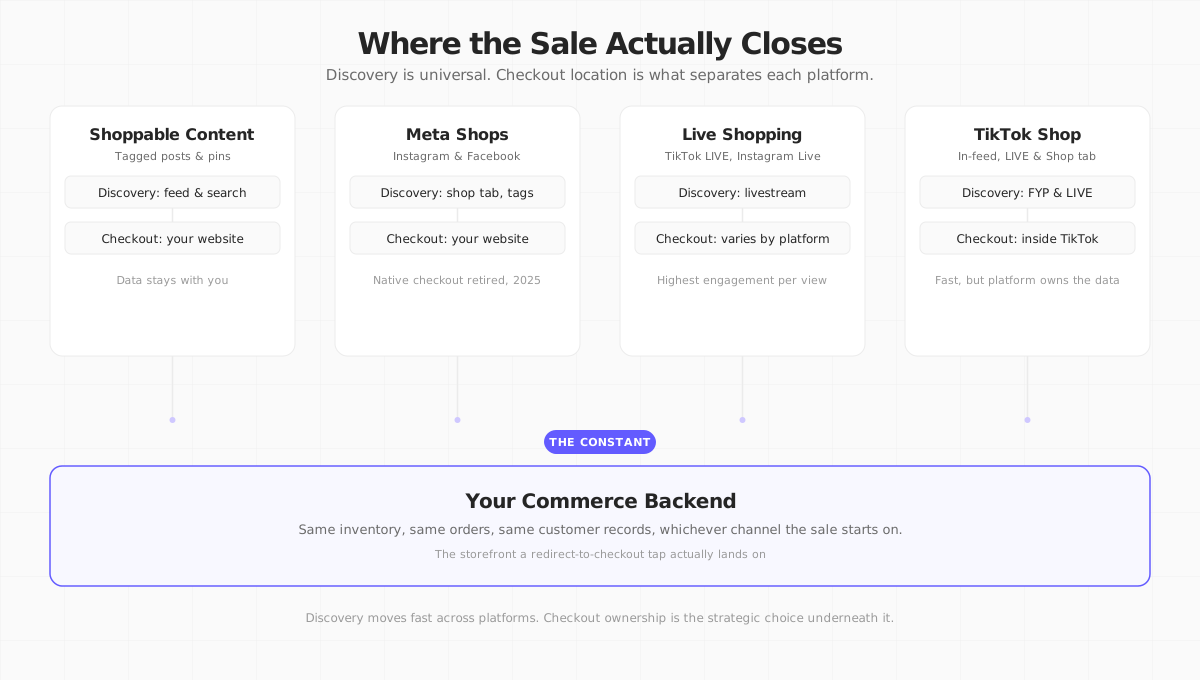
TikTok Shop sits at one end: discovery and checkout both happen natively, and the platform mediates the customer relationship. Meta Shops sits at the other, and moved further that direction in 2025: discovery is native, but checkout redirects to your own site. Live shopping and shoppable content fall in between, with the exact behavior depending on the platform.
The part that's easy to miss: none of that changes what has to exist underneath. Whether a shopper checks out on TikTok or gets redirected to your site from an Instagram tag, the order still needs to land in a real inventory system, get fulfilled, and show up correctly in your reporting. Betting your entire commerce strategy on one platform's checkout is riskier than betting on the discovery layer, because checkout policy is exactly what Meta just changed, with a year's notice, after building the opposite feature two years earlier.
Is Social Commerce Right for Your Brand?
Not every category benefits equally, and the honest answer depends more on what you sell than on how good your content is.
Categories where it works well:
- Beauty and personal care. Visual, demonstrable, and impulse-friendly; the category driving most of TikTok Shop's growth.
- Fashion and apparel. Styling content and try-on videos convert attention into purchase intent quickly. If you're building a brand in this space, our clothing brand guide and skincare brand guide both cover the category-specific tradeoffs of leaning on social from day one.
- Home goods and gadgets. Anything with a satisfying demo (unboxing, a product "actually working") performs well in short video.
- Low-consideration, low-price items. Impulse purchases under roughly $50 convert far more readily on social than considered purchases.
Categories where it's a weaker fit:
- High-consideration or high-ticket purchases (furniture, appliances, B2B). Social can still drive awareness, but the buying decision usually needs more research time than a scroll allows.
- Highly regulated categories (supplements, financial products, anything requiring disclosures). Platform ad and shopping policies are often stricter here, and enforcement varies.
A jurisdiction note: this isn't a US-only playbook
Platform availability and rules differ meaningfully outside the US, and treating US defaults as global ones is a common mistake.
In the EU, the Digital Services Act requires platforms to disclose who paid for an ad and why a given user is seeing it, which extends to shoppable and boosted social commerce content, not just traditional display ads. Cookie and tracking consent under GDPR also applies to the pixels most social commerce tools use for retargeting and attribution, so a shoppable-post strategy still needs a compliant consent setup, the same as any other tracking-based marketing.
TikTok Shop's rollout is also uneven by country. It launched in the UK before most of the EU, and availability, seller eligibility, and fee structures differ by market, so verify current availability for your specific country rather than assuming US feature parity.
Building a Social Commerce Strategy on a Headless Storefront
Here's the part that's directly relevant to what we build. Whichever platforms you use, and whether their checkout is native or redirects to you, a redirect-based sale (Meta Shops, most Pinterest and YouTube taps, and any TikTok traffic that lands off-platform) sends a shopper to a specific landing page on your own site. That page has to load fast, show accurate stock and price, and convert on the first screen, because a shopper coming from a 15-second video has approximately zero patience for a slow product page.
That's an architecture problem as much as a marketing one. In Your Next Store's storefront template, product pages are Next.js server components that fetch live data on every request through the commerce-kit SDK, a typed client over the managed backend's REST API, so a shopper landing from a redirect sees real inventory and pricing, not a stale cache. Combined with Partial Prerendering, the static shell of the page renders instantly while the dynamic parts (stock, price, personalized elements) stream in, which matters more for social traffic than almost any other source, since checkout drop-off compounds with every extra second of load time.
A minimal version of what a social-traffic landing page pulls looks like this:
The product catalog that page reads from is the same one that feeds your Meta product catalog and TikTok Shop listing, so a sale closing natively on TikTok and a sale closing on your own site after an Instagram tap both decrement the same inventory count. That's the "one commerce backend" idea from the diagram above: it's not a YNS-specific concept, it's true of any real commerce stack, but it's the reason a storefront that's fast to update and fast to load matters more, not less, as more of your traffic arrives pre-sold from a 15-second video.
Where we're honest about the gap: YNS doesn't have a native TikTok Shop or Meta catalog sync built into the product today. What it gives you is the fast, reliable landing surface that every non-native-checkout tap needs, plus a real product API you (or a connector) can feed into those platforms' own catalog tools.
If most of your social traffic redirects rather than checking out natively (which is now true for Meta Shops), audit your landing page speed before you audit your content. A viral video with a 4-second product page is a worse outcome than a smaller video with a 1-second one.
Build a storefront fast enough for social traffic. A Next.js store with real-time inventory, ready in minutes.
Star the repo on GitHub: github.com/yournextstore/yournextstore
FAQ
Is social commerce the same as ecommerce?
No. Social commerce is a subset of ecommerce where discovery, and sometimes checkout, happens inside a social platform instead of on a standalone website. Every social commerce sale still depends on the same underlying commerce infrastructure (inventory, fulfillment, payment processing) that any ecommerce sale needs.
Which social media platform is best for selling products?
It depends on the category more than the platform. TikTok Shop leads for beauty, personal care, and apparel, with the highest native-checkout convenience and the fastest growth. Instagram and Facebook Shops work well for brands that want to keep checkout, and the customer relationship, on their own site. Live shopping formats convert best for products that benefit from a real-time demo.
Do I need a website if I sell on TikTok Shop or Instagram Shops?
Yes, for most brands. Even on TikTok Shop, where checkout is native, you'll still want your own site for traffic Meta and other platforms redirect to you, for marketing you don't want tied to one platform's rules, and as a hedge against a platform changing its checkout policy the way Meta did in 2025. Relying entirely on one platform's storefront is a single point of failure most brands can't afford.