How to Start a Skincare Business, Line or Brand in 2026
 Jakub Neander
Updated Sep 18, 202620 min read
Starting a skincare business is one of the most exciting things a beginner can do, and one of the easiest to get wrong. The shelves are crowded, the rules are real (skincare is regulated, because you're putting it on people's faces), and a single product that separates or grows mold can end your brand before it starts. This is the guide I'd hand a friend before they spend a dollar on their own skincare line: seven steps in the right order, honest 2026 costs for each way of making your products, a launch timeline, and the US, EU and UK rules in plain English.
The short answer: to start a skincare business in 2026, pick one specific customer and problem, test demand before you buy stock, and launch with white label or private label products rather than a custom formula. Budget roughly $1,500–$5,000 for a white-label start, $12,000–$25,000 for a low-minimum private-label line, and $40,000+ for a custom formula. In the US, skincare is a cosmetic: no FDA approval, but you must make it safe, label it correctly and, above about $1 million in sales, register and list products under MoCRA. In the EU and UK, every product needs a Responsible Person, a safety report (CPSR) and a portal notification before it goes on sale. Sunscreen is the exception: in the US it's an over-the-counter drug, a much harder route.
Total beginner? This is written for you. Every rule and bit of jargon gets explained the first time it shows up. The one step you can't skip is Step 1.
Not in the US? The product, pricing, and marketing steps are the same everywhere. Step 4 covers the US, the EU and the UK separately, because the rules genuinely differ.
The 7 Steps to Start a Skincare Business, in Order
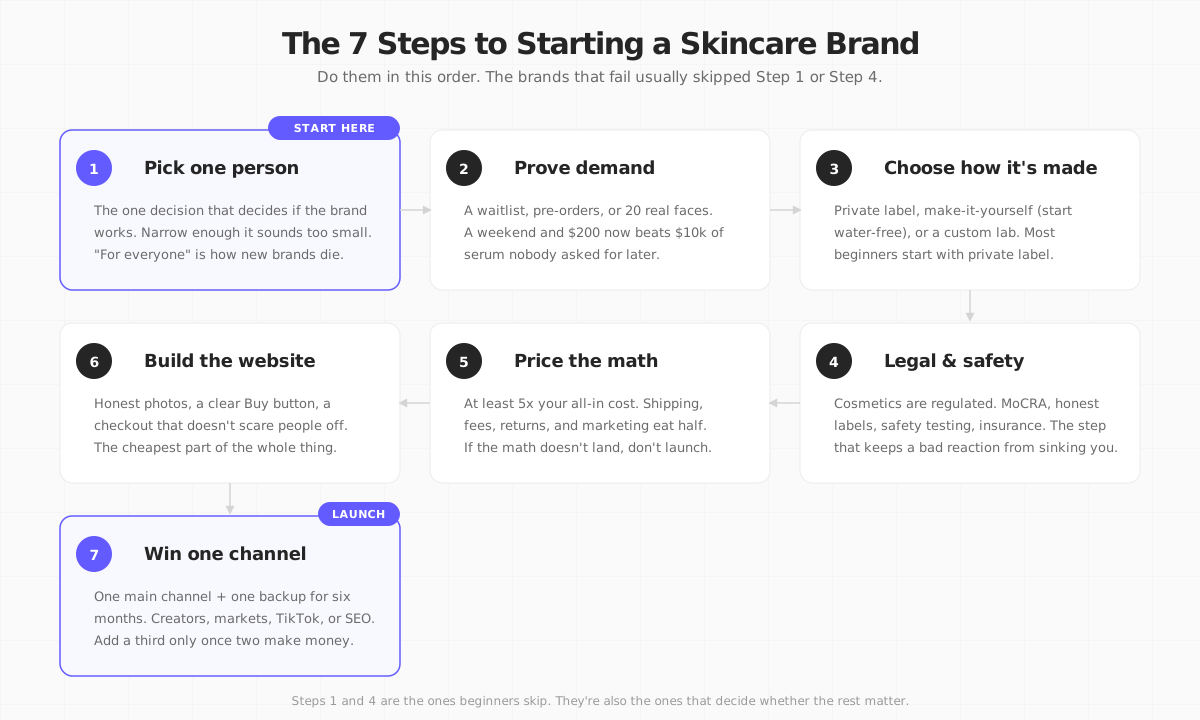
- Pick one specific person, or one specific problem. Not "people who want nice skin." One person, or one problem.
- Get a small group to say "yes, I'd buy this" before you order inventory.
- Decide how your skincare line actually gets made. White label, private label, home-made, or custom. The right one depends on your budget and your nerves.
- Do the legal and safety work. Skincare is regulated. This is the step that protects you.
- Set the price so the math works. For skincare, the honest rule is at least 5× your all-in cost.
- Set up a simple website where people can actually buy.
- Pick one place to get noticed. Not all of them. One.
Now the long version.
Step 1: Pick One Specific Person, or One Specific Problem
The fastest way a new skincare brand dies is being "for everyone." Open any drugstore aisle: you're competing with billion-dollar companies that can outspend you on every shelf, every ad, and every ingredient. You will not win by being a slightly nicer version of what already exists.
You win by being the obvious choice for one specific person, or the obvious answer to one specific problem. A good answer is narrow enough that it almost sounds too small. A bad answer is "a clean skincare line for women 25 to 45."
Good answers look like this:
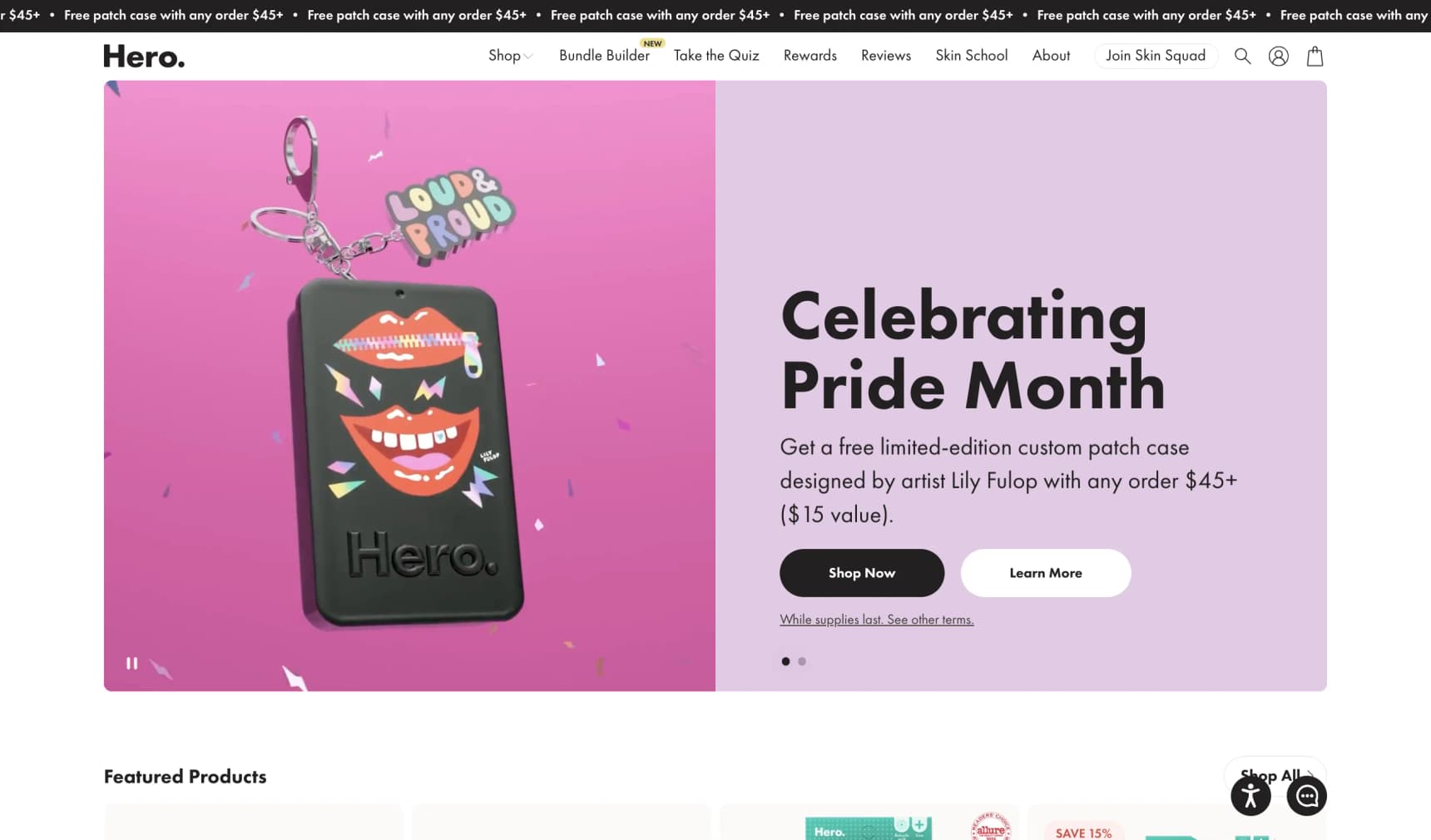
- Pimple patches, and almost nothing else. That's how Hero Cosmetics started in 2017: a single product (the Mighty Patch), launched on Amazon, that the founder developed for under $50,000. Five years later, Church & Dwight bought the company for $630 million. One problem, solved better than anyone.
- Skincare for one chronic condition you've lived with. Topicals focused on flare-ups from conditions like eczema and hyperpigmentation, told through a founder who grew up struggling with her own skin. That lived-in story helped make it Sephora's fastest-growing skincare brand. The story is the moat.
- The simplest possible routine for someone who has never had one. Three products, no 11-step guilt.
The test: if a giant beauty company could put your product on a shelf tomorrow without changing anything about who they are, you haven't picked a sharp enough idea. Your advantage as a small brand is not a bigger lab. It's that you can care about one specific person more than a giant company ever will, and tell a story they actually believe. In 2026, indie brands keep winning precisely because shoppers trust a real founder solving a real problem over a faceless megabrand.
Pick your person before you pick your products. Everything downstream gets easier. (If you're still deciding whether skincare is even the right thing to sell, our guide to starting any online store walks through the category choice first. If color cosmetics tempt you more than skincare, read how to start a makeup brand.)
Your Step 1 exercise (5 minutes): Finish this sentence in a notes app.
"My skincare is for ________ who struggle with ________, and I'm the one to make it because ________."
If the first blank is "everyone" or "women who want good skin," it's not narrow enough yet. Keep going until the sentence makes you a little nervous it's too specific. That nervousness is the signal.
Step 2: Get a Small Group to Say "Yes" Before You Order Inventory
This is the step almost every first-timer skips. You do not need 1,000 jars of moisturizer to find out if your idea is good. You need to find out if your idea is good before you order 1,000 jars of moisturizer.
Three cheap ways to test:
- A one-page website with a "Join the waitlist" button. Show your concept, the one problem you solve, the two or three planned products, and ask for an email. Spend $100 to $200 on Instagram or TikTok ads to send your target person there. If fewer than about 1 in 50 visitors sign up, your idea isn't landing yet. Go back to Step 1.
- Take pre-orders for a small first run. Same page, but instead of "Join the waitlist," it's "Pre-order, ships in 8 weeks." People who hand over a card are the only real signal. Ten pre-orders beat a thousand likes.
- Order samples and get them on real faces. Give them to 20 people in your target group and ask two questions only: "Would you actually pay for this?" and "What would you change?" Polite "love it!" replies don't count. You want the friend who tells you it felt greasy.
This step costs a weekend and maybe $200. Skipping it can cost you $10,000 in inventory for a product nobody asked for.
Step 3: Decide How Your Skincare Line Gets Made
This is the big fork in the road, and where beginners burn the most time. There are four real paths. The terms "white label" and "private label" get used interchangeably online, but they mean different things, and the difference decides your budget.
| Route | What it is | Minimum order | Typical upfront | Time to market |
|---|---|---|---|---|
| White label | A supplier's ready-made formula, unchanged, with your label | Often none | ~$1,500–$5,000 | 2–6 weeks |
| Private label | A manufacturer's proven base formula, tweaked (scent, texture, actives) and packed in your packaging | ~50–500 units per product | ~$12,000–$25,000 | 3–6 months |
| Home-made | You make it yourself, in small batches | None | A few hundred to ~$2,000 | 4–8 weeks |
| Custom formulation | A lab develops a unique formula to your spec | ~5,000–10,000+ units | $40,000+ | 6–12+ months |
Path A: White label (the cheapest way to test a skincare line)
A supplier already sells finished, tested products. You pick from their catalog, they print your logo on the label, and in many cases they ship each order to your customer for you. Blanka and Selfnamed both advertise no minimum order, so you can start with a handful of units, or none at all if they ship on demand.
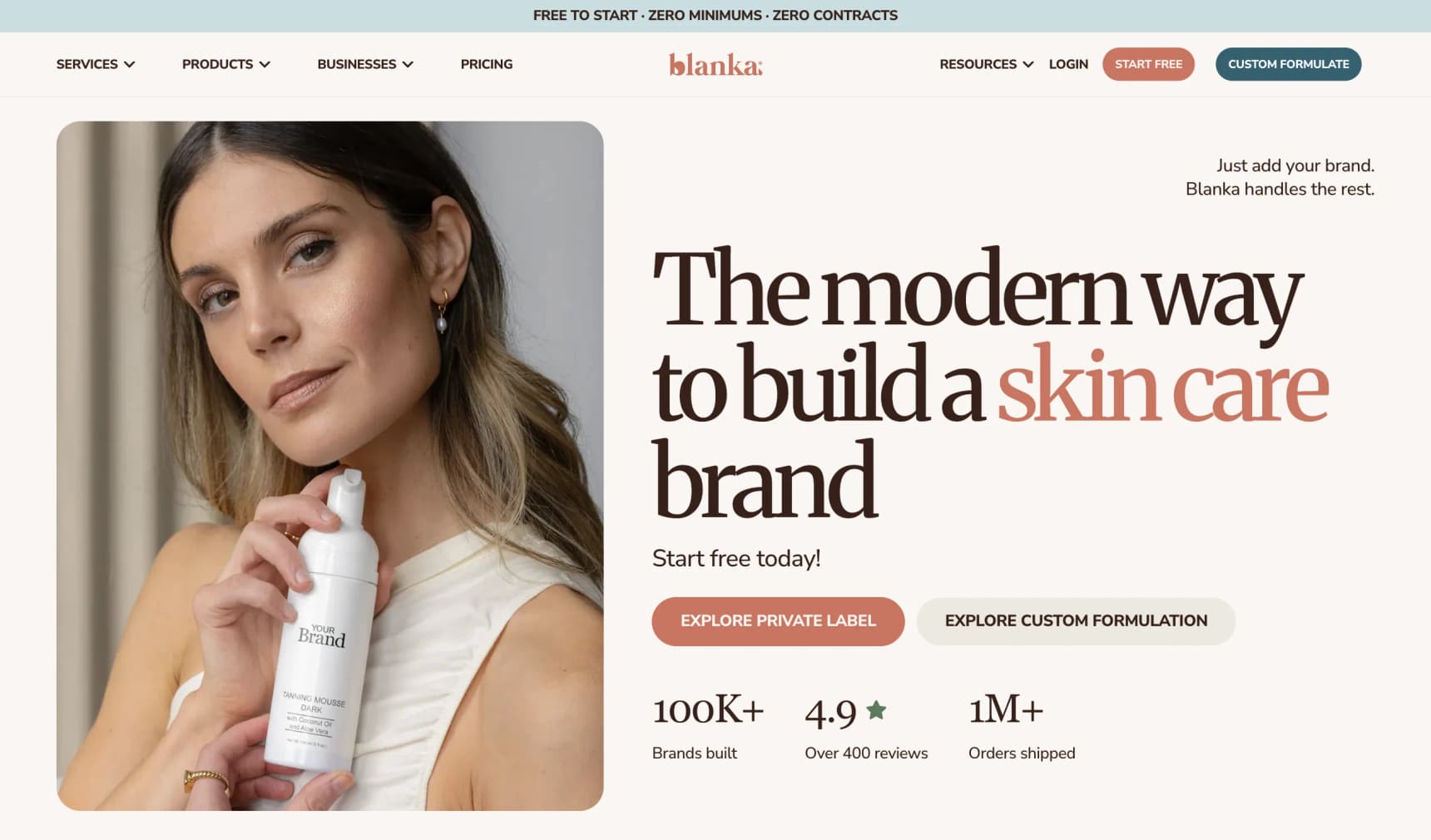
The trade-off: anyone else can sell the same formula, and your per-unit cost is higher, so margins are thinner. Blanka itself says most of its brands price at 2 to 3× product cost, well below the 5× rule in Step 5. That's fine for testing demand. It's a weak moat for a long-term brand.
Path B: Private label (the right default for most beginners)
A manufacturer has tested base formulas. You choose one, adjust it within limits (a different scent, a hero ingredient, a texture), and they fill it into your own packaging. You're not inventing a serum from scratch; you're choosing a proven one and making it yours.
Here's the part nobody tells beginners: the manufacturer runs the factory, so the factory-level rules (like US facility registration) are theirs, not yours. You still own the brand-level rules (labeling, safety records, product listing). Step 4 spells out who does what.
The numbers in 2026: low-MOQ ("MOQ" just means minimum order quantity, the smallest batch they'll make) private-label makers will do runs as small as 50 to 500 units per product. A first launch of two or three products typically ties up $10,000 to $15,000 in product. You can be market-ready in 90 to 180 days.
Path C: Make it yourself at home (cheapest, most hands-on)
It is legal to make cosmetics in your home in the US for sale, as long as you make them in clean conditions that won't contaminate the product. This is the cheapest way in and gives you total control.
The catch: anything with water in it (lotions, creams, most serums) needs a preservative and real testing, or it grows bacteria and mold. That's genuinely hard to get right at home. Beginners who go this route should start with products that contain no water, like face oils, balms, and salves, which are far more forgiving.
Most cities also require a home occupation permit for a home-based business. Check yours. In the EU and UK, home-made is harder: every product still needs a safety assessment by a qualified person before you sell a single jar (more in Step 4).
Path D: Custom formulation (your own formula from scratch)
A lab develops a unique formula to your spec. This is how you get a truly one-of-a-kind product, and it's how most beginners overspend. Traditional contract manufacturers set minimums at 5,000 to 10,000+ units per product, which can mean $60,000 or more tied up in inventory before your first sale, plus formulation and stability testing on top, which alone takes months.
Save this for later. Validate demand with white or private label first, then move to a custom formula once you know people actually buy. Plenty of successful brands made exactly that move, in that order.
Step 4: Skincare Business Regulations in the US, EU and UK
This is the step that separates a hobby from a business, and skincare has more of it than candles, soap, or t-shirts, because you're selling something people rub into their skin. Skip it and a single bad reaction can become a lawsuit your insurance won't cover.
United States: the FDA and MoCRA
Skincare is a cosmetic, regulated by the FDA. The FDA does not approve cosmetics before you sell them, but you are fully responsible for making them safe and labeling them honestly. (Products that claim to treat something, like acne, eczema or sunburn, are drugs. More on that in the sunscreen section below.)
The law that changed things is the Modernization of Cosmetics Regulation Act of 2022 (MoCRA). It introduced the idea of a "responsible person": the manufacturer, packer, or distributor whose name appears on the label. If it's your brand name on the jar, that's you. Here's what MoCRA asks, and who carries it:
| Requirement | What it means | Who does it | Small-business exempt? |
|---|---|---|---|
| Facility registration | Register the factory with the FDA within 60 days of starting production, renew every 2 years | Whoever owns or runs the factory (your manufacturer, unless you make it yourself) | Yes |
| Product listing | List each product and its full ingredient list (including fragrances and colors) within 120 days of launch, update yearly | The responsible person (you) | Yes |
| Safety substantiation | Have, and keep records of, adequate evidence that the product is safe | The responsible person (you) | No |
| Adverse event reporting | Report any serious reaction to the FDA within 15 business days; keep reaction records for 6 years (3 for small businesses) | The responsible person (you) | No |
| Label contact info | A US address, US phone number, or electronic contact on the label so customers can report reactions | The responsible person (you) | No |
| Good manufacturing practice | FDA rules still pending; follow its existing GMP guidance | The factory | Yes (once issued) |
The small-business exemption: if your average US cosmetic sales over the previous three years are under $1,000,000 a year (adjusted for inflation), you're exempt from facility registration, product listing and the future GMP rules. That covers almost every brand reading this.
Two honest catches:
- The exemption does not apply if you make or sell products that regularly touch the mucous membrane of the eye (think mascara or eyeliner, not a typical eye cream), products that are injected or taken internally, or products meant to change appearance for more than 24 hours without the customer removing them.
- The exemption only skips the paperwork. Safety, honest labeling, reaction reporting and the label contact line apply to everyone.
One thing still in motion: MoCRA also requires fragrance allergens to be named on labels, but the FDA has been slow to publish the rule setting which allergens and at what levels. Check the FDA's MoCRA page before you print a big label run.
US labeling you must get right
Every product needs a compliant label: what the product is, the net amount in the container, your business name and address, the full ingredient list in descending order of amount (using the standardized INCI names), any required warnings, and the MoCRA contact line for reactions. Get the ingredient list from your manufacturer; don't freehand it. For a deeper plain-English walkthrough, Formula Botanica's US guide is a good read.
European Union: Responsible Person, CPSR and CPNP
The EU is stricter up front. Under the EU Cosmetics Regulation (EC) No 1223/2009, before a single product goes on sale you need:
- A Responsible Person (RP) established in the EU. If your business is outside the EU (including in the US or UK), you appoint an EU company as your RP. Many private-label suppliers and specialist consultancies offer this as a service.
- A Cosmetic Product Safety Report (CPSR) for every product: Part A is the safety data (formula, stability, microbiology, impurities, packaging), and Part B is the assessment signed by a qualified safety assessor (a pharmacist, toxicologist, doctor or similar).
- A Product Information File (PIF) holding the CPSR, product description, proof of good manufacturing practice and evidence for your claims, kept for 10 years after the last batch.
- A notification on the CPNP (Cosmetic Products Notification Portal) before launch. It's free, and one notification covers all EU countries.
- An EU-compliant label: the RP's name and address, nominal content, a best-before date or "period after opening" symbol, precautions, batch number, function, and the ingredient list.
There is no small-business exemption in the EU. A CPSR for a simple product typically costs a few hundred euros per product from independent assessors, more for complex formulas; get quotes, because pricing varies widely.
United Kingdom: UK Responsible Person and SCPN
Great Britain kept a near-copy of the EU system after Brexit, with its own paperwork. To sell cosmetics in Great Britain you need a UK-based Responsible Person (not a PO box or mail-forwarding address), a safety report with a Part A and a qualified assessor's Part B, a Product Information File kept for 10 years, and a notification through the government's Submit Cosmetic Product Notifications (SCPN) service before the product goes on sale. An EU notification does not count for Great Britain, and vice versa. Northern Ireland follows the EU rules.
The shortcut for nervous beginners: with white or private label, pick a supplier that already provides the safety paperwork for the markets you're selling into (US, EU, UK). You're then left with the label, the responsible-person duties, insurance, and selling. That's a much smaller pile of homework, and it's why most first-time founders start there.
Safety testing (do not skip this)
Before you sell, you need to know two things: that your product is safe on skin, and that it won't spoil. For any product with water in it, that means stability and preservative (challenge) testing, confirming the preservative actually works and the product lasts its claimed shelf life. White- and private-label products usually come pre-tested. Homemade water-based products do not, which is exactly why beginners should start water-free.
Business setup and insurance
The unglamorous checklist: register the business (an LLC in the US, a limited company in the UK, or your country's equivalent), get a tax ID, open a separate bank account, and run a trademark search on your brand name before you print anything.
Then get product liability insurance. For a small skincare brand it runs about $500 to $2,000 a year for a $1 million policy. One customer who blames your serum for a rash will eat years of premiums in a single claim. Many retailers and marketplaces also ask for proof of cover before they stock you.
Starting a Sunscreen Business: Why SPF Is the Hard Route
A lot of people search for "starting a sunscreen business," so this gets its own section (and a full guide: how to start a sunscreen brand). The short version: in the US, sunscreen is not a cosmetic. It's an over-the-counter (OTC) drug, because it claims to prevent sunburn. The FDA regulates sunscreens like other nonprescription medicines, under a rulebook called OTC Monograph M020.
What that means in practice:
- Only approved active ingredients, at approved strengths. You can't invent your own UV filter; the list is short and changes slowly (bemotrizinol was the first new one added in about 20 years).
- Drug manufacturing rules. The product must be made in an FDA-registered drug facility following drug-grade good manufacturing practice, which is far stricter than cosmetic rules. Home-made sunscreen for sale is, realistically, off the table.
- Mandatory lab testing. SPF and "broad spectrum" claims must be backed by the test methods the monograph sets out, and "water resistant" claims need their own testing.
- A Drug Facts label in the FDA's fixed format, not a normal cosmetic label.
- Annual FDA facility fees. Factories that make OTC monograph drugs pay a yearly user fee, $19,188 per facility for fiscal 2026 ($12,792 for contract manufacturers). Your manufacturer pays it, but it shows up in your per-unit price.
The same "it's a drug" logic applies to other treatment claims. An acne product with benzoyl peroxide or salicylic acid, or a moisturizer that says "with SPF 30," is also an OTC drug in the US.
In the EU and UK, it's different: sunscreens are cosmetics, handled through the same Responsible Person, CPSR and notification route as any cream. UV filters must come from the approved list, and SPF and UVA claims should follow the EU recommendation on sunscreen efficacy, which in practice means proper lab testing too.
Honest advice: don't make sunscreen your first product. If SPF is core to your idea, go private label with a manufacturer that already produces monograph sunscreens and holds the drug registrations, launch your cosmetic products first, and add SPF once the business is paying for itself.
Step 5: Set the Price So the Math Works
The classic beginner mistake: "the serum at Sephora is $40, so I'll charge $35." That math doesn't work, because the big brand's per-unit cost is a fraction of yours, and they're not paying to acquire every single customer the way you will.
The honest rule for skincare: your retail price should be at least 5× what one finished unit costs you, all-in. Skincare standardly runs 5 to 6× the landing cost, which lands you in the healthy 50% to 75%+ gross-margin range the category needs. Wholesale (if a shop resells you) is half your retail price, so your math has to survive that too.
Why 5×? Because "what it costs you" is never just the bottle. It's also:
- Card processing fees on the sale.
- Shipping to the customer.
- Boxes, inserts, and protective packaging (glass droppers break).
- Returns and the occasional reaction refund.
- Marketing: ads, free product to creators, your time making content.
Quick example for a serum. Say your all-in unit cost is $8 (product, dropper bottle, box, label). You sell it for $42 (about 5.25×). Here's where the money goes:
| Where the money goes | $ |
|---|---|
| Product, bottle, box, label | $8.00 |
| Card fee (Stripe, 2.9% + $0.30) | $1.50 |
| Shipping to customer (avg) | $5.50 |
| Returns / reaction reserve (~5%) | $2.10 |
| Marketing (~25% of revenue) | $10.50 |
| What you actually keep | ~$14.40 |
So a $42 serum nets you about $14. To clear a $12,000 first private-label order, you'd need to sell roughly 850 units, plus more to cover photos, samples, and tools. That's the realistic first-year target, not a flat revenue number.
Now watch what happens if you cave and price it at $28 (a 3.5× markup): your profit per unit collapses to a couple of dollars, and you'd need to sell thousands just to break even on the same inventory. If the math doesn't land, don't launch. Raise the price, simplify the packaging, or pick a cheaper bottle. The worst outcome is launching at the wrong price and discovering six months in that every sale loses money.
Step 6: Set Up a Simple Website
By now you have a product, real test results, pricing that works, and (hopefully) a waitlist. Time to give people a place to actually buy.
You don't need anything fancy. You need three things: a few honest product photos, a clear "Buy" button, and a checkout that doesn't scare people off. For skincare, add two more: the full ingredient list on every product page (shoppers check it, and it's where your label info lives online), and a clear returns and reactions policy.
The main options in 2026, honestly ranked for first-time skincare founders:
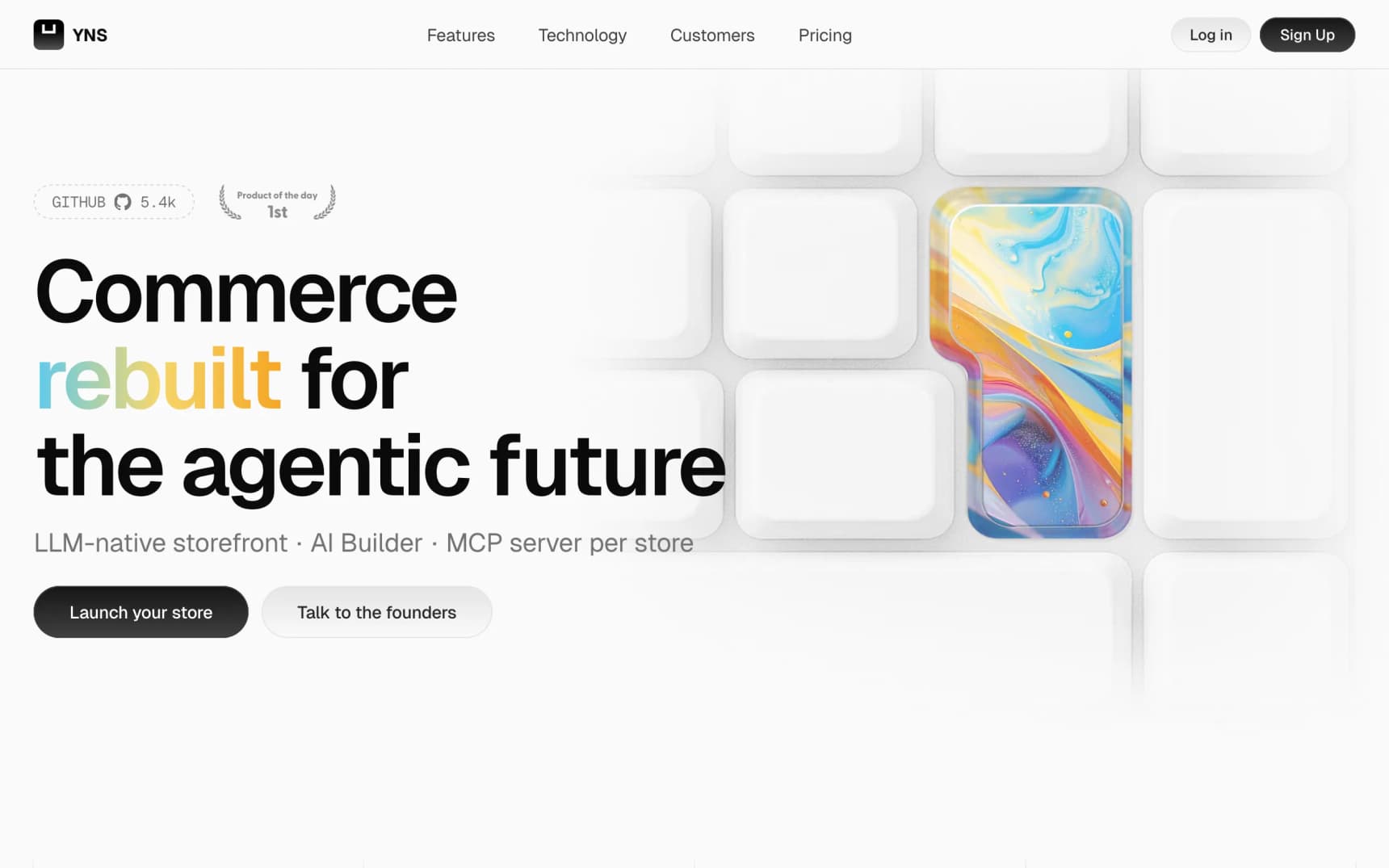
- Your Next Store (us, to be upfront) is the simplest way to get a modern store online without becoming a tech person. Starts at $25/month on the yearly plan, with no extra platform fee per sale (only standard card processing). An AI helper builds the store with you, and product search, a blog and translations are built in, so you're not bolting on a pile of paid add-ons later. Good fit if you want a real website fast and predictable monthly costs.
- Etsy is where many first-time makers start, and that's fine. Built-in shoppers, zero setup. The trade-off is real: Etsy takes a 6.5% transaction fee plus listing and ad fees, and the buyer thinks of themselves as an Etsy shopper, not your customer. Use it as a starting channel, plan to move buyers to your own site over time.
- Shopify is the safe middle ground. $39/month, just works, and there's a plug-in for everything. The downside: those plug-ins add up to another $200 to $500/month at volume, and Shopify takes a small extra fee on every sale unless you use their own payment method.
- Squarespace or Wix are cheap and very visual. Fine for a small first drop; most brands outgrow them within a year.
- Instagram plus a payment link. If you only have two or three products and your audience already lives on Instagram, you can take orders in DMs and use a simple Stripe payment link for checkout. Messy, but it costs $0. Graduate to a real site when you can't keep up.
Honest recommendation for most first-time founders: start with a simple website of your own and a presence wherever your audience already is, from day one. Your own site gives you a brand and a customer list you control. The marketplace gives you traffic. Run both; move repeat buyers to your site through inserts and email.
0% extra fees on every sale. A modern website for your skincare brand, ready in minutes.
Step 7: Pick One Place to Get Noticed
New skincare brands almost always win on exactly one channel in their first year, then expand. The beginner trap is trying all of them at once and doing none of them well.
Your options, honestly:
- TikTok and Instagram (free, slow, effective). The default for skincare, because results, routines, and "get ready with me" videos are made for the format. Works if you can post 3 to 5 times a week for 6 to 12 months. Most founders quit at month three. Don't be most founders. If your buyer skews younger, our guide on how to market to Gen Z goes deeper on which platform does what and why unpolished content usually outperforms a produced ad.
- Sending free product to small creators. Pick 30 creators (5,000 to 50,000 followers) whose audience is exactly your person, and send a free product with a handwritten note. Roughly 15 to 20% will post. Often the best return on spend under $10k in revenue, because skincare is trust-driven and a real face using your product beats any ad.
- Esthetician and salon partnerships. Get your product into the hands of the people your customers already trust with their skin. A facialist who recommends your serum is worth a hundred impressions.
- Local markets and pop-ups. Underrated. A weekend table lets you put product on real skin, build an email list, and collect honest reactions, for less than a single ad campaign.
- Wholesale to small boutiques. Once you can fulfill reliably, walk into 10 local shops with samples. A few will buy. Standard wholesale is 50% off retail, so make sure your Step 5 math still works at that price.
- Google and SEO. Slow (6 to 12 months) but powerful for specific searches like "fragrance-free moisturizer for rosacea." Plant seeds now; don't expect it to carry year one.
- Email. The most profitable channel once you have customers. Collect every email from day one, send a simple welcome series, and don't be shy about a campaign before each gift season.
- Paid ads. Skip until you have organic content that already works. Cold-start skincare ads are expensive and brutal on margins.
Whatever channel you pick, watch your words. "Soothes dry skin" is a cosmetic claim. "Heals eczema" or "treats acne" turns your product into a drug in the eyes of US regulators, and EU rules also require claims to be truthful and backed by evidence. Creators repeating your claims count as you making them.
Pick one main channel and one backup. Run both for six months. Add a third only when the first two are actually making money.
How Much Does It Cost to Start a Skincare Business in 2026?
The real-world ranges, by route. These are planning estimates built from supplier minimums and typical quotes; your numbers will depend on product count, packaging, and where you sell.
| Cost item | White label | Private label (low MOQ) | Custom formulation |
|---|---|---|---|
| Samples and product testing on real people | $100–$300 | $200–$1,000 | $1,000–$3,000 |
| Formula development | $0 | $0–$2,000 (tweaks) | $5,000–$15,000+ |
| First inventory | $0–$2,000 | $10,000–$15,000 | $30,000–$60,000+ |
| Stability and preservative testing | Included | Usually included | $2,000–$6,000+ |
| Packaging and label design | $0–$500 | $500–$3,000 | $2,000–$8,000 |
| Business registration and trademark filing | $100–$800 | $100–$800 | $500–$2,000 |
| Product liability insurance (per year) | $500–$2,000 | $500–$2,000 | $1,000–$3,000 |
| Website (per year) | $300–$500 | $300–$500 | $300–$1,000+ |
| Photos and launch marketing | $200–$1,000 | $500–$3,000 | $3,000–$10,000+ |
| Rough total to launch | ~$1,500–$5,000 | ~$12,000–$25,000 | ~$40,000–$100,000+ |
Selling in the EU or UK? Add a safety assessment (CPSR) per product per market, plus a Responsible Person service if you're not based there. Planning on sunscreen? Expect the custom-formulation column or higher, because of drug-level testing and manufacturing.
A home-made, water-free line (oils, balms, salves) is the one exception: roughly $1,000–$2,000 for ingredients, containers, labels, and insurance, plus a marketplace or simple website.
Two honest warnings hidden in that table:
- The private-label and custom columns will not break even in three months. Plan for 12 to 18 months of cash flow before things turn green.
- Only the white-label and home-made routes let you genuinely fail cheaply. Everything else carries real inventory risk. If your plan depends on everything going right, your plan is wrong.
Skincare Line Launch Timeline: Week by Week
Here's a realistic schedule for the most common route, a two-to-three-product private-label skincare line. White label compresses the middle into a few weeks; custom formulation adds 3 to 6 months of development and stability testing.
| Weeks | What happens | Done when |
|---|---|---|
| 1–2 | Pick your person and problem (Step 1); set up a waitlist page and run a small ad test (Step 2) | Your one-sentence brand statement, and signups coming in |
| 2–6 | Request samples from 3 to 5 manufacturers, test on 20 real people, compare quotes and MOQs | One manufacturer chosen, formulas locked |
| 3–6 | Register the business, run a trademark search, get insurance quotes | Business registered, name cleared |
| 5–9 | Design packaging and labels; check label content against US or EU/UK rules; order a CPSR if selling in the EU or UK | Print-ready artwork, safety paperwork in progress |
| 8–16 | Production run (lead times are commonly 4 to 8 weeks after artwork approval); build your website | Stock delivered, store ready |
| 14–18 | Notify on CPNP / SCPN if selling in the EU or UK; send product to creators; open pre-orders to your waitlist | First orders shipped |
| Month 6+ | Double down on the one channel that works; list products with the FDA once you pass the small-business threshold | Repeat customers |
If you've seen a "fast skincare brand launch guide" promising a finished, tested, water-based line in a week, that's a white-label store with someone else's formula, and you should know that's what you're getting.
A Word on Trends (and Why You Shouldn't Chase Them)
Skincare moves on ingredient hype: one year it's snail mucin, the next it's peptides, the next it's whatever goes viral on TikTok. It's tempting to build your whole brand around the trend of the moment.
Don't. Trends sell a first batch and leave you holding the second. Build your brand around the person and the problem from Step 1, and treat trendy ingredients as something you add to an already-clear story, not the story itself. The brands that last, like Hero with its patches, own a problem. The ones that vanish owned a hashtag.
The skincare founders who survive year one are not the ones with the prettiest jars. They are the ones who picked one person to serve, did the safety work properly, priced honestly, and won one channel before adding a second. Do those four things and the rest is patience.
FAQ
How do I start a skincare business with no experience?
Start small and borrow expertise. Pick one specific customer and problem, test demand with a waitlist or pre-orders, then launch with white label or private label products so a manufacturer supplies tested formulas and safety data. Register the business, get product liability insurance, make sure your labels meet your market's rules, and sell through a simple website plus one marketing channel. You don't need a chemistry background; you need a sharp idea and the discipline to do the safety work.
How do I start my own skincare line?
Decide on two or three products that solve one problem for one type of customer, get samples from several private-label manufacturers, test them on 20 real people, and pick the formulas people would actually pay for. Then design packaging, confirm the labels are compliant, order a small first run (often 50 to 500 units per product), and open pre-orders. Most first skincare lines take 3 to 6 months from idea to first shipment on the private-label route.
How much does it cost to start a skincare brand?
About $1,500 to $5,000 with white label, $12,000 to $25,000 with low-MOQ private label, and $40,000 or more for a custom formula, once you include inventory, testing, packaging, insurance, and a website. A home-made line of water-free products (oils, balms) can start around $1,000 to $2,000. Most beginners get the best risk-to-reward from private label.
What's the difference between white label and private label skincare?
White label is a supplier's finished product sold unchanged under your brand, often with no minimum order: cheap and fast, but anyone can sell the same formula. Private label starts from a manufacturer's base formula that you customize (scent, texture, key ingredients) and fill into your own packaging, usually with minimums of 50 to 500 units. White label is best for testing an idea; private label is a better foundation for a real brand.
Do I need FDA approval to sell skincare?
No. The FDA does not approve cosmetics before sale. Under MoCRA, you must be able to show your products are safe, label them correctly (including a US contact for reaction reports), and report serious reactions within 15 business days. Brands averaging over about $1 million a year in US cosmetic sales must also list their products with the FDA. Products that make drug claims, including sunscreen and acne treatments, are OTC drugs and follow stricter rules.
Can I start a sunscreen business?
Yes, but it's the hardest skincare route. In the US, sunscreen is an OTC drug: only FDA-approved UV filters, drug-grade manufacturing in a registered facility, SPF and broad-spectrum testing, a Drug Facts label, and annual FDA facility fees for the manufacturer. Home-made sunscreen for sale isn't realistic. In the EU and UK, sunscreen is a cosmetic but still needs a safety assessment and proper SPF testing. Most founders are better off launching regular skincare first and adding SPF through a manufacturer that already makes compliant sunscreens.
Do I need anything special to sell skincare in the EU or UK?
Yes. Every product needs a Responsible Person based in the market (EU or UK), a Cosmetic Product Safety Report signed by a qualified assessor, a Product Information File kept for 10 years, and a notification before sale: CPNP in the EU, SCPN in Great Britain. There's no small-business exemption, and one registration doesn't cover the other market.
Can I make skincare at home and sell it legally?
In the US, yes, as long as you work in clean conditions that won't contaminate the product and follow safety and labeling rules. The big trap is anything with water in it (lotions, creams, most serums), which needs a preservative and real testing or it grows bacteria. Start with water-free products like oils and balms, and check whether your city requires a home-business permit. In the EU and UK, home-made products need the same safety assessment and notification as any other cosmetic.
How long does it take to launch a skincare brand?
On the white-label route, as little as 2 to 6 weeks. On the private-label route, plan for 3 to 6 months once you include sampling, labeling, insurance, production, and a website. A custom formula takes 6 to 12 months or more, mostly because of development and stability testing. Anyone promising a fully tested, custom water-based line in a week is skipping the safety work.
Is a skincare business profitable?
It can be, with the right pricing. Skincare typically sells at 5 to 6 times what one finished unit costs you. Shipping, returns, and especially marketing eat a big chunk of that, so realistic take-home profit when you sell direct is a few dollars to about fifteen per unit, depending on price. Repeat customers are what make it work, which is why picking one loyal niche matters more than a big launch.
Do I need insurance to sell skincare?
It's not legally required, but skipping it is a serious mistake. Product liability insurance for a small skincare brand costs about $500 to $2,000 a year for a $1 million policy, and many retailers and marketplaces require it before they'll stock you. A single allergic-reaction claim can cost far more than years of premiums. Get it before your first sale.
Related Blog Posts
- How to Start a Peptide Store in 2026: The Honest Beginner's Playbook
- How to Start a Makeup Brand in 2026: A Real Guide
- How to Start an Online Store in 2026: 7 Steps to Your First Sale
- How to Start a Candle Business in 2026: The Honest Beginner's Playbook
- How to Start a Clothing Brand in 2026: The Honest Playbook
- How to Sell Online with Stripe in 2026: 5 Options