How to Start a Peptide Store in 2026: The Honest Beginner's Playbook
 Jakub Neander
Jun 9, 202614 min read
"Peptides" is one of the hottest words in beauty and wellness right now, and one of the easiest ways for a beginner to accidentally start an illegal business. The word covers three completely different kinds of product, and only two of them are legal for a normal person to sell online. This is the guide I'd hand a friend before they spend a dollar: which lane to pick, what you can and can't say, honest 2026 numbers, and the seven steps in the right order.
Total beginner? This is written for you. Every rule and bit of jargon gets explained in plain English the first time it shows up. If you only read one section, read the next one.
Not in the US? The business steps (pick a person, validate, price, build a site, market) are the same everywhere. The legal rules below are US rules, and they matter more here than in almost any other product. Most countries have a close equivalent: find your country's version before you sell.
First: There Are Three Kinds of "Peptide Store," and One Is a Trap
Before anything else, you have to know which kind of peptide business you're starting. People search "peptide store" meaning three very different things, and the difference is the difference between a real business and a shut-down notice.
| Lane | Example products | Legal to sell online? |
|---|---|---|
| Topical peptide skincare | Copper peptide and Matrixyl serums, peptide creams | ✅ Yes, as a cosmetic |
| Collagen peptide supplements | Collagen powder, peptide drinks, gummies | ✅ Yes, as a dietary supplement |
| Research / injectable peptides | BPC-157, TB-500, GLP-1 vials | ❌ No, not for human use |
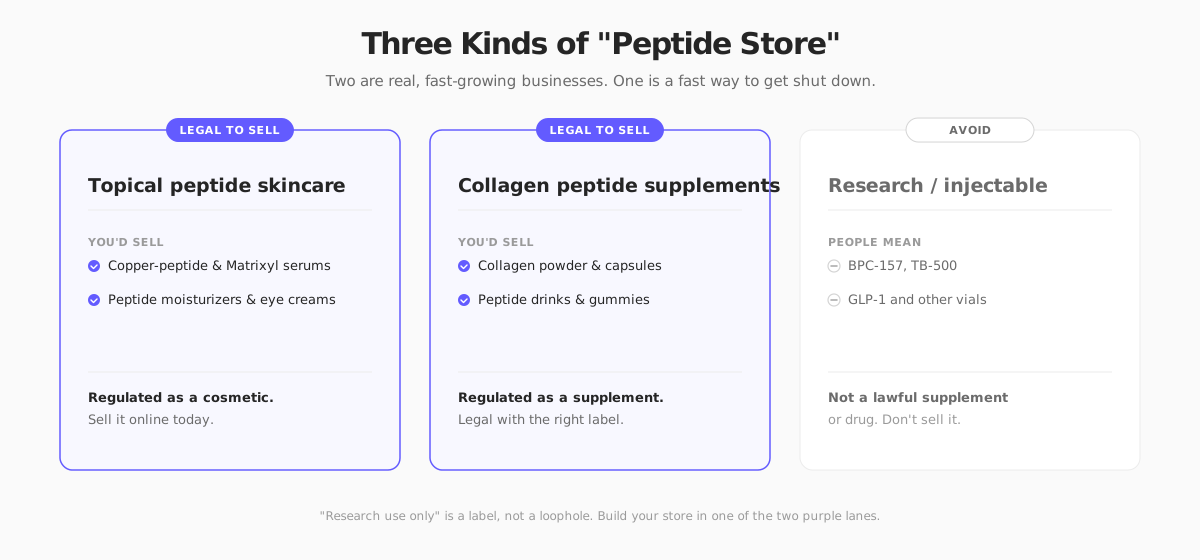
The short answer: you can legally sell peptide skincare (copper peptides, Matrixyl) and collagen peptide supplements in the US. You cannot legally sell BPC-157, TB-500, or GLP-1 peptides for people to use, no matter what the label says. The rest of this guide is about building a real business in the two legal lanes.
The first two are real, legal, fast-growing businesses. The peptide skincare market alone is projected to grow from about $2.9 billion in 2026 to $8.3 billion by 2035. The third is a legal minefield, and this guide is going to steer you firmly away from it. Here's why.
The lane to avoid: "research" and injectable peptides
Peptides like BPC-157, TB-500, and the GLP-1 compounds are the ones getting all the hype on podcasts. They are also not FDA-approved drugs and not lawful dietary supplement ingredients, which means they cannot legally be sold for people to use. The "research use only, not for human consumption" label you see on these sites is a fig leaf, not a loophole. Selling them puts you in a grey market that mainstream payment processors and every major ad platform ban outright.
(You may have seen news that in February 2026, HHS announced moving 14 peptides back toward compounding-pharmacy access. Read the fine print: that's about licensed pharmacies dispensing with a doctor's prescription. It is not a green light for a beginner to open an online store.)
If your plan was the injectable lane, this is your sign to pick a different product. The rest of this guide is about the two lanes you can actually build a business on. The good news: they're bigger, safer, and far easier to market.
The 7 Steps, in Order
- Pick your legal lane and one specific person. Topical skincare or ingestible collagen. Then one type of person within it.
- Get a small group to say "yes, I'd buy this" before you order inventory.
- Decide how your product gets made. For peptides, this almost always means a private-label lab.
- Do the legal and claims work. For peptides this is the make-or-break step. What you say can sink you faster than what you sell.
- Set the price so the math works. The honest rule is at least 4 to 5× your all-in cost.
- Set up a simple website where people can actually buy.
- Pick one place to get noticed. Not all of them. One.
Now the long version.
Step 1: Pick Your Lane and One Specific Person
You've already picked your legal lane (topical skincare or ingestible collagen). Now narrow it to one specific person, because "people who want peptides" is not a business.
The fastest way a new brand dies is being "for everyone." You're competing with billion-dollar companies on every shelf. You don't beat them with a slightly nicer serum. You beat them by being the obvious choice for one specific person, or the obvious answer to one specific problem.
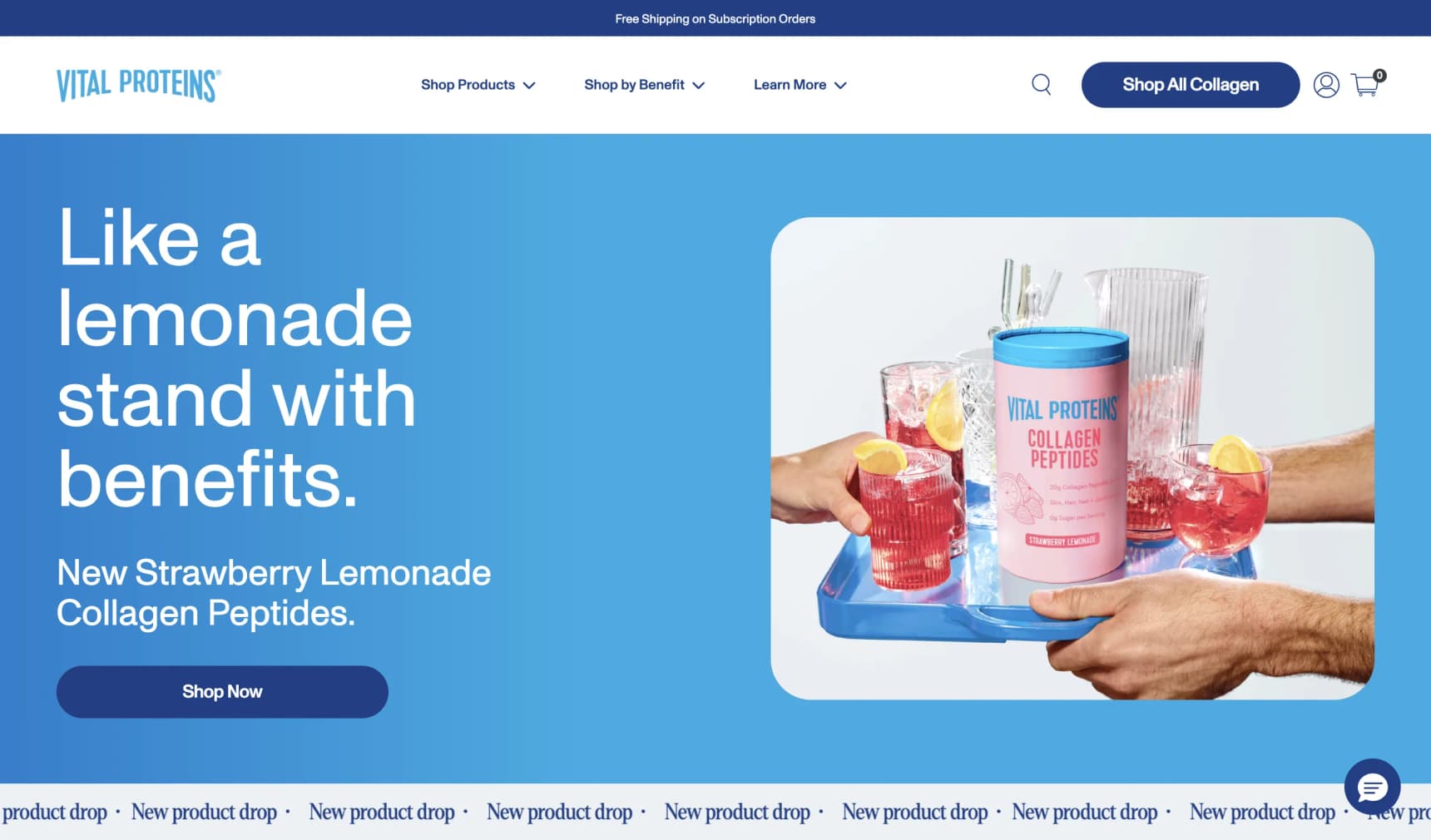
The proof this works in the peptide world: Vital Proteins. Founder Kurt Seidensticker started it in 2013 around a single, focused idea: collagen peptides for everyday skin, hair, nail, and joint support. In about six years it became America's leading collagen brand, and Nestlé acquired it. One ingredient, one clear promise, one kind of customer.
On the topical side, The Ordinary did the same thing in reverse: it built a cult following on affordable, no-nonsense peptide serums (its copper peptides and the multi-peptide "Buffet" formula) with one clear idea, clinical actives without the luxury markup, repeated across a tight range. Different lane, same lesson: one sharp idea beats a broad menu.
Good "one person" answers look like this:
- Copper peptide serums for people in their 40s who are done with 11-step routines and want one bottle that does the work.
- Collagen peptides for postpartum recovery, sold by someone who lived it.
- Unflavored collagen for coffee, for the person who wants the benefit without changing their morning.
The test: if a giant brand could put your product on a shelf tomorrow without changing anything about who they are, your idea isn't sharp enough. Your advantage as a small brand is that you can care about one specific person more than a giant company ever will. (Still deciding whether peptides are even the right category? Our guide to starting any online store covers the category choice first, and our skincare brand playbook goes deep on the topical side.)
Your Step 1 exercise (5 minutes): Finish this sentence in a notes app.
"I sell ________ (a peptide skincare product or a collagen supplement) for ________ who want ________."
If the middle blank is "everyone" or "people who want healthy skin," it's not narrow enough yet. Keep going until it names a person you could actually picture. That clarity is what makes your marketing in Step 7 cheap instead of expensive.
Step 2: Get a Small Group to Say "Yes" Before You Order Inventory
This is the step almost every first-timer skips. You do not need 1,000 units to find out if your idea is good. You need to find out if your idea is good before you order 1,000 units.
Three cheap ways to test:
- A one-page website with a "Join the waitlist" button. Show your concept, the one problem you solve, and ask for an email. Spend $100 to $200 on Instagram or TikTok ads to send your target person there. If fewer than about 1 in 50 visitors sign up, your idea isn't landing yet. Go back to Step 1.
- Take pre-orders for a small first run. Same page, but "Pre-order, ships in 8 weeks." People who hand over a card are the only real signal. Ten pre-orders beat a thousand likes.
- Get a sample batch into real hands. Have your private-label lab send you sample units, give them to 20 people in your target group, and ask two questions: "Would you actually pay for this?" and "What would you change?"
This step costs a weekend and maybe $200. Skipping it can cost you $10,000 in inventory nobody asked for.
Step 3: Decide How Your Product Gets Made
For peptides, you are almost never making this yourself in a kitchen. Both legal lanes need a real lab, because the ingredients and testing are beyond a home setup. You have two realistic paths.
Path A: Private label (the right default for almost everyone)
A manufacturer already has tested, ready-to-sell peptide formulas. You pick one, put your brand on it, and they make it. The big advantage nobody tells beginners: the lab is the registered manufacturer in the eyes of the law, not you, and they make the product under the proper safety standards (more on that in Step 4).
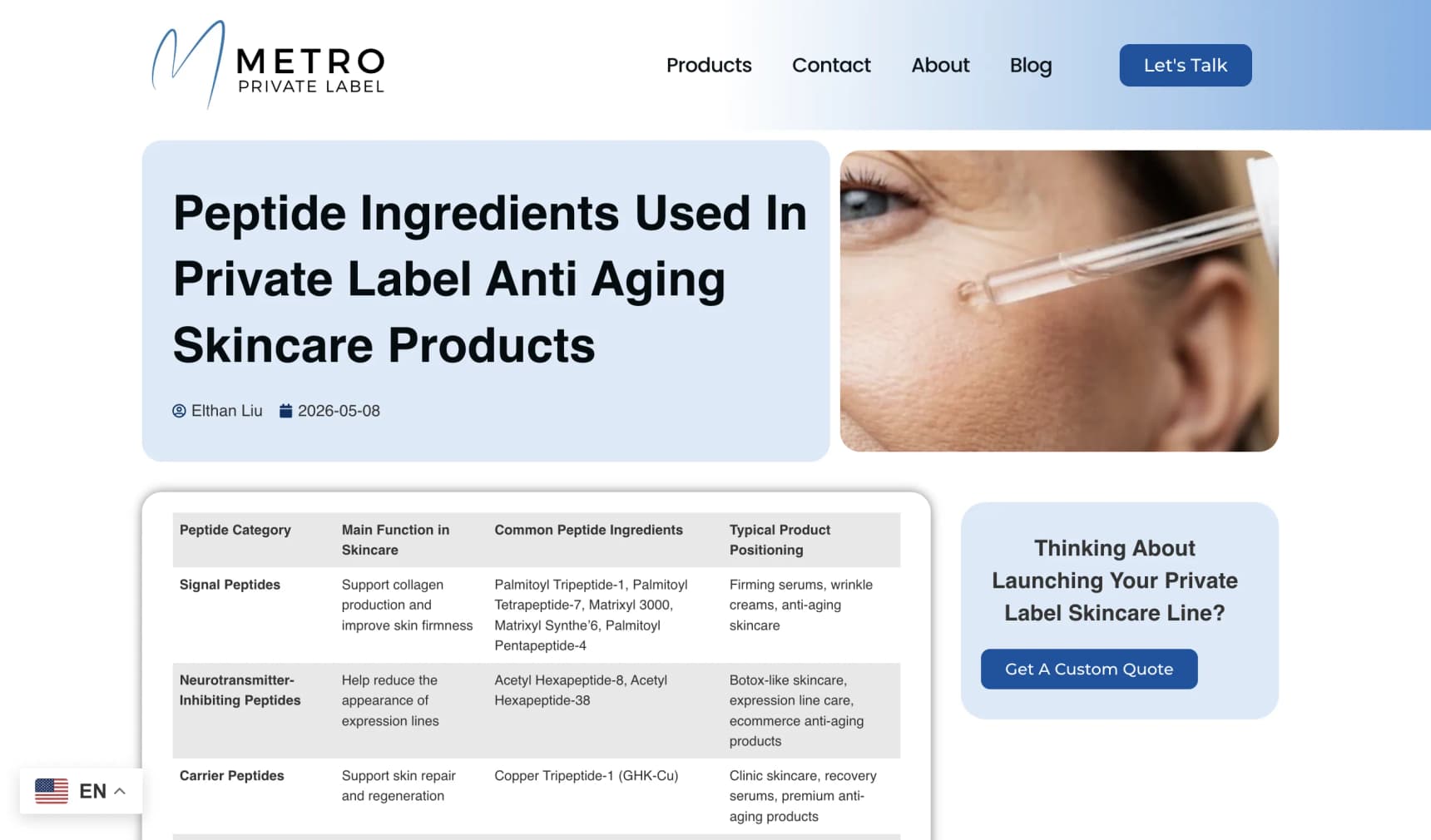
- Topical peptide skincare: specialist labs offer ready formulas built around copper peptides (GHK-Cu), Matrixyl, and Argireline, the three workhorse cosmetic peptides. Serums are the most popular format. Minimums can be as low as a few dozen to a few hundred units.
- Collagen peptide supplements: look specifically for a lab that makes supplements under supplement manufacturing standards (not just a food packer). Collagen powder, capsules, gummies, and drink formats are all standard. Minimums are usually higher, often 500 to 1,500 units per product.
Path B: Custom formulation (your own formula from scratch)
A lab develops a unique formula to your spec. This is how you get something truly one-of-a-kind, and it's how most beginners overspend. Expect minimums of several thousand units and $30,000+ tied up before your first sale, plus formulation and testing fees.
Save this for later. Prove people buy with a private-label product first, then invest in a custom formula once you have a hero product worth protecting.
| Path | Upfront cost | Who handles safety/factory rules | Best for |
|---|---|---|---|
| Private label | $8k–$20k | The lab | Almost every beginner |
| Custom formulation | $30k–$60k+ | The lab | Proven brands scaling up |
Step 4: Do the Legal and Claims Work (This Is the One That Matters)
For most products, the legal step is about labels and insurance. For peptides, what you say about your product is the thing most likely to get you shut down. Peptides tempt founders into medical-sounding promises, and those promises are exactly what regulators act on. Read this step twice.
The rules depend on your lane.
If you sell topical peptide skincare
Your product is a cosmetic. The FDA doesn't approve it before sale, but you're responsible for safety and honest labeling, and there's a federal cosmetics law (MoCRA) with a small-business exemption for brands under about $1 million a year. Our skincare brand guide covers all of that in plain English.
The peptide-specific trap is claims. A cosmetic can talk about appearance. It cannot claim to change the body. So:
- ✅ Allowed: "reduces the look of fine lines," "for firmer-looking skin."
- ❌ Not allowed: "rebuilds collagen," "heals scars," "repairs the skin barrier." Those are drug claims, and they turn your serum into an unapproved drug in the eyes of the FDA.
If you sell collagen peptide supplements
Your product is a dietary supplement, governed by a law called DSHEA (the full launch path is in our guide to starting a supplement brand). Three non-negotiables:
- You may only make "structure/function" claims, not disease claims. ✅ "Supports skin elasticity and joint comfort" is fine. ❌ "Cures arthritis" or "reverses aging" is illegal.
- Your label must carry this exact disclaimer, in bold: "This statement has not been evaluated by the Food and Drug Administration. This product is not intended to diagnose, treat, cure, or prevent any disease."
- Every claim needs real evidence behind it. The FTC requires "competent and reliable scientific evidence" for anything you say in marketing. "Studies show" means you can point to the studies.
Make your supplement at a facility that follows supplement good manufacturing practices, and they'll handle most of the compliance plumbing for you.
Both lanes: insurance
Get product liability insurance before your first sale. For a small brand it runs roughly $500 to $2,000 a year for a $1 million policy. A single customer claim, especially for something people put on their skin or in their body, will cost far more than years of premiums.
The one-sentence version of this whole step: sell the legal lanes, label them correctly, and never claim your peptide treats, cures, heals, or rebuilds anything. Talk about look (skincare) and support (supplements), and you stay on the right side of the line.
Step 5: Set the Price So the Math Works
The classic beginner mistake: "the serum at Sephora is $40, so I'll charge $35." That math doesn't work, because the big brand's per-unit cost is a fraction of yours and they aren't paying to win every customer the way you will.
The honest rule: your retail price should be at least 4 to 5× what one finished unit costs you, all-in. Peptide products support premium pricing (the ingredient story helps), but "what it costs you" is never just the bottle. It's also:
- Card processing fees.
- Shipping to the customer.
- Boxes, inserts, protective packaging.
- Returns and the occasional refund.
- Marketing: ads, free product to creators, your time making content.
Quick example for a peptide serum. Say your all-in unit cost is $9 (product, bottle, box, label). You sell it for $45 (5×). Here's where the money goes:
| Where the money goes | $ |
|---|---|
| Product, bottle, box, label | $9.00 |
| Card fee (Stripe, 2.9% + $0.30) | $1.60 |
| Shipping to customer (avg) | $5.50 |
| Returns reserve (~5%) | $2.25 |
| Marketing (~25% of revenue) | $11.25 |
| What you actually keep | ~$15.40 |
So a $45 serum nets you about $15. To clear a $12,000 first order, you'd need to sell roughly 800 units, plus more to cover photos, samples, and tools. That's the realistic first-year target, not a flat revenue number.
Watch what happens if you cave and price at $30 (about 3.3×): your profit per unit collapses to a few dollars and you'd need to sell thousands just to break even. If the math doesn't land, don't launch. Raise the price, simplify the packaging, or pick a cheaper bottle.
Step 6: Set Up a Simple Website
By now you have a compliant product, real test feedback, pricing that works, and (hopefully) a waitlist. Time to give people a place to buy.
You need three things: a few honest product photos, a clear "Buy" button, and a checkout that doesn't scare people off.
One peptide-specific note before the options: mainstream payment processors and ad platforms support compliant cosmetic and supplement businesses, but they ban research-chemical peptides. This is one more reason to be in a legal lane: it's the difference between a checkout that works and an account that gets frozen.
The main options in 2026, honestly ranked for a first-time peptide founder:
- Your Next Store (us, to be upfront) is the simplest way to get a modern store online without becoming a tech person. Starts at $25/month on the yearly plan, with no extra fees per sale. An AI helper builds the store with you, and search, reviews, and email are already built in, so you're not bolting on a pile of paid add-ons later. Good fit if you want a real website fast and predictable monthly costs.
- Shopify is the safe middle ground. $39/month, just works, a plug-in for everything. The downside: those plug-ins add up to another $200 to $500/month at volume, and Shopify takes a small extra fee on every sale unless you use their own payment method.
- Amazon is where a lot of supplement buyers actually search. Huge built-in demand, but heavy fees, fierce competition, and you're renting the customer. Good as a channel, not as your only home.
- Squarespace or Wix are cheap and visual. Fine for a small first drop; most brands outgrow them within a year.
Honest recommendation: run your own website and a marketplace presence from day one. Your own site gives you a brand and a customer list you control; the marketplace gives you traffic. Move repeat buyers to your site through inserts and email.
0% extra fees on every sale. A modern website for your peptide brand, ready in minutes.
Step 7: Pick One Place to Get Noticed
New brands almost always win on exactly one channel in their first year, then expand. The beginner trap is trying all of them at once and doing none of them well. And for peptides there's a catch: ad platforms are strict about supplement and "peptide" claims, so your channel mix matters more than usual.
Your options, honestly:
- TikTok and Instagram (free, slow, effective). The default, because routines and results are made for video. Works if you can post 3 to 5 times a week for 6 to 12 months. Keep your claims clean (talk about look and support, never cure), because medical claims get content pulled. Most founders quit at month three. Don't be most founders.
- Sending free product to small creators. Pick 30 creators (5,000 to 50,000 followers) whose audience is exactly your person, send a free product with a handwritten note. Roughly 15 to 20% will post. Often the best return on spend under $10k in revenue, because peptides are trust-driven.
- Content and SEO. Slow (6 to 12 months) but powerful, because people research peptides heavily before buying ("copper peptides vs retinol," "best collagen for joints"). Honest, well-sourced articles also dodge the ad-platform claim problem entirely.
- Email. The most profitable channel once you have customers. Collect every email from day one and send a simple welcome series.
- Paid ads. Skip until you have organic content that works, and expect extra ad-review friction in this category. Cold-start ads here are expensive and easily rejected for claims.
Pick one main channel and one backup. Run both for six months. Add a third only when the first two are making money.
What It Actually Costs to Start a Peptide Store in 2026
The real-world ranges for the two legal lanes:
| Your approach | Upfront cost | Monthly spend | What you get |
|---|---|---|---|
| Topical peptide skincare (private label) | ~$8,000–$15,000 | ~$300 | 2–3 peptide serums, your own site, insurance, labels |
| Collagen supplement (private label) | ~$10,000–$20,000 | ~$400 | 1–2 collagen products at 500–1,500 units, supplement-grade lab, label compliance |
| Custom formulation (either lane) | $30,000–$60,000+ | $1,000+ | A unique formula, big minimums, full testing, pro branding |
Two honest warnings:
- None of these break even in three months. Plan for 12 to 18 months of cash flow before things turn green.
- The cheapest way to lose everything is the illegal lane. A research-peptide store can look profitable for a few months and then vanish with a frozen payment account and a regulator's letter. The legal lanes are bigger anyway.
The peptide founders who survive year one aren't the ones with the boldest claims. They're the ones who picked a legal lane, served one person well, said only what they could back up, and won one channel before adding a second. Do those four things and the rest is patience.
FAQ
Is it legal to sell peptides online?
It depends entirely on the peptide. Topical peptide skincare (copper peptides, Matrixyl) is legal to sell as a cosmetic. Collagen peptide supplements are legal to sell as dietary supplements. But research or injectable peptides like BPC-157, TB-500, and GLP-1 compounds are not legal to sell for human use, and "research use only" labeling doesn't change that. Stick to the first two lanes and you have a real business.
How much does it cost to start a peptide store in 2026?
For a legal lane, roughly $8,000 to $20,000 to launch with private-label products: a couple of peptide serums or one or two collagen supplements, plus a website, insurance, and compliant labels. A fully custom formula starts around $30,000 because of higher minimum order quantities. Most beginners get the best risk-to-reward from private label.
What can I legally claim about my peptide product?
For skincare, you can talk about appearance ("reduces the look of fine lines") but not the body ("rebuilds collagen"). For supplements, you can make structure/function claims ("supports skin elasticity") but not disease claims ("cures arthritis"), you must include the FDA disclaimer on your label, and you must have real scientific evidence for every claim. When in doubt, claim less.
Do I need FDA approval to sell peptide skincare or supplements?
No. The FDA does not approve cosmetics or dietary supplements before sale. But you are fully responsible for making the product safely (use a proper lab), labeling it correctly, and only making claims you can back up. The FDA and FTC act after the fact when products are unsafe or claims are misleading.
Can I sell BPC-157 or GLP-1 peptides if I label them "research use only"?
No. Those peptides are not approved drugs or lawful supplement ingredients, and labeling them "research use only / not for human consumption" is a fig leaf, not a legal shield. Mainstream payment processors and ad platforms ban them, and you take on serious legal and safety risk. This guide strongly recommends against it.
Which legal lane is easier to start, skincare or supplements?
Topical peptide skincare usually has lower minimum orders and slightly simpler rules, so it's the easier first step for most people. Collagen supplements have a larger built-in audience but higher minimums and stricter labeling. Many founders start with one serum, prove it sells, then expand.