Saleor vs Shopify: Open Source or Hosted? (2026)
 Jakub Neander
Oct 2, 202611 min read
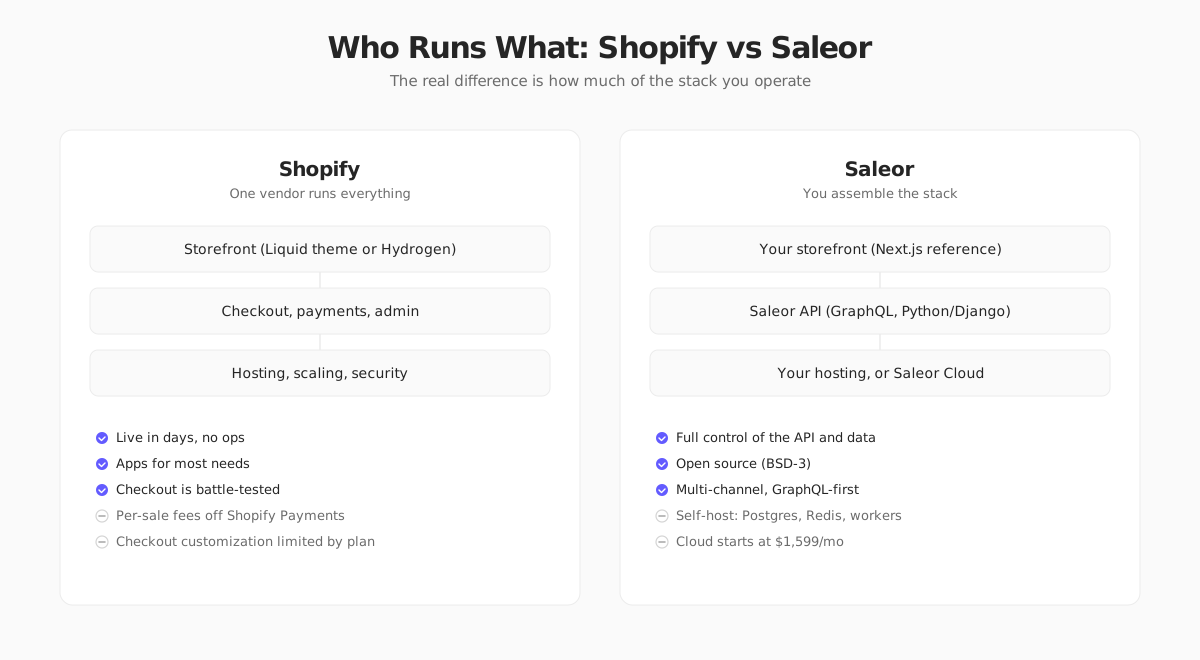
Saleor vs Shopify is not really a feature comparison. It is a question of who operates your store. Shopify runs the storefront, checkout, admin, hosting, and security for you. Saleor hands you an open-source commerce API and expects you to build and run everything around it, or pay for Saleor Cloud to run the API. This guide compares them on cost, control, and effort, using public 2026 pricing, so you can tell which side of that trade you are on.
Bias disclosure: We build Your Next Store, which sits between these two (a managed backend with an open-source Next.js storefront). We say where it fits near the end, but the comparison below is about Saleor and Shopify on their own terms.
Saleor vs Shopify at a Glance
| Shopify | Saleor | |
|---|---|---|
| Model | Hosted SaaS | Open-source headless engine (plus managed Cloud) |
| License | Proprietary | BSD-3-Clause |
| Stack | Liquid themes, Hydrogen for headless | Python, Django, GraphQL |
| API | Admin and Storefront APIs (GraphQL and REST) | GraphQL only |
| Storefront | Themes included | Bring your own (Next.js reference storefront) |
| Checkout | Shopify's hosted checkout | You build or extend it |
| Entry price | $29/mo (Basic) | Free to self-host; Cloud from $1,599/mo |
| Per-sale platform fees | 2% to 0.2% if you skip Shopify Payments | 0.8% above plan GMV on Cloud; none self-hosted |
| Best for | Shipping a store fast with minimal engineering | Teams who need to own the commerce API and data model |
What Shopify Gives You
Shopify is the default answer for a reason: you sign up, pick a theme, add products, and you can take payments the same day. Hosting, scaling, PCI compliance, checkout, tax tooling, and an app store with thousands of extensions are all included.
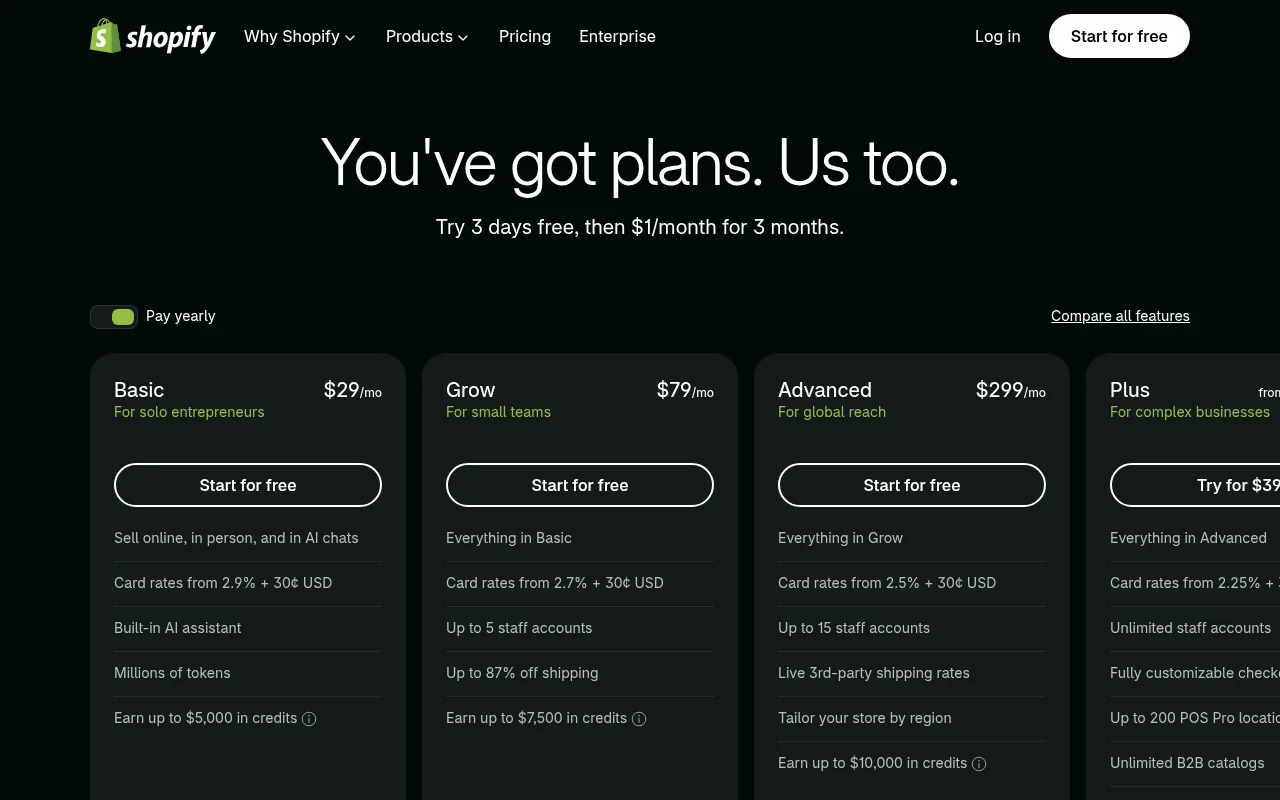
As of October 2026, Shopify's public pricing lists:
| Plan | Price | Card rate (online) | Third-party gateway fee |
|---|---|---|---|
| Basic | $29/mo | 2.9% + 30¢ | 2% |
| Grow | $79/mo | 2.7% + 30¢ | 1% |
| Advanced | $299/mo | 2.5% + 30¢ | 0.6% |
| Plus | from $2,300/mo | 2.25% + 30¢ | 0.2% |
The third-party gateway fee only applies if you take payments through a provider other than Shopify Payments. We break the math down in how much Shopify takes from a $100 sale.
Where Shopify is strongest:
- Time to first sale. Hours, not weeks, and no one on your team has to write code.
- Checkout. It is one of the most heavily tested checkouts on the web, and it is not something you have to build or secure.
- Ecosystem. Subscriptions, reviews, loyalty, shipping and ERP connectors exist as apps, usually installable in minutes.
- Zero operations. No servers, no upgrades, no on-call.
Where it pinches:
- Customization has a ceiling. Themes go far, but deep checkout or data-model changes depend on your plan and on Shopify's extension points.
- App costs add up. The headline plan price is rarely the real monthly bill once you add apps.
- Headless means a second system. If you want a custom storefront, you are still paying Shopify and also running a frontend (see Shopify Hydrogen alternatives).
What Saleor Gives You
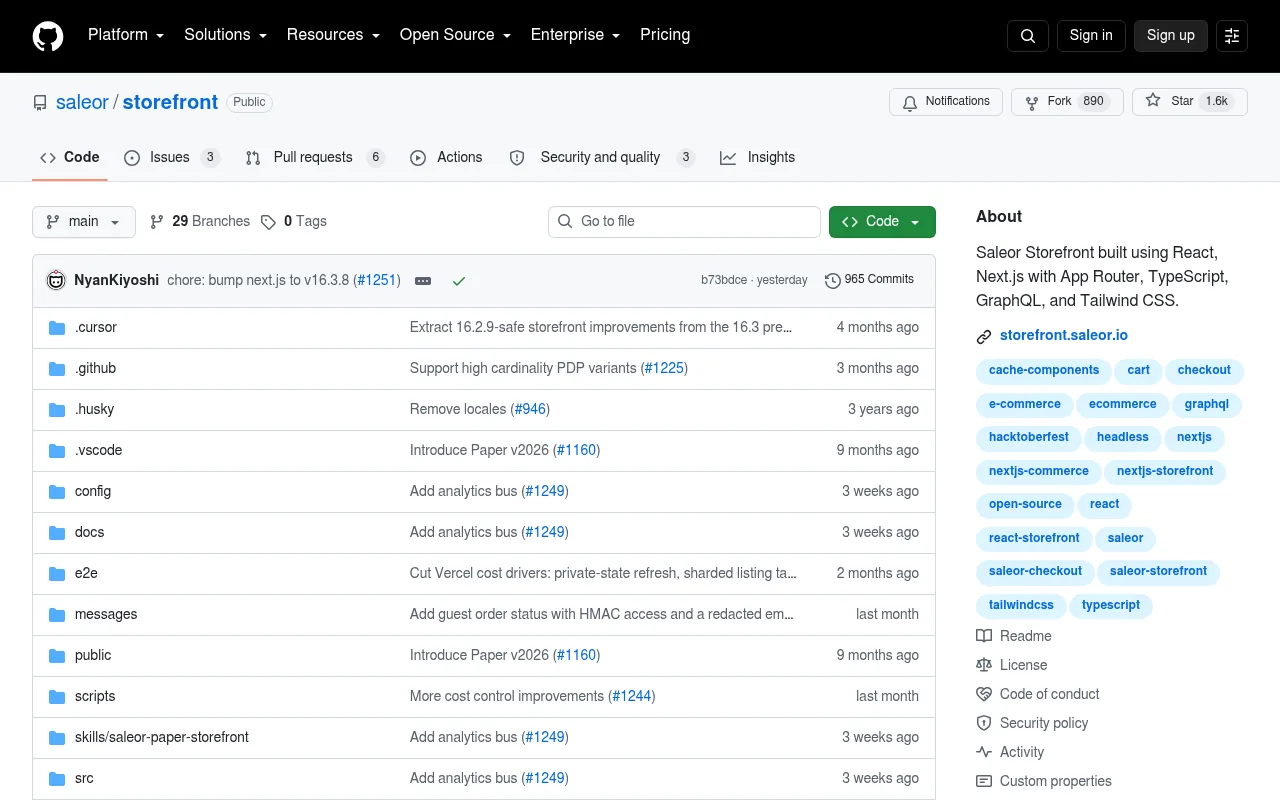
Saleor is an open-source commerce API. It is licensed BSD-3-Clause, built on Python and Django, and exposes everything through a single GraphQL schema: products, variants, channels, warehouses, orders, checkout, and permissions. The repository has more than 23,000 GitHub stars as of October 2026.
Saleor is not a store. It is the engine behind one. That distinction drives almost every difference in this comparison.
What you get that Shopify will not give you:
- Full ownership of the data model and API. You can read the source, fork it, and extend it.
- Multi-channel by design. One catalog can feed multiple channels with their own currencies, pricing, and availability, a first-class concept in the schema.
- GraphQL everywhere. One typed, introspectable API, which frontend teams who like codegen tend to enjoy.
- No platform lock-in on the backend. Self-host it anywhere that runs Postgres.
What you take on:
- A storefront. Saleor publishes a Next.js storefront (App Router, TypeScript, Tailwind, GraphQL) as a starting point, but it is a reference implementation you will customize, not a finished theme with a theme editor.
- A second language. The API is Python and Django. If your team is JavaScript end to end, extending Saleor (apps and webhooks aside) means someone on the team is comfortable in Django.
- Operations if you self-host. Expect PostgreSQL, Redis, background workers, and media storage alongside the API service.
- Everything around the engine. Search, email, tax rules for your markets, and shipping integrations are yours to wire up through Saleor's app and webhook system.
Cost: The Real Comparison
The two price lists are shaped differently, so compare totals, not tiers.
Shopify is a monthly plan plus apps plus (possibly) a gateway fee. A small store lives comfortably at $29 to $79/mo before apps. Cost scales gently with revenue.
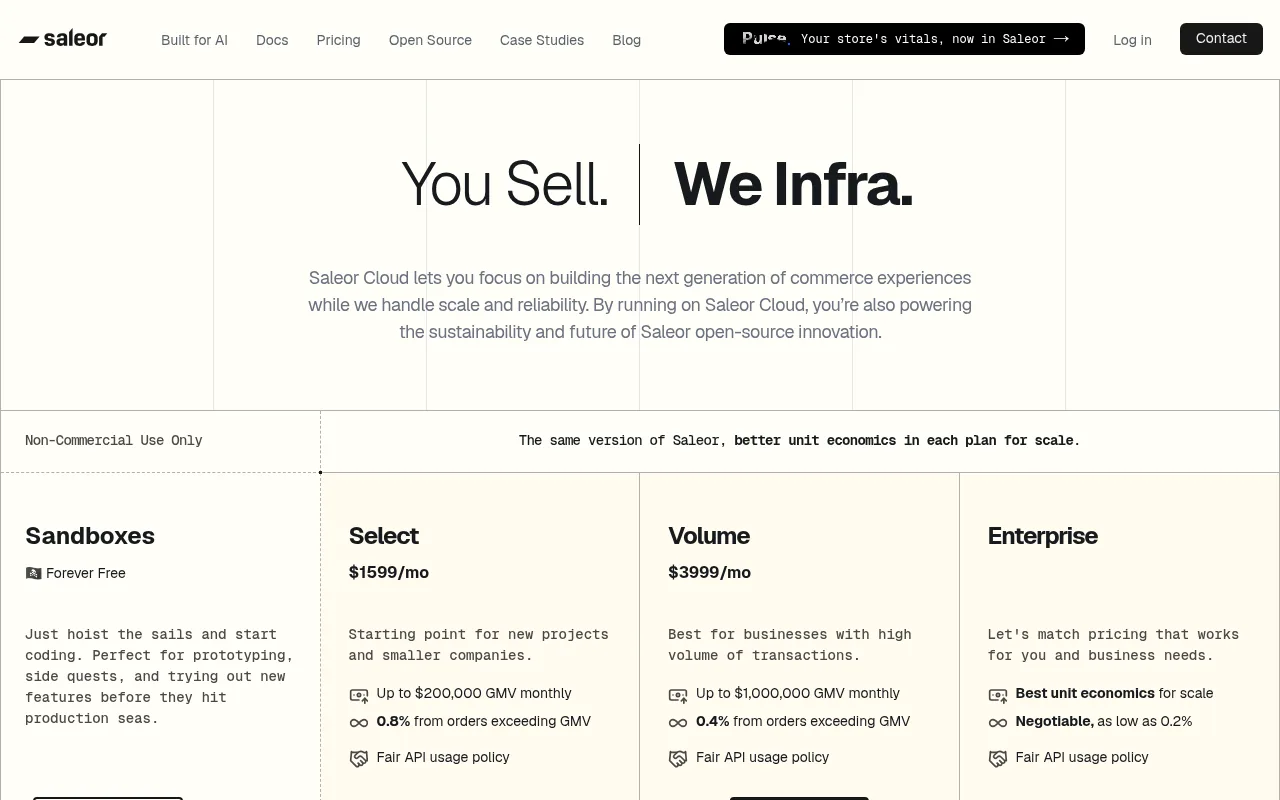
Saleor is free if you self-host, and Saleor Cloud prices like an enterprise product:
| Saleor Cloud plan | Price | Included GMV | Fee above limit |
|---|---|---|---|
| Sandboxes | Free | Prototyping only | None |
| Select | $1,599/mo | $200,000/mo | 0.8% |
| Volume | $3,999/mo | $1,000,000/mo | 0.4% |
| Enterprise | Custom | Negotiated | From 0.2% |
Self-hosting is free in license terms but not in effort: you pay in infrastructure and engineering time. A rough mental model:
- Under roughly $200k/mo in sales: Shopify is almost always cheaper in total cost, because Saleor's cheapest managed plan costs more than Shopify's Advanced plan, and self-hosting needs engineering time.
- Large catalogs, many channels, custom order logic: Saleor's cost can win, because you are not paying per-seat, per-app, and per-feature on a SaaS to approximate behavior you could just code.
- Plus-level volume: Shopify Plus starts around $2,300/mo, so the gap narrows, and the decision becomes about control rather than price.
Payment processing (Stripe, Adyen, and so on) is separate in both cases and is not included in any figure above.
Developer Experience and Control
This is where the two diverge most.
With Shopify, you work inside Shopify's guardrails. Themes are written in Liquid, checkout customization goes through extensions, and custom logic often lives in apps or Shopify Functions. That is productive when your needs match what Shopify anticipated, and slower when they do not.
With Saleor, you write the storefront in whatever you like, call a GraphQL API, and extend the backend through webhooks and apps (or by forking the core). A typical product query looks like this:
That is a lot of power, and a lot more surface area to own. Preview environments, caching, image handling, SEO, and checkout UX are all decisions your team makes instead of defaults you inherit.
What Nobody Tells You
- Saleor is not a Shopify you host yourself. There is no admin theme editor, no app store of one-click extensions, and no template library. The comparison people make ("free Shopify") is the most common reason Saleor projects stall.
- Shopify's real limit is rarely features, it is shape. When your catalog, B2B pricing, or fulfillment model does not fit Shopify's model, you start paying in workarounds.
- Headless Shopify costs twice. Teams who move to a custom frontend while staying on Shopify pay for the platform and for a frontend team.
- Saleor Cloud is a service relationship. Its plans bundle onboarding, a solution architect, and a dedicated support channel, which is valuable for enterprise teams and overkill for a two-person startup.
Which Should You Choose?
Choose Shopify if:
- You want to be selling this week and do not have an engineer to spare.
- Your catalog and checkout needs fit a standard model.
- You prefer paying a predictable monthly fee over running infrastructure.
Choose Saleor if:
- Commerce is core to your product and you need to own the API, data model, and roadmap.
- You run multiple channels, currencies, or warehouses from one catalog.
- You have engineers who are comfortable with GraphQL, and at least one who can run or extend a Python service (or the budget for Saleor Cloud).
Consider neither if you want a custom Next.js storefront without running a backend or paying enterprise prices. That is the gap Your Next Store is built for: a managed commerce backend with 0% platform transaction fees, an open-source Next.js storefront, and an AI store builder, starting at $30/mo. It is honest to say what it is not: it has no GraphQL API and does not offer a free self-hosted backend, so Saleor remains the better pick if GraphQL or full backend ownership is the requirement. If you are weighing that route, see Saleor alternatives and open source Shopify alternatives.
FAQ
Is Saleor better than Shopify?
Neither is better in general. Shopify is better when speed and low operational burden matter most. Saleor is better when you need ownership of the API and data model and have the engineering capacity to use it.
Is Saleor free?
The open-source core is free under the BSD-3-Clause license, and Saleor Cloud offers a free sandbox for prototyping. Production on Saleor Cloud starts at $1,599/mo, and self-hosting costs infrastructure and engineering time.
Can I migrate from Shopify to Saleor?
Yes, but plan it as a rebuild, not an import. Products and customers can be exported from Shopify and loaded into Saleor through its API, but the storefront, checkout, and integrations all need to be built. Our guide to migrating from Shopify to headless commerce walks through the phases.
The Bottom Line
Shopify sells you a finished store. Saleor sells you the parts to build a better one. If you cannot say what you would build with the extra control, you do not need it yet.