How to Start a Shoe Brand in 2026: The Honest Playbook
 Jakub Neander
Aug 24, 202612 min read
Shoes are one of the hardest physical products a beginner can pick, and one of the most rewarding when the pieces line up. They're regulated less than skincare, but the manufacturing is more technical than a t-shirt, the samples take longer, and the online return rate is higher than almost any other category because fit is so personal. This is the guide I'd hand a friend before they spend a dollar: seven steps, in the right order, with honest 2026 numbers for what it actually costs.
The 7 Steps, in Order
- Pick a very specific kind of person, or a specific problem, to design shoes for. Not "people who need shoes." One type of person or problem.
- Get a small group to say "yes, I'd buy this" before you order a single pair.
- Decide how your shoes actually get made. There are three real paths, and the right one depends on your budget.
- Do the boring legal and labeling work. Footwear has its own rules, lighter than apparel in some places, stricter in others.
- Set the price so the math works. For shoes, the honest rule accounts for a return rate most beginners underestimate.
- Set up a simple website where people can actually buy.
- Pick one place to get noticed. Not all the places. One.
Now the long version.
Step 1: Pick a Very Specific Kind of Person to Make Shoes For
The fastest way a new shoe brand fails is trying to be "for everyone." Walk into any shoe wall at a big-box retailer and you'll see hundreds of near-identical sneakers competing on nothing but price and logo. You cannot out-manufacture Nike or Skechers. You can out-care them for one specific person.
So before you sketch a silhouette, decide who the shoe is for, or what specific problem it solves. A good answer is narrow enough that it almost sounds too small. A bad answer is "people 20 to 40 who want stylish, comfortable shoes."
If you're still deciding whether footwear is even the right category to start with, our broader playbook for starting any online store walks through the customer and category decisions before you commit.
Good answers look like this:
- People who live somewhere it rains constantly and are tired of soggy commutes ruining their shoes.
- Runners with a specific gait or foot shape that off-the-shelf sneakers don't fit well.
- People who want one pair of leather shoes that actually lasts instead of replacing cheap ones every year.
That first one is Vessi, a Vancouver-based footwear brand built entirely around one idea: a knit sneaker that's genuinely waterproof. No hundred-SKU catalog, no chasing every trend. Just one clear problem, solved well, marketed relentlessly to people who live with that exact problem. Vessi crossed $100 million in annual sales within seven years, bootstrapped, without outside funding. It's also, specifically, a sneaker: if the narrower, drop-driven world of sneaker culture (colorways, collabs, limited releases) is closer to what you're building than general footwear, our guide to starting a sneaker brand goes deeper on that specific path.

The test: if a shoe wall at Target could carry your design tomorrow without changing anything about who they are, you haven't picked a sharp enough idea. The US footwear market alone is worth tens of billions of dollars a year and growing steadily, which means there's plenty of room, but only for brands specific enough to actually get noticed inside it.
Step 2: Get People to Say "Yes" Before You Order a Single Pair
This is the step almost every first-timer skips, and footwear punishes skipping it harder than most categories. Shoes involve real tooling costs, real samples, and real minimums. You do not want to discover your idea doesn't resonate after you've already paid for a mold.
Three cheap ways to test:
- A one-page website with a "Join the waitlist" button. Show renderings or sketches of the shoe, explain the specific problem it solves, and ask for an email. Spend $100 to $200 on Instagram or TikTok ads sending your target person there. If fewer than 1 in 50 visitors sign up, the idea isn't landing yet. Go back to Step 1.
- Take pre-orders for the first small batch. Same page, but instead of "Join the waitlist," it's "Pre-order, ships in 10 to 14 weeks." People who hand over a card are the only signal that actually counts. Ten pre-orders beat a thousand likes.
- Get 20 people in your target group to try an early sample. Ask two questions only: "Would you actually buy this?" and "What would you change?" Polite "love it!" replies don't count. You want the person who tells you the toe box is too narrow.
This step costs a weekend and maybe a couple hundred dollars in ads. Skipping it can cost you thousands in a first production run for shoes nobody wanted.
Step 3: Decide How Your Shoes Actually Get Made
This is the biggest fork in the road, and where beginners waste the most time. There are three real paths, and the right one depends almost entirely on your budget and how much risk you can carry.
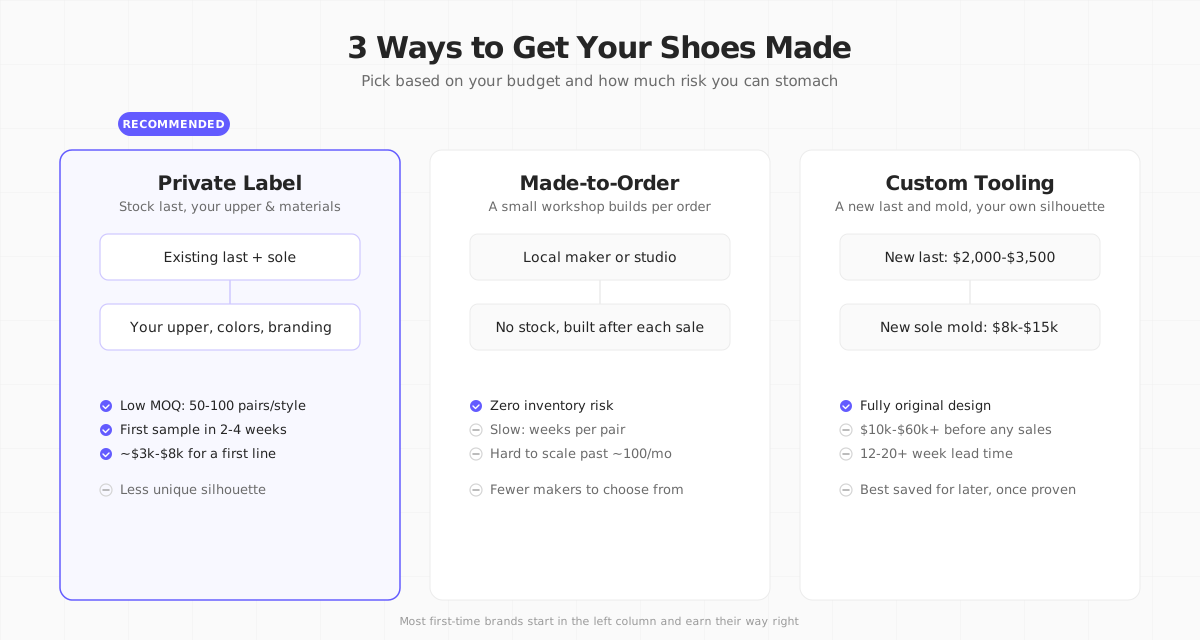
Path A: Private label on a stock last (the safe default)
A manufacturer already has a working last (the foot-shaped mold everything is built around) and a proven sole. You design the upper, the materials, and the colorway, and they build it on tooling that already exists. You're not engineering a shoe from scratch, you're customizing a good one.
This is the right starting point for most beginners. A newer generation of factories has built programs specifically for small brands, with MOQs as low as 50 to 100 pairs per style, and a realistic first line of 3 to 5 styles landing in the $3,000 to $8,000 range, a fraction of what private label footwear used to require. Because there's no new tooling to build, you can typically get a first sample in a few weeks rather than months.
The trade-off: you're working within an existing silhouette. You can change the upper dramatically, but the sole profile and fit are largely fixed.
Path B: Made-to-order, small batch
A local workshop or small maker builds each pair after someone orders it. No stock, no inventory risk, and often genuinely handmade quality. Sites like Maker's Row (the same directory clothing founders use to find sewing studios) also list small footwear and leather-goods makers willing to take tiny orders.

The catch is speed and scale. Made-to-order footwear is slow, often weeks per pair, and it's hard to reliably fulfill more than a hundred or so orders a month this way. It's a good fit if your product is genuinely premium and your customers already expect to wait.
Path C: Custom tooling, your own last and mold
A factory builds a brand-new last and sole mold to your exact spec. This is how you get a fully original silhouette that nobody else can copy off the shelf, and it's how most beginners overspend.
The real numbers: modifying an existing last to fit your design typically runs $500 to $1,500, but a genuinely new last costs closer to $2,000 to $3,500 for a full size run, and a new sole mold adds another $8,000 to $15,000 depending on complexity. Add sampling, materials, and a first production run, and a fully custom sneaker launch commonly starts around $10,000 and can climb well past $60,000. A new last alone can add four to six weeks to your timeline, and a full custom project typically runs 20 to 24 weeks from finished brief to factory dispatch, before you've sold a single pair.
Save this path for later. Validate demand on a stock last first. Move to custom tooling once you know people actually buy, the same way plenty of now-established shoe brands did.
Step 4: Do the Boring Legal and Labeling Work
This is the step that separates a hobby from a business. The good news: footwear is lighter on labeling rules than clothing. The less good news: get the safety and business basics wrong and a single bad batch, or a single injury claim, can end your brand before it starts.
Labeling is simpler than you'd expect
Unlike apparel, footwear is largely exempt from the FTC's textile fiber-content labeling rules. The core requirement is a country of origin disclosure, and additional rules only kick in if your shoe contains specific materials: real leather falls under a separate leather-labeling rule, and any wool or fur content triggers its own disclosure requirements. If your shoe is a standard synthetic or textile upper with no leather, wool, or fur, your label obligations are lighter than a t-shirt's. Confirm the specifics for your exact materials with your manufacturer or a footwear labeling reference before you print your first hang tag.
Business basics you still need
- A business license from your city, usually $50 to $100 a year.
- A sales tax permit if you're selling directly to customers in states that require one.
- Product liability insurance. A pair of shoes that causes a slip, a blister, or a structural failure can result in a claim your homeowner's policy won't touch. Budget a few hundred to a couple thousand dollars a year depending on your volume and materials, similar to what small apparel and accessories brands pay.
Fit is your real liability
The single most common complaint in footwear isn't a defect, it's a size that doesn't match expectations. That's not just a returns problem, it's a customer-trust problem. Publish an honest, specific size guide (true to size, runs narrow, runs wide) before you ever ship a pair. It will save you money in Step 5 and headaches in Step 7.
Step 5: Set the Price So the Math Works
The classic beginner mistake: "similar sneakers retail for $90, so I'll charge $75." That math rarely works, because the big brand pricing at $90 is likely paying $15 to $20 a pair at scale, while you're paying $25 to $35 for a small run.
The footwear industry has its own version of the standard apparel markup. Retail footwear traditionally runs a somewhat lower margin than the full apparel "keystone" double, commonly landing around a 45% gross margin at wholesale-to-retail, roughly a 1.8x to 2x multiple from wholesale cost to retail price. But that's the wholesale number. If you're selling direct-to-consumer, your real multiple needs to be higher, because you're also paying for the marketing and shipping a wholesale retailer would otherwise absorb.
Here's the honest rule for a DTC shoe brand: price at least 3.5x to 4x your all-in landed cost per pair, and build in a returns reserve that's higher than almost any other product category, because footwear is uniquely returns-heavy.
Why? Because "what it costs you" isn't just the shoe. It's also:
- Card processing fees on the sale.
- Shipping to the customer, and often a second shipment back.
- Packaging that survives freight (shoe boxes are bulky and easy to crush).
- Returns. Footwear returns run 18% to 19% online on average, roughly double the return rate of most other product categories, and sizing alone drives the large majority of them.
- Marketing (ads, samples to creators, your own time).
Quick example for a $22-landed-cost sneaker. You sell it for $85 (about 3.9x). Here's roughly where the money goes:
| Where the money goes | $ |
|---|---|
| Landed cost per pair (product + freight to your warehouse) | $22.00 |
| Card fee (Stripe, 2.9% + $0.30) | $2.77 |
| Shipping to customer (avg, footwear is bulky) | $9.00 |
| Return reserve (~18% of orders, full value) | $15.30 |
| Marketing (~22% of revenue) | $18.70 |
| What you actually keep | ~$17.00 |
So an $85 pair nets you roughly $17. To clear a $5,000 first private-label order across a few styles, you'd need to sell around 290 pairs, plus more to cover photos, samples, and a size-exchange program. That's a realistic first-quarter target, not a flat revenue number.
Now watch what happens at $65 (about a 3x markup): the landed cost and shipping don't move, so profit per pair collapses to roughly $6, and you'd need nearly 900 pairs to break even on the same order. If the math doesn't land, don't launch. Raise the price, simplify materials, or reduce your size run. The worst outcome is discovering six months in that your best-selling shoe loses money on every return.
Step 6: Set Up a Simple Website
By now you have a product, real fit feedback, pricing that works, and hopefully a waitlist. Time to give people a place to actually buy.
You don't need anything fancy. You need three things: honest product photos from multiple angles (including the sole), a clear size guide, and a checkout that doesn't scare people off.
The main options in 2026, honestly ranked for first-time shoe founders:
- Your Next Store (us, to be upfront) is the simplest way to get a modern store online without becoming a tech person. Starts at $25/month on the yearly plan, with no extra fees per sale. An AI-powered builder helps you set up the store, and search, reviews, and email are already built in, so you're not bolting on paid add-ons just to launch a proper size-exchange flow.
- Etsy works for handmade or made-to-order footwear (Path B above), less well for a private-label sneaker line, since buyers expect handcrafted, one-of-a-kind items there. Expect a 6.5% transaction fee plus listing fees.
- Shopify is the safe, popular middle ground. $39/month, and there's a plug-in for size charts, exchange flows, and virtually anything else. The trade-off: those plug-ins add up to another $200 to $500/month at real volume, and Shopify takes a small extra fee on every sale unless you use their own payment method.
- Squarespace or Wix are cheap and visual, fine for a small first drop, but most footwear brands outgrow the limited product-variant handling within a year.
- Instagram plus a payment link. If you only have one or two styles and your audience already follows you, you can take orders in DMs and use a simple Stripe payment link for checkout. Messy but free. Graduate once size exchanges get hard to track by hand.
Honest recommendation for most first-time footwear founders: because sizing drives so many returns and exchanges, prioritize a platform where you can show a real size guide, fit notes, and easy exchanges from day one, not just a "buy" button. A dedicated website earns that back quickly once you're past your first 20 to 30 orders.
0% extra fees on every sale. A modern website for your shoe brand, ready in minutes.
Step 7: Pick One Place to Get Noticed
New shoe brands almost always win on exactly one channel in their first year, then expand. The beginner trap is trying all of them at once and doing none of them well.
Your options, honestly:
- Instagram and TikTok (free, slow, effective). Footwear is visual and shows well on feet, in motion, in the rain or the mud if that's your angle. Works if you can post 3 to 5 times a week for 6 to 12 months. Most founders quit at month three.
- Sending free pairs to small creators. Pick 30 to 50 creators (5,000 to 50,000 followers) whose feet, style, or lifestyle match your specific person from Step 1. Send a free pair with a handwritten note. Roughly 15 to 20% will post. Often the strongest channel under $10k in revenue, because people trust a real foot in a real shoe more than a studio shot.
- Local run clubs, boutiques, and pop-ups. If your shoe solves a physical problem (running, standing all day, rain), the people who live that problem gather somewhere in person. A weekend table lets people actually try the shoe on, which is the single biggest barrier to a first online purchase.
- Wholesale to small independent shops. Once you can fulfill reliably, walk into 10 local shops with samples. A few will buy. Standard wholesale works out to roughly half your retail price (the 45% margin math from Step 5, run in reverse), so make sure your Step 5 math still works there.
- Google and SEO. Slow (6 to 12 months) but powerful for specific searches like "waterproof sneakers for commuting" or "wide toe box running shoes." Plant seeds now, don't expect it to carry year one.
- Email. The most profitable channel once you have customers, especially for a category with repeat purchases (people replace shoes). Collect every email from day one.
- Paid ads. Skip this until you have organic content that already works. Cold-start footwear ads are expensive, and a high return rate eats into what you can afford to pay per customer.
Pick one main channel and one backup. Run both for six months. Add a third only when the first two are actually making you money.
What It Actually Costs to Start a Shoe Brand in 2026
The real-world ranges, by how you choose to make your product:
| Your approach | Upfront cost | Monthly spend | What you get |
|---|---|---|---|
| Made-to-order, one style | ~$1,000–$3,000 | ~$100 | 1 style, small batches, a marketplace plus Instagram |
| Private label, stock last | ~$3,000–$8,000 | ~$300 | 3–5 styles at 50–100 pairs each, your own website, insurance |
| Custom tooling, first drop | $15,000–$40,000 | $1,000+ | 1–2 fully original silhouettes, real branding, wholesale samples |
| Full custom launch, multiple silhouettes | $60,000+ | $2,500+ | Multiple original lasts and molds, PR, paid ads, retail push |
Two honest warnings hidden in that table:
- A custom-tooling launch will not break even in three months. Between the tooling lead time and the 18%+ return rate, plan for 12 to 18 months of cash flow before things turn green.
- Private label on a stock last is the only row where you can validate a real brand without betting your savings on a mold. Every row to the right of it carries real inventory and tooling risk.
If your plan depends on everything going right, your plan is wrong. Budget for a second sample round that fixes what the first one got wrong, because with footwear, it usually does.
The shoe founders who make it past year one aren't the ones with the most original silhouette on day one. They're the ones who picked a specific person, validated demand before ordering tooling, priced for the return rate footwear actually has, and picked one channel to win before adding a second. Do those four things and the rest is patience, and a very good size guide.
FAQ
How much does it cost to start a shoe brand in 2026?
Anywhere from $1,000 to $60,000+, depending on how your shoes get made. Made-to-order through a small workshop can start near $1,000 to $3,000 for one style. Private label on a stock last, the path most beginners should start with, typically runs $3,000 to $8,000 for a first line of 3 to 5 styles at low minimum order quantities. A fully custom last and sole mold pushes the number to $15,000 and up, sometimes well past $60,000, because of tooling costs and higher minimums. Most of the cost is the tooling and the marketing, not the website.
What's a realistic minimum order quantity (MOQ) for a new shoe brand?
For private label on an existing last, 50 to 100 pairs per style is realistic with manufacturers built for small brands. Custom tooling projects, and factories overseas that haven't built a low-MOQ program, often require several hundred to a few thousand pairs per style, which is a very different level of financial commitment. Confirm the MOQ per style, per colorway, before you commit; some quote per style but actually mean per style-per-color.
Should I start with a stock last or design a fully custom shoe?
Start with a stock last (private label). It's dramatically cheaper, faster to sample, and lets you validate whether people actually want your brand before you spend on tooling. Move to a custom last and sole mold once you have real sales data and know exactly which silhouette is worth the investment. Skipping straight to custom tooling is the single most common way beginners overspend.
Why do shoes have such a high online return rate?
Fit. Footwear return rates run around 18% to 19% online, roughly double most other product categories, and the large majority of those returns come down to sizing rather than any defect in the shoe itself. A specific, honest size guide (true to size, runs narrow or wide, best for which foot shape) reduces this more than almost anything else you can do.
Do I need special licenses to sell shoes?
You need the same basics as any small business: a business license from your city and a sales tax permit if required in your state. Footwear itself isn't a specially licensed product category the way food or cosmetics are. You should still carry product liability insurance, since a structural failure or a slip can lead to a claim.
How long does it take to launch a shoe brand?
On the private-label path, from idea to first sale, plan for 3 to 5 months: a few weeks of validation, a few weeks for your first sample on a stock last, then production and a website. On the custom-tooling path, plan for 6 to 9 months or more, since a new last and sole mold alone can add several months before you've made a single sellable pair. Anyone promising a fully custom sneaker line in six weeks is skipping the tooling.
Related Blog Posts
- How to Start an Online Store in 2026: 7 Steps to Your First Sale
- How to Start a Clothing Brand in 2026: The Honest Playbook
- How to Start a Candle Business in 2026: The Honest Beginner's Playbook
- How to Start a Skincare Brand in 2026: The Honest Beginner's Playbook
- How to Sell Online with Stripe in 2026: 5 Options