Ecommerce Loyalty Programs: How to Design One That Works
 Jakub Neander
Nov 17, 202611 min read
Most ecommerce loyalty programs are discounts with extra steps. A store promises "1 point per dollar", nobody does the math, and a year later the program is a quiet 5% margin cut on orders that would have happened anyway. A well-designed ecommerce loyalty program does the opposite: it changes what customers do, gets them to order a second and third time, and costs less than the ads it replaces. This guide covers which program type fits your store, how to set an earn rate you can afford, when tiers are worth it, the rules in the US, EU and UK, and how to tell whether the program is working.
Do You Need a Loyalty Program Yet?
A loyalty program rewards repeat behavior. If your customers have no reason to buy twice, there is nothing to reward. Check three things before you build one:
- Repeat purchase potential. Consumables (coffee, skincare, pet food, supplements) and collectible categories (fashion, candles, books) suit loyalty well. A mattress or a sofa does not, because the next purchase is years away.
- Enough repeat customers to matter. Look at your repeat purchase rate. If only a handful of people have ordered twice, fix the product, post-purchase emails and reviews first.
- Margin to share. Every reward is paid from gross margin. If you sell at 25% gross margin, a 5% reward is a fifth of your profit on those orders.
If all three check out, a simple program can be live in an afternoon. If not, a good post-purchase email flow will do more for retention than points.
The Main Types of Ecommerce Loyalty Programs
| Type | How it works | Best for | Watch out for |
|---|---|---|---|
| Points | Customers earn points per order and redeem them for discounts | Most stores, as a starting point | Becoming a flat discount nobody notices |
| Tiered (VIP) | Spending unlocks levels with better perks | Stores with a group of clear top customers | Tiers no one can reach |
| Paid membership | Customers pay a fee for ongoing perks | Frequent buyers, fast shipping, exclusive access | Members who stop seeing the value |
| Cashback / store credit | A percentage of each order comes back as credit | Simple messaging, price-sensitive buyers | It is the most "just a discount" of all |
| Value-based | Perks that are not discounts: early access, events, donations | Brands with a community or a cause | Harder to measure |
Most small stores should start with points and add tiers once they have regulars worth recognizing. Paid programs work for brands that already have frequent buyers and can offer something they cannot get elsewhere. According to a 2020 McKinsey consumer survey, members of paid programs were about 60% more likely to spend more on the brand after joining, compared with about 30% for free programs. Remember who joins a paid program, though: people who already planned to buy a lot.
How to Design an Ecommerce Loyalty Program in 6 Decisions
1. Pick one behavior to change
"Increase loyalty" is not a goal. Pick one measurable behavior:
- Get first-time buyers to place a second order within 90 days.
- Increase order frequency for customers who buy every few months.
- Move regulars to a higher-margin product line.
- Win back customers who have not ordered in six months.
The behavior decides the design. A second-order goal needs a reward that is reachable after one order. A frequency goal needs tiers or time-limited campaigns.
2. Set the earn rate and reward value together
Customers see two separate numbers ("1 point per $1" and "100 points = $5"), but you have to think about them as one: the effective reward rate. Then adjust it for how many points actually get redeemed.
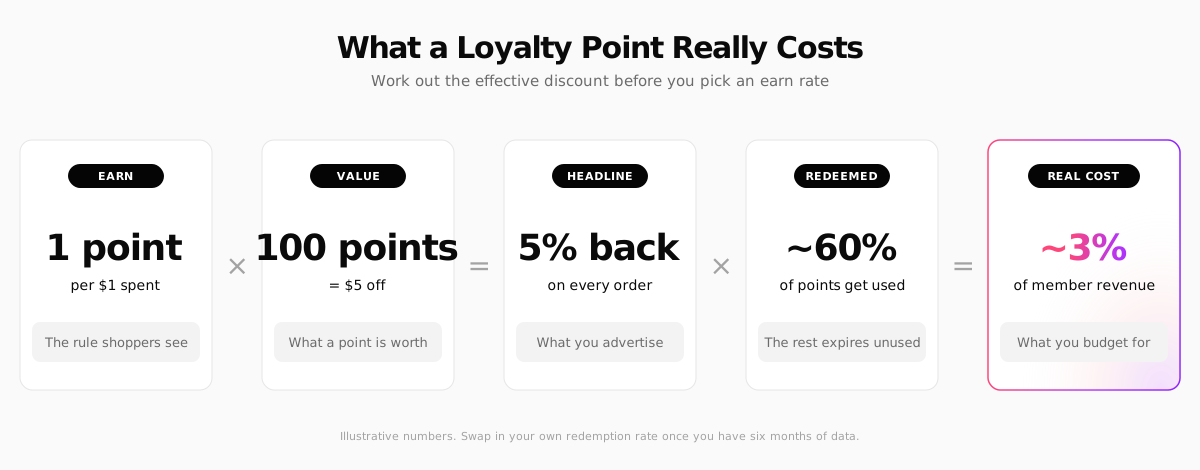
Points that are never redeemed are called breakage. Breakage makes the program cheaper than the headline number, but don't design around it. A program where most points expire unused is not changing anyone's behavior, so you pay for the software and get nothing back. Vendors tend to call a redemption rate below roughly 40% a sign that the rewards are too hard to reach.
A practical starting point for most stores: an effective reward rate of 2-5% of order value, with a higher rate only if your gross margin can carry it.
3. Make the first reward reachable after one or two orders
Nothing motivates like seeing you are close to a reward. If your average order is $40 and the first reward needs 500 points at 1 point per dollar, a customer needs about 13 orders to earn anything. They will forget the program long before that.
Set the first reward so a typical customer earns it on their second order. Show the balance where people will see it: the account page, the order confirmation, and the emails you already send.
4. Decide if tiers are worth it
Tiers give your best customers recognition and give everyone else a goal. Sephora's Beauty Insider is the textbook example: according to its program terms, members reach VIB status after spending $350 in a calendar year and Rouge after $1,000, and drop back if they do not requalify.
For a small store, two or three tiers are plenty. Good tier rules:
- Base thresholds on real data. Set the top tier around the spend of your top 5-10% of customers, not a round number you hope people reach.
- Make the top tier feel different, not just bigger. Early access to drops, free shipping on every order, or a handwritten note beats "7% instead of 5%".
- Requalify yearly so the tier reflects current behavior.
5. Reward more than purchases, carefully
Many programs award points for reviews, birthdays, social follows or referrals. Some of these are useful: a birthday reward is a natural reason to email, and reviews help every future shopper. Two cautions:
- Points for reviews must not depend on the review being positive. In the US, the FTC's rule on fake reviews prohibits buying reviews that express a particular sentiment, and in the UK the Digital Markets, Competition and Consumers Act 2024 bans fake and incentivized reviews unless they are clearly disclosed. Reward the act of reviewing, never the rating, and label incentivized reviews where your local rules require it.
- Points for social follows rarely change buying behavior. Spend your reward budget on actions linked to orders.
6. Set expiry rules you can explain in one line
Points without expiry pile up as a liability on your books. Points that expire too fast feel like a trick. A common middle ground: points expire 12 months after the member's last activity, so active customers never lose anything. Send a reminder email a few weeks before points expire. It is one of the best-performing emails a loyalty program can send.
Launching and Promoting the Program
A loyalty program nobody knows about does nothing. Put it where buying decisions happen:
- On the product page and in the cart: "Earn 45 points on this order."
- At checkout and on the order confirmation, with the balance and the next reward.
- In the welcome email and in every post-purchase email.
- For existing customers, consider crediting past orders when you launch, so the program starts with balances people care about.
- With campaigns: double points on a slow weekend, bonus points on a new collection.
How to Measure Whether Your Loyalty Program Works
The most common mistake is comparing members with non-members and calling the difference the program's effect. Your best customers were always going to join, so members will look better even if the program does nothing. This is selection bias, and it flatters almost every loyalty dashboard.
Better ways to measure:
- Before and after for the same customers. Did customers who joined order more often in the six months after joining than in the six months before?
- A holdout group. Keep a random 10% of eligible customers out of the program for a quarter and compare.
- Second-order rate for new customers, by monthly cohort, before and after launch.
- Redemption rate and cost per incremental order. If the program costs $3,000 a month and drives 100 extra orders, each extra order cost $30. Compare that with your customer acquisition cost.
Our guide to ecommerce analytics covers how to build these cohort reports.
What Nobody Tells You About Loyalty Programs
- Points are a liability on your books. Under the revenue standards ASC 606 (US) and IFRS 15 (most other countries), points that give customers a real future discount are usually treated as a separate obligation, and part of each sale is deferred until the points are used or expire. Small private companies may not report this way, but if you have investors or audited accounts, talk to your accountant before launch.
- You will train some customers to wait. Frequent "triple points" campaigns teach people to buy only during campaigns, just like constant sales do.
- Changing the rules is harder than setting them. Devaluing points or raising tier thresholds later feels like a broken promise. Start conservative and get more generous, not the other way round.
- The software is not the program. The tools below make it easy to launch, but the earn rate, rewards and communication decide whether it works.
Loyalty Program Rules in the US, EU and UK
Loyalty programs are lightly regulated compared with, say, sales tax, but a few rules apply almost everywhere.
Clear terms. Publish terms that explain how points are earned, what they are worth, when they expire and how you can change the program. In the EU and UK, unfair contract terms law means a clause that lets you change or cancel everything without notice may not hold up. Give notice before material changes.
Marketing consent (EU and UK). Running a loyalty program does not by itself give you consent to send marketing emails. Under the GDPR and ePrivacy rules (and the UK GDPR and PECR), collect marketing consent separately or rely on the soft opt-in for existing customers where it applies, and tell members what data you use to personalize rewards. Our GDPR guide for ecommerce covers the details.
Price reduction rules (EU). The Omnibus Directive rules on showing the prior lowest price apply to announced price reductions. Personalized loyalty discounts are generally outside that rule, but check how your country applies it. See our post on Omnibus Directive pricing.
Reviews and endorsements. As covered above, reward reviews only in ways that do not depend on the rating, and disclose incentives where required.
Expiry and unclaimed property (US). Points given away for free are usually treated differently from gift cards, which many states protect from expiry. Rules vary by state, especially for points customers can buy, so check before you sell points or treat them like cash.
Always check the current rules where you sell. This guide summarizes US, EU and UK rules that affect loyalty programs as of November 2026. Consumer, privacy, review and accounting rules change and vary by country and state, so confirm the details with a local lawyer, accountant or consumer protection authority before you launch or change a program. This is general information, not legal, tax or accounting advice.
Ecommerce Loyalty Program Software
If your platform does not include a loyalty module, these are the established apps. All three are built mainly for Shopify, and each supports a few other platforms, so check yours before you choose.
Smile.io
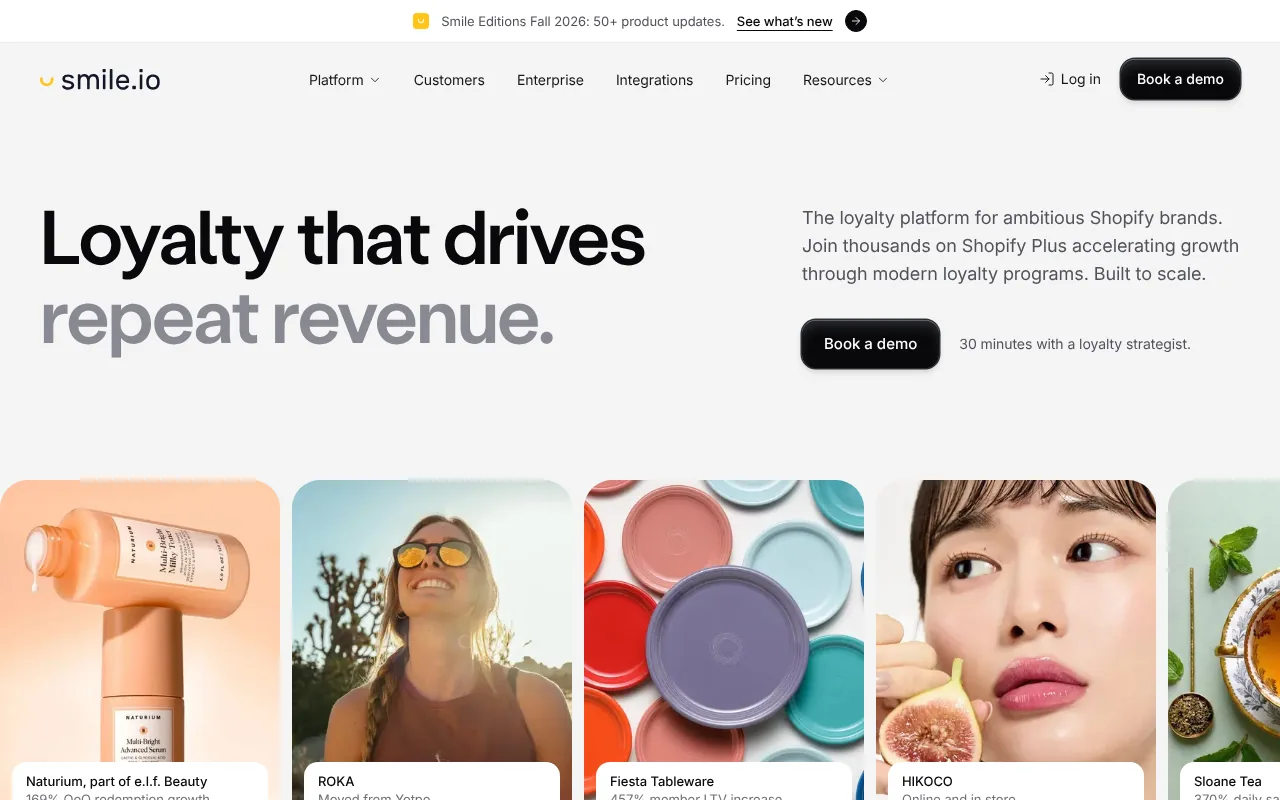
Smile.io is one of the most widely used loyalty apps for small and mid-sized Shopify stores, with points, VIP tiers and referrals. It is quick to set up and has a free plan for stores with up to 200 orders a month, with more advanced features on paid plans.
LoyaltyLion
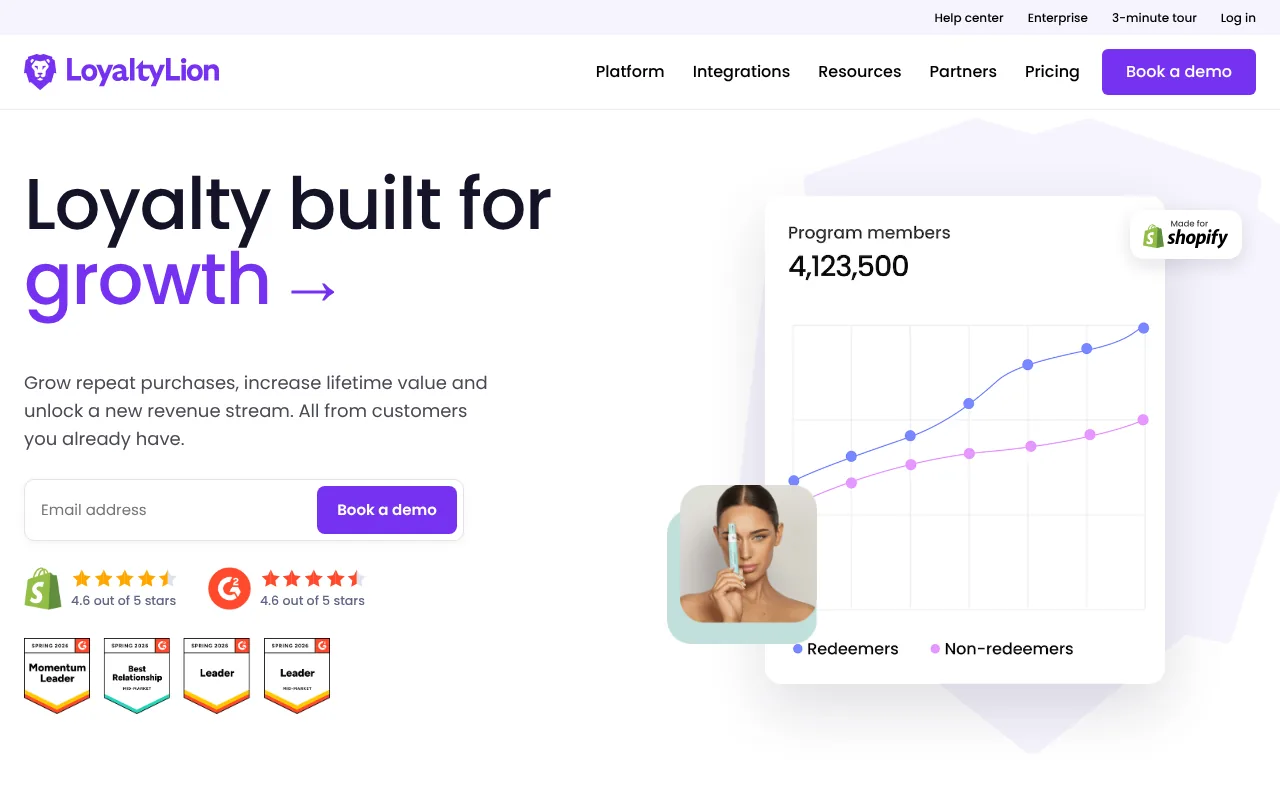
LoyaltyLion focuses on data and segmentation: who redeems, who does not, and how members compare. It suits growing brands that want to tune the program instead of just running it.
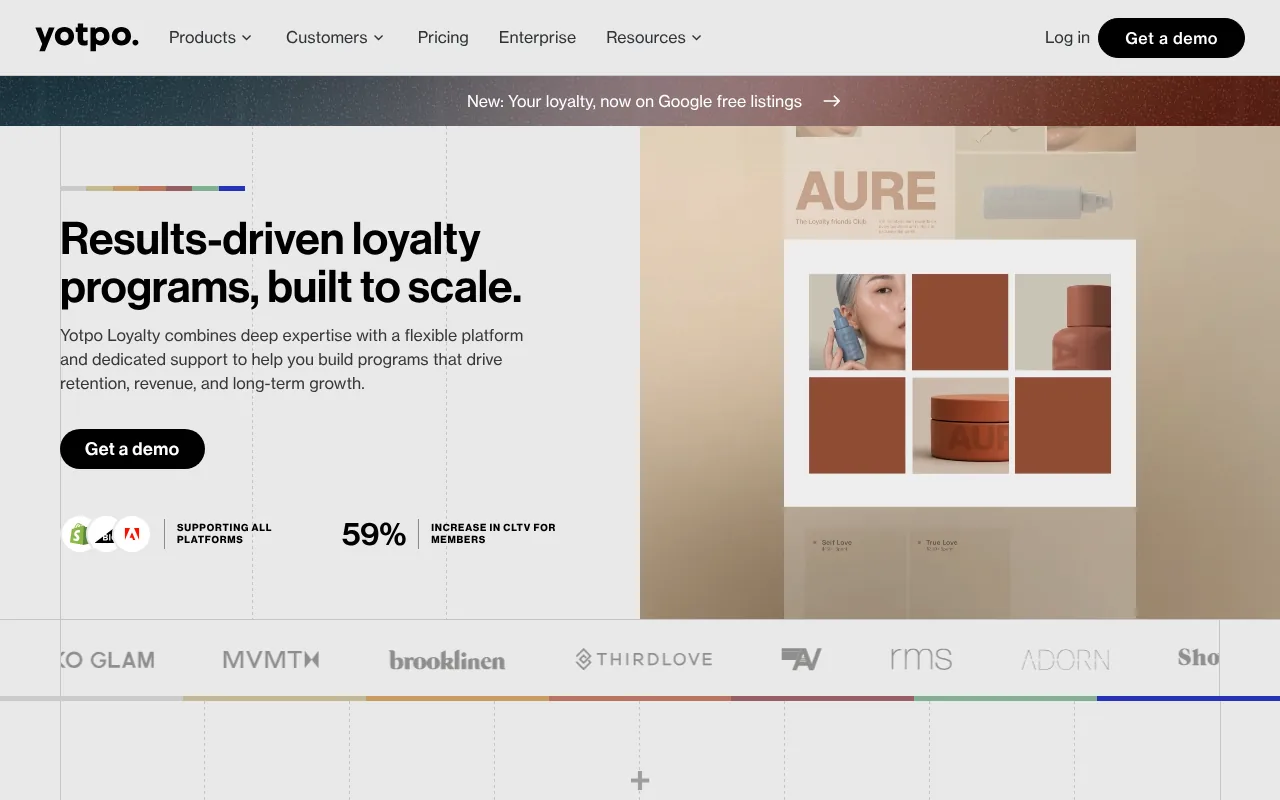
Yotpo Loyalty
Yotpo Loyalty sits alongside Yotpo's reviews, SMS and email products, which is useful if you already use them. It is aimed at larger brands, and pricing reflects that.
Loyalty Built Into Your Next Store
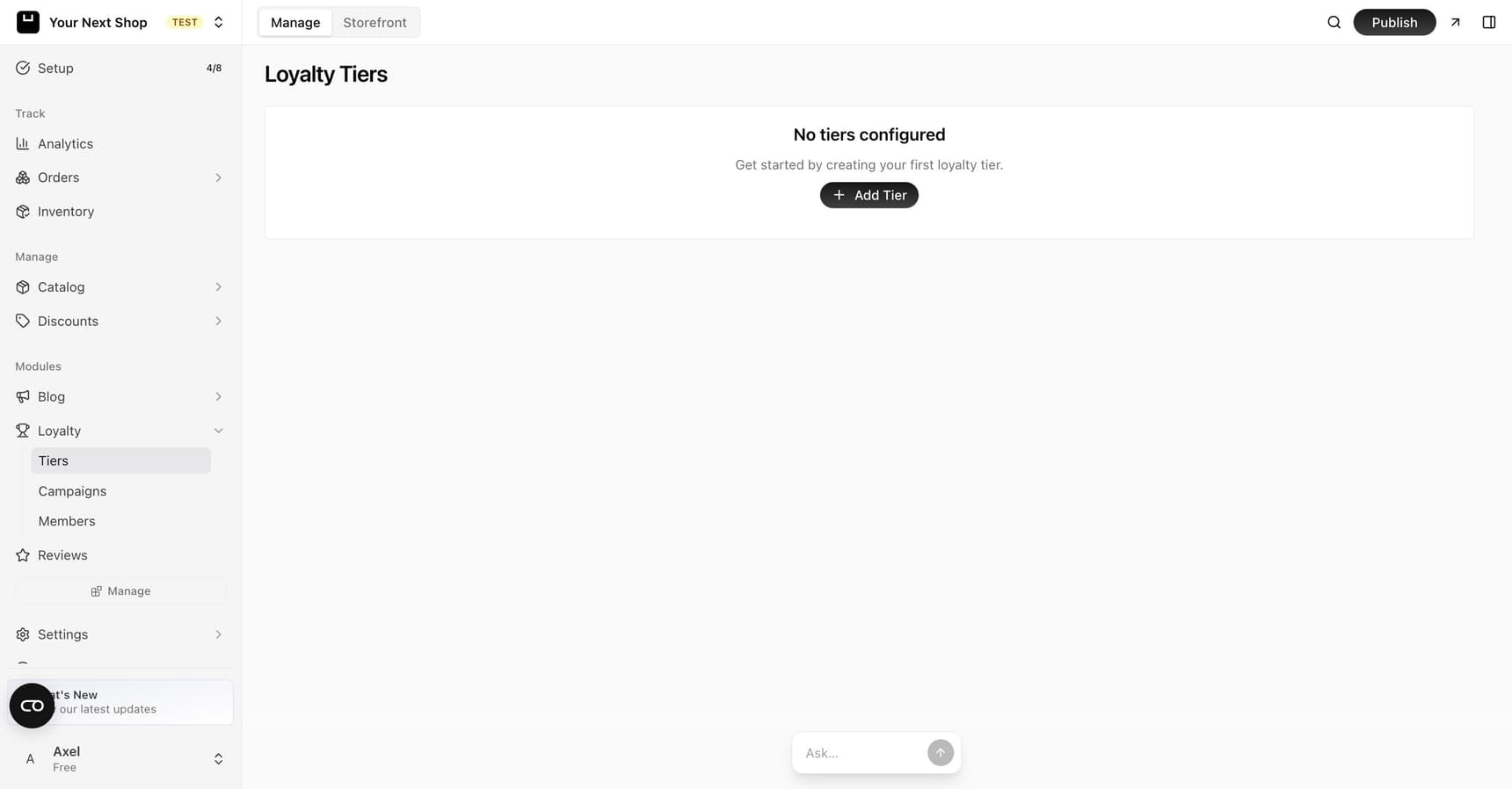
Your Next Store is an AI-powered commerce platform with a managed backend and an open-source Next.js storefront. A loyalty program is one of its built-in modules, so there is no separate app to connect or pay for:
- Points for spending, with a conversion rate you set.
- Tiers such as Bronze, Silver and Gold, each with its own perks.
- Rewards redeemed as a discount at checkout.
- Campaigns for time-limited boosts like double points.
- A members list showing each customer's points and tier.
To be clear about the limits: the built-in reward type is a discount. Perks like free shipping or a gift for top-tier members are something you offer manually today, and gift card purchases do not earn points until the card is spent on products.
Plans start at $30 a month with 0% platform transaction fees, and the storefront code is open source on GitHub.
FAQ
What is a good earn rate for an ecommerce loyalty program?
Think in terms of the effective reward rate rather than points. A practical range is 2% to 5% of order value, for example 1 point per dollar with 100 points worth $3 to $5. Choose the rate from your gross margin: the lower your margin, the lower the rate, and the more you should lean on non-discount perks.
Should a small online store have a loyalty program?
Only if customers have a reason to buy more than once and you have some repeat buyers already. If that is true, a simple points program with a reachable first reward is a cheap way to lift second orders. If most customers buy once, work on product, reviews and post-purchase emails first.
Points or tiers: which is better?
Start with points. They are easy to explain and work from the first order. Add tiers once you can see a clear group of top customers, and set the thresholds from your actual spend data so the top tier is reachable but special.
Do loyalty points expire?
That is up to you, within local law. A common approach is to expire points 12 months after a member's last activity, with a reminder email beforehand. Free points are usually treated differently from gift cards, but rules vary, especially in US states, so check before you set an expiry policy.
Related Blog Posts
Before you spend more on ads,
check your store.
Get a free 25-point checklist to find what could be holding back your sales, from product pages to checkout.