Ecommerce Link Building: What Works in 2026
 Jakub Neander
Nov 17, 202611 min read
Nobody links to a product page because it exists. Journalists link to data, bloggers link to guides, and gift-guide editors link to products they can describe in one line. That is why most ecommerce link building fails: stores pitch the pages they want to rank instead of the pages people want to cite. This guide covers the tactics that still earn links in 2026, the ones that now get stores penalized, and the step most stores skip: moving that authority from the pages that earn links to the pages that make money.
Why Ecommerce Link Building Is Harder Than It Looks
Links are still one of the clearest signals that other people vouch for your site. But online stores start with three disadvantages that a SaaS company or a media site does not have.
- Your money pages are commercial. A category page for "linen bedding" is useful to shoppers and boring to writers. Editors rarely link to a page whose main job is to take payment.
- Your catalog is huge. A blog with 50 posts can push links to each one. A store with 2,000 products cannot, so it has to choose where authority goes.
- Most content earns nothing. A Backlinko and BuzzSumo study of 912 million blog posts found that about 94% of them had zero external links. Publishing more does not create links by itself.
The other change is that the bar for "natural" keeps rising. Google's spam policies describe link spam as "creating links to or from a site primarily for the purpose of manipulating search rankings", and the examples hit ecommerce tactics directly.
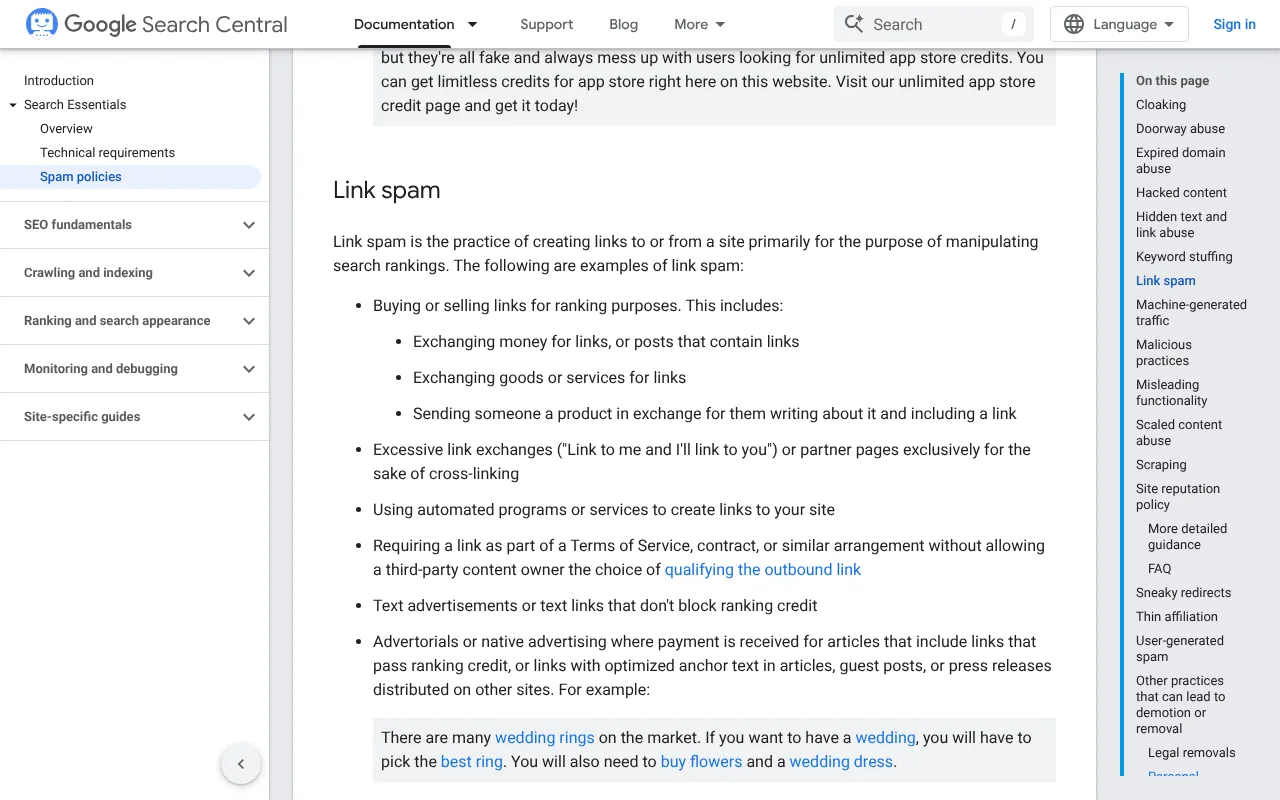
Note the third bullet under buying links: "Sending someone a product in exchange for them writing about it and including a link." The classic ecommerce move of gifting products to bloggers for a followed link is, in Google's own words, a link scheme. You can still send products. The link just has to be marked rel="sponsored" or rel="nofollow", and in the US the post has to disclose the free product (more on that below).
The Ecommerce Link Building Tactics That Still Work
Here is what earns links for stores without putting the domain at risk, roughly in order of payoff for a small team.
| Tactic | Effort | Typical link quality | Best for |
|---|---|---|---|
| Expert quotes for journalists | Low, ongoing | High (news and trade sites) | Founders with real expertise |
| Unlinked brand mentions | Low | Medium to high | Stores that already get press |
| Gift guides and roundups | Medium, seasonal | Medium | Giftable products |
| Linkable assets (data, tools, guides) | High, one-off | High, compounding | Stores with unique data or know-how |
| Supplier, partner and stockist pages | Low | Medium, very relevant | Brands with wholesale or makers |
| Competitor link gap | Medium | Varies | Finding all of the above faster |
| Broken link and redirect reclaim | Low | Recovers lost value | Stores that changed URLs |
1. Answer journalist requests with real expertise
The original free HARO is gone (Cision closed it in 2024, and the brand has since been relaunched as a paid service), but the idea lives on. Journalists still post requests for sources, and platforms such as Qwoted, Featured and the free Source of Sources newsletter pass them on. A founder who can answer "how do small brands handle tariffs" or "what is driving the rise in refillable packaging" in three useful sentences can land links from sites that would never cover a product launch.
What makes it work:
- Answer only where you are genuinely the expert. A candle maker on wax sourcing beats a candle maker on "marketing trends".
- Lead with the quote, not the bio. Journalists skim. Put your best line first, then one line about who you are.
- Be fast. Requests fill within hours. Set a daily 15-minute slot.
- Check where the link lands. Some paid platforms publish answers on their own content network. A quote on a real news or trade site is worth far more than a dozen on a roundup farm.
2. Turn unlinked mentions into links
If your store has been written up anywhere, some of those articles mention your brand without linking. Search for your brand name in quotes, exclude your own domain ("your brand" -site:yourstore.com), or set up a mention alert. Then email the author with a short, polite note and the exact URL to link. Conversion rates are good because the writer already chose to mention you.
3. Get into gift guides and roundups the honest way
Gift guides are where ecommerce links live. Editors plan them months ahead: holiday guides are often assembled in late summer and early autumn, Mother's Day guides in early spring. To get in:
- List the publications and blogs that ran a guide in your category last year.
- Find the author of each and pitch two or three months before their usual publishing window.
- Send a one-paragraph pitch with the product, price, a high-resolution image and why it fits their readers.
If you send a free sample, that is fine, but you cannot require a link in return. If the writer links, the link should carry rel="sponsored" or rel="nofollow", and US creators must disclose the free product under the FTC's endorsement rules, as its Disclosures 101 guide explains. In the UK, the CMA and ASA expect the same kind of clear labeling. Sponsored links still send buyers. They just do not count as editorial votes.
4. Build one linkable asset, not twenty blog posts
The same Backlinko study found that "why" posts, "what" posts and infographics earned noticeably more referring domains than how-to posts and videos. For stores, the pattern is simple: people link to things they want to cite or reuse.
Ideas that work for online stores:
- Original data from your own orders. "What 10,000 orders say about gift-buying deadlines", "The most returned sizes in women's running shoes". Aggregate and anonymize it, and keep personal data out.
- Reference pages. A size conversion chart, a fabric care guide, a "which coffee grind for which brewer" table. These earn links for years.
- Small tools. A ring size calculator, a paint quantity estimator, a "how many candles for this room" calculator.
- A strong opinion with evidence. "Why we stopped selling fast-fashion basics" will get linked by people who agree and people who disagree.
Then promote it. A linkable asset without outreach is just a blog post. Send it to the writers who covered the topic in the last year and to the newsletters in your niche.
Our ecommerce content marketing guide covers how to pick topics that also send buyers to product pages, which is the other half of the job.
5. Ask the people you already work with
Your suppliers, manufacturers, wholesale stockists, local business associations, trade bodies and event organizers often have "where to buy", "our partners" or "member" pages. Those links are relevant, easy to get and completely legitimate, as long as they exist because the relationship is real. What Google flags is "excessive link exchanges" and partner pages created only for cross-linking, so skip the swap-a-link schemes.
6. Mine your competitors' links
The fastest way to find prospects is to look at who links to stores like yours but not to you. The free Ahrefs Backlink Checker shows the top links for any domain. Paid tools from Ahrefs, Semrush or Moz show the full list and a "link gap" report across several competitors.
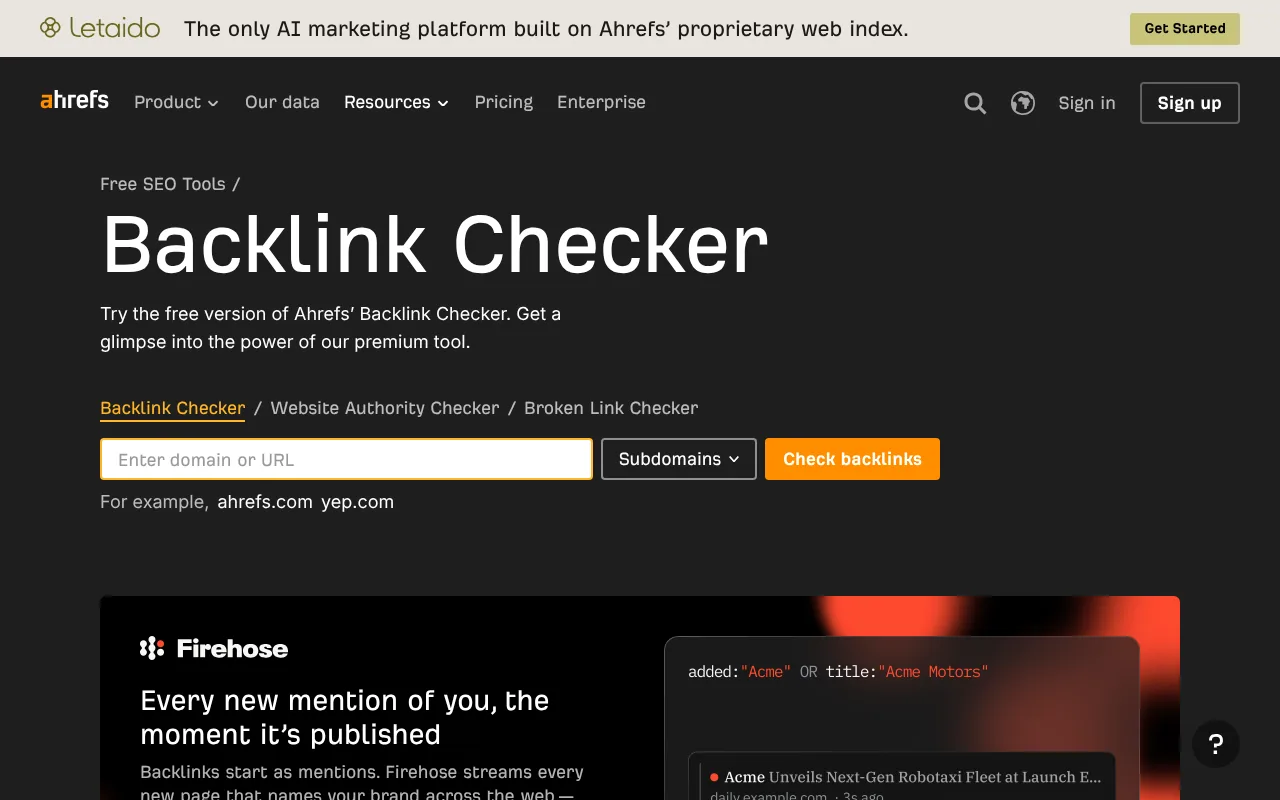
Sort what you find into buckets: press you could pitch, roundups you could join, directories that matter in your niche, and partner pages you could qualify for. A site that links to three of your competitors is a far better prospect than a high-authority site that has never covered your category. Our roundup of ecommerce SEO tools compares the options if you are deciding what to pay for.
7. Reclaim the links you already lost
Every replatform, renamed product and deleted collection breaks links that other sites still point at. Before you build new links, check old ones:
- Export your top linked pages from Google Search Console (Links report) or a backlink tool.
- Find the ones that now return a 404.
- 301 redirect each one to the closest live page, not blanket to the homepage.
This is the cheapest link building there is, because the links already exist. If you are moving platforms, our ecommerce platform migration guide covers redirect mapping in detail.
What to Stop Doing
Some tactics still get sold to store owners every week. Here is why to skip them:
- Buying followed links or "guest post packages". Paying for links that pass ranking credit is the first example in Google's link spam policy. Guest posts written mainly to carry keyword-rich anchors are named too.
- Gifting products in exchange for a followed link. Named in the policy. Ask for honest coverage instead and accept a sponsored link.
- Directory blasts and forum signatures. Low-quality directories and optimized links in forum posts are listed examples. A handful of genuine niche or local directories are fine.
- Exact-match anchor text everywhere. Forty links reading "buy cheap linen sheets" look like what they are. Natural anchors are mostly brand names, URLs and plain phrases.
- Footer links in themes or widgets you give away. Widely distributed links in templates are a listed example.
The risk is not only an algorithmic downgrade. Google can apply a manual action, and cleaning that up takes months of work you could have spent earning real links.
The Step Most Stores Skip: Routing Authority to Product Pages
Here is the part that turns links into sales. Even a perfect campaign will mostly earn links to your homepage, your guides and your data pages. Your category and product pages, where buyers actually search and pay, will get few links directly. Internal links are how the authority gets there.
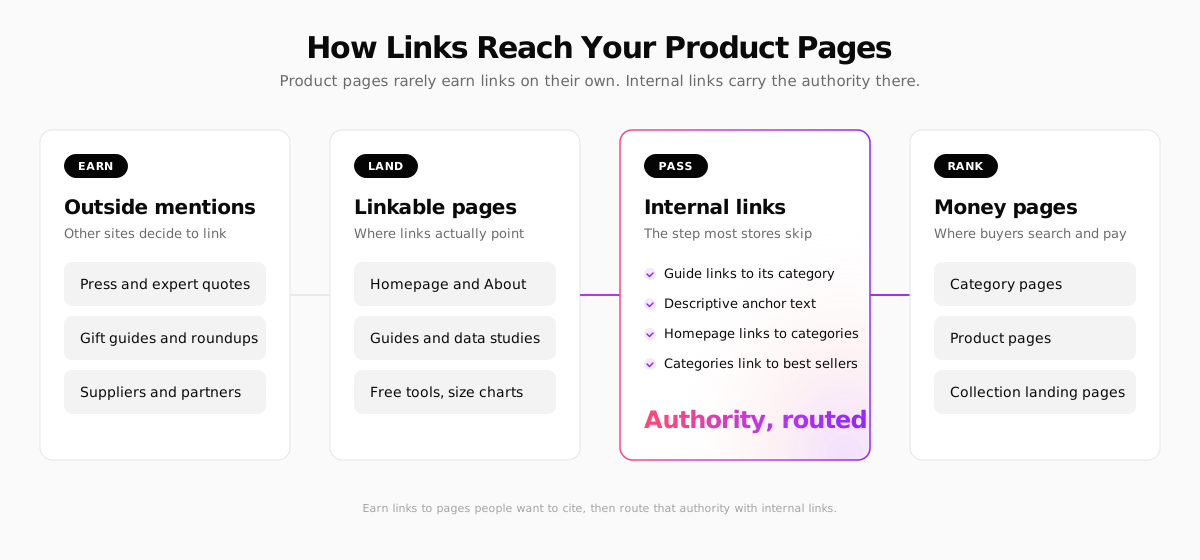
Practical rules:
- Every guide links to its category. A post about choosing linen sheets should link to the linen sheets category with descriptive anchor text, near the top, not only in the footer.
- The homepage links to your most important categories, not just to "Shop all".
- Categories link to their best sellers and to related categories. Keep important products within two or three clicks of the homepage.
- Fix orphan pages. A product nobody links to internally is hard for search engines to find and rank.
- Update old posts that already rank or have links with links to new categories and products.
Our ecommerce SEO guide covers site structure in depth, and an ecommerce SEO audit will surface orphan pages and broken internal links.
Links help AI search too. AI answer engines tend to recommend brands that are cited by sources they trust. The same expert quotes, reviews and roundup mentions that earn links also make your store more likely to show up in AI answers. Our guide to generative engine optimization for ecommerce goes deeper.
A 90-Day Link Building Plan for a Small Store
If you have three hours a week, this is a realistic plan.
| Weeks | Focus | Output |
|---|---|---|
| 1-2 | Reclaim broken links, fix internal links to top categories | Redirects in place, homepage and guides linking to money pages |
| 2-4 | Competitor link gap, list of 50 prospects | A spreadsheet sorted by press, roundups, partners and directories |
| 3-12 | Journalist requests, 15 minutes a day | 3-10 quotes published, depending on niche |
| 4-8 | Build one linkable asset | A data study, reference page or tool |
| 8-12 | Promote the asset, pitch seasonal gift guides | Outreach to 30-50 writers |
| Ongoing | Unlinked mentions, supplier and stockist pages | A steady trickle of relevant links |
Measure what matters: referring domains to the site, links landing on pages that link onward to categories, and organic traffic to category pages. Domain rating scores from tools are a rough proxy, not the goal.
The whole strategy fits in one line: earn links to what people want to cite, then route them to what people want to buy.
How Your Next Store Helps
Your Next Store is an AI-powered commerce platform with a managed backend and an open-source Next.js storefront. It will not earn links for you, nobody can, but it covers the on-site groundwork that decides whether those links pay off:
- A built-in blog for guides, data studies and reference pages, so linkable assets live on your own domain and can link straight to products.
- A redirect manager with hit counts, so you can reclaim old URLs after a migration and see which ones still get traffic.
- Automatic sitemaps and structured data, including product markup, so search engines understand the pages your links point to.
- Fast storefront pages built with Next.js server components and partial prerendering, which matters once those links start sending visitors.
Plans start at $30 a month with 0% platform transaction fees, and the storefront code is open source on GitHub.
FAQ
How many backlinks does an ecommerce site need?
There is no fixed number. What matters is how your link profile compares with the stores ranking for your target keywords, and whether the links come from relevant sites. A competitor link gap analysis tells you more than any rule of thumb: if the top five stores in your niche each have links from 40 to 80 relevant domains, that is your benchmark.
Is it safe to send free products to bloggers for links?
Sending products is fine. Requiring or rewarding a followed link in return is not: Google's spam policy lists "sending someone a product in exchange for them writing about it and including a link" as link spam. Let the writer cover the product honestly, ask for a rel="sponsored" link if they link, and make sure they disclose the free product as the FTC (US) or ASA (UK) requires.
Should I build links to product pages or category pages?
Build links to whatever people genuinely want to cite, usually your homepage, guides, tools and data. Then pass that authority to category pages with internal links, since categories target broader, higher-volume searches. Product pages benefit through categories and from links in gift guides and reviews.
How long does ecommerce link building take to work?
Expect months, not weeks. New links have to be found and recrawled, and ranking changes from off-page authority tend to compound slowly, often 3 to 12 months for a smaller domain. Reclaiming broken links and fixing internal links shows results fastest.
Related Blog Posts
Before you spend more on ads,
check your store.
Get a free 25-point checklist to find what could be holding back your sales, from product pages to checkout.