Digital Product Passport: What ESPR Means for Online Stores
 Jakub Neander
Nov 11, 202611 min read
Within a few years, much of what you sell in the EU will need a digital product passport: a scannable record of what the product is made of, where it came from and how to repair or recycle it. The law behind it, the Ecodesign for Sustainable Products Regulation (ESPR), is already in force. The product-by-product rules are not, and that gap is where most of the confusion comes from. This guide explains what the digital product passport is, which products come first, what it means for a store that sells online, and what you can sensibly do now without paying a consultant for a problem you will not have until 2028.
What Is a Digital Product Passport?
A digital product passport (DPP) is a structured, online record attached to a physical product through a data carrier, usually a QR code on the label, tag or packaging. Scan it and you get information about that product: materials, substances of concern, origin, care and repair instructions, recycled content, and how to dispose of it.
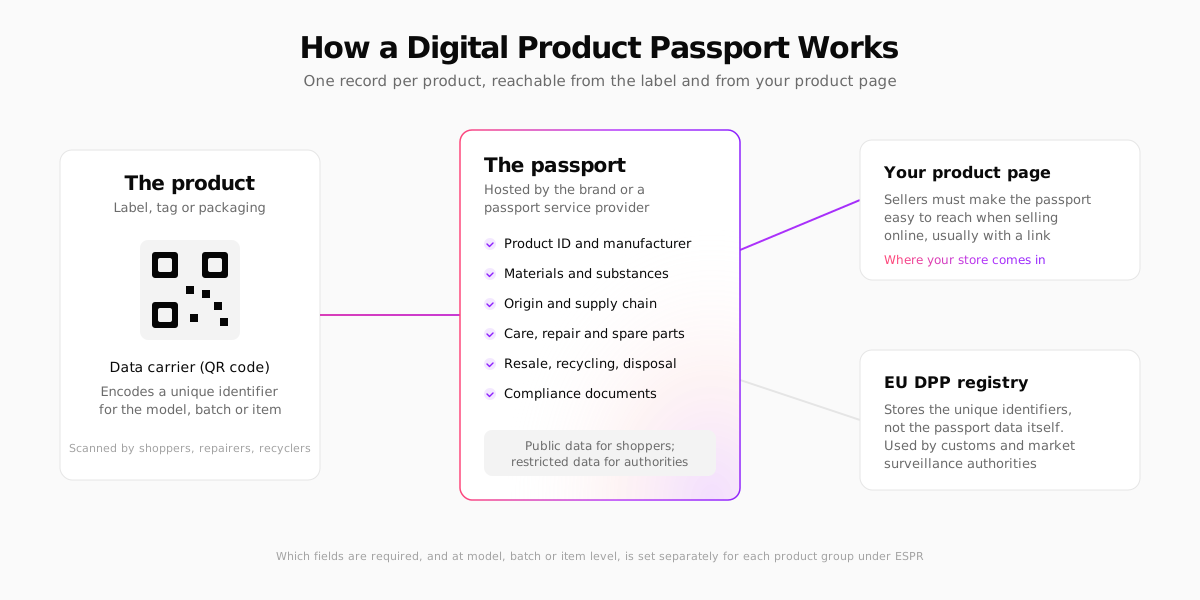
Four ideas sit at its core:
- A unique identifier. Each passport belongs to a product model, a batch or an individual item. Which level applies is decided product group by product group.
- Decentralized hosting. The passport data is not uploaded to an EU database. It is hosted by the company responsible for the product, or by a passport service provider it hires.
- A central registry. The EU keeps a registry of the unique identifiers, so customs and market surveillance authorities can check that a passport exists. The Commission has set up the registry and a testing environment for it.
- Layered access. Shoppers see the public layer. Repairers, recyclers and authorities can get more detailed, restricted data.
The point is not paperwork for its own sake. The EU wants products that last longer, can be repaired and can be recycled, and it cannot check any of that without data that travels with the product.
ESPR: The Law Behind the Passport
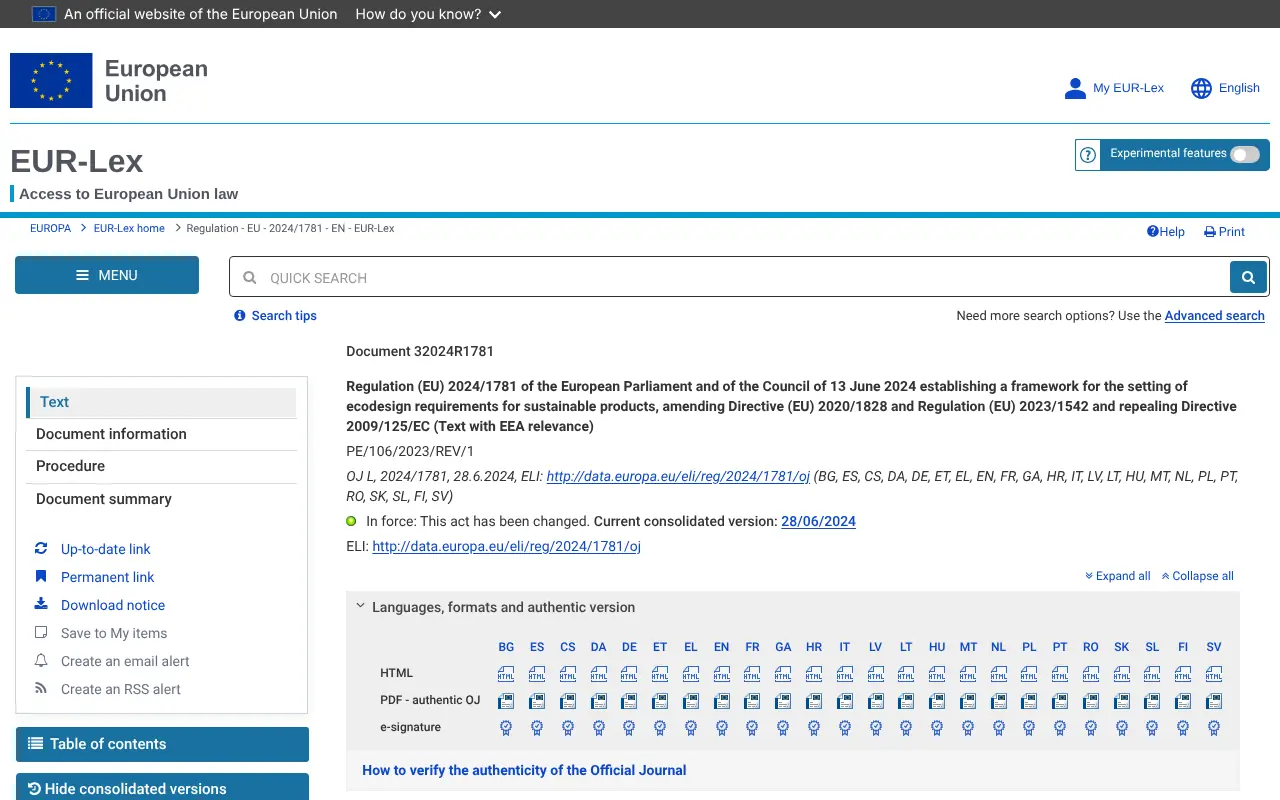
The legal basis is Regulation (EU) 2024/1781, the Ecodesign for Sustainable Products Regulation. It entered into force on 18 July 2024 and replaced the old Ecodesign Directive, which only covered energy-related products such as fridges and boilers. ESPR covers almost every physical product sold in the EU. Food, feed, medicines, living plants and animals, and motor vehicles are among the exclusions.
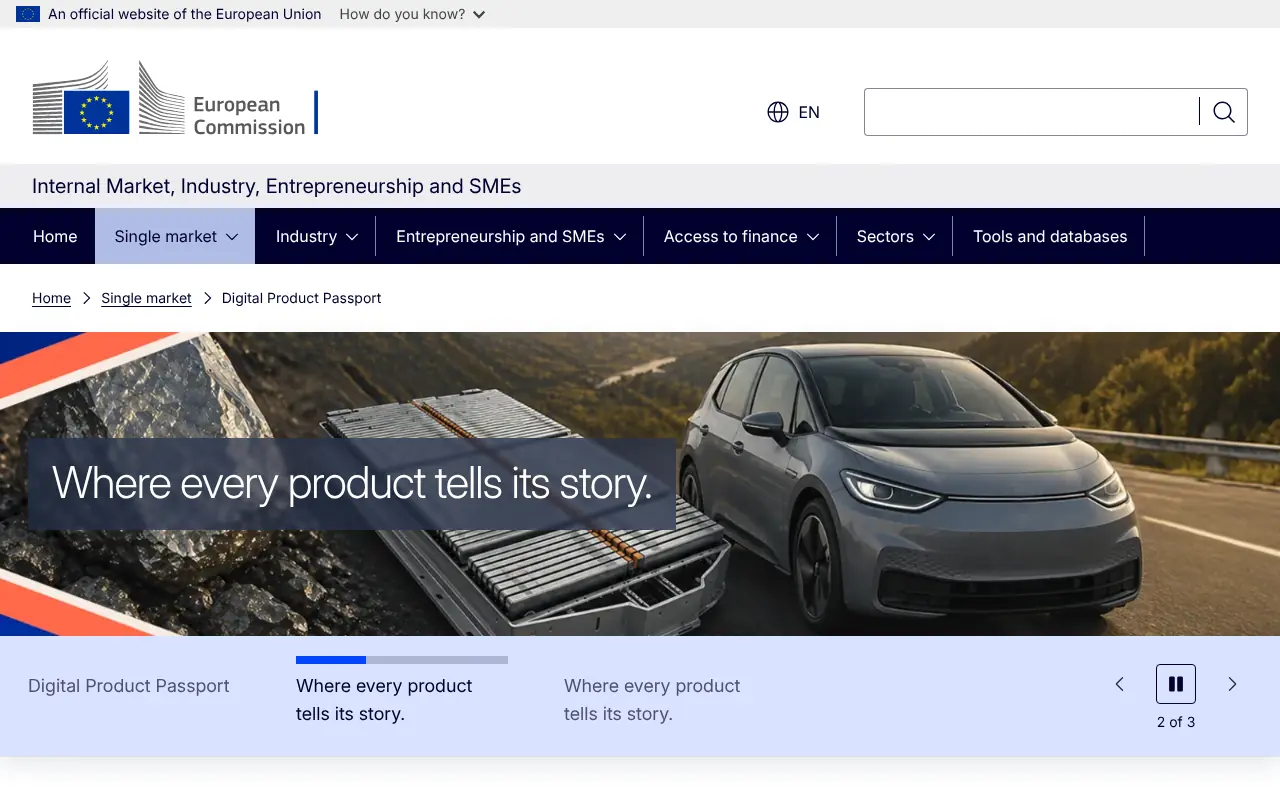
ESPR itself is a framework. It says what kinds of requirements the EU can set (durability, repairability, recycled content, substances of concern, information duties, the passport) but it does not set them for any product. That happens in delegated acts, one per product group, each with its own content and deadlines. As a rule, a delegated act applies no earlier than 18 months after it enters into force, which gives businesses time to adapt.
Which products come first
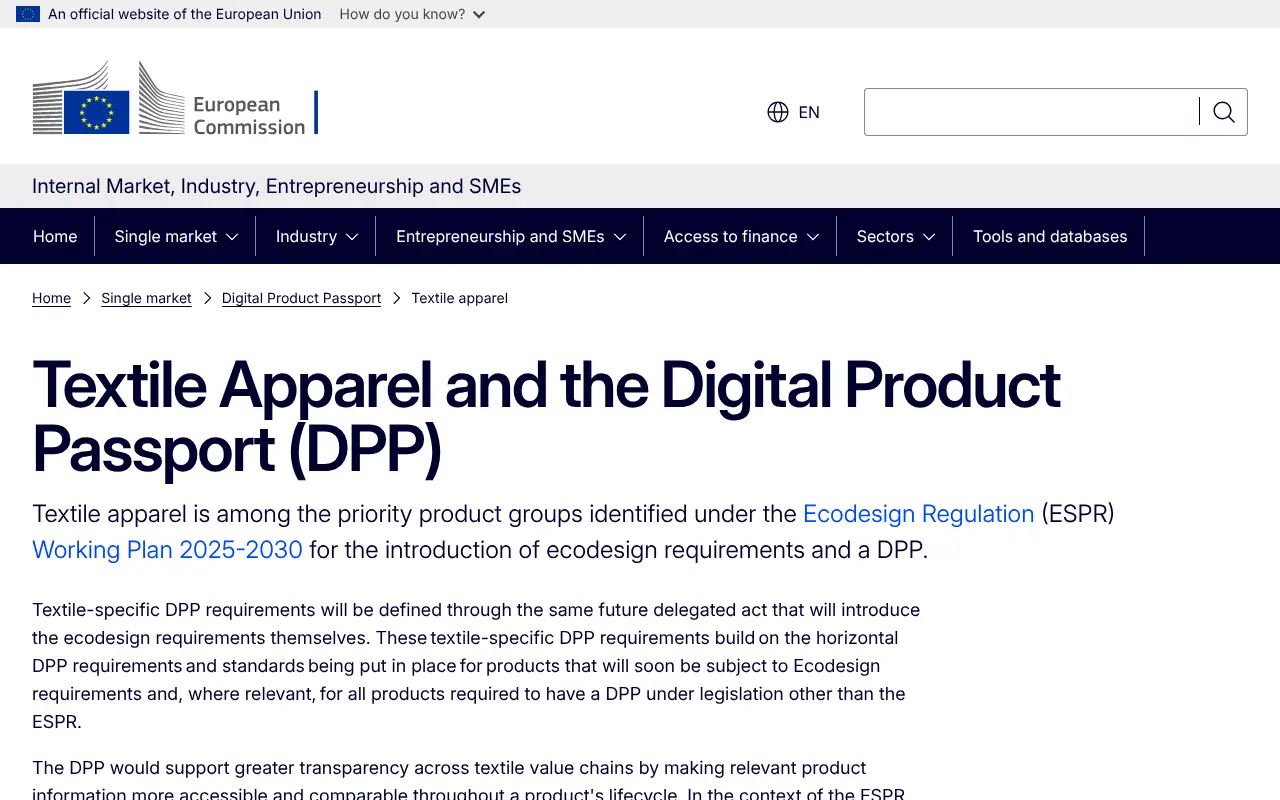
The Commission's ESPR working plan for 2025 to 2030, adopted in April 2025, sets the priority order, and the Commission's textiles page gives the latest timing for clothing. The product groups that matter most for online stores:
| Product group | Status (November 2026) | Relevance for online stores |
|---|---|---|
| Textiles and apparel | Delegated act planned for Q4 2027 | High: clothing is one of the largest ecommerce categories |
| Furniture | In the working plan | High for home and furniture brands |
| Mattresses | In the working plan | High for sleep and bedding brands |
| Tyres | In the working plan | Medium: auto parts sellers |
| Iron, steel and aluminium | Earlier in the queue | Low: mostly industrial |
| Electronics | Repairability and other rules for some products; more planned | Medium for gadget and accessory stores |
Batteries are on a separate track. The EU Batteries Regulation requires a battery passport from 18 February 2027 for electric vehicle batteries, industrial batteries over 2 kWh and batteries for "light means of transport" such as e-bikes and e-scooters. If you sell e-bikes, that deadline comes before any ESPR one.
Toys are also getting a passport under the new EU Toy Safety Regulation, with its rules applying later this decade.
Key Dates for the Digital Product Passport
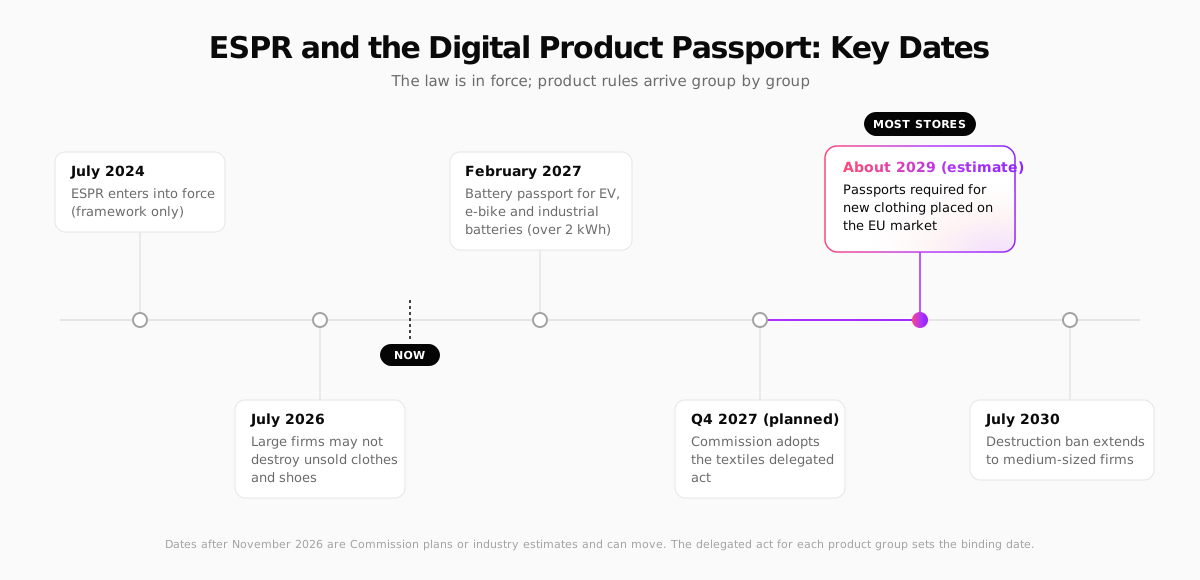
- 18 July 2024: ESPR enters into force.
- 19 July 2026: large companies may no longer destroy unsold clothing, clothing accessories and footwear, with limited exceptions. Large companies must also disclose how many unsold consumer products they discard and why.
- 18 February 2027: battery passport required for EV, light-transport and large industrial batteries.
- Q4 2027 (planned): the Commission adopts the textiles delegated act, which will set the passport content for clothing.
- Around 2029 (estimate): textile passports become mandatory for new products placed on the market, if the usual 18-month lead time applies.
- 19 July 2030: the destruction ban extends to medium-sized companies. Micro and small companies remain exempt.
Everything after November 2026 is a plan or an estimate. Commission timetables slip. Watch the Commission's ESPR pages for your product group rather than relying on any blog, this one included.
Who Is Responsible: Brand, Importer or Store?
ESPR assigns duties by role, and a small online store can hold more than one.
If you make the product (or have it made under your brand)
You are the manufacturer, even if a factory in Portugal or Bangladesh does the sewing. You are responsible for creating the passport, keeping the data accurate, hosting it (directly or through a service provider) and putting the data carrier on the product. This is the role most DTC brands are in, and it carries the bulk of the work.
If you bring products into the EU from outside
You are the importer. You must check that a passport exists and the data carrier is on the product before you place it on the EU market. If your supplier outside the EU will not produce one, the product cannot legally be sold once its delegated act applies.
If you resell other brands' products
You are a dealer (retailer). You do not create passports, but you must make them available to customers. For online sales, that means the passport, or a link to it, must be easy to reach from the product page. You also must not sell products that should have a passport and do not.
If you sell from outside the EU directly to EU consumers
The products still need passports when they arrive. EU market surveillance rules already require an EU-based responsible person for many product types, and ESPR leans on the same structure. A UK or US brand shipping direct to EU customers should plan to have passports for those products, whatever it does at home.
Marketplaces
ESPR also places duties on online marketplaces: they must let sellers show the passport information and cooperate with authorities. If you sell on Amazon or Zalando as well as your own store, expect them to ask you for passport links when your category comes into scope.
Always check the current rules where you sell. This guide summarizes ESPR, the EU Batteries Regulation and related rules as of November 2026. Product-specific requirements are still being written and dates can change, so confirm what applies to your product group with the European Commission, your national market surveillance authority or a product compliance specialist. This is general information, not legal advice.
What the Passport Means for an Online Store
For most stores the passport touches three things: your product data, your product pages and your suppliers.
1. Your product data model
A passport is only as good as the data behind it, and most of that data already exists in pieces: fiber composition from the care label, country of origin from customs paperwork, supplier names from purchase orders, certifications in someone's inbox. The work is collecting it per product, in a structured form, before anyone asks.
Fields worth adding to your product records now, wherever your platform allows custom attributes:
- GTIN or another persistent product identifier
- Material composition by percentage
- Country of manufacture, and ideally the factory
- Care, repair and spare parts information
- Certifications (OEKO-TEX, GOTS, FSC and similar) with expiry dates
- A passport URL field, empty for now
2. Your product pages
Once your category is in scope, a shopper buying online must be able to reach the passport before buying, just like one picking the product up in a shop. In practice, that is a clearly labelled link on the product page. If you store the passport URL as a product attribute, the storefront change is small:
Keep the link visible near the materials and care information, not buried in the footer. It is also good content: shoppers who care about origin and materials will read it, and the same data makes your product pages more convincing even before the law requires it.
3. Your suppliers
If you design but do not manufacture, your passport depends on data your suppliers hold. Start asking now, and add passport data to new supplier agreements: material composition, origin, chemical compliance documentation and the right to use it in a passport. Suppliers who already sell to large European brands are being asked the same questions and are often ahead of you.
Building Passports: Standards and Service Providers
You do not need to build passport infrastructure yourself. European standards bodies are drafting the technical standards for identifiers, data carriers and data exchange. QR codes based on GS1 Digital Link, which encode a GTIN as a web address, are the most likely route for consumer goods, since the same code can open a passport and work at a retail checkout.
Specialist passport providers already host passports for fashion and electronics brands piloting them voluntarily, and many label and tag printers are adding passport QR codes to their offer. The EU-funded CIRPASS project prepared the groundwork with pilots in textiles, electronics and batteries, and its successor work continues.

For a small brand, the sensible plan is:
- Do not buy a platform yet unless you sell batteries or a retailer demands it. The data requirements for most categories are not final.
- Clean up your product data now. That work is useful anyway and will be most of the effort later.
- Choose a provider when your delegated act is adopted, comparing on data portability, pricing per product and whether they handle the QR codes and registry upload.
The UK and the US
- United Kingdom: ESPR does not apply in Great Britain. A UK brand selling to EU customers still needs passports for those products, and Northern Ireland follows some EU product rules under the Windsor Framework, so check its position for your category.
- United States: there is no federal passport requirement. Some state laws push in a similar direction, such as textile extended producer responsibility in California, but nothing requires a scannable product record. US brands selling into the EU need passports for those products like everyone else.
How Your Next Store Fits In
Passports are mostly a data problem, and data lives in your commerce backend. Your Next Store stores products with variants, categories, collections and attributes in its own database, with CSV import and export and a REST API. That makes it practical to add composition, origin and a passport URL as product attributes today, import them in bulk from a supplier spreadsheet, and render a passport link on the product page with a component like the one above.
What it does not do is generate or host passports. Those come from you or a passport provider, and YNS is where you link to them. Because the storefront is open source Next.js, the product page change is yours to make, or you can ask the AI store builder to add it.
A Digital Product Passport Checklist
- Find your product groups in the ESPR working plan and note the expected dates
- If you sell e-bikes, e-scooters or large batteries, plan for February 2027 now
- Work out your role for each product: manufacturer, importer or dealer
- Give every product a persistent identifier, such as a GTIN
- Record material composition and country of manufacture per product
- Collect certifications and chemical compliance documents in one place
- Add passport data clauses to new supplier agreements
- Add a passport URL attribute and a product page link that appears when it is filled
- If you are a large clothing or footwear company, document what happens to unsold stock
- Recheck the Commission's pages when your category's delegated act is published
FAQ
When is the digital product passport mandatory?
It depends on the product. Battery passports apply from 18 February 2027. For textiles, the Commission plans to adopt the rules in late 2027, with passports likely required around 2029. Other groups follow in later years. Nothing applies to a product group until its delegated act is adopted and its lead time has passed.
Does the digital product passport apply to small businesses?
Yes, once your product group is in scope. ESPR exempts micro and small companies from the ban on destroying unsold goods and from reporting on it, but not from the passport itself. Delegated acts may adapt requirements for smaller companies, and ESPR obliges the Commission to support them with guidance.
What information is in a digital product passport?
It varies by product group. For textiles, the Commission lists product identification, fiber composition, use, repair and care information, reuse and recycling information, origin, the companies involved and compliance documents. The exact fields will be set in the textiles delegated act.
Do I need a digital product passport for secondhand goods?
The passport attaches to new products placed on the EU market after the rules apply. Products already on the market do not need one retroactively. Resellers benefit later: a garment with a passport tells a thrift store or resale platform exactly what it is made of.
Final Takeaway
The digital product passport is coming category by category, not all at once, and for most online stores the deadline is years away. The work that will matter then is the boring work you can do now: know what every product is made of, where it was made and who made it, and keep that data in one place. The stores that do will find the passport is a link on a product page. The ones that do not will spend 2028 emailing factories.
Related Blog Posts
Before you spend more on ads,
check your store.
Get a free 25-point checklist to find what could be holding back your sales, from product pages to checkout.