
How to Start a Bedding Brand in 2026: The Honest Playbook
 Jakub Neander
Aug 28, 202614 min read
Starting a bedding brand is one of the few plays where a small company can genuinely out-market the giants: everyone sleeps, everyone has an opinion about their sheets, and the global bedding market is worth an estimated $153.12 billion in 2026, growing to $205.05 billion by 2031. Shopify's own 2026 trending-products data ranks bedding as the 14th best-selling product category on the platform, ahead of alcohol, kitchen appliances, and perfume. But "sheets" is also one of the most commoditized products on earth, sold by the same handful of overseas mills to a thousand different labels. This is the guide I'd hand a friend before they order their first case of percale: seven steps, in the right order, with an honest read on what actually differentiates one bedding brand from the next.
The 7 Steps, in Order
- Pick one specific reason to exist, not "we sell nice sheets." Bedding is the most commoditized category in home goods; a vague brand loses to the mill it's buying from.
- Get real people to say "yes, I'd buy this" before you order a case of anything.
- Choose how your bedding actually gets made. Print-on-demand, white label, or private label, and the MOQ and margin tradeoff between them.
- Get your material claims and labeling right. Thread count is the industry's favorite lie, and the compliance rules differ by country.
- Solve packaging, shipping, and returns. Bedding is bulky but not fragile, which changes the math from almost every other physical product.
- Price with returns baked in, not bolted on after launch.
- Set up a website that shows real material and fit, then pick one channel to get noticed.
Now the long version.
Step 1: Pick One Specific Reason Your Bedding Brand Should Exist
Here's the uncomfortable truth about bedding: a huge share of the sheets sold under a hundred different labels come off the same handful of mills in Nantong, Denizli, and northern Portugal. The fabric in a $200 sheet set and a $40 sheet set is sometimes closer than either brand wants you to know. If your pitch is "soft, high-quality sheets," you are competing against literally every other bedding brand's identical pitch, plus Target, plus Amazon Basics, plus the hotel-supply wholesaler that will sell the exact same 200TC percale to anyone with a business license.
Here's the honest scorecard, compared to an easier first product to launch:
| Bedding | A typical easy first product (candles, tees) | |
|---|---|---|
| Product differentiation | Low: same mills supply most brands | Can be genuinely unique (scent, design) |
| Average order value | Moderate: $60 to $250 per set | Low: $15 to $60 |
| Return rate | 21.3% for bedding and bath | Often under 10% |
| Shipping cost per order | Low: parcel-eligible, $6 to $16 | Usually $5 to $15 |
| Regulatory labeling burden | Real: fiber content, country of origin, RN number | Minimal |
| Repeat-purchase potential | High: sheets wear out, seasons change | Varies |
None of this means don't do it. It means your actual job in Step 1 isn't "make good sheets," it's finding the one specific angle that gives a shopper a reason to pick you over the twelve other brands selling the same weave. Search "cotton sheets" and you're competing with Brooklinen, Parachute, and Target on their turf, with none of their marketing budget. If bedding's regulatory and sourcing detail feels like a lot before you've made a single sale, our broader playbook for starting any online store covers the fundamentals that apply no matter what you end up selling.
Good, specific angles look like this:
- A single material story, done extremely well. Brooklinen built an entire company on "Best. Sheets. Ever." and two core fabrics (percale and sateen), rather than a sprawling catalog.
- A sensitivity or values angle. Organic, GOTS-certified cotton for eco-conscious buyers, or fully synthetic bamboo/lyocell sheets marketed specifically at hot sleepers and people with sensitive skin.
- A life stage or room. Dorm-sized bedding kits, nursery and toddler bedding in non-toxic fabrics, or guest-room sets designed to be low-maintenance (wrinkle-resistant, machine-washable, no ironing).
- A specific climate or sleep problem. Cooling sheets for hot sleepers, heavyweight flannel for cold-climate buyers, or moisture-wicking performance fabric aimed at night sweats.

The test: if a shopper could swap your product photo for a competitor's and nothing about the pitch would change, the angle isn't sharp enough yet. Your advantage as a small bedding brand isn't a better mill relationship than Brooklinen has. It's caring about one specific sleeper's problem more than a catalog with forty colorways ever will.
Step 2: Get Real People to Say "Yes" Before You Order Anything
Bedding has real MOQs behind it once you go past print-on-demand, so guessing wrong costs real money, not just wasted ad spend. Three cheap ways to validate demand before you place a bulk order:
- A one-page site with a waitlist. Show real fabric swatches, mockups, or samples from a manufacturer. Explain the one specific angle from Step 1. Spend $150 to $300 on Instagram or Pinterest ads sending your target buyer there. If fewer than 1 in 50 visitors sign up, the angle isn't landing yet.
- List the same design through a print-on-demand supplier first, before committing to a bulk white-label or private-label order (more in Step 3). If a specific duvet cover or sheet color sells reliably for 60 to 90 days through POD, you have real proof before you tie up cash in a case order.
- Pre-sell a small first run. "Ships in 4 to 6 weeks" instead of "in stock now." A deposit is a far stronger signal than a wishlist click.
This step costs a weekend and a few hundred dollars in ads, at most. Skipping it can cost you thousands in a first bulk order of a colorway or fabric weight nobody actually wanted, sitting in a spare bedroom you're now using as a warehouse.
Step 3: Choose How Your Bedding Actually Gets Made
Unlike furniture, bedding almost never requires you to touch a freight broker. But the sourcing decision still determines your margin, your MOQ, and how much control you have over the one thing that actually differentiates a bedding brand: the fabric itself.
Print-on-demand and dropship (the safe way to start)
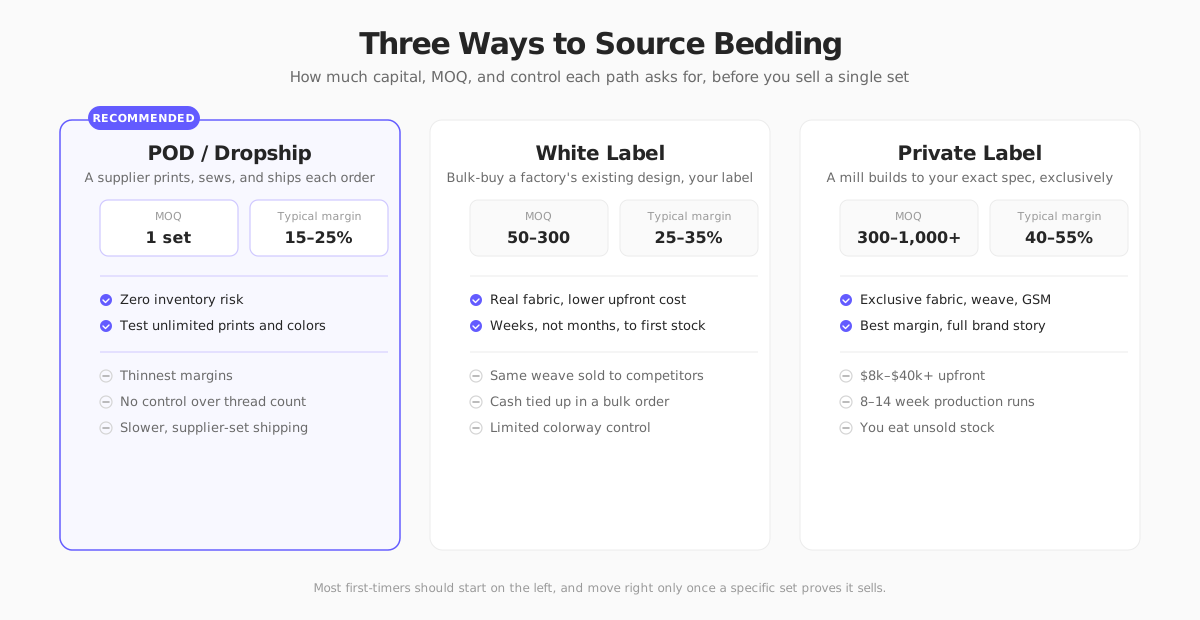
A supplier like Printify prints your design onto duvet covers, pillow shams, and other bedding, then ships each order directly to your customer. There's no MOQ, no inventory, and you can list dozens of print variations without tying up a dollar in stock.

The tradeoff is real: dropshipping and POD margins on bedding typically land in the 15% to 25% range, and you don't control the base fabric or thread count. This model works well for pattern- and design-driven brands (novelty prints, licensed art, dorm decor), and poorly for brands whose entire pitch is fabric quality, since you're stuck with whatever base material the supplier offers.
White label (buy the mill's existing design, put your label on it)
A factory that already makes a specific weave and thread count will sell you that same fabric, cut and sewn to your specs, with your label sewn in instead of theirs. MOQs commonly run 50 to 300 sets per style or colorway for stock fabrics, according to sourcing guides for private-label bed sheets, with much higher minimums for custom prints, embroidery, or retail packaging.
This is the honest recommendation for most beginners who've validated demand through Step 2 and want to move past razor-thin POD margins. You're not funding a custom weave from scratch, and you get real fabric in hand within weeks rather than months. Margins typically land in the 25% to 35% range. The catch: the exact same fabric may be sold under other labels too, since you're buying an existing design, not commissioning an exclusive one.
Private label / custom manufacturing (the most control, and the most capital)
You work directly with a mill, often in Turkey's Denizli region or Portugal's textile belt around Guimarães, to spec your own weave, thread count, and finish, exclusively for your brand. Denizli-based manufacturers like Jante Textile describe this as "end-to-end textiles and fabrics manufacturing customized to your brand," and Portuguese mills like BOVI offer everything from plain sateen to washed linen at this tier.

MOQs here typically start around 300 to 1,000+ units per style, with 8 to 14 week production runs once your specs are locked. This is where the real margin lives, commonly 40% to 55%, and it's the only model where your thread-count and fiber claims are actually true to a fabric nobody else sells. It's also the model with the most cash tied up before you've made a single sale, and the one where a slow-selling colorway is entirely your problem.
Save this path for a fabric and weight you've already validated. Start on POD or white label, learn which specific fabric, weight, and colorway combination actually sells in your niche, then move the winner to private label once demand is proven.
Step 4: Get Your Material Claims and Labeling Right
This is the step most first-time bedding sellers skip, and it's the fastest way to lose credibility with a buyer who's shopped for sheets before.
Thread count is the industry's favorite lie
A quality percale sheet needs roughly 200 to 400 thread count to feel crisp and breathable; sateen typically performs best in the 300 to 600 range. Above that, manufacturers commonly count each strand of a twisted multi-ply thread separately to inflate the number, which is how a sheet set can claim 1,000 or 1,500 thread count while actually performing worse than an honest 300 thread count single-ply sheet from long-staple cotton. Don't market a thread count you can't back up with a real spec sheet from your mill, and don't be afraid to sell a 250 thread count percale confidently. It's a better, more honest number than a padded 1,000.
Know your fabrics before you write copy about them
| Fabric | What it is | Feel | Typical price tier |
|---|---|---|---|
| Cotton percale | Plain, one-under-one-over weave | Crisp, matte, breathable, gets softer with washing | Entry to mid |
| Cotton sateen | Four-over-one-under weave | Silky, subtle sheen, warmer, drapes more | Mid to premium |
| Linen (flax) | Woven from flax fiber | Textured, highly breathable, wrinkles by design | Premium |
| Bamboo / lyocell (TENCEL) | Cellulose fiber, closed-loop processed | Silky, cooling, strong moisture-wicking | Mid to premium |
| Microfiber / poly-blend | Synthetic or cotton-poly blend | Soft but less breathable, wrinkle-resistant, cheapest | Budget |
Pick the fabric that actually matches your Step 1 angle. "Cooling sheets for hot sleepers" sold in microfiber undermines your own pitch; "budget-friendly, easy-care bedding" sold in 100% linen mispositions the product entirely.
Labeling: know the jurisdiction
In the US, the FTC's Textile Fiber Products Identification Act requires every bedding item, including sheets, pillowcases, comforters, quilts, and bedspreads, to carry a label listing fiber content by percentage, country of origin, and either the manufacturer's name or a Registered Identification Number (RN). Sheets and comforters are not classified as "clothing," so the CPSC's general wearing-apparel flammability standard, 16 CFR Part 1610, does not apply to them; the CPSC's mattress flammability standard, 16 CFR Part 1632, applies specifically to mattresses and mattress pads, not to the sheets and covers that go on top of them. Confirm this distinction with your supplier in writing, since "flammability compliant" claims on a fitted sheet listing are sometimes just marketing.
In the EU and UK, Regulation (EU) No 1007/2011 on textile fibre names and labelling applies directly to bed linen, requiring fibre composition in descending order by weight using only the official fibre names in the regulation's annex, not marketing terms. The UK retained this regulation as domestic law after Brexit, so the same fibre-labeling rules apply on both sides of the Channel, even though enforcement now runs through separate bodies.
Get your fiber content and RN number requirements confirmed by your supplier before your first listing goes live, not after a customer or a regulator asks. Most established mills already handle compliant labeling; the mistake is assuming a smaller or newer supplier has, without checking.
Step 5: Solve Packaging, Shipping, and Returns
Bedding has a genuine structural advantage over furniture and most home goods: it's bulky but not fragile. Nothing about a folded sheet set breaks in transit. That changes the shipping math entirely.
Parcel, not freight
A queen sheet set weighs roughly 3 to 4 lbs; a comforter or duvet insert can run heavier, especially with down or down-alternative fill. Almost everything in a bedding catalog ships as a standard parcel via USPS, UPS, or FedEx, never LTL freight. For context, an 8 lb box shipped domestically runs roughly $10 to $13 via USPS Priority or UPS/FedEx Ground, which puts a typical bedding order's outbound shipping well under $15 in most cases, a fraction of what a furniture seller budgets per order.
Poly-bagging is the whole packaging conversation
Where furniture needs crating, corner protectors, and pallet-banding, bedding mostly needs a clean poly bag or a printed mailer, sealed to keep the product presentable and protected from moisture in transit. Vacuum-compressing comforters and heavier items before bagging can meaningfully cut both box size and shipping weight. This is a genuinely simple packaging problem compared to almost anything else in home goods, and it's one of the reasons bedding is a friendlier first category than furniture.
Returns are still the real cost center
Bedding and bath return 21.3% of the time online, close to the overall ecommerce average but meaningfully higher than apparel-adjacent basics. Most returns aren't damage, they're fit, feel, or color mismatch: a sheet that "looked whiter online" or a duvet cover that runs smaller than expected. Clear, accurate sizing charts and honest, unfiltered product photography reduce this more than any packaging change ever will. Budget a real return reserve into your price in Step 6 rather than treating returns as a rounding error.
Step 6: Price With Returns Baked In
The classic beginner mistake is pricing off a competitor's sticker price without knowing your own landed cost. A basic 60/40 cotton-poly percale queen sheet set from a US wholesale hospitality supplier runs roughly $16.67 per flat or fitted sheet and $4.86 per pillowcase in case quantities of 20, landing a basic four-piece set at around $43 before your own markup, branding, and packaging. Private-label overseas FOB pricing for a comparable or better all-cotton spec commonly lands lower per unit once you're ordering in the hundreds, though exact pricing varies enough by mill and spec that you should always get it in writing rather than assume a number.
Here's the honest rule: price at least 2.5x to 3x your landed cost, and build your return reserve into the price itself, not into a hope that returns won't happen to you.
Quick example for a private-label queen sheet set. Landed cost is $43. You sell it for $129 (about 3x):
| Where the money goes | $ |
|---|---|
| Landed cost (fabric, sewing, inbound freight) | $43.00 |
| Card fee (Stripe, 2.9% + $0.30) | $4.04 |
| Outbound parcel shipping to customer | $9.00 |
| Return and damage reserve (~21% of orders, ~$25 processing cost) | $5.25 |
| Marketing (~20% of revenue) | $25.80 |
| What you actually keep | ~$41.91 |
That's roughly 32% of revenue kept per order, a meaningfully better margin than the parcel-shipping math works out to in most heavier home-goods categories, precisely because outbound shipping stays cheap. To clear a $5,000 first private-label test order, you'd need to sell around 120 sets, a realistic first-quarter target once you've validated a specific fabric and colorway through Steps 2 and 3.
Run the same table at a 2x price ($86) instead of 3x, and the fixed-dollar costs (landed cost, shipping, return reserve) barely move while your revenue does, dropping you to roughly 10% kept per order. Bedding's margin floor is more forgiving than furniture's because shipping stays cheap, but it still punishes underpricing. If the math doesn't clear at least 2.5x, the fabric or the fulfillment model is wrong, not the price.
Step 7: Set Up a Website That Can Actually Sell Bedding
By now you have a validated niche, a sourcing model, and real landed costs. Time to give people a place to buy.
Bedding buyers want to see real texture and drape, honest color photography (fabric color notoriously shifts under bad lighting), clear sizing (twin, full, queen, king, California king), and fiber content up front, not buried in a PDF. A generic template built for one-size-fits-all products loses bedding sales when it can't clearly present size and material variants.
The main options in 2026, honestly ranked for first-time bedding sellers:
- Your Next Store (us, to be upfront) is a modern storefront with an AI-powered builder, starting at $25/month on the yearly plan with 0% platform transaction fees. Product pages support multiple images and custom attributes, so you can show real fabric texture and list size/color variants clearly instead of a single generic listing, and because pricing is flat, a $129 sheet set doesn't cost you more in platform fees than a $30 pillowcase. Good fit once you're ready for a real brand home, not just testing a single POD design.
- Shopify is the most common choice for bedding sellers because of its variant handling (size, color, fabric) and its wide app ecosystem for sizing charts and fabric swatches. It starts at $39/month, and Shopify takes a small extra fee on every sale unless you use their own payment processor.
- Etsy works well for handmade or small-batch bedding, less well for private-label or dropshipped catalogs, since buyers there expect one-of-a-kind items. Expect a 6.5% transaction fee plus listing fees.
- Squarespace or Wix are fine for a small first catalog of a handful of colorways, but most bedding sellers outgrow their variant handling once they carry more than a few fabric options across multiple sizes.
- A marketplace listing (Amazon, Wayfair) plus your own site. Marketplaces bring instant traffic and shoppers who already trust the checkout, but they compress your margin further on top of your supplier's cut, and you never own the customer relationship for the repeat business bedding brings (people replace sheets, redecorate a guest room, buy a gift set).
Honest recommendation for most first-time bedding sellers: get a simple website live before you spend real marketing money anywhere, even if you're starting purely with print-on-demand designs. You need a place that shows real fabric and honest sizing, and you need to own the customer relationship for the repeat purchases bedding reliably brings.
0% extra fees on every sale. A modern website for your bedding brand, ready in minutes.
Then pick one place to get noticed
New bedding brands almost always win on exactly one channel first, then expand:
- Instagram and TikTok, styled in a real bed. Bedding sells on texture and how a room feels, not a white-background product shot. "Get ready with me" bedroom content and "sheets that changed how I sleep" formats consistently outperform straight product ads in this category.
- Pinterest. People plan bedrooms months before they buy, and bedding converts well here because the buying intent already exists by the time someone clicks through.
- Sending sets to home and lifestyle creators. A well-styled post showing your sheets on a real bed answers the question every shopper actually has: does this look and feel as good as the photos claim?
- Email and SMS. Sheets wear out on a predictable cycle. Capture every email from day one and follow up around replacement timing (roughly 1 to 2 years for daily-use sheets), not just at launch.
- Google and SEO. Slower to pay off, six to twelve months, but durable for specific searches like "cooling sheets for hot sleepers" or "organic toddler bedding." Plant this early even if you don't expect it to carry year one.
- Paid ads. Worth testing once organic content is already converting, since bedding's decent margins (see Step 6) can support real ad spend once you know your numbers, unlike thinner-margin categories.
Pick one main channel and one backup. Run both for a full quarter before adding a third.
What It Actually Costs to Start a Bedding Brand in 2026
The real-world ranges, by sourcing model:
| Your approach | Upfront cost | Monthly spend | What you get |
|---|---|---|---|
| POD / dropship test | ~$100–$500 | ~$50–$150 | Unlimited prints and colors, a real website, 15–25% margins, zero inventory |
| White label | ~$1,500–$8,000 | ~$200–$500 | An existing weave with your label, 25–35% margins, weeks to first stock |
| Private label / custom | ~$8,000–$40,000 | ~$800–$2,500 | An exclusive fabric and spec, 40–55% margins, real inventory risk |
| Serious launch (multi-SKU line) | $50,000+ | $4,000+ | Full sheet, duvet, and pillow lines, staff, wholesale accounts |
Two honest warnings hidden in that table:
- A private-label launch will not break even in one quarter. Between the bulk order, the return reserve from Step 6, and the marketing needed to introduce an unknown brand, plan for realistic runway, not a single strong month.
- POD and white label are the only rows where a slow-selling colorway doesn't sit in your spare room for a year. Every row past white label carries real inventory risk that an unpopular fabric weight or color can turn into a cash-flow problem fast.
If your plan depends on every colorway selling evenly, your plan is wrong. Budget for at least one SKU that doesn't move the way you expected, because in a category this commoditized, differentiation is the whole game, and not every bet on it will land.
The bedding brands that make it past year one aren't the ones with the highest thread-count claim. They're the ones with one specific, honest reason to exist, real fabric they can back up with a spec sheet, and pricing that accounts for the roughly one in five orders that comes back. Do those three things and the rest is patience, good photography, and a mill that actually answers your emails.
FAQ
How much does it cost to start a bedding brand in 2026?
Anywhere from $100 to $40,000+, depending entirely on your sourcing model. A print-on-demand test with a supplier like Printify can start under $500 since you never hold inventory. White-labeling an existing weave typically runs $1,500 to $8,000 for a first bulk order across a few colorways. Private-label, custom-spec production through a mill in Turkey or Portugal, the model with the best margins, typically requires $8,000 to $40,000 to start. Most of the cost difference comes down to MOQ and inventory risk, not the website.
What's the minimum order quantity for private-label bedding?
It varies by fabric and customization. Stock fabrics with simple labels can sometimes start as low as 50 units through a white-label arrangement, while a fully custom weave, thread count, or exclusive print through a private-label mill commonly starts at 300 to 1,000+ units per style. Ordering your full range, sheets, duvet covers, and pillowcases, in one production window typically improves your per-unit pricing, since fabric setup and finishing changeovers, not the sewing itself, drive most of the small-run cost penalty.
Is dropshipping bedding actually profitable?
Yes, but the margins are thin, typically 15% to 25%, roughly half of what a private-label model can earn. It's a genuinely workable way to start with no inventory and no bulk-order capital tied up, and it's the honest recommendation for testing which specific designs and colorways sell before you commit real money to a white-label or private-label order. Treat it as a testing ground, not necessarily your permanent model.
Do I need to worry about flammability regulations for bed sheets?
In the US, the CPSC's mattress flammability standard (16 CFR Part 1632) applies to mattresses and mattress pads, not to the sheets, duvet covers, and pillowcases that go on top of them, since bedding isn't classified as clothing under the general apparel flammability standard either. What you do need is accurate FTC textile labeling: fiber content by percentage, country of origin, and either your business name or a Registered Identification Number, on every item. In the EU and UK, Regulation (EU) No 1007/2011 requires the same kind of fibre composition labeling using official fibre names, and the UK kept this rule in force after Brexit. Confirm your specific labeling obligations with your supplier or a compliance consultant before your first listing goes live, since requirements can shift by product type and destination market.
What thread count should I actually use in my marketing?
Whatever your fabric genuinely tests at, and don't be afraid of an honest, moderate number. Quality percale performs best in the 200 to 400 range and quality sateen in the 300 to 600 range; numbers well above that are usually achieved by counting multi-ply twisted threads as separate strands, which inflates the number without improving how the sheet actually feels or lasts. A confidently marketed, honest 300 thread count sheet from good long-staple cotton will out-sell and out-perform a padded 1,200 thread count claim once a customer actually sleeps on it and leaves a review.
How long does it take to launch a bedding brand?
On the print-on-demand or white-label path, plan for 4 to 8 weeks: a couple of weeks to validate demand, time to set up a supplier account and your website, then launch. On the private-label path, plan for 3 to 5 months, since spec development, sampling, and an 8 to 14 week production run take longer than most first-timers expect. Anyone promising a fully custom, exclusive-fabric bedding brand in two weeks is skipping the sampling process.