How AI Is Replacing Ecommerce Admin Panels
 Jakub Neander
Sep 1, 202611 min read
Open your ecommerce admin panel right now and count the clicks between "I need to change this price" and the price actually changing. Five, six, maybe eight, spread across two menus and a modal. That gap between intent and action is exactly what AI is closing. Not by making the admin panel prettier: by making most of it optional. Here's what's actually automated in 2026, what still genuinely needs a human, and the parts of this shift nobody's being honest about.
Bias disclosure: We build Your Next Store, an ecommerce platform with an AI assistant built into the admin. We'll flag where that colors the analysis, and we'll say plainly where AI backend automation still falls short, including ours.
The Admin Panel Was Never the Point
Nobody wakes up excited to use an admin panel. It's a means to an end: change a price, update stock, answer a customer, publish a product. The panel itself, the sidebar navigation, the settings tabs three levels deep, the bulk-edit spreadsheet view, is overhead. It exists because until recently there was no other way to translate "what I want to happen" into "what the database now says."
That overhead adds up. A merchant running a few hundred SKUs spends a real chunk of every week clicking through the same handful of screens: editing a description here, adjusting stock there, reading a support ticket, checking whether a discount code still applies. None of that work is hard. All of it is slow, because every action requires finding the right screen first.
This is the actual shift behind "AI is replacing the ecommerce admin panel": not a redesign of the dashboard, but a new layer that sits between what a merchant wants and the backend that has to record it. You describe the outcome. Something else finds the right screen, fills in the right fields, and (increasingly) commits the change itself.
What "AI Replacing the Admin Panel" Actually Means
That layer isn't one thing. It's maturing in three fairly distinct stages, and most of the coverage of this trend conflates them.
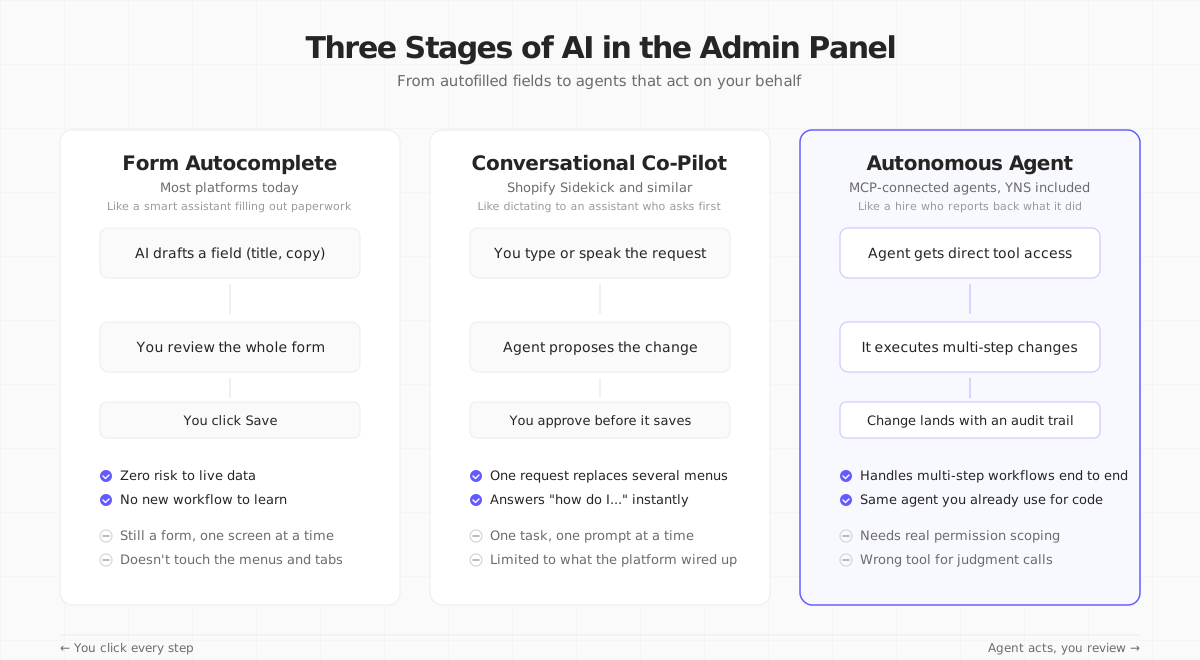
Stage 1: form autocomplete. AI drafts a product title or description into an existing field; you still open the form, still review every line, still click Save. This is the baseline most platforms shipped first because it's the lowest-risk integration: the AI never touches live data directly, it just writes faster than you would have.
Stage 2: the conversational co-pilot. Instead of navigating to a settings screen, you tell an assistant what you want and it makes the change (or proposes it) through a chat interface layered over the same backend. Shopify's Sidekick is the clearest mainstream example: as of the Winter 2026 release it can create products, draft Flow automations, and answer "how do I..." questions conversationally, and Shopify is explicit that it never saves a change without surfacing it for review first. That review step is the entire safety model at this stage. It works, but it's still one request, one task, at a time.
Stage 3: the autonomous agent. This is the newest and least understood stage: an AI agent with direct, standardized tool access to the backend, capable of chaining several actions into one workflow (restock this SKU, notify the supplier, update the low-stock banner) without a human clicking through each step individually. The Model Context Protocol (MCP), which we covered in depth in our guide to MCP servers for ecommerce, is what's making this stage possible: it gives any AI agent (Claude, ChatGPT, a custom internal tool) a standard way to call a store's real backend functions instead of every platform inventing its own bespoke integration.
The honest framing: stage 3 doesn't replace stages 1 and 2, it sits on top of them. And which stage is right for a given task depends entirely on how reversible that task is, which is the actual question the rest of this article is about.
Where This Is Actually Shipping Right Now
Skip the "AI will transform ecommerce" hand-waving. Here's concretely what exists today.
Shopify Sidekick is the most visible example of stage 2 at scale. Free on every plan as of January 2026, it can create and edit products from a plain-language prompt, generate internal tools, and (via Sidekick App Extensions launched in the Spring '26 Edition) connect to 15+ third-party apps including Klaviyo and Yotpo, so the assistant's reach extends past Shopify's own settings screens into the merchant's wider app stack.
MCP endpoints are becoming a standard backend feature, not a novelty. Stripe runs a remote MCP server at mcp.stripe.com scoped by restricted API keys, PayPal shipped its own covering orders, invoices, and disputes, and Shopify publishes four official servers, though it still relies on community wraps of its Admin API for merchant-side tasks rather than a first-party admin MCP. Your Next Store ships both a consumer-side endpoint (/api/mcp, for shopping agents to search and fetch products) and a separate merchant-side "Code Mode" MCP for admin actions. The distinction matters: an agent that can browse your catalog on a customer's behalf is a different trust level from one that can edit it. This is stage 3 infrastructure, and it's shipping across the industry less than two years after MCP itself launched in November 2024.
Analytics is quietly following the same pattern. Instead of a merchant reading a dashboard and inferring what changed, an AI agent watches the same metrics and writes the sentence: "conversion dropped 8% on mobile checkout since Tuesday, most likely tied to the new shipping-calculator widget." The dashboard doesn't disappear, but it stops being the first thing a merchant looks at.
None of this means the admin panel is going away. It means fewer of your weekly tasks require opening it.
What AI Actually Handles Well vs. What Still Needs You
This is the part most coverage skips, because "AI will run your back office" is a better headline than "AI is good at some of your back office and bad at the rest." Here's the honest split, plotted against the two things that actually matter: how routine the task is, and how easy the change is to undo if the AI gets it wrong.
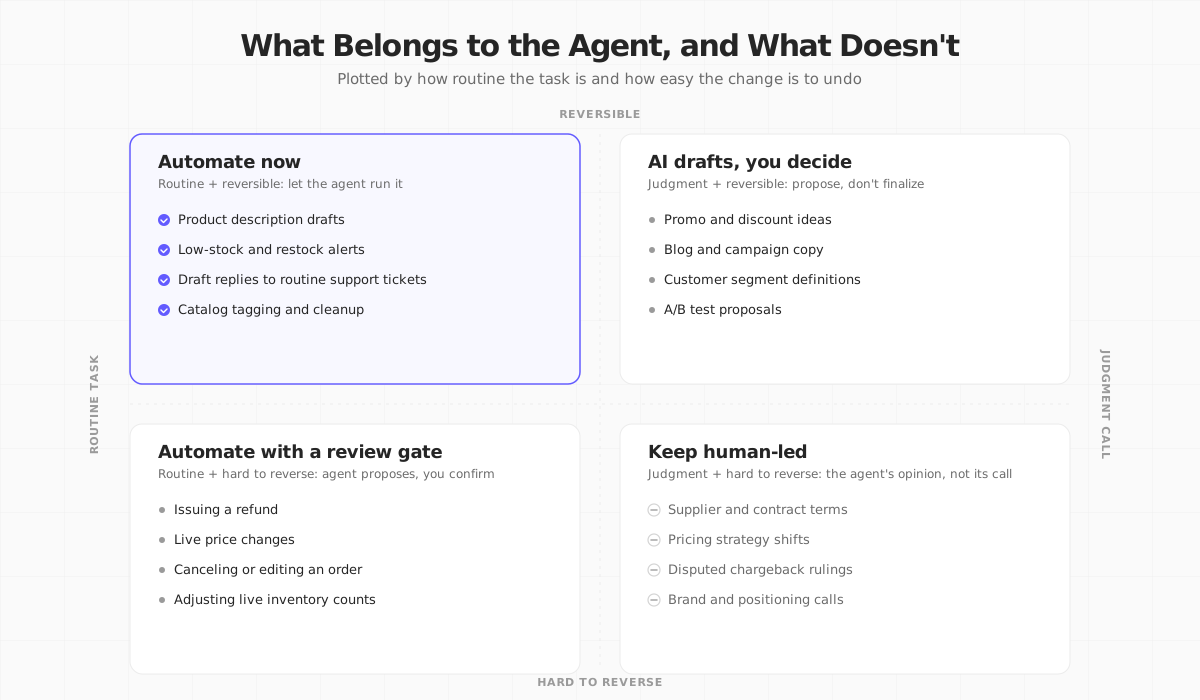
The pattern that matters: reversibility, not difficulty, is the real gate. Writing a product description and issuing a refund are both mechanically simple for an AI to do. Only one of them is safe to let it do unsupervised, because a bad description costs you a re-edit and a bad refund costs you money that's already gone. Any AI-in-the-admin-panel pitch that doesn't draw this line is selling you the upside without the failure mode.
What Nobody Tells You About Letting AI Touch Your Backend
The parts of this shift that don't show up in the launch announcements.
"Never saves without review" only works if someone actually reads the diff. Shopify's own design principle for Sidekick, requiring review before every change lands, is the right default. But review fatigue is real: after the fortieth "approve this product edit?" prompt in a week, humans start clicking approve without reading. The safety model only holds if the review step stays meaningfully different from a rubber stamp, which usually means showing a real diff (old value vs. new value), not just "AI wants to update this product, OK?"
Permission scoping matters more with agents than with staff accounts. A human employee with admin access still has to physically click through the UI, which is its own (weak) rate limiter. An agent with API or MCP access can execute hundreds of changes in the time it takes you to notice something's wrong. Scope agent credentials the way you'd scope a contractor's access, not the way you'd scope your own: narrowest permission that gets the job done, expiring tokens, and a real audit log of what the agent actually did, not just what it was asked to do.
Hallucination risk doesn't disappear just because the target is a database instead of an essay. An AI agent can misread a SKU, apply a discount to the wrong collection, or "helpfully" restock a discontinued product because the pattern looked familiar. The failure mode isn't a wrong sentence, it's a wrong database row. Treat any agent with write access to production commerce data the way you'd treat a junior hire's first week: reviewed changes, a rollback plan, and nothing irreversible until it's earned more trust.
If You're in the EU or UK
Letting an AI system make or influence backend decisions that affect customers isn't just an operational question in Europe: it's a legal one, and the rules changed meaningfully in 2026.
GDPR Article 22 restricts decisions based solely on automated processing, including profiling, that produce a legal or similarly significant effect on a person. Personalized pricing driven entirely by an algorithm is a commonly cited example. If an AI agent in your admin autonomously sets a customer-specific price or auto-approves or denies a refund with no human able to override it, that can trigger Article 22 obligations, including a documented basis for the automated decision and a way for the customer to request human review. In the UK, the Data (Use and Access) Act 2025 changed the underlying framework from an outright prohibition to a safeguards-and-transparency model, with the ICO consulting on updated guidance through mid-2026, so if you sell to UK customers, check the current guidance rather than assuming the old absolute rule (or its replacement) still matches what you read last year.
The EU AI Act's transparency rule is now live. Article 50 became enforceable on 2 August 2026 and requires that any AI system interacting directly with a person, including a customer-facing chat assistant in your storefront, be designed so people are told they're talking to AI, disclosed at or before the first interaction. This applies to ordinary businesses running ordinary chatbots, not just AI vendors, and penalties run up to €15 million or 3% of global turnover. If your admin AI ever surfaces directly to customers (a support bot, an order-status assistant), this is not optional reading.
Neither rule bans AI from your back office. Both assume a human stays reachable when the automated decision actually matters to someone outside your team.
Where Your Next Store Fits
We've been building toward stage 2 and 3 from day one, not bolting AI onto an existing admin as an afterthought.
The AI assistant built into the YNS admin has a customizable knowledge base per store, so it answers "how do I set up a discount code" or "why did this order fail" with your store's actual configuration in context, not generic documentation.
The merchant-side "Code Mode" MCP is the stage-3 layer described above: it's what lets an agent like Claude act on your admin data directly, separate from the consumer-facing /api/mcp endpoint that shopping agents use to search your catalog. Combined with the AI-powered store builder, which we cover in our AI ecommerce deep dive, the same agentic pattern that edits your storefront's code can also run your day-to-day operations.
Where we're not there yet: we don't currently expose a granular, per-agent permission-scoping UI the way the "permission scoping" section above argues you should demand. Team members get organization-level admin access; a narrower, per-credential scope specifically for MCP and AI tool calls isn't something we've shipped yet. If autonomous-agent write access to your backend is the specific thing you're evaluating platforms on, ask any vendor (including us) exactly how they scope it, not just whether they support it.
Your Next Store is open source. Star the repo on GitHub: github.com/yournextstore/yournextstore
Want your backend agent-ready, not just your storefront? YNS ships an admin AI assistant and a live MCP endpoint on every store, so the same agent that edits your code can run your operations.
FAQ
Will AI completely replace the ecommerce admin panel?
Not entirely, and probably not soon. The admin panel becomes less of a daily destination as more routine tasks move into chat or agent workflows, but someone still needs a screen to review diffs, configure edge cases, and handle the judgment calls in the "keep human-led" quadrant above. Think of it less as replacement and more as the panel becoming the fallback interface instead of the primary one.
Is it safe to let an AI agent make changes to my live store?
For routine, reversible tasks (drafting descriptions, flagging low stock, tagging catalog items), yes, with normal review. For anything hard to reverse (refunds, live pricing, order cancellations), treat "AI agent" the same way you'd treat a new employee: scoped permissions, a visible audit trail, and a review step that shows the actual before/after, not just an approve button.
What ecommerce platforms already have AI-native admin tools?
Shopify's Sidekick is the most widely deployed conversational admin assistant as of 2026. On the developer/agent side, MCP endpoints are now standard on Stripe, PayPal, Shopify, and Your Next Store, letting any MCP-compatible AI agent call a store's real backend functions directly rather than clicking through a UI.
The Bottom Line
Count the clicks again, the way you did at the top of this article. If that number is smaller than it was a year ago, your admin panel is already losing ground to something else, and that's the right direction. The question worth sitting with isn't whether AI belongs in your back office. It's which of this week's clicks you'd trust an agent to make instead, and which ones you'd never hand over no matter how good the model gets. Get that line right, and the rest is implementation detail.