Amboras vs Shopify: Which Should You Build On in 2026?
 Jakub Neander
Sep 21, 202612 min read
Shopify has spent two decades turning "start a store" into a weekend project. Amboras is a 2025 startup betting that the whole job, design, copy, testing, even follow-up emails, can run on autopilot from a chat window. Both now charge exactly $399/month for their top self-serve plan, which tells you a lot about who they're both trying to poach customers from. Here's how they actually differ once you get past the marketing pages.
Bias disclosure. We build Your Next Store, an AI-native store builder that competes with both of these. We'll name our own weak spots plainly and won't shade the parts where Amboras or Shopify simply do it better. If you spot an error, open an issue on GitHub.
The Short Answer
Pick Shopify if you want the largest app ecosystem, a checkout with more than a decade of fraud-detection tuning behind it, and you're fine with Liquid themes or paying for Shopify Plus to go headless.
Pick Amboras if you want the AI to run nearly the whole operation, design, copy, A/B testing, and post-purchase emails, and you're comfortable being an early customer of a three-person, one-year-old company.
Pick neither if you're a developer who wants to own the storefront code outright; that's a third bucket, and we cover where Your Next Store fits later in this post.
Quick Comparison
| Amboras | Shopify | |
|---|---|---|
| What it is | AI-native platform, chat builds and runs the store | Established ecommerce platform, theme or headless |
| Founded | 2025 (YC Spring 2026, 3 employees) | 2006, public company |
| Entry price | $49/mo (Basic) | $29/mo (Basic, billed yearly) / $39/mo monthly |
| Mid-tier price | $105/mo (Grow) | $79/mo (Grow, yearly) / $105/mo monthly |
| Top self-serve price | $399/mo (Advanced) | $299/mo (Advanced, yearly) / $399/mo monthly |
| AI role | Builds, tests, and rewrites the store itself | Sidekick assists inside a normal admin; doesn't build the store |
| App ecosystem | Built-in features only, no public app marketplace | 8,000+ apps |
| Payment options | Stripe-based, 150+ payment methods claimed on the pricing page | Shopify Payments (Stripe-powered), or any third-party gateway for an added fee |
| Portability | Data export within 90 days of cancelling (Terms § 12.4); storefront design isn't itemized as exportable | Products/customers export as CSV; theme stays on Shopify unless you go headless |
Prices are what each vendor showed on its own pricing page in September 2026. Both change often, so check before you commit.
What Amboras Actually Is
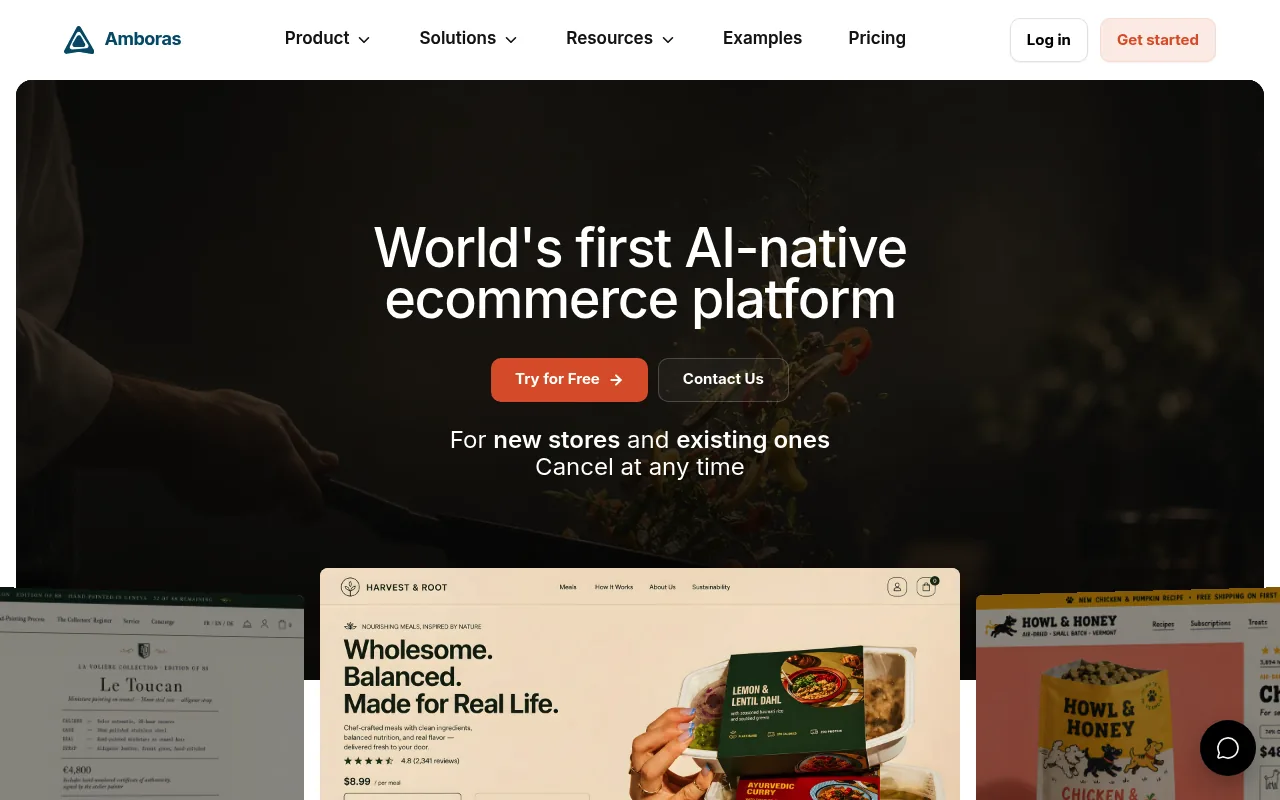
Amboras calls itself the "world's first AI-native ecommerce platform." You describe your store, the AI designs the storefront, writes the product copy, sets up a working checkout, and keeps making changes as you chat with it. It's not a static template generator: it's a running store from the first prompt, similar in spirit to what Your Next Store's AI builder does.
It's also genuinely new. The Y Combinator profile lists Amboras as founded in 2025 by brothers Imad Mokadem (CEO) and Amin Mokadem (CTO), part of the Spring 2026 batch, with three employees as of writing. We covered the trade-offs of betting on a team that size in our Amboras alternatives guide; nothing about that calculus has changed, it's just a smaller team behind a tool asking to hold your product catalog and customer list.
What Shopify Actually Is

Shopify needs less introduction. Founded in 2006 and public since 2015, it's the default answer to "how do I start an online store," with an app store, a mature checkout, and a Liquid-based theme system that a huge number of freelancers and agencies already know. Its own AI layer, Shopify Magic and Sidekick, writes copy, edits photos, and answers admin questions, but it's a helper bolted onto a mature product, not the thing building your store from scratch the way Amboras or YNS do.
Head-to-Head
1. What the AI Actually Does
This is the real fork in the road. Amboras's pricing page lets you pick your underlying AI model (it lists Opus 5, Sonnet 4.6, and GPT-5 among the options) and includes an "AI Store Designer" on every plan, including the $49/mo Basic tier. Higher plans don't unlock new AI capabilities so much as more of the same ones: Grow ($105/mo) gets "5x more AI usage than Basic," and Advanced ($399/mo) gets "20x more," plus autonomous A/B/n testing where the AI picks variants, runs the test, and declares a winner without you setting it up manually.
Shopify's AI, by contrast, lives inside a dashboard built for humans. Sidekick can draft a product description or adjust a theme setting when you ask, but you're still the one running the store day to day. If "the AI runs the operation" is the appeal, Amboras is closer to that promise. If "the AI helps me inside tools I already understand" is what you want, Shopify's approach will feel more familiar.
2. Pricing, Side by Side
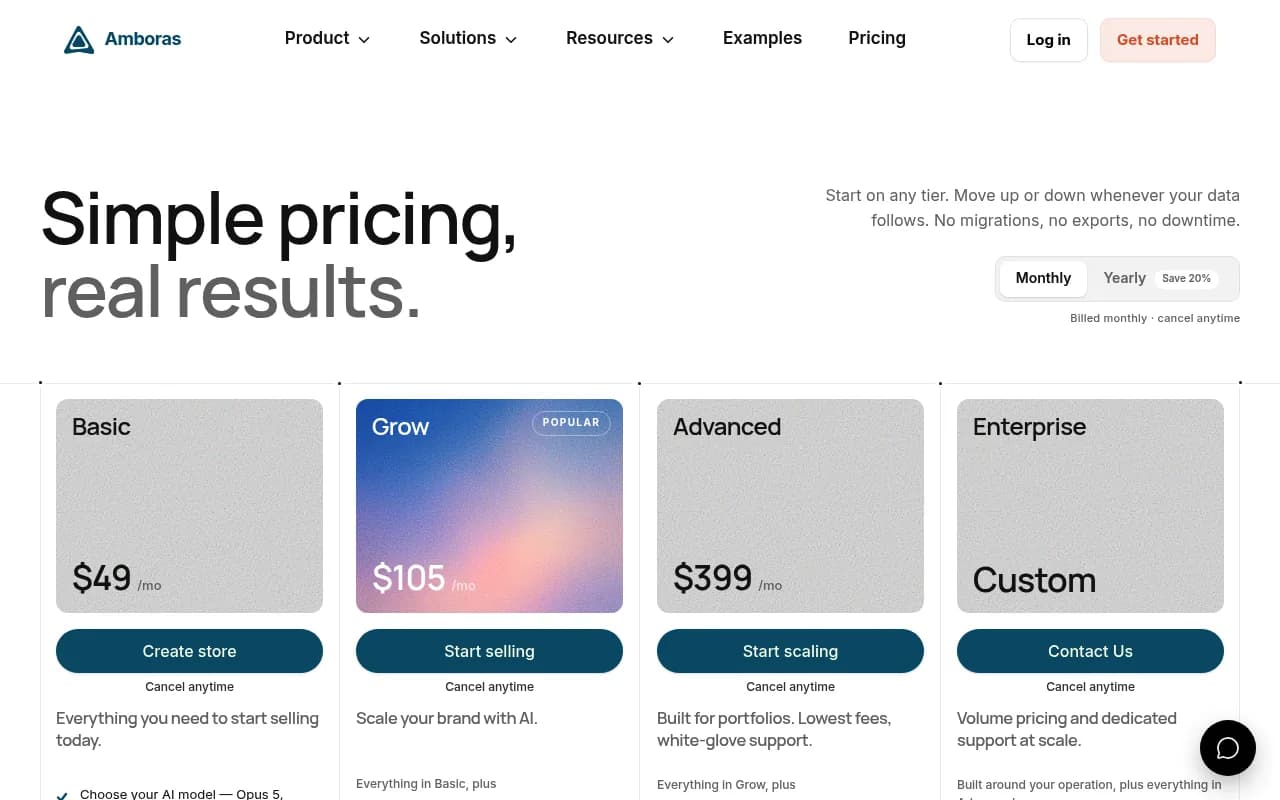
Line up what each platform charges when billed monthly and the numbers are stranger than you'd expect:
| Tier | Amboras (monthly billing) | Shopify (monthly billing) |
|---|---|---|
| Entry | $49/mo | $39/mo |
| Mid | $105/mo | $105/mo |
| Top self-serve | $399/mo | $399/mo |
Amboras's Grow and Advanced tiers land on the exact same monthly price as Shopify's Grow and Advanced. That's either a coincidence or a pricing team that benchmarked the competition line by line; either way, if you're comparing sticker prices, the middle and top tiers are a wash. Amboras's yearly toggle claims a flat 20% discount across the board; Shopify's yearly discount works out to roughly 25% on every tier (see the full breakdown in our Shopify transaction fees post).
Where the real gap shows up is fees on top of the subscription. Shopify charges 0.6%–2% extra if you don't use Shopify Payments, on top of your processor's own cut, a detail we've done the full math on in how much Shopify actually takes from a $100 sale. Amboras's pricing page advertises "150+ payment methods accepted" and doesn't list a separate platform cut on top of processing, though it's worth confirming current terms before you commit real revenue to either claim.
Amboras's footer still says "30-day launch guarantee on Launch, Grow & Advanced," even though the pricing cards above it are now named Basic, Grow, Advanced, and Enterprise. It's a small thing, but it's the second time we've caught the plan names drifting out of sync with the marketing copy around them (the first was the "unlimited AI" claim we flagged in our Amboras alternatives guide). Read what a page says next to the button you're about to click, not just the headline above it.
3. Ecosystem and What Happens When You Need a Weird Feature
Shopify's advantage here isn't close. Over 8,000 apps cover loyalty programs, subscriptions, complex shipping rules, and B2B ordering, almost anything a niche is going to ask for eventually has an app. The cost is real too: a typical store ends up running $100–$300/month in app fees once it needs more than the basics, and every app can inject its own JavaScript, which is most of why a Shopify store running a dozen apps tends to load slower than a clean one.
Amboras doesn't have a public app marketplace. Instead it bundles a fixed, expanding feature list directly into each plan: email campaigns and flows, native product reviews, multi-currency and auto tax on Grow and up, white-label storefronts on Advanced. If the feature you need is on that list, you get it without installing anything or paying a separate vendor. If it isn't on the list, there's no app store to check: you either wait for Amboras to build it or you don't get it. That's a real constraint for anyone with a specific operational need Shopify's ecosystem would normally solve with a $15/month app.
4. Company Maturity and What That Means Practically
Three employees and a one-year operating history is a real number, not a knock. Y Combinator companies are supposed to look like that. What it means practically: fewer integrations exist, support is a small team rather than a global operation, and there's less of a track record of how the product behaves under load or over years, not months. Amboras's own FAQ page even lists "Do you handle migration from Shopify?" as one of its five published questions, which tells you exactly who it's trying to win over right now.
None of that makes Amboras a bad bet. It makes it an early bet, and early bets carry the ordinary risks of any young vendor holding part of your business: ask what happens to your store if the company is acquired, pauses development, or simply moves slower than you need while it's still three people.
5. Can You Leave?
Per Amboras's Terms § 12.4, you get a 90-day window after cancelling to request a data export before your account data may be permanently deleted. The Terms don't itemize what that export contains, whether it's just products, orders, and customers, or whether it extends to the AI-designed storefront as something you could host elsewhere. In practice, on every AI store builder we've reviewed that works this way, "export" has meant your data, not your design. If you want the storefront itself as portable code, don't assume you'll get it from either Amboras or Shopify's standard plans; Shopify's theme lives on Shopify unless you pay for Plus and go headless, which starts at $2,300/month.
Your Next Store is open source. Star the repo on GitHub: github.com/yournextstore/yournextstore
A Note for EU and UK Sellers
Neither comparison above changes much by region, but two things are worth checking before you sign up. First, Shopify Payments is only available in about 39 countries; if yours isn't on the list, you're paying the third-party gateway penalty by default, not by choice. Second, both platforms route card processing through Stripe underneath (Amboras exclusively, Shopify via Shopify Payments), but neither one automatically registers and files your VAT for you. Stripe Tax calculates and can collect VAT once you turn it on, but the registration thresholds and filing obligations in each EU country, and in the UK, are still on you. Don't assume "AI-native" or "handles the whole stack" extends to your tax filings.
What Nobody Tells You
The first prompt is the demo. The fiftieth prompt is the product. Every AI store builder looks magical in the first thirty seconds. Whether Amboras's AI still gives you what you want on request fifty, six weeks in, or starts drifting from your brand, is the thing a five-minute trial can't show you. Do at least ten or fifteen rounds of real changes before you commit a plan.
"Unlimited" and "more usage" are relative, not absolute. Amboras's Terms say AI usage allocations don't roll over month to month (§ 4.4), and the pricing page describes higher tiers only in multiples ("5x," "20x") rather than a number you can plan against. Ask directly what happens to a chat mid-edit when you hit the cap.
A 20-app Shopify store and a 2-app Shopify store are different products. The performance and cost numbers people quote for Shopify usually describe the appified version, because that's what most real stores end up running. A lean Shopify store with a good theme performs fine; budget for the apps you'll actually install, not the base plan price.
Neither platform's export gives you the design. Both let you take your data. Neither, on standard plans, hands you the storefront as code you can host yourself. If that matters to you, it's worth ruling in or out before you build six months of catalog on top of either one.
Where Your Next Store Fits
We built Your Next Store because we wanted the "describe your store, watch AI build it" experience Amboras offers, without the part where the storefront can only ever live on our servers. (Bias flag: this is our product.)
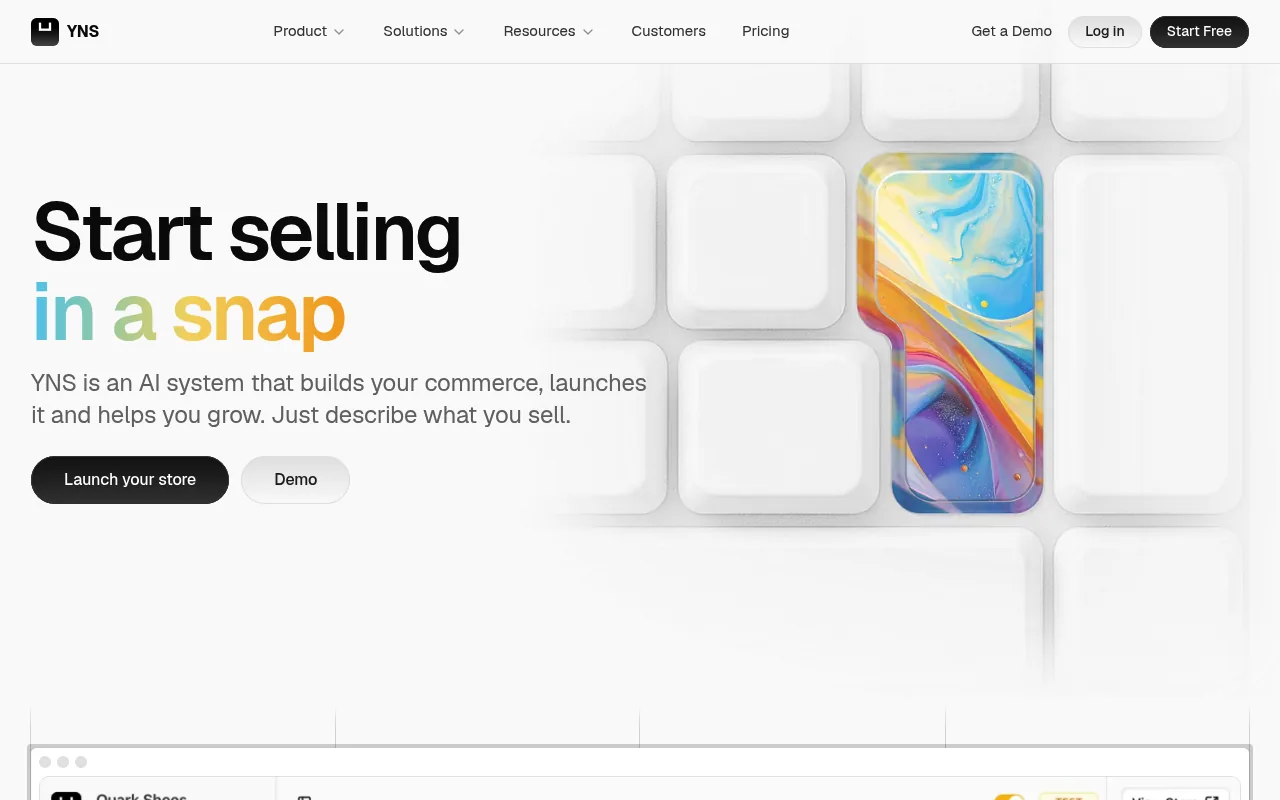
The pitch is close to Amboras's: chat with the AI, describe what you sell, watch a real store come together with products, stock, taxes, shipping, and checkout already working, then keep chatting to change it. The difference is what happens if you ever leave. YNS's storefront is also published as free, open-source code on GitHub. If you decide to self-host somewhere else, the design comes with you, not just a CSV of your order history.
Where we're honestly behind both: no public app marketplace like Shopify's, and payments run through Stripe only today, no PayPal-as-a-button, no 150+ payment methods claim. Where we differ from Amboras: the storefront is open source, plans start at $30/month with 0% platform transaction fees, and pricing hasn't moved since spring.
Where we pull ahead of Shopify on cost: a store doing $200K/year in sales pays roughly $2,220/year all-in on YNS Growth versus $7,468/year on Shopify Basic once you add fees and typical apps, a gap we walk through in full in our Next.js vs Shopify comparison.
Want the "AI builds it" experience with a storefront you can actually take with you? Describe your store in plain English and keep the code if you ever leave.
Decision Framework
You want the biggest ecosystem and don't mind Liquid or an app subscription: Shopify.
You want the AI to run nearly everything, and you're fine being an early customer of a small startup: Amboras.
You want AI-native building and a storefront you can self-host if you ever leave: Your Next Store.
You're not sure yet: start with our broader best AI store builders guide, which puts both of these next to Wix, Squarespace, 10Web, and half a dozen others on the same six questions.
FAQ
Is Amboras cheaper than Shopify?
Not really, once you compare like for like. Amboras's entry plan is $49/mo against Shopify's $39/mo billed monthly ($29/mo billed yearly). The middle and top self-serve tiers are priced identically at $105/mo and $399/mo. The bigger cost difference on Shopify comes from apps and payment-gateway fees, which our Shopify transaction fees breakdown covers in detail.
Can Amboras replace Shopify for an existing store?
Amboras's own FAQ lists "Do you handle migration from Shopify?" as a published question, so it's clearly built to accept switchers. What you should check before migrating: whether your specific Shopify apps have an Amboras equivalent (Amboras has no public app store), and what Amboras's data export actually covers if you ever need to leave again. Per Terms § 12.4, you get a 90-day export window after cancelling, but the storefront design isn't itemized as part of it.
Does Shopify have an AI store builder like Amboras?
Not in the same sense. Shopify's Sidekick and its free AI theme generator help you get started and make ongoing edits, but you're still working inside a normal ecommerce admin. Amboras's chat interface is closer to the whole operating model, not just a feature inside one.
Related Blog Posts
- 8 Best Amboras Alternatives in 2026
- Best AI Store Builders in 2026
- Shopify Transaction Fees: The Real Cost of Selling on Shopify
Both of these platforms are betting that AI changes what "starting a store" means, Amboras by putting AI at the center from day one, Shopify by bolting it onto twenty years of infrastructure most sellers already trust. Neither bet is wrong. The question worth answering before you sign up isn't "which AI is smarter," it's "if this company disappeared tomorrow, what would I be left holding." Answer that honestly, and the rest of the decision gets a lot easier.
Curious about an AI store builder you can take with you if you ever leave? Try Your Next Store. Describe your shop in plain English, and keep the code.