How to Start a Toy Brand in 2026: The Honest Playbook
 Jakub Neander
Sep 9, 202614 min read
The US toy industry grew 6 percent in 2025 after two flat years, and the global toys and games market is on pace for $136 billion in 2026. It's also one of the few product categories where a design mistake can end up in a child's mouth, which is why toys carry more mandatory safety testing than almost anything else you could sell online. This is the guide I'd hand a friend before they spend a dollar on how to start a toy brand: seven steps, in the right order, with the honest 2026 numbers for sourcing, safety certification, and the pricing math that decides whether the business survives its first year.
The 7 Steps, in Order
- Pick a very specific kind of kid (or grown-up collector) your toy is for. Not "kids who like toys." One age, one interest, one occasion.
- Get real parents (or collectors) to say "I'd buy that" before you spend on molds.
- Pick how you'll actually make the toy. Print-on-demand plush, private label, or custom manufacturing.
- Do the boring safety and certification work. This is not optional for a toy business, and it's the step every generic "start a business" guide glosses over.
- Price so the math survives testing, shipping, and platform fees.
- Set up a place people can actually buy from.
- Pick one channel to get discovered. Not all of them at once.
Now the long version.
Step 1: Pick a Very Specific Kind of Kid Your Toy Is For
Walk down the toy aisle at any big-box retailer and you'll see the same handful of categories repeated a thousand times: generic plush animals, generic building blocks, generic "educational" flashcards. The toy brands that actually build a following didn't try to be for every kid. They picked one kid, one moment, or one obsession, and built for that.
Good answers look like this:
- Toddlers going through a specific "big feelings" phase (a plush that teaches naming emotions), not "kids who need comfort."
- Kids obsessed with one very specific animal or dinosaur, not "animal-loving kids."
- Adult collectors who grew up on 90s cartoons and want a designer vinyl figure of a character nobody else is making, not "nostalgic adults."
- Parents looking for a screen-free gift for a 5-year-old's birthday party, not "gift-givers."
That last one describes a real and growing niche: toys marketed explicitly as an alternative to screen time, sold through parenting newsletters and Instagram accounts rather than the toy aisle. If you haven't settled on a toy business as the right category yet, our broader playbook for starting an online store walks through picking a product before you commit to one.
The test: if a big-box retailer could put your toy on a shelf tomorrow without changing anything about who it's for, the idea isn't sharp enough yet. Your advantage as a small toy brand isn't a bigger factory or a licensing deal. It's caring about one specific kid, or one specific collector, more than a giant toy company ever will.
Step 2: Get Real People to Say "Yes" Before You Spend on Molds
This is the step almost every first-time toy founder skips, and it's the most expensive one to skip in this entire category. A custom injection mold can run $3,000 to $15,000 or more before you've made a single unit. You do not want to find out your idea doesn't sell after that check clears.
Three cheap ways to validate first:
- Post renders or a rough prototype in the community it's for. A parenting Facebook group, a collector's Discord, a subreddit for the hobby the toy connects to. Ask directly: "would you buy this, and what would you pay?" Vague enthusiasm doesn't count. A specific price someone would actually pay does.
- Take pre-orders on a one-page site before you own any inventory. Show a mockup or a hand-made prototype, describe the concept, and ask for a deposit. Ten real pre-orders are worth more than a thousand social likes.
- Sell a small hand-made batch at a market or a school fair. Twenty to thirty units, made by hand or with a cheap 3D print, sold in person. You'll learn which detail people actually pick up and pay for, which is different from which detail gets a compliment.
This step costs a weekend and maybe a few hundred dollars in prototyping. Skipping it is how founders end up with a shipping container of a toy nobody outside their own head wanted.
Step 3: Pick How You'll Actually Make the Toy
This is the decision that shapes every other number in this guide, and most first-timers only know the expensive option exists.
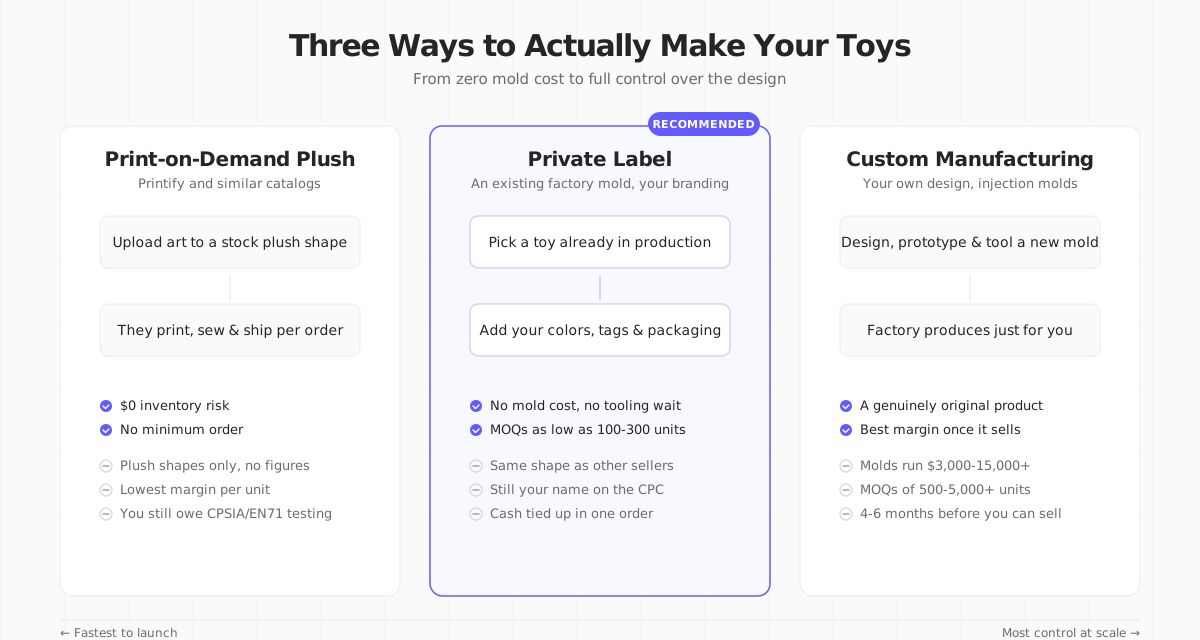
Print-on-demand plush
Upload your artwork or a simple character design to a print-on-demand catalog built for soft toys, and they cut, sew, stuff, and ship each order as it comes in. Printify's custom stuffed animal catalog works this way: no minimum order, no upfront inventory, live the same day.
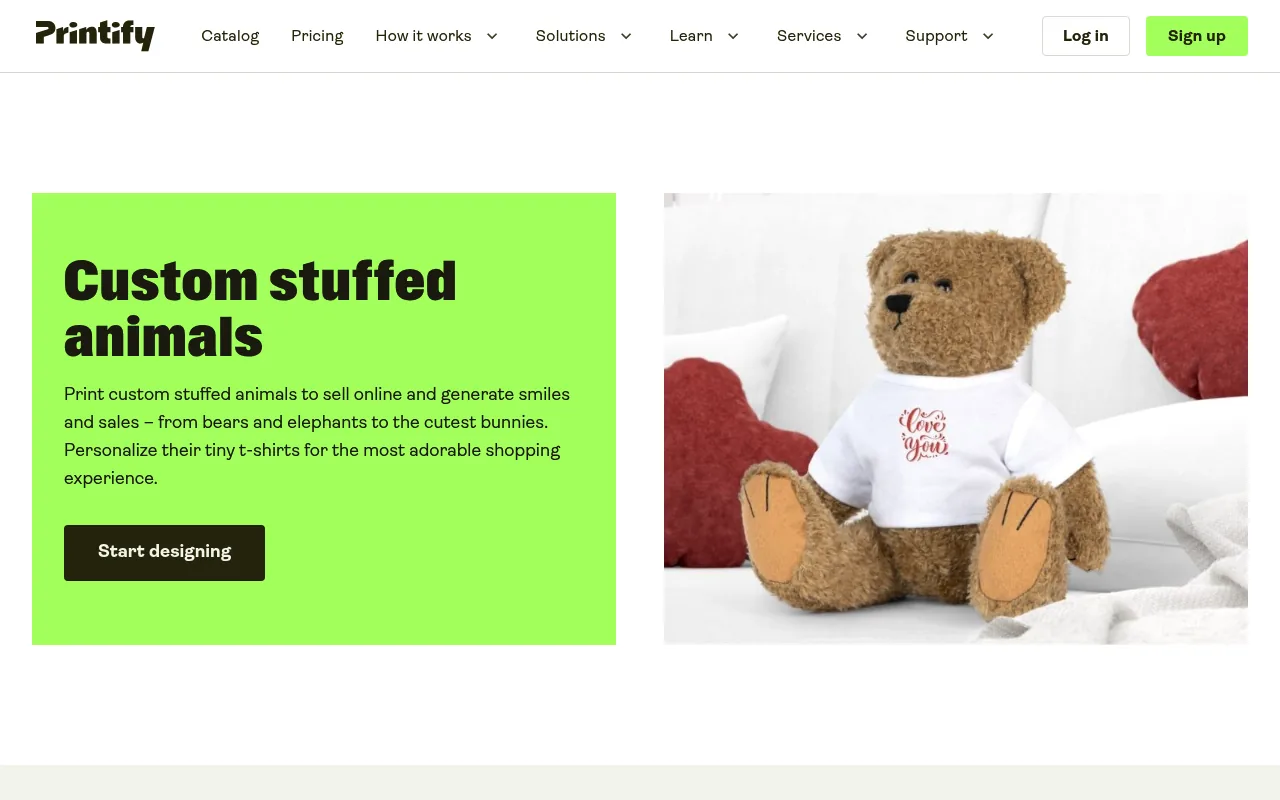 The catch is real: you're limited to whatever plush shapes the catalog already offers, so you can brand and decorate a bear or a bunny, but you can't invent a new character silhouette. It's also the lowest margin of the three paths, since you're paying per-unit production at retail-adjacent prices. This is the closest thing to the no-inventory model used across dropshipping generally, applied to soft toys specifically, and it's the same "prove it before you tool up" logic that makes print-on-demand the right starting point for a sticker business too.
Private label
Somewhere between "zero design control" and "your own mold," private label means picking a toy that a factory is already producing (a wooden puzzle, a set of building blocks, a basic plush shape) and adding your own branding, colors, packaging, and label. You're not inventing the toy, but you're not stuck with a stock character either. Minimum orders for private label toys typically start around 100 to 300 units, far below the 500 to 5,000+ a custom mold requires, and there's no tooling cost or multi-month mold lead time. This is the honest starting point for most first-time toy brands: real product, real margin, no six-figure risk.
Custom manufacturing
Your own original design, tooled into a steel injection mold that only makes your toy. This is where real toy brands eventually end up, and it's also where most first-timers lose money by starting too early. A decent first mold runs $3,000 to $15,000, production minimums are usually 500 to 5,000+ units, and the process from finished design to a finished pallet of toys typically takes four to six months, including mold-cutting, sampling, and lab testing. Cosmo Sourcing's guide to finding toy manufacturers is a good next read once you're at this stage, and note the same fairness point applies to overseas sourcing platforms as anywhere else: Alibaba connects you to manufacturers directly, but you're the one vetting the factory, the samples, and the paperwork.
Honest recommendation: start on private label if a stock toy shape can carry your concept. Move to custom tooling only after a private-label version of the idea has sold enough to justify the mold cost, unless the entire idea depends on a shape nobody else makes.
Whichever path you pick, order a physical sample before committing to a real production run. Photos and 3D renders lie about scale, weight, and how a fabric actually feels in a small hand. A $50 to $150 sample fee is the cheapest insurance in this entire business.
Step 4: Do the Boring Safety and Certification Work
This is the step that separates a real toy business from a liability lawsuit waiting to happen, and it's genuinely different from almost every other product category on this blog. Candles need a burn test. Stickers need a copyright check. Toys need both a legal safety certificate and a redesign if a piece is small enough for a toddler to choke on. Skip this step and you're not just risking a bad review, you're risking a federal recall.
In the United States: CPSIA, ASTM F963, and the small-parts cylinder
Every toy sold in the US is legally required to pass testing to ASTM F963, the mandatory federal toy safety standard, at a third-party lab accepted by the Consumer Product Safety Commission (CPSC). The standard covers mechanical hazards (sharp edges, points, small parts that can choke a child), flammability, and chemical limits on lead and phthalates in anything a child could put in their mouth.
For anything marketed to children under 3, there's a specific physical test: the small-parts cylinder, a tube 1.25 inches wide and 1 to 2.25 inches deep, built to approximate a toddler's throat. If any piece of your toy, including a piece that breaks off during normal use, fits entirely inside that cylinder in any orientation, it fails and cannot be sold for that age group without a redesign or a "not for children under 3" warning that most retailers and marketplaces won't accept anyway.
Once your toy passes testing, you issue a Children's Product Certificate (CPC), the document under the Consumer Product Safety Improvement Act (CPSIA) that legally declares your product complies. That certificate is tied to the exact production lot tested. Change a supplier, a material, or the design, and you need to retest and reissue it. The same CPC and testing logic applies to children's apparel, which we cover in our baby clothing brand guide. There's no grandfathering a new batch onto an old certificate.
Budget $500 to $2,000 per SKU for third-party lab testing, depending on how many hazard categories apply, and expect two to three weeks for results. Build that into your timeline before you promise a launch date.
In the EU and UK: the Toy Safety Directive, EN 71, and CE marking
The rules run on the same underlying idea, through a different system. Toys sold in the EU today are governed by the Toy Safety Directive (2009/48/EC), which requires a conformity assessment against the EN 71 family of standards (mechanical and physical safety, flammability, chemical migration), a CE mark affixed to the toy or its packaging, and a Declaration of Conformity kept on file for 10 years. Unlike the US system, there's no single mandatory third-party lab requirement for every toy category, but most manufacturers get third-party testing anyway because self-declaring a false conformity carries real liability.
Worth knowing if you're launching in 2026 specifically: the EU adopted a new Toy Safety Regulation, (EU) 2025/2509, that entered into force on 1 January 2026 and tightens chemical restrictions, adds cybersecurity requirements for connected toys, and introduces a Digital Product Passport (a QR code linking to compliance and safety data) that customs and consumers can check. The regulation doesn't fully apply until 1 August 2030, so the Toy Safety Directive and EN 71 are still what you certify against today, but if you're building a toy brand for the long run, it's worth designing your compliance file so it's easy to extend rather than starting from scratch in a few years.
In the UK, the news is simpler than most guides make it sound: as of 2026, the UK government has confirmed CE marking is accepted indefinitely for toys sold in Great Britain, so a UKCA mark is optional, not required, for this category. The one exception is Northern Ireland, where CE marking (not UKCA alone) is required under the Northern Ireland Protocol. If your toy already carries a valid CE mark, you can sell into the UK without a separate UKCA process, one piece of paperwork most toy guides don't mention you're free to skip.
Insurance
Product liability insurance for a small toy business runs roughly $1,200 to $4,000 a year, higher than the $500 to $1,500 typical of lower-risk product categories, because insurers price toys as a higher-liability category by default. Skipping this to save a few hundred dollars a year is the single worst trade in this entire guide: one choking-hazard claim can cost far more than a decade of premiums.
Step 5: Price So the Math Survives Testing, Shipping, and Fees
The classic mistake: "toys at Target cost $12, so I'll charge $10." That math works for a factory shipping a million units a year with testing costs spread across all of them. It does not work for you.
The honest rule for a small toy brand: price at 3.5x to 4x your all-in landed cost, higher than most physical products, because toy-specific costs (safety testing, insurance, and higher shipping due to bulkier packaging) eat more of the margin than they do in most categories.
Worked example for a private-label plush toy, landed cost included:
| Where the money goes | $ |
|---|---|
| Unit cost (private label, landed) | $6.00 |
| Amortized safety testing (per unit, across a 300-unit run) | $2.00 |
| Amortized insurance (per unit, across a year's volume) | $0.80 |
| Card processing (2.9% + $0.30) | $0.87 |
| Shipping to customer (avg, bulky item) | $6.50 |
| Breakage/returns reserve (~5%) | $1.20 |
| Marketing (~15% of revenue) | $3.60 |
| Retail price | $24.00 |
| What you keep | ~$3.03 (13%) |
That thin a margin is the honest number for a first small run. It gets better fast at volume: testing and insurance are largely fixed costs that get spread across more units, so a 1,000-unit run instead of 300 can push the same $24 toy from 13% net margin to well over 30%, which is exactly why Step 3's "prove it on private label first" advice matters. You want the volume discount on fixed costs before you're locked into a custom mold.
If the math doesn't survive the first run, don't launch yet. Raise the price, simplify the packaging, or find a cheaper (still compliant) material. Compliance costs in this category don't get cheaper if you sell at a loss and hope volume fixes it later.
Step 6: Set Up a Place People Can Actually Buy From
By now you've got a validated concept, a sourcing plan, and pricing that survives testing and shipping. Time to give people somewhere to actually buy.
Your realistic options in 2026, honestly ranked:
- Etsy has a large handmade-toy buyer base already searching for what you make, and zero setup cost beyond listing fees. The trade-off: a $0.20 listing fee, 6.5% transaction fee, and 3% + $0.25 payment processing add up to roughly 10% of every sale, and Etsy's own seller handbook walks through the same CPC and third-party testing requirements for children's items, so the certification work in Step 4 isn't optional even on a marketplace.
- Your Next Store (us, to be upfront) gets you a real branded storefront instead of a marketplace listing. Plans start at $30/month ($25/month billed yearly) with 0% platform transaction fees, an AI-powered builder that sets up product pages and checkout from a description of what you sell, and search, reviews, and email already built in. The advantage over a marketplace: a repeat buyer remembers your brand, not "that toy shop on Etsy."
- Shopify is the safe, well-trodden middle ground at $39/month, with an app for almost anything you'll eventually want. Those apps add up fast, and Shopify still takes a small extra fee on every sale if a customer pays with something other than Shop Pay.
- Amazon, specifically the toys category, has enormous built-in traffic, but it's also the strictest about upfront compliance documentation. Since September 2025, Amazon has required toy sellers to submit annual test reports through an approved third-party testing provider rather than self-uploading them, and a listing can be suspended without valid documentation on file. Plan for that paperwork before you list, not during a suspension appeal.
- A simple Stripe payment link plus Instagram DMs works if you only have a couple of SKUs and your audience already follows you. It's the $0 option, but it caps out fast and looks the least trustworthy to a parent buying a gift for someone else's kid.
Honest recommendation for most first-time toy founders: run Etsy and your own website at the same time from day one. Etsy brings you buyers who are already searching for handmade or small-batch toys; your own site builds the brand and the customer list you actually own, and it's the version of your business a wholesale buyer or a local boutique will take seriously. Route repeat buyers to your site over time and don't be afraid to drop the marketplace later.
0% extra fees on every sale. A real website for your toy brand, ready in minutes.
Step 7: Pick One Channel to Get Discovered
New toy brands almost always win on one channel first, then expand. Trying every channel at once, badly, is the most common way founders burn out before the first holiday season.
Your honest options:
- Parenting and collector communities, not general social media. A toy sells on trust from other parents (or other collectors) far more than a cold ad ever will. A single well-placed post in the right Facebook group or subreddit can outperform a week of paid ads.
- Instagram and TikTok unboxings. Toys are inherently visual, and the "reveal" moment is exactly the kind of content that performs. Works if you can post consistently for three to six months before judging results.
- Local markets, school fairs, and pop-up shops. A table at a craft fair or a local market puts your toy in a kid's hands, which is the single best way to see what actually gets picked up and played with, not just liked online.
- Sending free samples to parenting or collector creators. Pick 20 to 30 creators whose audience matches your Step 1 answer exactly, and send a free unit with a personal note. This regularly outperforms paid ads for a brand-new toy shop, and costs almost nothing per creator.
- Wholesale to local toy stores and boutiques. Once you can reliably produce 100+ units a week, a sample dropped off at 10 independent toy shops in your area typically converts 2 to 3 into a standing order. Standard wholesale is 50% off retail, so revisit Step 5's math at that price before you commit.
- Paid ads. Skip these until an organic channel is already converting. Toy ads targeting parents are expensive and heavily regulated on some platforms (children's advertising rules apply even when you're targeting the parent, not the child).
Pick one primary channel and one backup. Give both a full season, ideally including the holidays, before adding a third.
A Word on Seasonality
Toy sales are brutally seasonal. The second half of the year accounts for over 60 percent of annual toy sales, according to Circana's reporting through the Toy Association, with the holiday season carrying most of that. Plan around it:
- Your first serious inventory build should land by early fall, not November, since safety testing and shipping both take weeks you don't get back once the holiday rush starts.
- Retailers and marketplaces get stricter about compliance paperwork right before the holidays, when scrutiny (and recall risk) is highest. Have your CPC or Declaration of Conformity ready well before your first big push, not while orders are already coming in.
- The first quarter is genuinely slow for toys. Many small toy brands use January and February to develop the next product, refresh photos, and get ahead on next year's safety testing instead of trying to force sales in the dead months.
What It Actually Costs to Start a Toy Brand in 2026
Real-world numbers, based on cost breakdowns from Gembah, JIM, and the sourcing and testing figures cited throughout this guide:
| Your approach | Upfront cost | What you get |
|---|---|---|
| Print-on-demand plush | $0-200 | A few Etsy listings on a stock plush shape, zero inventory risk |
| Private label starter run | $1,500-4,000 | 100-300 units of a branded existing toy, safety testing, insurance, a real website |
| First custom-molded product | $8,000-30,000 | Your own original design, one steel mold, a 500-2,000 unit first run |
| Established toy brand | $50,000+ | Multiple SKUs, retail/wholesale distribution, a full compliance program |
Two honest notes on that table. First, the print-on-demand row is the only one where you genuinely cannot lose much, which is exactly why Step 2 tells you to validate there or with hand-made samples before spending on anything with a mold attached to it. Second, a first custom mold at $8,000-30,000 is not a decision to make on a hunch: that number assumes the design has already sold at private-label volume, and even then, budget 4 to 6 months before that mold produces a single sellable unit.
The toy brands still around in a few years aren't the ones with the cleverest character design. They're the ones that validated the idea before they spent on tooling, treated the certification paperwork as the price of admission instead of a suggestion, and priced with testing and insurance already subtracted from the math. A cute toy nobody asked for and a compliant toy nobody validated fail the exact same way: quietly, with your money already spent. Everything else in this guide is execution.
FAQ
How much does it cost to start a toy brand in 2026?
Anywhere from under $200 to $30,000+, depending on the sourcing path. Print-on-demand plush is nearly free to start since there's no inventory or mold cost, just listing fees. A private-label starter run, including safety testing and insurance, typically lands between $1,500 and $4,000. A first custom-molded product with your own original design runs $8,000 to $30,000 once you include the mold, sampling, and a real first production run.
Do I legally have to safety-test toys before selling them?
Yes, in the US. Every toy sold in the US must be tested to ASTM F963 at a CPSC-accepted third-party lab, and you must hold a Children's Product Certificate declaring that specific production lot compliant. In the EU, the Toy Safety Directive requires a conformity assessment against EN 71 and a CE mark before you can sell, and in the UK, CE marking is accepted indefinitely for toys in Great Britain, so a separate UKCA process isn't required. There's no jurisdiction covered in this guide where you can legally skip safety certification for a toy marketed to children.
Can I sell handmade toys on Etsy without formal certification?
Not safely, and not really legally either. Etsy's seller policies explicitly require sellers of children's items to comply with applicable safety laws, which in the US means CPSIA and ASTM F963 apply the same way they would on your own website. "Handmade" and "small batch" don't exempt a toy from the small-parts and chemical-safety rules. If your toy is aimed at children, budget for testing regardless of which platform you sell it on.
What's the cheapest way to start a toy business?
Print-on-demand plush. It has no minimum order, no mold cost, and lets you validate a design before committing real money, though you're limited to whatever stock plush shapes the catalog offers and you still owe the same safety testing on the finished product. Private label is the next step up: still no mold cost, but a wider range of toy types and a real (if modest) margin once you're producing 100+ units.
Is a toy business actually profitable?
Yes, but the margins on a small first run are thinner than most beginners expect, typically 10 to 15% net once testing, insurance, shipping, and marketing are subtracted, because toy-specific compliance costs get spread across a smaller batch. Margins improve significantly at volume, often reaching 25 to 35%+, since testing and insurance are largely fixed costs. The founders who lose money are usually the ones who priced against the sticker price of a mass-market toy instead of their own, much smaller, production run.
Do I need different certifications to sell in the US versus the EU or UK?
Yes. A CPC and ASTM F963 test report cover the US. They do not cover the EU, which requires its own conformity assessment against EN 71 and a CE mark. The UK, as of 2026, accepts a valid CE mark for Great Britain without requiring a separate UKCA process, though Northern Ireland still requires the CE mark specifically. If you plan to sell into more than one of these markets, budget for testing against each region's standard rather than assuming one certificate covers all three.