# How to Reduce Ecommerce Returns (and What They Cost You)
How to reduce ecommerce returns: what one return really costs, 10 fixes matched to return reasons, and the EU and UK rules you can't bend. Start here.
*Published 2026-11-27*
**A returned order doesn't just cancel a sale; it costs you roughly what the sale would have earned.** Shoppers send back an estimated [19.3% of everything bought online](https://nrf.com/media-center/press-releases/consumers-expected-to-return-nearly-850-billion-in-merchandise-in-2025), and most stores never calculate what each one costs. This guide shows you how to price a return, how to reduce ecommerce returns by fixing the reason behind each one, and which tactics the EU and UK simply don't allow.
Returns are not all bad. A generous policy sells more, and some returns are the price of selling online at all. The goal isn't zero returns. It's getting rid of the ones you caused: the size chart that lied, the photo that flattered, the box that crushed. Those are usually most of them.
If you need the legal side first (windows, refund deadlines, a template), start with our [ecommerce return policy guide](/blog/ecommerce-return-policy). This post is about the operations and the money.
## What Ecommerce Returns Really Cost You
The National Retail Federation and Happy Returns estimate that US consumers returned [$849.9 billion of merchandise in 2025](https://nrf.com/media-center/press-releases/consumers-expected-to-return-nearly-850-billion-in-merchandise-in-2025), 15.8% of all retail sales, with online sales returned more often than store sales. The same report found that 9% of all returns are fraudulent.
Industry totals don't tell you what your returns cost, though. Here is one return, priced line by line:
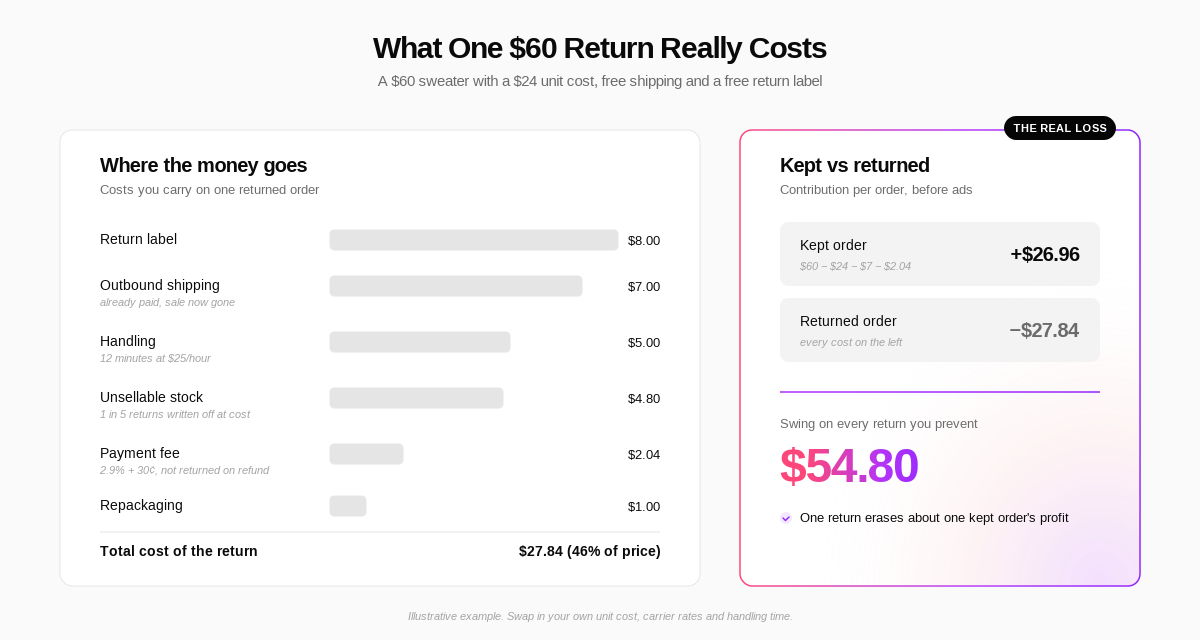
A few of those lines surprise people:
- **The payment fee doesn't come back.** [Stripe's refund docs](https://docs.stripe.com/refunds) state that the fees from the original payment aren't returned when you refund. Most processors work the same way.
- **Outbound shipping is sunk.** If you offered free shipping, you paid the carrier for a sale that no longer exists.
- **Not every return goes back on the shelf.** Worn, damaged, out-of-season or missing-tag items get discounted, sold to a liquidator or written off. The example assumes one in five; measure your own.
- **Handling is real labor.** Opening, inspecting, refolding, retagging and restocking takes minutes per item, plus the support email that came first.
The example lands at **$27.84 per return, or 46% of the item price**. A kept order earns $26.96 after product cost, shipping and fees, so the swing between a kept order and a returned one is about $55. **One return erases roughly the profit of one kept order.** Put your own numbers in, but expect the same shape: the returns you prevent are worth far more than the extra sales you chase.
## Measure Your Return Rate by Reason
You can't fix "returns". You can fix "too small on the slim-fit chinos". Start by measuring:
**Return rate = units returned ÷ units sold**, per product, per variant and per reason, over a fixed period. Use units rather than orders, so a five-item order with one return counts as a 20% rate, not 100%.
Then make every return carry a reason. Use a fixed list (free text is impossible to count), ask it when the return is requested, and check it again when the item arrives, because "defective" sometimes turns out to be "changed my mind". [YouGov's 2025 survey of US shoppers](https://yougov.com/en-us/articles/53346-free-fast-and-convenient-how-us-shoppers-want-retail-returns) gives a sense of how reasons split:
| Return reason (YouGov, US, 2025) | Share of returners | Usually caused by | Who fixes it |
|---|---|---|---|
| Didn't meet expectations (quality, color, size) | 44% | Photos, copy, color accuracy | Merchandising |
| Poor fit | 39% | Size chart, fit notes | Product and merchandising |
| Damaged or defective | 34% | Packaging, carrier, supplier quality | Operations and sourcing |
| Wrong item ordered or received | 23% (women) to 28% (men) | Picking errors, confusing variants | Warehouse and UX |
| Ordered several options to compare | 13% | Bracketing, low confidence in sizing | Product page and policy |
Respondents could pick several reasons, so the shares overlap. Your own split will differ by category: furniture is mostly damage, apparel mostly fit.
Two rules make this data useful. Look at reasons **per SKU**, because a store-wide 12% can hide one product at 40%. And set a threshold that triggers action, such as any variant returning more than twice the category average after 20 sales.
## How to Reduce Ecommerce Returns: 10 Fixes Matched to Reasons
### 1. Publish real measurements, not just S, M, L
Fit is the biggest controllable reason in apparel and footwear. A generic size chart copied from a supplier is worse than none, because it gives false confidence.
- **Measure the garment, not the body template.** Chest, length, waist, inseam and sleeve, per size, in inches and centimeters.
- **Add fit notes in plain words**: "runs small, size up if between sizes", "relaxed through the hip". Pull them from your return reasons and reviews.
- **Show the model's height and size** in every photo caption.
- **Compare to something they own**: "fits like a Levi's 501" works when it's true.
For large apparel and footwear catalogs, a fit tool can help. [True Fit](https://www.truefit.com/) uses purchase-and-return data from retailers to recommend a size. It claims up to 40% fewer fit-related returns when shoppers follow its guidance, which is a vendor figure measured on its own customers. Pricing is by demo, and it targets established retailers rather than a store with 30 SKUs.

### 2. Show the product exactly as it arrives
"Not as expected" is mostly a photography problem. Shoot in daylight-balanced light, show texture close up, show scale (in a hand, on a person, next to a common object), and never ship a color you couldn't match in a photo. Short video helps with drape and movement. Our guide to [DIY product photography](/blog/ecommerce-product-photography) covers the setup for a few hundred dollars.
### 3. Write descriptions that set limits, not just hopes
Copy that only sells creates returns. State dimensions, weight, materials, care, what's in the box and what isn't. If the "large" tote won't fit a 16-inch laptop, say so. A product that disappoints one in ten buyers because a detail was hidden costs more than the sale it won. See [how to write product descriptions that sell](/blog/how-to-write-product-descriptions) for the structure.
### 4. Let reviews answer fit and quality questions
Reviews from verified buyers are the most trusted sizing advice you have. Ask reviewers about fit specifically ("How did it fit?" with runs small, true to size, runs large), show that summary near the size picker, and reply to reviews that reveal a problem. A cluster of "runs small" reviews is a size chart to fix this week.
### 5. Answer the question before the order, not after
Every "will this fit?" or "is this compatible with…?" that goes unanswered becomes a bracketed order or a guess. Put a short FAQ on product pages, answer pre-sale questions within hours, and consider an assistant that answers from your sizing notes and policies. We covered when [AI shopping assistants](/blog/ai-shopping-assistant) actually pay off.
### 6. Pack for the worst carrier day
Damage is the reason you control most completely. Test-ship your fragile products to yourself, use right-sized boxes with void fill, double-box glass and ceramics, and keep photos of how each SKU should be packed at the packing station. Track damage returns by carrier and by warehouse; a spike usually points to one of them.
### 7. Ship the right item
Wrong-item returns are pure waste: two shipments, an apology and a customer who now doubts you. Scan items at packing rather than picking by eye, give similar variants distinct SKUs and bin locations, and make variant names obvious on the product page ("Navy" and "Midnight" side by side invites mistakes).
### 8. Ship on time and say when it will arrive
An item that arrives after the event it was bought for comes back. Show a realistic delivery date at checkout, not a hopeful one, and send tracking proactively. If you sell gifts, publish holiday cut-off dates.
### 9. Turn refunds into exchanges and store credit
Some returns are unavoidable, but the refund isn't. Offer an exchange first in the return flow, ship the replacement as soon as the return is scanned, and consider a bonus for store credit (for example, +10%). The NRF found that [76% of consumers](https://nrf.com/media-center/press-releases/consumers-expected-to-return-nearly-850-billion-in-merchandise-in-2025) are more likely to choose a return option that offers an instant refund or exchange. In the EU and UK, store credit can only be an option, never a replacement for a cash refund the law requires.
### 10. Handle bracketing and serial returners with data, not suspicion
Bracketing (ordering two sizes to keep one) is rational when the size chart can't be trusted, so fixes 1 to 4 reduce it more than any rule. For the small group that returns most of what they buy, look at return rate per customer, and reach out or adjust terms for the outliers rather than punishing everyone. Fraud (empty boxes, swapped items, wardrobing) is a different problem with different tools, covered in our [ecommerce fraud prevention](/blog/ecommerce-fraud-prevention) guide.
**Sometimes the cheapest return is no return.** If return shipping plus handling costs more than the item is worth after it comes back, refund and let the customer keep it (a "returnless refund"). Set a value threshold, apply it only to the reason codes where it makes sense, such as damage with a photo, and watch for abuse.
## Don't Cut Returns by Making Them Painful
The tempting shortcut is a stricter policy: shorter windows, fees, hidden instructions. It reduces returns and sales together.
A [meta-analysis of 21 studies on return policy leniency](https://econpapers.repec.org/RePEc:eee:jouret:v:92:y:2016:i:2:p:226-235) found that leniency increases purchases more than it increases returns, and that longer return windows in particular were associated with lower return rates. In [YouGov's survey](https://yougov.com/en-us/articles/53346-free-fast-and-convenient-how-us-shoppers-want-retail-returns), 75% of US shoppers said free returns influence their decision to buy, and the [NRF](https://nrf.com/media-center/press-releases/consumers-expected-to-return-nearly-850-billion-in-merchandise-in-2025) found that 71% are less likely to shop again after a poor returns experience.
That doesn't mean free returns on everything. Reasonable middle grounds:
- **Free exchanges, paid refunds.** Keeps the sale, covers the label.
- **A flat return fee deducted from the refund**, disclosed before purchase. The NRF reports retailers adding fees because of rising processing and carrier costs.
- **Free returns for members or above an order value.**
- **A longer window with clear conditions** (unworn, tags on).
Making returns easy and cheap to process (a self-service portal, drop-off without a box) lowers your cost per return without hurting conversion. That's the second lever after prevention.
## EU and UK Rules That Limit How You Reduce Returns
In the US, there's no federal right to return non-defective goods, so most of the tactics above are business choices, subject to state disclosure rules and card network dispute rules. In the EU and UK, some shortcuts are off the table.

| Tactic | United States | European Union | United Kingdom |
|---|---|---|---|
| Return window shorter than 14 days | Allowed if disclosed | Not for withdrawal: consumers get [14 days from delivery](https://europa.eu/youreurope/citizens/consumers/shopping/returns/index_en.htm) | Not for cancellation: 14 days under the [Consumer Contracts Regulations](https://www.legislation.gov.uk/uksi/2013/3134/contents) |
| Customer pays return shipping | Allowed if disclosed | Allowed only if you told them before purchase | Allowed only if you told them before purchase |
| Restocking fee | Allowed if disclosed | Not on a withdrawal; you may deduct only for loss in value from excess handling | Same as the EU |
| Refuse opened items | Allowed if disclosed | Generally not; customers may inspect goods as in a shop (exceptions such as sealed hygiene items) | Same as the EU |
| Store credit instead of a refund | Allowed if disclosed | Only as an option; withdrawal requires a refund to the original payment method | Same as the EU |
| Refund the outbound delivery charge | Your choice | Required on withdrawal, up to the cheapest standard delivery | Same as the EU |
Two more details matter for cost. In the EU and UK you may withhold the refund until the goods come back or the customer shows proof of sending, which protects you from refunding items that never return. And since [Directive (EU) 2023/2673](https://eur-lex.europa.eu/eli/dir/2023/2673/oj) applies from 19 June 2026, EU online sellers must offer an electronic withdrawal function, a clearly labeled way to start a withdrawal online. Our [return policy guide](/blog/ecommerce-return-policy) covers these rules in full.
What you can always do, everywhere: prevent the return. Better sizing, photos and packaging are not restricted by any consumer law.
**Always check the current rules where you sell.** This guide summarizes US, EU and UK consumer return rules as of November 2026. Rules change and vary by country and US state, so confirm the details with a consumer-law specialist or your local consumer authority before you change your policy or fees. This is general information, not legal advice.
## Returns Tools Worth Knowing
You don't need software to start: a spreadsheet of returns by SKU and reason gets you most of the insight. Once volume grows, these tools cover the parts that are hard to build. Prices were checked on each vendor's site in November 2026.
| Tool | What it does | Platforms | Starting price |
|---|---|---|---|
| [Loop](https://www.loopreturns.com/) | Returns portal focused on exchanges, store credit and fraud checks | Built for Shopify; other platforms through a custom implementation | [From $340/month](https://www.loopreturns.com/pricing/) |
| [Happy Returns](https://www.happyreturns.com/) | Box-free, label-free drop-off at Return Bar locations in the US | Portal plus integrations; demo-based | Quote |
| [Sendcloud](https://www.sendcloud.com/returns/) | Shipping and branded returns portal, strong in Europe | 100+ shop systems, plus an API | [Growth plan €87/month](https://www.sendcloud.com/pricing/) (returns portal) |
| [True Fit](https://www.truefit.com/) | Size and fit recommendations from purchase-and-return data | Apparel and footwear retailers | Quote |
### Loop

[Loop](https://www.loopreturns.com/) is built around keeping revenue: instant exchanges, bonus credit and a "Shop Now" flow that turns a refund into a new order. Its homepage says it was originally built for Shopify and is now available on all platforms, while its FAQ notes that non-Shopify stores go through a custom implementation with longer timelines. At $340 a month and up, it suits brands with steady return volume.
### Happy Returns

[Happy Returns](https://www.happyreturns.com/), a UPS company, doesn't prevent returns; it makes them cheaper to process. Shoppers drop items at a Return Bar without a box or label, the items are consolidated, and you receive them in bulk. The site cites about 10,000 Return Bar locations. US only.
### Sendcloud

[Sendcloud](https://www.sendcloud.com/returns/) is a shipping platform with a branded returns portal, so customers pick a return method and you collect reason codes in one place. It integrates with over 100 shop systems and has an API for custom stores. The returns portal starts on the Growth plan, and it's strongest for sellers shipping from Europe.
## A 30-Day Plan to Reduce Ecommerce Returns
1. **Week 1: measure.** Export 6 to 12 months of returns. Calculate return rate per SKU and variant, and tag every return with a reason from a fixed list.
2. **Week 2: price a return.** Fill in the cost breakdown above with your own label, handling and write-off numbers. Multiply by your return volume. That's your budget for fixes.
3. **Week 3: fix the top five.** Take the five variants with the most returns and fix the cause: re-measure the size chart, reshoot the photo, rewrite the description, change the packaging.
4. **Week 4: change the flow.** Offer exchanges first, decide a returnless-refund threshold, and make the returns page clear and easy to find.
Then repeat monthly. Most stores find that a handful of products cause a large share of returns.
## Where Your Next Store Fits
[Your Next Store](https://yournextstore.com/) isn't a returns platform. It has no self-service return portal, return labels or exchange flow built in, so if you need those, pair it with a dedicated tool. What it does give you is the data and the product-page building blocks that prevent returns in the first place.

- **Refunds with reasons.** You [issue full or partial refunds](/help/orders/refunds-and-returns) from the order, pick the items that came back, record a reason and a private note, and choose whether the items go back into stock. The customer is emailed automatically.
- **Returns in your numbers.** [Analytics](/help/orders/analytics) shows refunds as a share of revenue and charts revenue net of refunds, so a bad week of returns is visible, not hidden.
- **Measurements on every variant.** [Custom fields](/help/products/custom-fields) hold per-variant details such as garment measurements or fit notes, and you choose which ones shoppers see.
- **Verified reviews.** [Product reviews](/help/marketing/product-reviews) come only from customers who bought and received the product, so fit feedback comes from real buyers.
- **Pre-sale answers.** [Store Chat](/help/marketing/store-chat) answers shopper questions from your catalog and the sizing and returns notes you write. It's a paid module, included on the Pro plan.
- **EU withdrawal.** The [Withdrawal Button module](/help/account/compliance) adds a withdrawal action to eligible orders, so EU customers can exercise their right without emailing you.
Plans start at $30 a month with 0% platform transaction fees; see [pricing](https://yournextstore.com/pricing). The storefront is also [open source on GitHub](https://github.com/yournextstore/yournextstore) if you'd rather build your size guide component yourself.
## FAQ
### What is a good return rate for an online store?
It depends on the category. The NRF estimates that [19.3% of online sales](https://nrf.com/media-center/press-releases/consumers-expected-to-return-nearly-850-billion-in-merchandise-in-2025) were returned in 2025 across US retail. Apparel and footwear run well above that, while consumables and beauty run far below. Compare yourself with your own history per product, not with a store-wide average.
### How much does it cost to process an ecommerce return?
Add the return label, the outbound shipping you already paid, handling time, packaging, the payment fee you don't get back and the share of returns you can't resell. In our $60 example, that came to $27.84, or 46% of the item price. Small, cheap items often cost more to return than they're worth, which is where returnless refunds make sense.
### Can I charge customers for returns in the EU?
You can make customers pay the cost of sending the item back, but only if you told them before they bought. You can't charge a restocking fee on a statutory withdrawal; you can only deduct for any loss in value caused by handling beyond what's needed to check the goods. The UK works the same way.
## The Bottom Line
Every return you prevent saves the profit of an order you've already won, so fix the size chart before you buy the next ad.
## Related Blog Posts
- [Ecommerce Return Policy: EU and US Rules (Plus a Template)](/blog/ecommerce-return-policy)
- [Ecommerce Product Photography on a Budget (DIY Guide)](/blog/ecommerce-product-photography)
- [How to Write Product Descriptions That Sell (and Rank)](/blog/how-to-write-product-descriptions)
- [Ecommerce KPIs: The Metrics That Actually Matter](/blog/ecommerce-kpis)