# Next.js vs Nuxt for Ecommerce: Which Should You Pick?
Next.js vs Nuxt for ecommerce compared on ecosystem, performance, hiring, and commerce tooling. See which framework fits your team and store.
*Published 2026-10-02*
**For ecommerce, the Next.js vs Nuxt decision is mostly a decision about React vs Vue, and your team's skills should settle it before any benchmark does.** Both frameworks can render a fast, SEO-friendly storefront. Both deploy almost anywhere. The difference that shows up in month six is how many commerce starters, SDKs, and engineers you can find for each. This guide compares [Next.js](https://nextjs.org/) and [Nuxt](https://nuxt.com/) for online stores and tells you when each one wins.
**Bias disclosure:** [Your Next Store](https://yournextstore.com/) is built on Next.js, so we are not neutral. We still use Vue-based tooling where it makes sense, and the verdict below recommends Nuxt for a specific kind of team.
## Next.js vs Nuxt for Ecommerce: The Short Answer
| | **Next.js** | **Nuxt** |
|---|---|---|
| UI library | React 19 | Vue 3 |
| Server layer | Route handlers, Server Actions, React Server Components | Nitro server engine, server routes |
| Rendering | SSR, SSG, ISR, Partial Prerendering, streaming | SSR, SSG, hybrid per-route rules, ISR-style caching |
| Learning curve | Steeper (server components, caching) | Gentler (conventions, auto-imports) |
| Commerce ecosystem | Largest: official Shopify, Stripe and headless kits | Smaller: Shopify and Medusa modules, Alokai |
| Hiring pool | Larger | Smaller |
| Best for | Teams that know React, or want the widest commerce tooling | Teams already on Vue who value simple conventions |
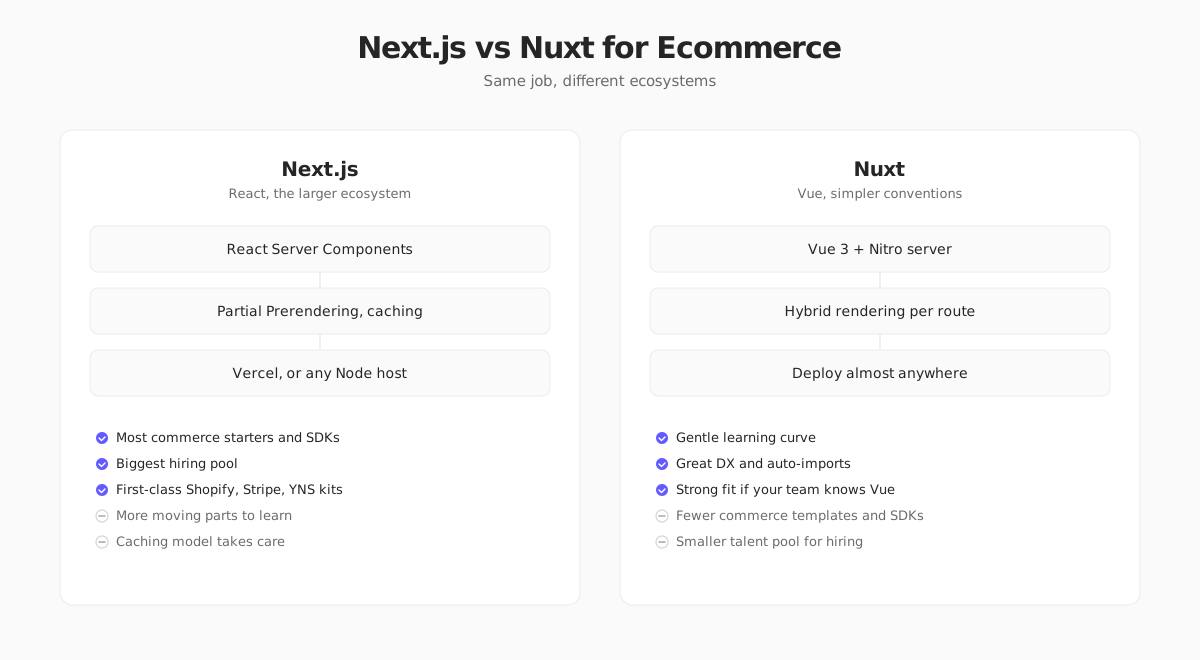
**Rule of thumb:** if your team writes React, use Next.js. If your team writes Vue, use Nuxt. If nobody has a preference, pick Next.js for the larger commerce ecosystem.
## What Ecommerce Needs From a Framework
A storefront is not a blog. Four things decide whether a framework is a good fit:
1. **Fast first load on mobile.** Product and category pages need server rendering and small client bundles, since [site speed affects conversion](/blog/ecommerce-website-speed-optimization).
2. **Dynamic and static content on the same page.** A product page is mostly static (title, images, description) with small dynamic parts (price, stock, cart, personalization).
3. **SEO fundamentals.** Metadata, structured data, sitemaps, canonical URLs, and crawlable HTML. See our [ecommerce SEO guide](/blog/ecommerce-seo).
4. **Integrations.** Payments, search, a CMS, analytics, and a commerce backend. The less glue you write, the faster you ship.
## Next.js for Ecommerce

Next.js is the React framework from Vercel. Its App Router is built around React Server Components, so most of a product page renders on the server and ships little JavaScript.
**Strengths for stores:**
- **Partial Prerendering (PPR).** A static shell for the product page streams instantly while dynamic parts such as price, stock, or cart count fill in. We explain how it works in [Partial Prerendering in Next.js](/blog/partial-prerendering-in-nextjs), and it is a big part of [why Your Next Store is so fast](/blog/how-is-your-next-store-so-fast).
- **Server Actions.** Add to cart, apply discount, and checkout flows can call server code without a hand-written API layer. With Zod they can be [type-safe end to end](/blog/typesafe-server-actions-zod-nextjs).
- **Ecommerce tooling.** Most commerce vendors ship React or Next.js examples first. See the [best Next.js ecommerce templates](/blog/best-nextjs-ecommerce-templates).
- **Hiring.** React developers are the largest pool in frontend, which matters when you need to staff a store.
**Weaknesses:**
- **A real learning curve.** Server vs client components, and the caching model, trip up newcomers.
- **Rapid change.** The framework moves quickly, so pin versions and read release notes.
- **Easy to over-build.** The flexibility that lets you build anything also lets you build a complicated checkout nobody needed.
## Nuxt for Ecommerce

Nuxt is the full-stack framework for Vue. Its pitch is convention over configuration: file-based routing, auto-imported components and composables, and the Nitro server engine, which compiles to many deployment targets (Node, edge runtimes, serverless, static). The project has more than 60,000 GitHub stars and is on version 4 as of October 2026.
**Strengths for stores:**
- **Productive from day one.** Auto-imports and a small set of conventions mean less boilerplate. Developers new to the framework are usually productive quickly.
- **Per-route rendering rules.** You can mark category pages as cached, product pages as server-rendered, and marketing pages as static, all in config.
- **Portable deployment.** Nitro makes it easy to move between hosts without rewriting the app.
- **Vue's reactivity model.** Many developers find Vue's state handling more predictable than React's, which is pleasant for cart and filter UIs.
**Weaknesses:**
- **A smaller commerce ecosystem.** There are fewer starters, SDKs, and agency case studies. The main enterprise option is [Alokai](https://alokai.com/) (formerly Vue Storefront), a frontend platform that supports both Nuxt and Next.js.
- **A smaller hiring pool.** Vue developers are easier to find than they used to be, but still fewer than React developers in most markets.
- **Less first-party vendor support.** Many commerce platforms publish Next.js examples and treat Nuxt as a community project.

## Performance: Closer Than the Internet Says
Both frameworks server-render HTML, both split code per route, and both can be cached at the edge. For a typical store the framework is rarely your bottleneck. What slows stores down is:
- Oversized images (use responsive formats and lazy loading)
- Third-party scripts for analytics, chat, and reviews
- Uncached data fetching from your commerce backend
Next.js has an edge in one area: Partial Prerendering and React Server Components let you keep the client bundle small while still showing dynamic data. Nuxt can match the outcome with route rules and caching, but you assemble it yourself. Measure Core Web Vitals on your real pages, not on a demo.
## Commerce Integrations
| Need | Next.js | Nuxt |
|---|---|---|
| Shopify headless | [Hydrogen](https://hydrogen.shopify.dev/) is React-based; many Next.js starters | Community modules and Alokai connectors |
| Stripe | Official guides and examples for Next.js | Works fine, fewer official examples |
| Medusa and Saleor | Official Next.js storefront starters | Community starters |
| Commerce Kit / YNS | Open-source Next.js storefront | Use the REST API directly |
| CMS | First-class integrations with most headless CMSs | Strong, especially Nuxt Content and Storyblok |
If you are choosing a headless stack from scratch, our [best tech stack for ecommerce](/blog/best-tech-stack-for-ecommerce) and [best headless commerce platforms](/blog/best-headless-commerce-platforms) cover the backend side.
## What Nobody Tells You
- **The framework is the cheap decision.** Your commerce backend, checkout, and search choices cost far more to change later.
- **Next.js defaults can surprise you.** Caching behavior in the App Router is powerful, but you have to understand it, or a product price can be cached longer than you intended.
- **Vue-based commerce means more custom code.** With a smaller ecosystem you will write more integration glue yourself, which is fine if your team enjoys it and costly if it does not.
- **Hiring beats elegance.** A "better" framework your team cannot staff is worse than a "good" one they can.
## Which Should You Pick?
**Pick Next.js if:**
- Your team already writes React.
- You want the widest range of starters, SDKs, and vendor examples.
- You plan to hire, or work with agencies, who mostly know React.
- You want Partial Prerendering for fast product pages with live data.
**Pick Nuxt if:**
- Your team already writes Vue and does not want to switch.
- You prefer strong conventions over assembling your own architecture.
- You are building a content-heavy store where Nuxt's content and hybrid rendering tooling shines.
- You are comfortable writing more integration code yourself.
**Skip both if** you do not want to build a storefront at all. [Your Next Store](https://yournextstore.com/) gives you a managed commerce backend with 0% platform transaction fees and an AI store builder from $30/mo, and the [open-source Next.js storefront](https://github.com/yournextstore/yournextstore) is yours to customize. It is storefront-only (it needs the managed backend), so it suits Next.js teams. A Nuxt team would integrate through the REST API instead.

## FAQ
### Is Nuxt good for ecommerce?
Yes. Nuxt handles server rendering, hybrid caching, and SEO well, and teams ship real stores with it. The trade-off is a smaller commerce ecosystem than Next.js, so expect to write more integration code.
### Is Next.js faster than Nuxt?
Not by a margin that matters for most stores. Both server-render and split code per route. Real-world speed depends on images, third-party scripts, and backend caching more than on the framework.
### Can I use Nuxt with Shopify?
Yes. You can call Shopify's Storefront API from Nuxt, use community modules, or use a platform like Alokai, which supports Shopify and other backends. Shopify's own headless framework, Hydrogen, is React-based.
## The Bottom Line
Pick the framework your team can ship and hire for. For most ecommerce teams in 2026 that means Next.js, and for Vue teams it means Nuxt, without apology.
## Related Blog Posts
- [Next.js Ecommerce: How to Build a Store in 2026](/blog/how-to-build-ecommerce-website-nextjs)
- [Best Next.js Ecommerce Templates: 9 Free Starters for 2026](/blog/best-nextjs-ecommerce-templates)
- [Best Tech Stack for Ecommerce in 2026 (By Store Type)](/blog/best-tech-stack-for-ecommerce)
- [Next.js vs Shopify: An Honest Take from a Developer](/blog/nextjs-vs-shopify)
- [Partial Pre-Rendering in Next.js 15](/blog/partial-prerendering-in-nextjs)