# International SEO for Ecommerce: Hreflang Done Right

International SEO for ecommerce: pick a URL structure, set up hreflang and x-default, and localize product pages so each market finds the right store.
*Published 2026-11-24*

<div className="lead">
**Most international stores don't have a ranking problem. They have a "Google shows the wrong country" problem.** A shopper in Munich searches in German and lands on your US page in dollars, or your UK and US product pages compete with each other until neither ranks. International SEO for ecommerce fixes that with three decisions: one URL per market, hreflang tags that tie those URLs together, and pages that are genuinely local rather than auto-translated copies. This guide covers all three, with the real hreflang output from this very site and the mistakes that quietly break it.
</div>

## What International SEO for Ecommerce Actually Covers

International SEO is the work of getting the right version of your store in front of the right market in search. It is two overlapping problems:

- **Multilingual SEO**: the same store in several languages (English, German, French). Search engines need a crawlable, indexable page per language.
- **Multi-regional SEO**: the same language for several countries (US, UK, Australia). The words barely change, but prices, currency, shipping and stock do.

Most stores that sell abroad have both. A German page serves Germany and Austria; an English page might need a US and a UK version because one shows `$` and sales tax at checkout, the other `£` with VAT included.

Why bother? [CSA Research surveyed 8,709 consumers in 29 countries](https://csa-research.com/blogs-events/csa-in-the-media/press-releases/consumers-prefer-their-own-language) and found that 76% prefer to buy products with information in their own language, and 40% will not buy from websites in other languages at all. If the German version of your store exists but Google keeps sending Germans to the English one, you have paid for a translation and still lost the sale.

Before you touch a tag, decide which markets you are actually serving. One properly localized market beats ten half-translated ones, a point we make at length in our guide on [how to sell internationally](/blog/how-to-sell-internationally).

## Step 1: Choose an International URL Structure

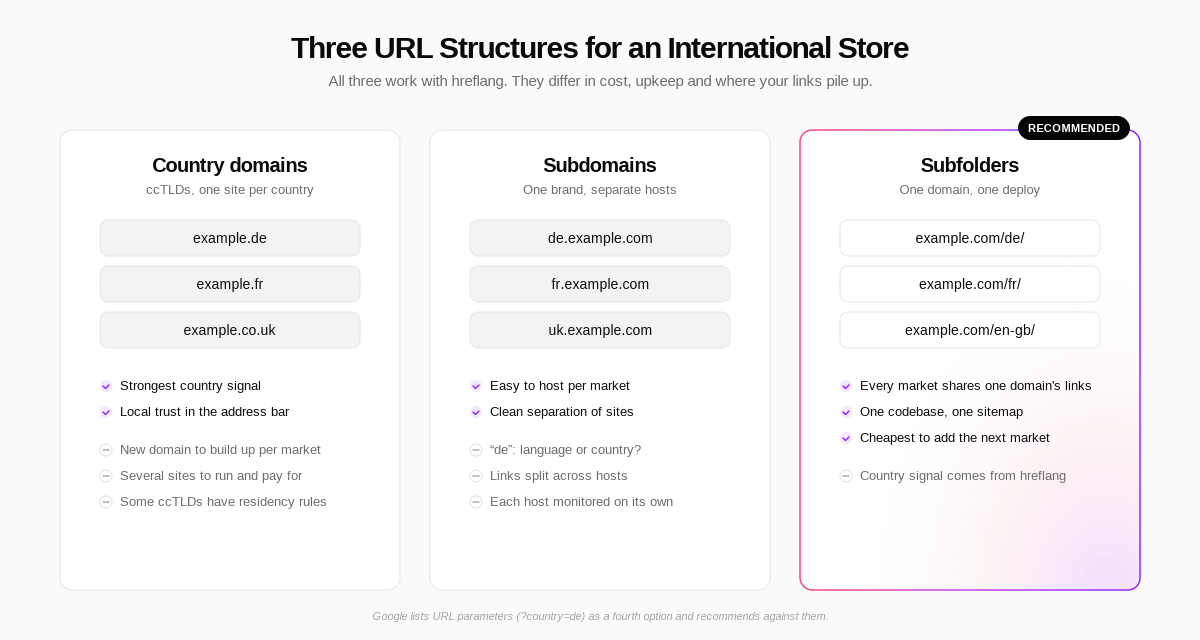
Every market needs its own URL. If your store switches language with a cookie or a JavaScript toggle on the same URL, search engines see one page and index one version. Google lists [four ways to give each market an address](https://developers.google.com/search/docs/specialty/international/managing-multi-regional-sites): country domains, subdomains, subfolders and URL parameters.
![Three URL structures for an international store: country domains, subdomains and subfolders, with subfolders recommended](/_blogposts/international-seo-ecommerce/international-url-structures.svg)

| Structure | Example | Best for | Main cost |
| --- | --- | --- | --- |
| **Subfolders** | `example.com/de/` | Most stores, from 2 to 20+ markets | Country signal relies on hreflang and content |
| **Country domains (ccTLDs)** | `example.de` | Brands with a local team and budget per country | A new domain to build authority for, per market |
| **Subdomains** | `de.example.com` | Markets that need separate hosting or a separate team | Links and monitoring split across hosts |
| **URL parameters** | `example.com?country=de` | Nothing | Google recommends against them |

**Our recommendation for most stores is subfolders.** Every link anyone earns to any market strengthens the whole domain, you run one codebase and one sitemap, and adding a market is a config change rather than a new site. Shopify reaches the same conclusion: its [international SEO documentation](https://help.shopify.com/en/manual/markets/seo) recommends subfolders for most stores.

Country domains still win in specific cases. In Germany or Poland, a `.de` or `.pl` address can reassure shoppers who prefer local sellers, and if you have a separate legal entity, warehouse and support team in a country, a separate site can mirror that. Just budget for it: each ccTLD starts with zero links.

### Language-only or language-and-country folders?

Pick the folder by what actually changes:

- **Language only** (`/de/`, `/fr/`) when one German page serves Germany, Austria and Switzerland with the same prices and shipping.
- **Language and country** (`/en-gb/`, `/de-ch/`) when the same language needs different prices, currency, VAT display or stock. Switzerland is the classic case: German, French and Italian speakers, Swiss francs, and shipping outside the EU customs union.

Don't create `/en-au/`, `/en-ca/` and `/en-ie/` on day one because the menu looks complete. Each regional version is a page you have to keep different enough to justify, which brings us to duplicate content in Step 4.

## Step 2: Set Up Hreflang Tags

Hreflang is how you tell search engines that a set of URLs are versions of the same page for different languages or regions. It doesn't make a page rank. It makes Google swap in the right version once a page in that cluster ranks.

![Google Search Central documentation: Tell Google about localized versions of your page](/_blogposts/international-seo-ecommerce/google-search-central-hreflang-docs.webp)

Google's [hreflang documentation](https://developers.google.com/search/docs/specialty/international/localized-versions) is short and strict. The rules that matter for a store:

- **Three equivalent methods.** `<link rel="alternate" hreflang="…">` tags in the `<head>`, a `Link` HTTP header, or `<xhtml:link>` entries in your XML sitemap. Google says using more than one gives no extra benefit, so pick the one your stack makes easiest to keep correct.
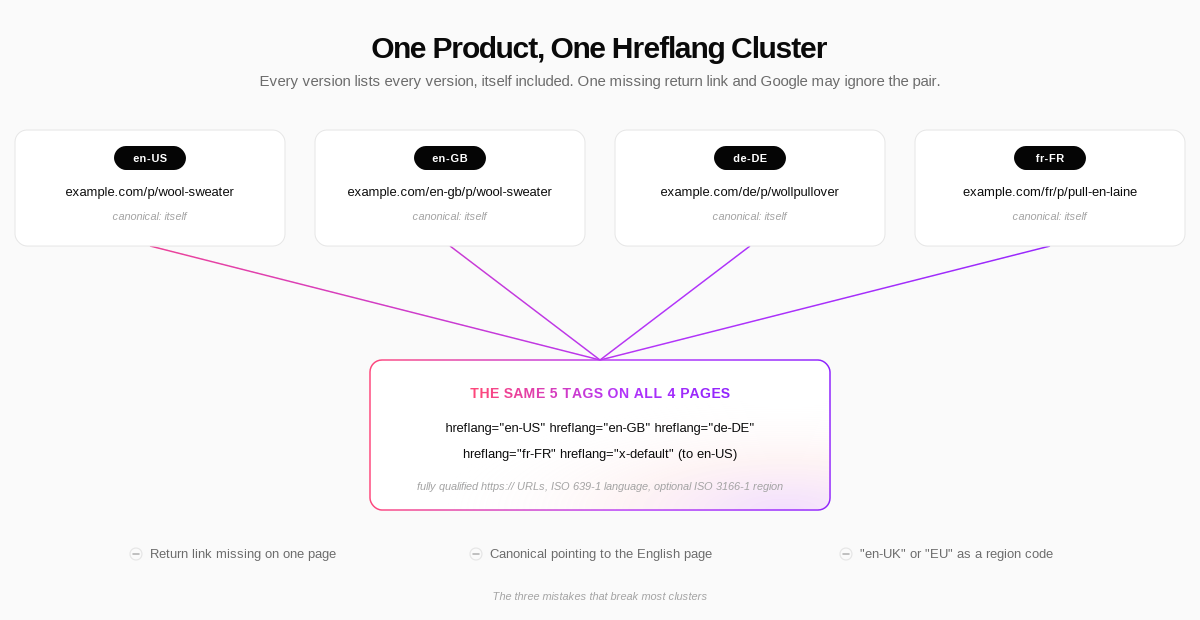
- **Every version lists every version, itself included.** If the German page points to the French page but the French page doesn't point back, Google may ignore the pair.
- **Fully qualified URLs.** `https://example.com/de/p/wollpullover`, not `/de/p/wollpullover`.
- **Valid codes.** An ISO 639-1 language code (`de`, `fr`), optionally followed by an ISO 3166-1 Alpha 2 region (`de-AT`, `en-GB`). A region on its own (`hreflang="gb"`) is invalid, and so are made-up regions like `EU` or `UK`. The UK is `GB`.
- **`x-default` for everyone else.** It names the page for shoppers whose language matches none of your versions: usually your main English page or a country picker.
![One product, one hreflang cluster: four localized URLs that all carry the same five hreflang tags](/_blogposts/international-seo-ecommerce/hreflang-cluster.svg)

### What hreflang looks like on a real page

Here is the hreflang output of the Polish version of one of our own posts, fetched from production today:

```html
<link rel="alternate" hrefLang="en" href="https://yournextstore.com/blog/how-to-start-an-online-store"/>
<link rel="alternate" hrefLang="pl" href="https://yournextstore.com/pl/blog/jak-zalozyc-sklep-internetowy"/>
<link rel="alternate" hrefLang="x-default" href="https://yournextstore.com/blog/how-to-start-an-online-store"/>
```

Three details worth copying. The Polish slug is Polish (`jak-zalozyc-sklep-internetowy`, "how to start an online store"), because Polish shoppers search in Polish. The English page carries exactly the same three tags, so every return link exists. And `x-default` points to the English source.

### Generating hreflang in Next.js

In the Next.js App Router you return the cluster from `generateMetadata` under `alternates.languages`, and Next.js resolves relative paths against `metadataBase` into the fully qualified URLs Google wants. This is the helper our blog uses, unchanged:

```ts
/**
 * hreflang alternates for a page's language versions, each path prefixed with `base` (empty for page
 * metadata, the site URL for the sitemap). None when the page exists in one language only.
 */
export function blogHreflang(versions: BlogVersions, base = ""): Record<string, string> | undefined {
	const languages = BLOG_LOCALES.flatMap((locale) => {
		const path = versions[locale];
		return path ? [[locale, `${base}${path}`] as const] : [];
	});
	const source = versions[BLOG_SOURCE_LOCALE];
	return languages.length > 1 && source
		? { ...Object.fromEntries(languages), "x-default": `${base}${source}` }
		: undefined;
}
```

The important line is the last one: **a page that exists in one language gets no hreflang at all.** That sounds obvious, but a common hreflang bug on stores is the opposite: a framework or plugin that prints a tag for every enabled language on every page, whether that page is translated or not. On our site, pages that exist only in English 301 from `/pl/...` to the English URL, so the middleware strips the hreflang header from those routes. Otherwise we would be telling Google that `/pl/some-page` is a Polish page when it is a redirect.

The same function feeds the sitemap (the `base` argument adds the domain), so the HTML tags and the sitemap can never disagree.

### Hreflang on hosted platforms

If you are on a hosted platform, check what it already does before adding a plugin. Shopify Markets, for example, generates hreflang tags automatically for each market that has its own domain, subdomain or subfolder, and its documentation warns that turning them off hurts SEO unless you replace them.

![Shopify help center: International SEO for markets, covering URL structure, hreflang, canonical URLs and sitemaps](/_blogposts/international-seo-ecommerce/shopify-markets-international-seo.webp)

Whatever the platform, the rule is the same: one source of hreflang, not a theme setting plus an SEO app plus a sitemap plugin all emitting their own slightly different clusters.

## Step 3: Get Canonicals and Redirects Right

Hreflang and canonical tags have to agree, and this is where most international setups break.

**Each localized page canonicalizes to itself.** The German product page's canonical is the German product page. If it points to the English page, you are telling Google "the English page is the real one, index that," and the hreflang cluster collapses. This often happens when a translation layer is added on top of a store that hard-coded canonicals to the default language.

**Don't auto-redirect by IP or browser language.** It is tempting to bounce every German IP from `/` to `/de/`. Google's [guidance on multi-regional sites](https://developers.google.com/search/docs/specialty/international/managing-multi-regional-sites) advises against it: Googlebot usually crawls from the US and sends no `Accept-Language` header, so forced redirects can hide your other versions from it entirely. They also annoy real people, like a German expat in London who wants the UK store. Instead:

- Show a dismissible banner ("Looks like you're in Germany. Go to the German store?")
- Keep a visible country and language switcher in the header or footer, made of plain links
- If you do redirect shoppers, exclude crawlers and always let a manual choice win

**Keep the switcher crawlable.** A language switcher built from real `<a href>` links to each localized URL helps both shoppers and crawlers. A `<select>` that rewrites a cookie and reloads the same URL helps neither.

## Step 4: Localize the Page, Not Just the Words

Hreflang tells Google which URL to show. It doesn't make a thin page worth showing. Shopify's own guide says it plainly: if your international versions are the exact same content, don't expect good SEO results, even with hreflang in place. For a store, "localized" means:

| Element | What to localize | Why it matters |
| --- | --- | --- |
| **Product title and description** | Translated and adapted, with local search terms | People search "Wollpullover", not "wool sweater" |
| **URL slug** | Translated: `/de/p/wollpullover` | Readable local URLs earn more clicks |
| **Title tag and meta description** | Written per language, within length limits | German copy often runs much longer than English |
| **Price and currency** | Local currency, set prices rather than live conversion | `€49` beats `€48.73` and matches ads and feeds |
| **Tax display** | VAT included in the EU and UK, excluded in the US | EU and UK shoppers expect the final price |
| **Sizes and units** | EU/UK sizes, metric units | Prevents returns, earns long-tail searches |
| **Shipping and returns copy** | Local carriers, delivery times, return address | Answers the questions that stop checkout |
| **Structured data** | `priceCurrency` and `availability` per market | Rich results and shopping listings need the right currency |

### Same language, different country

The hard case is `en-US` and `en-GB`, or `de-DE` and `de-AT`, where most of the text is identical. Google can treat near-identical regional pages as duplicates and pick one to show. What keeps them distinct is everything in the table above that isn't wording: currency, price, VAT, shipping promises, sizes, spelling ("color" vs "colour"), local reviews and payment methods. If none of that actually differs between two regions, merge them into one language page and skip the regional variant.

This matters for structured data too. A UK page that renders `"priceCurrency": "USD"` in its [product schema markup](/blog/product-schema-markup) is sending Google a mixed signal and may show the wrong price in results. Generate the JSON-LD from the same market context as the visible price.

### Machine translation: draft, then edit

AI translation is now good enough for a first draft of product descriptions, and for a catalog of a thousand products it is the only realistic start. But keyword choice is not translation. A literal translation of your English keyword is often not what locals type, so check the main category and product terms with native speakers or local search data, and have a person review titles, slugs and anything legal before you publish.

## Step 5: Sitemaps, Feeds and Search Console

**Sitemaps.** Include every localized URL in your sitemap. If you put hreflang in the sitemap instead of the HTML, each `<url>` entry lists all its alternates with `<xhtml:link>` and the `xmlns:xhtml` namespace declared. A sitemap file can only list URLs in the directory where it is hosted or below it, so host a domain-wide sitemap at the root.

**Shopping feeds.** Google Merchant Center works per country and language. A feed for Germany should point to your German product URLs with euro prices that match the page. If the feed price and the landing page price disagree, products can be disapproved.

**Search Console.** Google [retired the International Targeting report in September 2022](https://support.google.com/webmasters/answer/12474899), and with it the manual country targeting setting. It still supports hreflang, but there is no dedicated hreflang error report any more. To check your setup:

1. Use **URL Inspection** on a localized URL to see which canonical Google selected. If Google picked your English page as canonical for the German one, your cluster or content needs work.
2. Use the **Performance** report filtered by country to see which URLs show for each market. If US URLs get most of the German impressions, Google isn't swapping versions.
3. Run a crawler or a free checker over your templates.

![The hreflang Tags Testing Tool on technicalseo.com, which checks HTML, HTTP header and XML sitemap hreflang annotations](/_blogposts/international-seo-ecommerce/hreflang-tags-testing-tool.webp)

The [hreflang Tags Testing Tool](https://technicalseo.com/tools/hreflang/) checks a page's HTML tags, HTTP headers or XML sitemap and flags missing return links and invalid codes. Test one URL of each template (home, category, product, content page), because hreflang bugs almost always live in a template, not on a single page.

## The International SEO Checklist

Use this before you launch a new market, and again after any platform or theme change:

- [ ] Each market has its own crawlable URL (subfolder, subdomain or ccTLD)
- [ ] Hreflang comes from one source only, and every page in a cluster lists all versions including itself
- [ ] Hreflang URLs are fully qualified; codes are valid (`en-GB`, not `en-UK`)
- [ ] `x-default` points to your main page or country picker
- [ ] Untranslated pages carry no hreflang for languages they don't exist in
- [ ] Each localized page canonicalizes to itself
- [ ] No forced redirects by IP or browser language for crawlers; a link-based switcher on every page
- [ ] Product titles, slugs, meta tags and descriptions are localized, with local keywords
- [ ] Prices, currency, VAT display and structured data match the market
- [ ] Sitemap includes all localized URLs; shopping feeds point to localized pages
- [ ] Search Console URL Inspection shows the localized URL as its own canonical

Hreflang is plumbing: invisible when it works, and when it breaks, your German shoppers quietly get the American store. Check it like plumbing, after every renovation.

For the rest of your technical SEO, our [ecommerce SEO audit](/blog/ecommerce-seo-audit) walks through indexing, speed and site structure in the same pass-by-pass way.

## Where Your Next Store Fits

![The Your Next Store homepage with Elliot AI, the AI store assistant](/_blogposts/_shared/yournextstore-homepage.webp)

[Your Next Store](https://yournextstore.com/) gives you the content side of international SEO in the admin, so the work in Step 4 doesn't need a plugin:

- **Translated catalog fields.** With the Localization module on, each product, collection and category has its own translated name, URL slug, descriptions, SEO title and SEO description per language. AI drafts the translations, and you review them before saving. Untranslated fields fall back to your default language.
- **Prices per currency.** Additional currencies take prices you set yourself for products, shipping, coupons and promotions, rather than a live conversion.
- **The language carries through.** The shopper's language follows the cart into checkout, order emails and their account, and orders can be filtered by language, so you can see which market versions actually sell.
- **Sitemap and structured data are automatic**, and an SEO audit checks AI discoverability as well as search basics.

The storefront is an [open-source Next.js app](https://github.com/yournextstore/yournextstore) that you or the AI builder can change, so locale routing, the language switcher and the hreflang tags are code you can read and fix, like the helper above. Be aware of the trade-off: a hosted platform such as Shopify Markets generates hreflang for you, while on YNS you should check how your storefront renders alternates for the languages you enable, and ask the AI builder to add or adjust them if needed. Plans start at $30/month with 0% platform transaction fees.

## FAQ

### Does hreflang help my store rank higher?

Not directly. Hreflang doesn't add ranking strength. It tells Google which version of an already-ranking page to show to each language or country. The effect you see is better click-through and fewer bounces, because German shoppers land on German pages with euro prices.

### Do I need hreflang if my store is only in English?

Only if you serve several English-speaking countries with different pages, for example a US store in dollars and a UK store in pounds. Then `en-US` and `en-GB` hreflang tells Google which one to show where. A single English store selling worldwide from one set of pages doesn't need it.

### Should I use subfolders or country domains for international SEO?

For most ecommerce stores, subfolders (`example.com/de/`) are the better default: one domain collects all your links, and adding a market is cheap. Country domains make sense when you run a separate business per country with its own team and marketing budget.

### What is x-default in hreflang?

`x-default` names the page to show shoppers whose language or region matches none of your versions. Point it to your main store, usually the English version, or to a country picker page if you have one.

## Related Blog Posts

- [How to Sell Internationally: An Ecommerce Guide for 2026](/blog/how-to-sell-internationally)
- [Ecommerce SEO: A Technical Guide for Developers](/blog/ecommerce-seo)
- [Ecommerce SEO Audit: A Step-by-Step Checklist](/blog/ecommerce-seo-audit)
- [Product Schema Markup: Structured Data for Online Stores](/blog/product-schema-markup)
- [European Payment Methods: BLIK, iDEAL, Klarna and More](/blog/european-payment-methods)
