# Influencer Marketing for Ecommerce: A Small-Store Playbook
Influencer marketing for ecommerce on a small budget: find micro creators, set fair deals, track every sale and follow FTC, ASA and EU rules. Start here.
*Published 2026-11-24*
**You don't need a celebrity, an agency or a five-figure budget. You need ten people with 5,000 followers who already love what you sell.** Influencer marketing for ecommerce works for small stores when you treat it like a sales channel, not a brand campaign: start with gifts and commissions, pay flat fees only to creators who have proven they sell, track every order with a code and a link, and disclose every post. This playbook covers how to find those creators, what to pay them, how to measure the results and which rules apply in the US, UK and EU.
## Influencer Marketing for Ecommerce: Why It Works for Small Stores
A recommendation from someone you already follow beats an ad from a brand you've never heard of. That is the whole mechanism, and it favors small stores more than big ones. A large brand needs reach. A small store needs trust in a niche, and niche trust lives with smaller creators who answer their comments and whose audience shares their taste.
The market has noticed. Influencer Marketing Hub's [Influencer Marketing Benchmark Report 2026](https://influencermarketinghub.com/influencer-marketing-benchmark-report/) found that more than half of marketers plan to start or increase work with micro creators (52.83%) and nano creators (51.43%), while only a small minority plan to cut back. The same survey found that two-thirds of brands (66.33%) run their influencer programs entirely in-house. This is a channel a founder can run from a spreadsheet.
It is also a channel where most small stores waste money, and they do it in the same three ways:
- **Buying reach instead of fit.** A creator with 300,000 followers in a general lifestyle niche sells fewer candles than one with 6,000 followers who posts about candles every week.
- **Paying up front before anyone has proven they sell.** A flat fee is paid whether the post works or not.
- **Not tracking.** Without a code and a tagged link per creator, you're left guessing which partnership paid off and which didn't.
The rest of this guide is built to avoid all three.
**Influencer marketing is not the right first channel for every store.** If your product needs a long explanation, has a price above what an impulse buyer would spend, or you can't afford to ship 20 free units, start with [content marketing](/blog/ecommerce-content-marketing) or search ads first and come back when you have margin to spare.
## The Creator Deal Ladder: How to Structure Influencer Deals
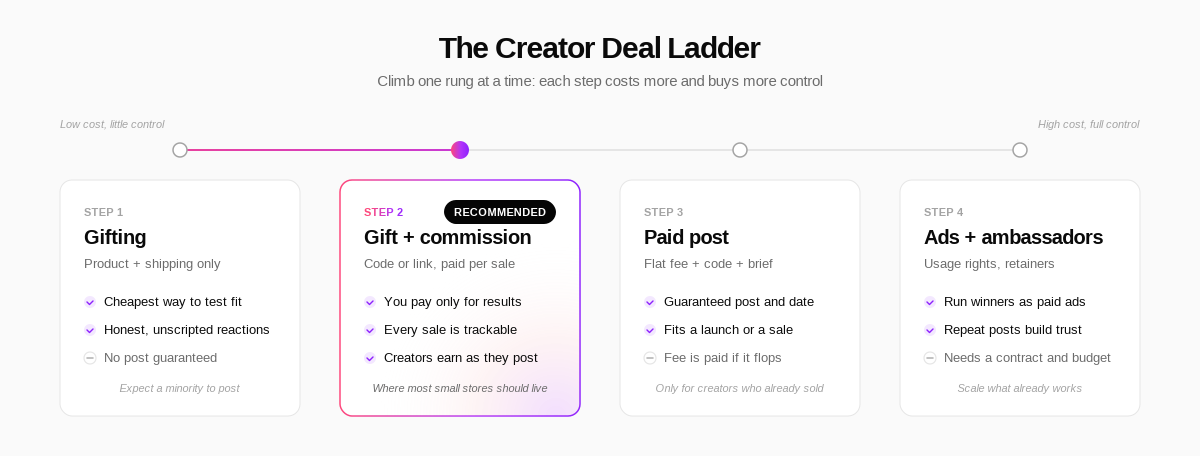
Every influencer deal is some mix of three currencies: free product, commission on sales and a flat fee. For a small store, the right mix depends on how much you know about the creator. Start cheap, learn who actually sells, then pay more to the people who have earned it.
### Step 1: Gifting (product seeding)
You send a product with no obligation to post. Your cost is the unit plus shipping. Many creators won't post, and that is fine: the ones who do post about something they actually liked, which reads as a real recommendation. Gifting is your cheapest way to test which creators fit your product and which audiences respond.
Gifting is not free of rules, though. If the creator posts, the free product is a material connection that must be disclosed (more on that in the rules section below).
### Step 2: Gift plus commission (where most small stores should live)
You send the product and give the creator a personal discount code and a tracked link. They earn a commission on every sale, typically 10% to 20% of the order value for physical products, more for high-margin goods. You pay only for results, every sale is attributable, and creators have a reason to keep posting long after the first video.
This is the rung most small stores should stay on for their first few months. It turns influencer marketing from a gamble into a channel with a known cost per order.
### Step 3: Paid post
A flat fee for a defined deliverable: one Reel, one TikTok, one YouTube integration, on an agreed date, usually with a code on top. Paid posts make sense for a launch or a sale where timing matters, and for creators who already proved on Step 2 that their audience buys from you. Paying a flat fee to a creator you've never worked with is the most common way small stores lose money in this channel.
### Step 4: Paid ads and ambassador retainers
Once a creator's video sells, buy the right to run it as an ad. Instagram and Facebook call these partnership ads (formerly branded content ads), and TikTok offers similar Spark Ads. A post that converted organically usually makes a strong ad, because it already looks like content rather than advertising. The last rung is a retainer: a monthly fee for a set number of posts, which turns your best creators into long-term ambassadors whose audience sees your product again and again.
## How Much Do Influencers Cost?
Prices vary widely by niche, format and country, but published benchmarks give you a sane starting range. Influencer Marketing Hub's [2026 influencer rates guide](https://influencermarketinghub.com/influencer-rates/) lists these typical fees per sponsored deliverable:
| Tier | Followers | Instagram post | TikTok video | YouTube video |
| --- | --- | --- | --- | --- |
| Nano | 1K to 10K | $10 to $100+ | $50 to $200 | $20 to $200+ |
| Micro | 10K to 100K | $100 to $500+ | $200 to $800 | $200 to $1,000+ |
| Macro | 100K to 1M | $5,000 to $10,000+ | $800 to $5,000 | $10,000 to $20,000+ |
Treat these as planning numbers, not rate cards. Video costs more than a static image, usage rights for ads cost extra, and a creator in a high-value niche (finance, B2B software, luxury) charges far more than one in a crowded one. The [same benchmark report](https://influencermarketinghub.com/influencer-marketing-benchmark-report/) found that about half of the nano and micro cost ranges brands reported were under $500.
### Do the break-even math before you pay a flat fee
A flat fee only makes sense if the creator is likely to generate enough gross profit to cover it. Run the numbers first:
```text
Break-even orders = (flat fee + product + shipping) / (average order value x gross margin)
Example: $300 fee + $40 gifted product and shipping
Average order value $65, gross margin 55%
340 / (65 x 0.55) = 340 / 35.75 = about 10 orders
```
If you can't believe the creator will drive 10 orders, don't pay $300. Offer a smaller fee plus a higher commission, or start them on Step 2. If you track customer lifetime value (see our guide to [ecommerce KPIs](/blog/ecommerce-kpis)), you can afford to break even on the first order and profit on the repeat purchases, but be honest about whether those repeat purchases actually happen.
## How to Find the Right Influencers for Your Store
The best creators for a small store are rarely found in a database first. Work from the inside out.
### Start with your own customers and followers
Look at who already tags you, reviews you or comments on your posts. A customer with 3,000 engaged followers who bought twice is a better partner than a stranger with 50,000. They already like the product, and their content won't feel scripted. Export your customer list and check it against your followers. If you collect reviews, the people writing detailed, enthusiastic ones are a good shortlist (our guide on [how to get product reviews](/blog/how-to-get-product-reviews) covers collecting them).
### Search the platforms manually
Search hashtags and keywords for your niche on TikTok, Instagram and YouTube, and look at who other small brands in your category work with. Look at tagged posts on competitors' accounts, not just their feed. Sort by recent, not top: you want creators who post consistently now.
### Use creator search tools once you outgrow manual search

Dedicated tools filter creators by audience location, age, engagement and niche, which saves hours once you're contacting dozens of people a month. [Modash](https://www.modash.io/) is one of the better-known options for small brands; its [pricing page](https://www.modash.io/pricing) starts at $199 a month on annual billing, with a 14-day free trial. Upfluence, Aspire and GRIN serve larger programs at higher prices. For most stores under a few hundred orders a month, a spreadsheet and manual search are enough. Pay for a tool when finding creators, not paying them, is your bottleneck.
The platforms have their own marketplaces too. If you sell through TikTok Shop, its [affiliate program](https://ads.tiktok.com/help/article/about-open-collaborations-in-seller-center) lets creators request samples and promote your products for a commission you set. Shopify merchants have [Shopify Collabs](https://apps.shopify.com/collabs), which handles applications, gifting, codes and commission payouts inside Shopify.

### Vet every creator before you reach out
Follower count is the least useful number on a profile. Check these instead:
- **Audience location.** If 70% of a creator's followers are in a country you don't ship to, their post is wasted on you. Search tools show this; you can also ask the creator for a screenshot of their audience insights.
- **Engagement that looks human.** Read the comments. Real comments ask questions ("does it come in green?"). Fake engagement looks like emoji strings and "nice pic!" from accounts with no posts.
- **Consistency.** Someone who posts three times a week in your niche beats someone with one viral video from last year.
- **Previous brand posts.** Do sponsored posts get similar engagement to their organic ones? If sponsored posts get a fraction of the likes, their audience tunes out ads.
- **Disclosure habits.** A creator who never labels their partnerships is a legal risk to you, not just to them.
- **Values fit.** Scroll back six months. If something in their history would embarrass your brand, it will surface eventually.
## Outreach That Gets Replies
Small creators get a lot of spam from dropshipping stores offering "free product for a post." Stand out by being specific, honest about the deal and short. A DM or email like this works:
```text
Hi Maya, I'm Sam, I run Northwick Candles (a two-person shop in Leeds).
I saw your video on cosy reading corners last week, the bit about scent
and lighting was exactly how we think about our candles.
Would you like to try our Library candle? No obligation to post.
If you like it and want to share it, we'd set you up with a 15% code
for your followers and a 15% commission on every order through it,
paid monthly.
Happy to send it wherever suits you. Sam
```
What makes it work: you've watched their content and say so, you name the product, the deal is spelled out in two lines, and there's no pressure. Follow up once after a week if you don't hear back. Then let it go.
## The Brief and the Agreement
Even on a gifting deal, write down what you expect. Once money changes hands, put it in a short written agreement. It doesn't need to be a 20-page contract; a one-page email both of you reply "agreed" to is far better than nothing. Cover these points:
| Item | What to agree |
| --- | --- |
| Deliverables | Format, number of posts, platform, rough date |
| Key messages | Two or three facts to get right (materials, sizing, shipping); no script |
| Disclosure | How the post will be labeled (for example "#ad" at the start, plus the platform's paid partnership label) |
| Code and link | The creator's code, its discount, the tagged link, how long it runs |
| Payment | Flat fee and/or commission rate, when you pay, on which orders (after returns?) |
| Usage rights | Whether you can repost or run the content as an ad, for how long, and in which countries |
| Exclusivity | Any period when they won't promote a direct competitor (this costs extra) |
| Approval | Whether you review before posting (only to check facts and disclosure, not to polish it into an ad) |
Give creators freedom on the creative. You chose them because their audience trusts how they talk. A brief that tells them what to say word for word produces a post that reads like an ad and performs like one.
## How to Track Influencer Sales
If you can't see which creator drove which order, you can't pay commissions fairly or decide who to work with again. Use two tracking methods together, because each one misses sales the other catches.
| Method | What it catches | What it misses |
| --- | --- | --- |
| Personal discount code (`MAYA15`) | Buyers who saw the post on one device and bought on another, or typed the URL by hand | Buyers who forgot the code. It also over-counts anyone who found the code on a coupon site |
| Tagged link (UTM parameters) | Every click from the creator's bio, story link or description, code or no code | Buyers who didn't click; visitors who decline analytics cookies |
| Post-purchase survey ("How did you hear about us?") | Word of mouth, people who saw the post and searched your name | Customers who skip the question |
Codes are the most common method for a reason: the benchmark report found that [45.9% of brands use promo codes](https://influencermarketinghub.com/influencer-marketing-benchmark-report/) to measure influencer ROI, ahead of affiliate links (26.0%). They also have a known weak spot. Once a code is public, browser coupon extensions and coupon sites collect it, and you end up paying commission on orders the creator didn't influence. Limit the damage by setting a usage cap and an end date on every code, using one code per creator (never a shared one) and checking where coupon orders come from.
A tagged link for a creator looks like this:
```text
https://yourstore.com/products/library-candle?utm_source=instagram&utm_medium=influencer&utm_campaign=maya-nov26
```
Keep the naming consistent (`utm_medium=influencer` for every creator, the creator's handle in the campaign) so your reports group cleanly. Our guide to [ecommerce analytics](/blog/ecommerce-analytics) covers setting up the reports themselves.
### What to measure
- **Orders and revenue per creator**, from code and link combined.
- **Cost per order**: everything you spent on a creator (product, shipping, fee, commission) divided by their orders.
- **New customers**: what share of a creator's orders came from people who never bought before. A creator who mostly reaches existing customers is a loyalty channel, not an acquisition one.
- **Content value**: posts you can reuse as ads, on product pages or in emails. A video that doesn't sell on the creator's account can still be your best-performing ad.
Give each post time. Most sales arrive in the first days after posting, but some come weeks later from saves and search. Judge a creator on 30 days, not 48 hours.
## Influencer Marketing Rules for Ecommerce in the US, UK and EU
Every paid or gifted post must be clearly labeled as advertising, in all three markets. And the responsibility isn't only the creator's: brands can be held liable for their partners' undisclosed posts.
### United States: the FTC Endorsement Guides
The FTC's [Disclosures 101 for Social Media Influencers](https://www.ftc.gov/business-guidance/resources/disclosures-101-social-media-influencers) sets out the rules creators must follow. Any "material connection" to a brand must be disclosed, and that includes free or discounted products, not just payment. The disclosure has to be hard to miss: in the post itself (not only in the bio or behind a "more" link), in the video and not just the description, and repeated during livestreams. Clear terms like "ad," "sponsored" or "Thanks to Acme for the free product" work; vague ones like "sp," "spon" or "collab" don't.

For brands, the key page is [FTC's Endorsement Guides: What People Are Asking](https://www.ftc.gov/business-guidance/resources/ftcs-endorsement-guides). It says advertisers need "reasonable programs in place to train and monitor members of their network," and that responsibility for disclosure rests with the influencer and the brand, not the platform. In practice: put the disclosure requirement in your brief, check posts after they go live, and stop working with creators who repeatedly skip it.
### United Kingdom: the ASA, CAP and CMA guide
In October 2026, the ASA, CAP and the Competition and Markets Authority published the fourth edition of their [Influencers' guide to making clear that ads are ads](https://www.asa.org.uk/resource/influencers-guide.html), updated for the Digital Markets, Competition and Consumers Act and with new material on fake reviews. The ASA expects a prominent "ad" label upfront, and says platform tools like "paid partnership" may not be enough on their own if they're easy to miss.

The stakes for brands went up in 2025. Under the DMCC Act, the CMA can now [enforce consumer law directly](https://www.gov.uk/government/publications/how-the-cma-uses-its-direct-consumer-enforcement-powers/how-the-cma-uses-its-direct-consumer-enforcement-powers) and fine businesses up to 10% of global turnover or £300,000, whichever is greater, without going to court first.
### European Union: the Influencer Legal Hub
In the EU, hidden advertising is an unfair commercial practice under existing consumer law, and the European Commission's [Influencer Legal Hub](https://commission.europa.eu/topics/consumers/consumer-rights-and-complaints/influencer-legal-hub_en) explains how it applies to creators, including gifted products and affiliate links. National consumer authorities enforce it, and many countries add their own rules on top. France's [2023 influencer law](https://www.vie-publique.fr/loi/288793-loi-influenceurs-proposition-de-loi-delaporte-vojetta), for example, requires a "publicité" or "collaboration commerciale" label and bans the promotion of certain products. If you work with creators in a specific EU country, check that country's regulator.
**Always check the current rules where you sell.** This guide summarizes US, UK and EU influencer disclosure rules as of November 2026. Rules change and vary by country, especially within the EU, so confirm the details with your local consumer authority or an advertising lawyer before you launch a paid program. This is general information, not legal advice.
## What Nobody Tells You About Influencer Marketing
A few things you'll only learn after a few months of running a program:
- **Most gifted products produce nothing.** Plan for a minority of gifted creators to post at all. Budget for it as a testing cost, not a failure.
- **Your code will leak.** Within weeks of a popular post, the code shows up in coupon extensions. Cap it, date it, and don't pay commission on orders you can trace to coupon sites.
- **International creators mean international shipping.** A creator with a big US audience is useless if you only ship within the UK, and sending them a gift may cost more in shipping and duties than the product.
- **Content outlives the post.** The single most valuable thing many creators produce is a 20-second video you can run as an ad for months. Negotiate usage rights up front, when they're cheap, not after the video has gone viral.
- **Creators are a supply chain.** A creator who sells out a product you can't restock for six weeks has cost you money. Check stock before a planned post goes live.
- **Relationships compound.** The fifth post from a creator who loves your product sells more than the first, because their audience has seen it repeatedly. Fewer, longer partnerships beat many one-offs.
## Running Influencer Campaigns on Your Next Store

If your store runs on [Your Next Store](https://yournextstore.com/), most of the mechanics above are built into the dashboard:
- **A code per creator with guardrails.** [Coupons](/help/payments/coupons-and-discounts) support percentage, fixed and free-shipping discounts, a total usage limit, one use per customer, start and end dates, a minimum order value and product scope. That covers the code-leak problem: give each creator a code that expires and caps out.
- **Short links for bios and stories.** [Redirects](/help/domains/redirects) let you create a short path like `/maya` that forwards to your product page with UTM tags attached, so the creator shares a clean link and you still get the tracking.
- **Attribution in your analytics.** The [Analytics](/help/orders/analytics) dashboard's Sales by Channel widget shows which channel was responsible for each order, using how the shopper first found you and what brought them back, not just the last click. Orders keep the UTM source of the visit that led to them.
- **Reviews from the customers creators send you.** Built-in [product reviews](/help/marketing/product-reviews) ask buyers for a verified review after delivery, so a creator's audience turns into social proof for the next shopper.
To be clear about the limits: YNS has no built-in creator marketplace or automatic commission payouts to influencers. You'll pay commissions yourself from the orders each code and link brings in, or connect a third-party affiliate tool. For a store with a handful of creators, a monthly payout from a spreadsheet is enough. If you're running hundreds of affiliates, a dedicated affiliate platform is the better fit. Plans start at $30 a month with 0% platform transaction fees (see [pricing](/pricing)), and the storefront is open source on [GitHub](https://github.com/yournextstore/yournextstore).
## Your First 30 Days of Influencer Marketing
1. **Week 1:** Write down your goal (sales, not "awareness"), your margin and the maximum cost per order you can afford. Build a list of 30 creators from your customers, tagged posts and hashtag searches.
2. **Week 2:** Vet the list down to 15. Send personal outreach to all 15 with a gift and commission offer. Create one code and one tagged link per creator.
3. **Week 3:** Ship gifts to everyone who says yes. Send a short brief with the facts and the disclosure requirement.
4. **Week 4:** Track posts and orders per creator. Repost the best content with permission. Thank everyone who posted, whether it sold or not.
At the end of the month, you'll know which two or three creators sell. Offer them more: a higher commission, a paid post for your next launch, or usage rights to run their video as an ad. That is the whole program. Small stores don't win by going wide. They win by finding the few people whose recommendation their customers trust, and paying them well.
## FAQ
### How much should a small business pay an influencer?
Start with free product and a 10% to 20% commission instead of a fee. When you do pay a flat fee, 2026 benchmarks put nano creators (under 10,000 followers) at roughly $10 to $200 per post and micro creators (10,000 to 100,000) at roughly $100 to $800, depending on platform and format. Before paying, check that the fee plus product and shipping can be covered by the orders you realistically expect.
### Is influencer marketing worth it for a small ecommerce store?
Yes, if you sell a product people can understand in a short video, you have enough margin to give away samples, and you track results per creator. It is usually not worth it if you pay large flat fees up front to creators who haven't proven they sell, or if their audience lives somewhere you don't ship.
### Do influencers have to disclose free products?
Yes. In the US, the FTC treats free or discounted products as a material connection that must be disclosed clearly in the post. The UK's ASA and CMA and EU consumer law take the same view. Brands share responsibility, so include the disclosure requirement in every brief and check posts once they're live.
## Related Blog Posts
- [Social Proof in Ecommerce: What Works and What Backfires](/blog/ecommerce-social-proof)
- [What Is Social Commerce? The 2026 Guide for Brands](/blog/social-commerce)
- [How to Market to Gen Z: An Ecommerce Guide for 2026](/blog/how-to-market-to-gen-z)
- [Ecommerce KPIs: The Metrics That Actually Matter](/blog/ecommerce-kpis)
- [Google Shopping vs Meta Ads: Which Pays Off for Ecommerce?](/blog/google-shopping-vs-meta-ads)