# How to Write Product Descriptions That Sell (and Rank)
Learn how to write product descriptions that sell and rank: a three-layer structure, before and after examples, SEO rules and a checklist you can use today.
*Published 2026-10-28*
**A product description has one job: answer the question the photo can't.** Shoppers can see the product. What they can't see is whether it fits their life, whether it is worth the price and what happens if it goes wrong. This guide shows how to write product descriptions that sell and rank: a three-layer structure, before and after rewrites, the SEO rules that matter and a checklist you can run on every product page.
## Why product descriptions still decide sales
Your product photos get attention. Your description gets the decision. A shopper on a product page is asking three things in order: is this for me, why this one instead of the other tab I have open, and what if it goes wrong. A good description answers all three before the shopper leaves.
It also does a second job that is easy to forget: it is the main text a search engine, a marketplace feed and an AI shopping assistant read to understand what you sell. Thin copy such as "Premium quality. Available in multiple colors." gives all of them nothing to work with.
Most stores fail in one of two ways:
- **Spec-sheet copy.** A list of materials and dimensions with no reason to care.
- **Brand-poetry copy.** Three paragraphs of mood that never say what the product does or what size to order.
The fix is the same for both: write for the reader's questions, in layers.
## The three-layer structure
Shoppers don't read a description top to bottom. They scan, then read the part that matters to them, then check the details. So write it in three layers, each for a different reader.
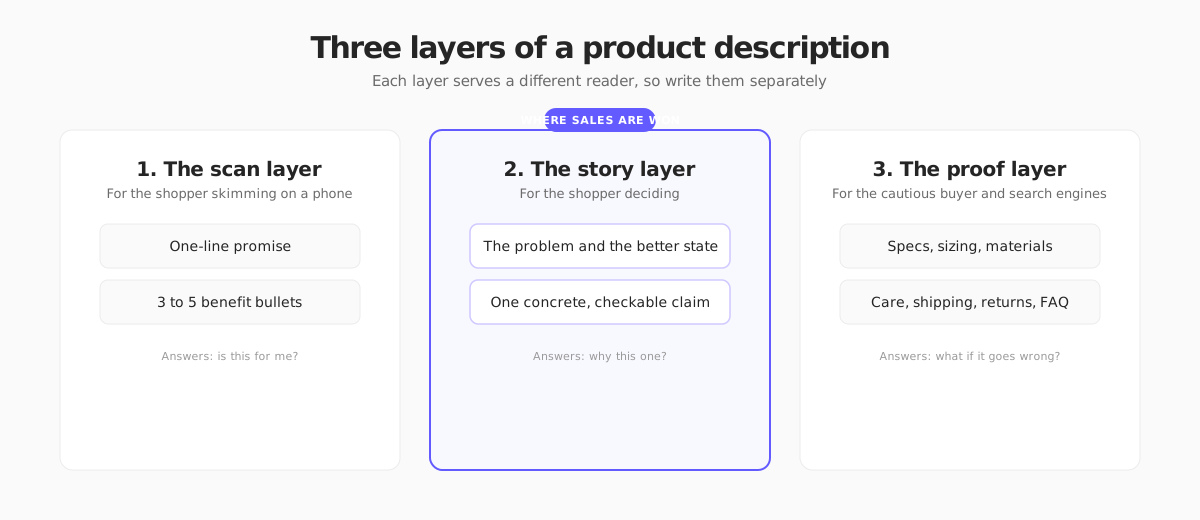
### Layer 1: the scan layer
This is what a person sees on a phone without scrolling: a one-line promise and three to five benefit bullets. Lead with the outcome, not the feature.
- Weak: "Double-wall stainless steel."
- Better: "Keeps drinks cold for up to 24 hours."
Put the strongest benefit first. If you only have one line of attention, spend it here.
### Layer 2: the story layer
This is a short paragraph, two to five sentences, that does four things:
1. Names the problem the buyer has right now.
2. Describes the better state the product delivers.
3. Makes one concrete claim the buyer can check.
4. Removes the single objection most likely to stop the purchase.
This is where sales are won, and it is the layer most stores skip. If you only have time to rewrite one thing on a product page, rewrite this.
### Layer 3: the proof layer
Specs, sizing, materials, care, shipping and returns. This layer is for the cautious buyer and for search engines. Keep it structured: a table or a short list, not a wall of text. Sizing and fit notes belong here, and they are also a quiet way to cut returns because the buyer knows what to expect.
## Before and after: rewriting a real product page
Here is a typical description for a water bottle:
> Stainless steel water bottle. High quality. Double-wall insulation. Leak-proof lid. Available in black and copper. Perfect gift for any occasion.
Every sentence is true and none of them helps. Now the same product through the three layers:
> **Cold at 5 p.m., not just at 9 a.m.**
> - Keeps drinks cold for up to 24 hours or hot for 12
> - Leak-proof lid that survives a laptop bag
> - Fits standard cup holders
>
> Most bottles are cold on the commute and lukewarm by lunch. This one uses double-wall vacuum insulation, so the outside stays dry and the inside stays cold through a full workday. It is heavier than a plastic bottle (about 400 g empty), and that is the trade: if weight matters more than temperature, a lighter bottle suits you better.
>
> **Specs:** 750 ml, 18/8 stainless steel, 7.5 cm base. Hand wash the lid. Free returns within 14 days.
Notice what changed. The claim is specific. There is an honest trade-off, which makes everything else more believable. The specs moved down where they belong. (The figures here are an example: use your own tested numbers, never a competitor's.)
Here is a product page that puts the structure above to work in a real storefront, with a short description next to the price and the details under it:

## Write for one person, in their words
The easiest way to sound generic is to write for "customers". Write for one specific buyer instead. Then borrow their language from three places:
- **Your reviews.** Search them for the phrases buyers repeat. If three people say "doesn't dig into my shoulder", that is your bullet.
- **Customer service emails.** The questions people ask before buying are the objections your description must answer.
- **Return reasons.** "Ran small" means the sizing note belongs in the scan layer, not the proof layer.
Allbirds is a good example of a brand that puts the buyer's real question right at the decision point. The product page tells shoppers the shoe runs small and to size up, next to the size picker, not buried in a footer:

## Words to cut, words to keep
A fast edit pass removes most weak copy. Cut or replace:
| Cut | Why | Replace with |
|---|---|---|
| "High quality", "premium" | Every store says it | The detail that makes it so: "full-grain leather, 2.2 mm thick" |
| "Perfect for any occasion" | Says nothing | The one occasion it is perfect for |
| "Elevate your everyday" | Filler | The specific everyday problem it solves |
| "Innovative", "cutting-edge" | Claims without proof | What the innovation does |
| Passive voice | Slows the reader | "Keeps drinks cold", not "Drinks are kept cold" |
Keep numbers, materials, dimensions, honest limits and plain verbs.
## Product description SEO that actually matters
You don't need keyword tricks. You need a few basics done every time.
### Match the words shoppers type
Pick one primary phrase per product, the way a shopper would search it: "insulated stainless steel water bottle 750 ml", not "hydration solution". Use it naturally in the page title, the H1, the first sentence of the description and the image alt text. Add two or three related phrases (material, use, size) where they fit. If a sentence reads worse because of a keyword, remove the keyword.
### Make every description unique
Copying the supplier's text across your catalog, or across color and size variants, creates duplicate content and gives search engines no reason to prefer your page. Write each product's story layer from scratch and keep variants on one page with a shared description where possible.
### Add structured data
Search engines can show price, availability and ratings in results when your page includes Product structured data. [Google's Product structured data documentation](https://developers.google.com/search/docs/appearance/structured-data/product) explains the fields and the difference between product snippets and merchant listings. Make sure the name, description, price and availability in the markup match what is on the page.

### Write for AI shoppers too
AI shopping assistants and answer engines read your description to decide whether to recommend you. They favor clear, factual, structured copy: what it is, who it is for, materials, dimensions, compatibility, price and policies. The three-layer structure happens to be exactly that. Plain facts in the proof layer are not boring; they are what gets you quoted. For more on this shift, read [how agentic commerce changes product pages](/blog/agentic-commerce).
## Length, tone and formatting
- **Length:** as long as the buyer's doubts require. A commodity item with no trade-offs may need 60 words. A considered purchase (a mattress, a camera bag, skincare with ingredients) may need 300 to 500 plus a spec table.
- **Tone:** match your brand, but keep sentences short. If you wouldn't say it out loud to a friend in a shop, don't write it.
- **Formatting:** bullets for features, short paragraphs for story, a table for specs. No walls of text, no all-caps.
- **Mobile first:** most shoppers will read this on a phone. Check the page at 375 px wide before you publish.
## Scaling to hundreds of products
Quality is easy for ten products and hard for a thousand. A workable process:
1. **Write a template** with the three layers and the questions each must answer.
2. **Gather facts first**: materials, dimensions, who it is for, one honest limitation. Never ask a writer, human or AI, to invent them.
3. **Draft, then edit.** Use AI for a first draft if you like, but give it the facts and your banned-phrase list, and read every output. Our [AI product descriptions guide](/blog/ai-product-descriptions) covers prompts and failure modes in depth.
4. **Prioritize.** Rewrite your top 20 products by revenue first, then those with the highest traffic and the lowest conversion.
5. **Re-check quarterly.** Reviews and return reasons give you fresh language.
## Rules to know before you publish
Descriptions are also advertising claims, so they carry legal weight.
- **In the US**, the FTC expects claims you make to be truthful and backed by evidence, and extra rules apply to health, "made in USA" and environmental claims. See the [FTC's advertising and marketing guidance](https://www.ftc.gov/business-guidance/advertising-marketing).
- **In the EU and UK**, consumer law requires you to give the main characteristics of the product, and misleading descriptions can count as unfair commercial practices. Some categories (food, cosmetics, textiles, electronics) also have mandatory labeling or information requirements, and EU stores often need to present information in the buyer's language.
- **Everywhere**, don't use a competitor's copy or another brand's photos without permission.
**Always check the current rules where you sell.** This guide summarizes US, EU and UK advertising principles in general terms as of October 2026. Regulations change and vary by country and product category, so confirm the details with your local regulator or a legal specialist before you publish claims. This is general information, not legal advice.
## Where Your Next Store fits
If you run your catalog on [Your Next Store](https://yournextstore.com/), the AI assistant lives in the admin with access to your product data, so it drafts a description from the real fields rather than a pasted prompt. Brand voice rules and banned phrases go in once under Settings → AI → Knowledge and apply to every conversation after that. You can also paste a block of text or describe products in plain English and have them created as structured products.

It will not replace your judgment about the honest trade-off or the one claim you can prove. That part stays yours, on any platform.
## Product description checklist
Run this on every page before it goes live:
- One-line promise that states an outcome
- Three to five benefit bullets, strongest first
- A story paragraph with the problem, the better state, one checkable claim and one objection removed
- At least one honest limit or "who this isn't for"
- Specs, sizing, materials and care in a table or list
- Shipping and returns summarized or linked
- Primary keyword in the title, H1, first sentence and image alt text
- Unique text, not copied from a supplier or another variant
- Product structured data matches the page
- Read aloud on a phone: nothing you would be embarrassed to say to a customer
## FAQ
### How long should a product description be?
As long as the buyer needs to decide. Simple products work with 50 to 100 words plus a spec list. Considered purchases often need 250 to 500 words. Add length only when it answers a real question.
### Should I use the manufacturer's description?
No. It is the same text every other retailer has, which makes your page one of many duplicates. Use the manufacturer's facts and write your own story layer.
### How do I write descriptions for products with many variants?
Keep one page and one story layer for the product, and list what differs by variant (size, color, material) in the proof layer. Give each variant its own accurate details, such as measurements, rather than copying the same line.
### Do product descriptions affect SEO?
Yes. The description gives search engines the words and context to match your page to a query, and unique, useful copy tends to perform better than copied or thin text. It works best alongside good titles, images, structured data and a fast page.
## The bottom line
Write the answer to the shopper's real question, in layers, with one claim you can prove and one limit you admit. Everything else, keywords included, is polish on top of that.
## Related Blog Posts
- [AI Product Descriptions: The Honest 2026 Guide](/blog/ai-product-descriptions)
- [Ecommerce SEO: A Technical Guide for Developers](/blog/ecommerce-seo)
- [Ecommerce Product Photography on a Budget (DIY Guide)](/blog/ecommerce-product-photography)
- [Ecommerce Checkout Optimization: The 2026 Playbook](/blog/ecommerce-checkout-optimization)
- [Agentic Commerce: How AI Agents Will Buy From Your Store](/blog/agentic-commerce)