# How to Start a Sunscreen Brand: Rules, Costs and Launch Steps
How to start a sunscreen brand in 2026: FDA and EU/UK rules, SPF testing, private label costs, pricing and a launch plan. Read before you order stock.
*Published 2026-09-30*
**Learning how to start a sunscreen brand means learning one thing first: in the US, sunscreen is not a cosmetic, it is an over-the-counter drug.** That single fact decides who can make it, how it is tested, how the label looks and what your first order costs. The good news is that the rules are a known checklist, and a small brand can follow them by working with the right manufacturer. Here is the path, in order, with the US, EU and UK differences spelled out.
## The Sunscreen Launch Path at a Glance
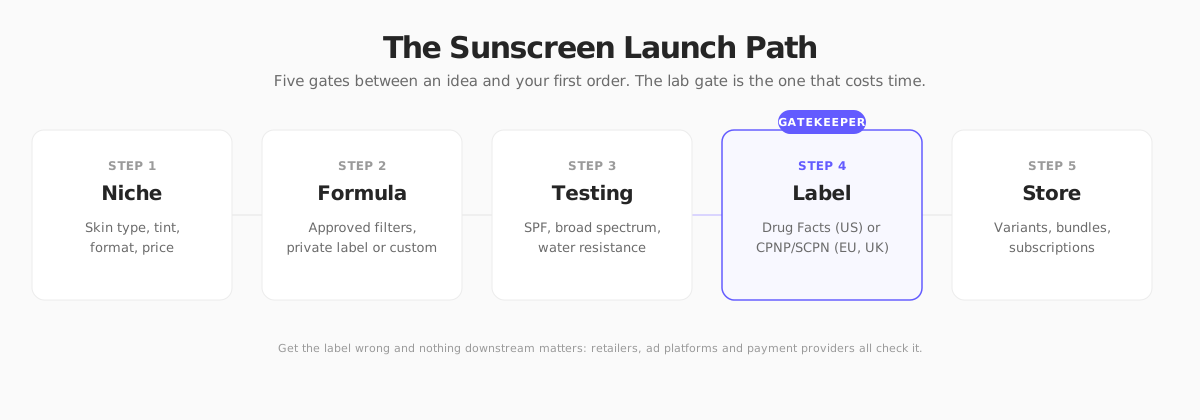
1. **Pick a niche** that a big brand is not serving well.
2. **Choose a formula** from approved filters, via private label or a custom formulation.
3. **Get the testing done** for SPF, broad spectrum and water resistance.
4. **Get the label right** for each market you sell in.
5. **Build the store** and plan shipping, returns and customer education.
Step 4 is the gatekeeper. Retailers, ad platforms and payment providers all look at your label, and a wrong one can stop a launch.
## Step 1: Pick a Niche Before a Product
Sunscreen is crowded, so "a good sunscreen" is not a brand. Pick a customer the shelf serves badly:
- **Skin tone and finish:** mineral formulas that do not leave a white cast on deeper skin tones, or tinted options
- **Activity:** sport, surf or hiking sunscreen that stays put and survives sweat
- **Skin condition:** fragrance-free, sensitive-skin or acne-prone formulas
- **Format:** sticks for faces and kids, powders for reapplying over makeup, lotions for bulk family use
- **Audience:** babies, men, runners, cyclists or anyone who buys sunscreen for a specific routine
Test demand before you order inventory: a waitlist page, a short survey and a sample batch shared with 20 or 30 people will teach you more than a spreadsheet. If you are still choosing the category, our guide to [starting an online store](/blog/how-to-start-an-online-store) covers that decision first.
## Step 2: Understand the Rules Where You Sell
### In the US: sunscreen is an OTC drug
The FDA [regulates sunscreens as nonprescription drugs](https://www.fda.gov/drugs/understanding-over-counter-medicines/sunscreen-how-help-protect-your-skin-sun) because they claim to prevent sunburn. The consequences:
- **Only approved active ingredients.** You cannot invent your own UV filter. The list is short and changes slowly; bemotrizinol was the [first new filter added in about 20 years](https://www.fda.gov/news-events/press-announcements/fda-expands-sunscreen-options-first-time-20-years).
- **Drug manufacturing standards.** The product must be made in an FDA-registered drug facility under drug-grade good manufacturing practice. Kitchen-made sunscreen cannot legally be sold.
- **Facility fees.** Makers of OTC monograph drugs pay a yearly FDA fee, [$19,188 per facility for fiscal 2026](https://www.federalregister.gov/documents/2026/03/18/2026-05276/over-the-counter-monograph-drug-facility-fee-rates-for-fiscal-year-2026) ($12,792 for contract manufacturers). Your manufacturer pays it; it shows up in your unit price.
- **A Drug Facts label** in the FDA's fixed format, listing active and inactive ingredients, directions and warnings.
- **Not a MoCRA cosmetics product.** The FDA's cosmetics modernization law covers cosmetics, not OTC drugs like sunscreen, which follow the drug rules instead. Confirm the details with a regulatory specialist.

### What the US label must say
| Claim | What it takes |
|-------|---------------|
| **SPF** | FDA labeling benefits start at SPF 15; the higher the number, the more UVB protection |
| **Broad spectrum** | Must pass the FDA's broad-spectrum test; required for any SPF 15+ sunscreen to carry full skin-cancer claims |
| **Water resistant** | Must state either 40 or 80 minutes; "waterproof" and "sweatproof" are not allowed |
| **Warning** | Products that are not broad spectrum or are below SPF 15 must carry the "Skin Cancer/Skin Aging Alert" |
| **Reapplication** | Directions must tell users to reapply; you cannot claim all-day protection |
### In the EU and UK: sunscreen is a cosmetic
In the EU and UK, [sunscreens are cosmetic products](https://single-market-economy.ec.europa.eu/sectors/cosmetics/cosmetic-products-specific-topics/sunscreen-products_en). That changes the route, not the seriousness:
- **A Responsible Person** based in the EU (or UK) for each market
- **A safety assessment** by a qualified assessor before the product goes on sale
- **Notification** through the EU's CPNP portal or the UK's SCPN portal
- **Approved UV filters only**, from the positive lists in the EU Cosmetics Regulation (1223/2009) and the UK equivalent
- **SPF and UVA claims** following the [EU recommendation on sunscreen efficacy](https://eur-lex.europa.eu/eli/reco/2006/647/oj/eng): SPF is shown in categories from low to very high, and UVA protection must be at least one third of the labeled SPF

**Selling across borders?** A formula and label that are fine in the EU can need changes for the US, and vice versa. Decide your launch market first and treat the second market as a separate project.
**Always check the current rules where you sell.** This guide summarizes US, EU and UK sunscreen rules as of September 2026. Regulations change and vary by country, so confirm the details with your local regulator or a regulatory specialist before you formulate, label or sell. This is general information, not legal advice.
## Step 3: Choose How Your Sunscreen Gets Made
| Route | Typical cost | Minimum order | Best for |
|-------|-------------|---------------|----------|
| **White label** (existing formula, your label) | Lowest per unit | Often a few hundred to a thousand units | Testing demand fast |
| **Private label** (tweak a base formula) | Roughly $1.50 to $7 per unit depending on type | Commonly 1,000+ units | Most new brands |
| **Custom formula** | Highest, plus development and testing fees | Higher | Brands with a real formulation edge |
Unit-cost ranges above come from [supplier sourcing guides](https://smartbuy.alibaba.com/buyingguides/sunscreen-private-label): basic chemical-filter lotion at the low end, mineral or tinted at the middle, and eco-certified formulas at the top. Treat them as a starting point and get real quotes.
**Choosing a manufacturer matters more than anything else in this step.** Ask:
1. Are you FDA-registered for OTC drugs, and can you show your most recent registration? (For the EU or UK, ask for evidence of cosmetic GMP and in-house safety support.)
2. Who runs the SPF and broad-spectrum tests, and can I see the reports?
3. What is the minimum order, and what is the lead time?
4. Who owns the formula and the test data if I switch suppliers?
5. Do you offer stability and compatibility testing for my packaging?
**Do not skip testing to save money.** SPF and water-resistance claims must be backed by test data. A product whose real SPF is lower than the label is a safety problem and a legal one.
## Step 4: Price It So the Math Works
Sunscreen is a low-margin category if you price like a drugstore and a healthy one if you build a brand. A simple rule is to aim for a retail price of at least 3 to 4 times your landed cost (product, packaging, testing share, freight and duties):
| Line item | Example per 50 ml tube |
|-----------|-----------------------|
| Product and filling | $3.00 |
| Packaging and carton | $0.80 |
| Testing and regulatory (share of batch) | $0.50 |
| Freight and duties | $0.40 |
| **Landed cost** | **$4.70** |
| Payment processing on a $24 sale (for example [2.9% + 30¢](https://stripe.com/pricing)) | about $1.00 |
| Shipping you absorb | $0 to $4 |
At $24, that leaves roughly $18 before marketing. Bundles (a face stick plus a body lotion) and a higher average order value make paid acquisition work. The numbers above are illustrative, not quotes.
## Step 5: Set Up Your Online Store
Sunscreen sells on trust, so your site has to explain what is in the tube and why. A good sunscreen store includes:
- **Clear product pages:** SPF, filter type (mineral or chemical), water resistance, size, skin tone or finish, and the full ingredient list
- **Variants:** sizes, tints and formats as variants of one product instead of separate listings
- **Bundles:** a "beach day kit" or "daily face set"
- **Education:** how much to apply, when to reapply and how to read a label
- **Reviews and photos** across different skin tones
- **Shipping rules:** a clear policy and any restrictions for aerosols (carriers often restrict aerosol sprays, so check before you offer one)
[Your Next Store](https://yournextstore.com/) is one option for this. It gives you an AI store builder that turns a description into a storefront, variants and collections for products, and an open-source Next.js storefront you can customize later. Plans start at $30/month with 0% platform transaction fees, and only Stripe's processing fees apply. Honest caveats: there is no free plan, and YNS does not handle regulatory work for you. You still need to keep your label, claims and testing documentation in order on your own. For other options, see our [best AI store builders](/blog/best-ai-store-builders) and our [ecommerce SEO guide](/blog/ecommerce-seo).

## Step 6: Launch and Get Noticed
Pick one channel and do it well:
- **Short video:** application demos, "how much is enough" and before-and-after UV camera shots
- **Creators in your niche:** sport, sensitive skin or a specific skin tone community
- **Search:** answer questions people type ("best mineral sunscreen without white cast") with honest comparison content
- **Sampling:** travel sizes inside other orders or at events
Sunscreen is seasonal in many markets, so plan your first production run to land a couple of months before summer, and use winter to build your email list and reviews.
## What Nobody Tells You
- **Claims drive trouble, not formulas.** Words like "waterproof," "sunblock" or "all-day protection" are not allowed on US labels. Keep copy on the site matching the label.
- **Minimums bite.** A thousand tubes is a lot of inventory if you have not proven demand. Start with one hero product.
- **Sunscreen expires.** Check the shelf life and storage guidance with your manufacturer, and plan stock rotation.
- **Customers misuse it.** Most people apply less than they should, so education is part of the product.
## FAQ
### Do you need FDA approval to sell sunscreen?
In the US, sunscreen does not get pre-market approval the way a new drug does, but it must follow the FDA's OTC monograph: approved active ingredients, drug-grade manufacturing, required testing and a Drug Facts label. A contract manufacturer registered with the FDA usually handles the facility side.
### How much does it cost to start a sunscreen brand?
A private-label start with one product often lands in the low thousands to low tens of thousands of dollars, depending on minimum order, packaging, testing and branding. Custom formulas cost more. Get quotes from at least three manufacturers.
### Can I make sunscreen at home and sell it?
Not legally in the US, where sunscreen is a drug and needs a registered drug facility. In the EU and UK, cosmetic rules still require safety assessment, testing and a Responsible Person, so home production is not realistic there either.
### Is sunscreen regulated differently in the EU and UK?
Yes. In the EU and UK it is a cosmetic, handled through a Responsible Person, a safety assessment and portal notification, while the US treats it as an OTC drug.
## Final Word
**Sunscreen rewards the brand that treats the label as seriously as the formula.** Pick a niche, pick a manufacturer who already knows the rules, and let the store be the easy part.
## Related Blog Posts
- [How to Start a Skincare Brand](/blog/how-to-start-a-skincare-brand)
- [How to Start a Makeup Brand](/blog/how-to-start-a-makeup-brand)
- [How to Start an Online Store](/blog/how-to-start-an-online-store)
- [Best AI Store Builders](/blog/best-ai-store-builders)
- [Ecommerce SEO](/blog/ecommerce-seo)