# How to Start a Streetwear Brand in 2026: Honest Playbook
How to start a streetwear brand in 2026: real MOQs, the design IP mistake nobody warns you about, and honest pricing math.
*Published 2026-09-09*
The global streetwear market is on track to hit roughly [$218.3 billion in 2026](https://www.mordorintelligence.com/industry-reports/streetwear-industry), and almost none of that is owned by the brands you'd list from memory. It's owned by thousands of small labels that figured out one thing early: streetwear isn't clothing with a bigger logo, it's a community that happens to sell merchandise. This is the honest version of how to start one: what actually makes streetwear different from general apparel, the design mistake that gets first-time founders a cease-and-desist letter, and real 2026 numbers for MOQs, costs, and pricing.
**A small disclosure:** I help run a company that makes online-store software. In the section on setting up a website, our product is one of several options. Everything else in this guide, including the legal section, has nothing to do with us, and I'll be straight with you throughout.
## Streetwear Isn't Just Clothing With a Logo
Before sourcing, pricing, or design, it's worth being precise about what actually separates a streetwear brand from a general clothing brand, because the difference changes almost every decision downstream.
- **Drop culture, not seasons.** A clothing brand restocks. A streetwear brand *drops*: a specific, limited release, on a specific date, that sells out or it didn't happen. The scarcity isn't a marketing trick bolted on afterward, it's the product structure itself.
- **Hype is a real input, not a nice-to-have.** A general apparel brand can succeed on quality and consistency alone. A streetwear brand needs people to *want to be seen* wearing it before it's widely available. That's a harder, more specific thing to engineer than "make a good hoodie."
- **Community is the distribution channel.** Streetwear historically grew out of skate shops, sneaker lines, and local scenes, not department stores. The brands that work today still behave like that: a Discord server, a small crew of people who post the drop, a comment section that feels like a group chat. If you're building general apparel with a broader audience in mind rather than a specific scene, our [clothing brand playbook](/blog/how-to-start-a-clothing-brand) covers that wider category in more depth.
- **The design matters more than the garment, up to a point.** A streetwear customer will forgive a basic blank hoodie if the graphic and the story behind it are genuinely good. They won't forgive a mediocre graphic on an expensive custom pattern. This is the opposite of a category like jackets, where [construction and fit carry the sale](/blog/how-to-start-a-jacket-brand).
None of this means streetwear is easier than other apparel categories. It means the skills that matter are different: a founder who can design a graphic people want to screenshot and repost will outperform one who spent their budget on a custom pattern nobody talks about.
## Step 1: Pick a Specific Scene, Not "Streetwear"
"Streetwear" stopped meaning one aesthetic around the time it became a $200 billion category. Skate-inspired, Y2K revival, techwear, anime and gaming crossover, gorpcore-adjacent, sports-logo bootleg energy, quiet minimalist boxy tees: these are different customers who happen to shop in the same general aisle.
Pick one. A good answer is specific enough that a stranger could describe your customer's whole outfit before ever seeing your product page:
- **A specific fandom or subculture.** Anime, a regional skate scene, a specific music genre. [Brain Dead](https://www.brain-dead.com/) built its whole identity around a mashup of skate, horror movies, and zine culture rather than trying to be generically "cool."
- **A specific city or scene story.** A lot of the biggest streetwear names (Supreme in New York, early Stüssy in California surf culture) started as an extension of one real, specific place before going national.
- **A specific stance or in-joke.** Deliberately absurd or satirical graphics that a niche audience immediately gets, and everyone else scrolls past. That's not a bug, it's the filter that makes it feel exclusive to the people it's for.
The test is the same one that applies to any apparel niche: if a fast-fashion chain could put your exact graphic on a rack tomorrow without changing anything about who they are, it's not specific enough yet. Your advantage as a small brand isn't a bigger factory, it's caring about one scene more than a company with ten thousand SKUs ever will.
## Step 2: Prove Demand Before You Print Anything
Streetwear has a specific trap that general clothing brands don't: it's cheap enough to sample that founders skip validation entirely and just print a full run, because "it's just a print run on blanks, how bad could it go." It can go quite bad. A 100-unit print run of a design nobody wanted is still 100 units of dead stock.
Three cheap ways to test before you commit to a real order:
1. **Post the design before the product exists.** A mockup on a blank hoodie, posted where your specific scene already hangs out, with a "drop coming, join the list" link. If it doesn't get real engagement as an image, it won't sell as a product.
2. **Take real pre-orders on a fixed drop date.** Not a vague waitlist, a specific date and a specific price. People who pay upfront for something that ships in three weeks are the only signal that counts.
3. **Sell 20 pieces face-to-face first**, if you're part of the scene you're designing for. A pop-up table at a show, a skate spot, a local event. Direct reactions from the exact people you're designing for are worth more than a thousand likes from strangers.
This step costs a weekend and maybe a few hundred dollars in ads or blanks for one sample. Skipping it can cost you an entire print run.
## Step 3: Choose How You'll Actually Make It
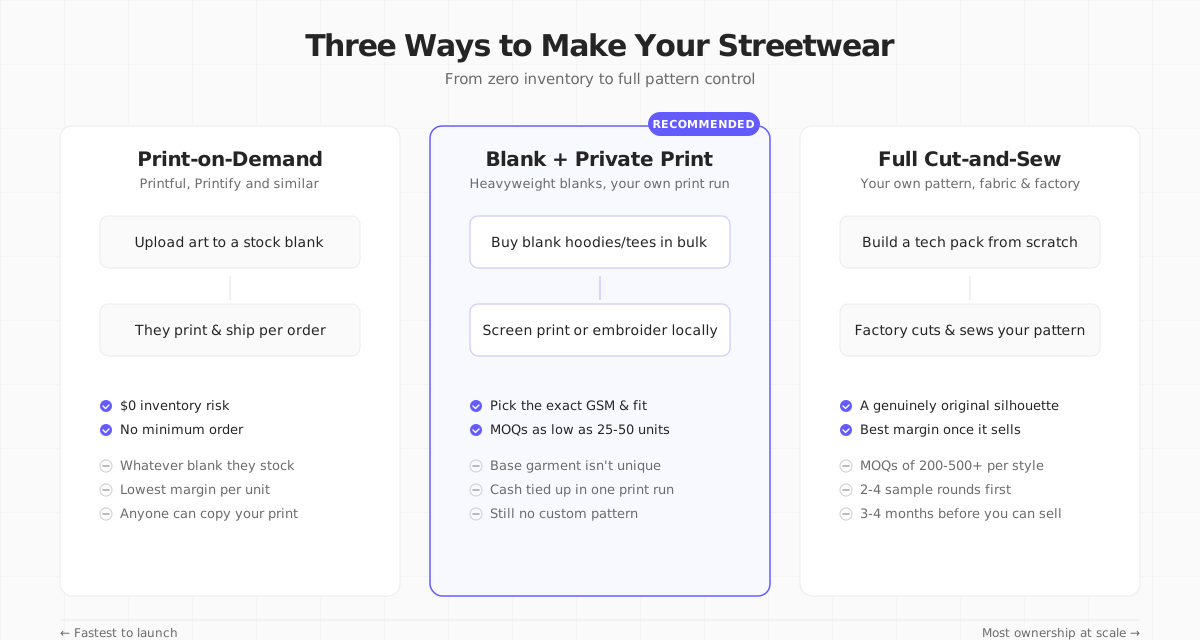
This is the biggest lever on how much cash you need before you've sold anything, and unlike some apparel categories, streetwear genuinely has three distinct paths worth comparing.
### Print-on-demand (the zero-risk way to test)
A supplier holds a blank garment and prints your design only after someone orders it. No inventory, no minimum, and you can be selling within a day.
[Printful](https://www.printful.com/custom-hoodies) and [Printify](https://printify.com/) both offer heavyweight hoodie and tee options with no minimum order quantity, and both integrate directly with most storefronts. The trade-off is real: you're limited to whatever blanks the provider stocks, the per-unit cost is the highest of the three models since you're paying single-unit pricing, and because anyone else can order the same blank and print a similar graphic, this model gives you the least protection against a near-identical knockoff.
### Blank + private print (the realistic first real run)
You buy blank garments in bulk from a wholesale supplier and screen print or embroider them yourself, or through a local print shop. This is where most real streetwear brands actually start, because it's the first model where you control the thing that matters most in this category: the weight and cut of the blank.
Streetwear buyers can tell a 180 GSM tee from a 240+ GSM tee by feel, and heavyweight, boxy silhouettes are what most of the category has converged on for 2026, generally **240 to 300 GSM for tees and 400+ GSM for hoodies**, according to [wholesale blank supplier data](https://merchinsiderdaily.com/plain-hoodies/). Low-MOQ blank suppliers now offer print-ready wholesale garments starting around **25 to 50 units per style and color**, a real drop from the 300+ minimums that used to gate small labels out.
### Full cut-and-sew (custom patterns, once you've proven the graphic)
A factory builds a garment from your own pattern, not an existing blank. This is where you get a genuinely original silhouette, boxier proportions, a custom pocket, a longer hem, but it comes with a real minimum order and a real timeline: expect 2 to 4 rounds of samples over 2 to 6 weeks each before a production run even starts.
MOQs vary sharply by where you produce: **roughly 50 to 150 pieces per style at US cut-and-sew shops**, per [recent US clothing manufacturing cost data](https://pluckyreach.com/us-clothing-manufacturing-data-report), rising to **200 to 500+ pieces per style, per colorway,** at overseas factories. That colorway detail is the one beginners miss most: three colorways at a 300-piece overseas minimum is really a 900-unit order, not 300.
**Start on the blank, not the pattern.** Validate a specific graphic on a private-printed blank first. Move to a custom cut-and-sew pattern only once a design has already sold out at least once. A custom pattern with an unproven graphic is the single most common way first-time streetwear founders end up with $8,000 of stock in a closet.
## Step 4: Own Your Designs, and Don't Accidentally Steal Someone Else's
This is the section most general apparel guides skip, and it's a genuine streetwear-specific gotcha. Streetwear leans harder on graphics, references, and pop-culture remixing than almost any other clothing category, which cuts both ways: your own designs are worth protecting, and it's unusually easy to accidentally infringe someone else's.
### Protecting what's yours
In the US, a design you create is **automatically copyrighted the moment you fix it in a tangible form**, no registration required. What registration with the [US Copyright Office](https://www.copyright.gov/) actually buys you is the ability to sue for infringement and to claim statutory damages instead of having to prove your actual financial loss, and it's inexpensive: a basic online registration runs $45 to $65 per work.
Your brand name and logo are a separate thing entirely: a **trademark**, not a copyright. In the US, filing costs [$350 per class of goods through the USPTO](https://www.uspto.gov/trademarks/trademark-fee-information) (clothing falls under Class 25), and it's worth searching the [USPTO's trademark database](https://tmsearch.uspto.gov/) before you fall in love with a name, because a name collision discovered after you've printed merch is expensive to fix.
Even established streetwear labels fight over this constantly. [Walker Wear, the 30-year-old streetwear label once worn by Tupac and Biggie, sued Off-White](https://www.surfacemag.com/articles/off-white-walker-wear-copyright-lawsuit/) in a trademark dispute over a design the smaller brand said was nearly identical to its own decades-old logo mark. Scale doesn't exempt anyone from this fight, and it doesn't only run one direction.
### The mistake that actually gets first-timers in trouble
The far more common problem for a new brand isn't defending your own design, it's accidentally using someone else's. Streetwear culture is built on remixing: band logos, movie stills, sports team marks, meme formats, a celebrity's face. All of that feels like it's "in the culture" and free to use. Almost none of it legally is, unless it's been licensed or genuinely falls under a narrow fair-use exception (parody and commentary, not decoration).
This isn't a hypothetical. [Kendall and Kylie Jenner released a line of t-shirts](https://www.cbsnews.com/amp/sanfrancisco/news/kendall-kylie-jenner-slapped-with-cease-and-desist-over-unauthorized-shirts-1) layering their own images over classic rock album art from Metallica, The Doors, Pink Floyd, and Led Zeppelin, and received cease-and-desist letters from multiple artists' estates within days. If a brand with a full legal team can miss this, a first-time founder printing a "vintage" band tee off a reference image found online is exposed in exactly the same way, just without the lawyers to negotiate it down.
The practical rule for a first drop: if you didn't draw it, and you don't have written permission to use it commercially, don't print it. A cease-and-desist letter is the good outcome. A lawsuit and a destroyed print run are the bad one, and either can happen off a single unlicensed graphic.
## Step 5: Price the Math So It Actually Works
The classic beginner mistake: "similar hoodies sell for $75, so I'll charge $65." That math only works for a brand ordering at a scale you're not at yet, since they're likely paying $12 to $18 a unit at volume while you're paying $22 to $35 on a small blank-plus-print run.
The honest rule: **price at least 3.5 to 4 times your fully landed cost per unit**, and build in a returns reserve. Apparel returns [average around 25% industry-wide](https://eightx.co/blog/average-ecommerce-return-rate), and while sizing drives most general apparel returns, streetwear specifically also sees a real share of "changed my mind after the hype wore off" returns on impulse drop purchases.
Here's where the money goes on a heavyweight private-printed hoodie that costs **$24** landed, sold at **$85** (about 3.5x):
| Where the money goes | $ |
|---|---|
| Landed cost (blank + print + inbound shipping) | $24.00 |
| Card processing fee (Stripe, 2.9% + $0.30) | $2.77 |
| Shipping to customer | $8.00 |
| Returns reserve (~20% of orders) | $9.00 |
| Marketing (~25% of revenue) | $21.25 |
| **What you actually keep** | **~$19.98** |
That's roughly 23% of revenue kept per hoodie. A $3,000 first blank-plus-print run needs about 150 hoodies sold to break even, before photos, samples, or ad spend to get people there in the first place. Drop the price to $65 (a 2.7x multiple on the same $24 cost) and what you keep falls to roughly $10 a unit, meaning the same $3,000 run needs 300 sales instead of 150. **If your margin depends on selling out fast, price it so a slower sellout doesn't sink you.**
## Step 6: Get the Labeling and Legal Basics Right
Once you're shipping real product, a few compliance items are genuinely mandatory, not optional paperwork, and they differ by where your customer lives.
### In the US
Two separate FTC rules apply to every garment. The [Textile Fiber Products Identification Act](https://www.ftc.gov/news-events/topics/tools-consumers/apparel-labeling) requires a permanent label stating fiber content by percentage, country of origin, and either the manufacturer's identity or a registered RN number. Separately, the [FTC's Care Labeling Rule](https://www.ftc.gov/business-guidance/resources/clothes-captioning-complying-care-labeling-rule) requires a permanent care label with washing and drying instructions, or the standardized care symbols in place of text. Most wholesale blank suppliers and cut-and-sew factories can pre-print compliant labels as part of your order; confirm it in writing before your first run ships.
### In the EU and UK
If you're selling into the EU, [Regulation (EU) No 1007/2011](https://europa.eu/youreurope/business/product-rules-compliance/textiles-and-footwear/textile-label/index_en.htm) requires a fibre-composition label in descending order by weight, translated into the language of every member state you sell into, not just English. The UK kept a near-identical rule on the books post-Brexit under the [Textile Products (Labelling and Fibre Composition) Regulations 2012](https://www.compliancegate.com/clothing-regulations-united-kingdom/).
On the tax side: if you're a US brand shipping into the EU, you generally need to register for VAT once you cross the relevant country's distance-selling threshold, or use the EU's One Stop Shop (OSS) scheme to file one return covering all member states instead of registering separately in each. UK sales carry their own VAT registration threshold, separate from the EU's. Rules and thresholds change; check current figures with an accountant before your first EU or UK sale rather than guessing.
## Step 7: Launch the Store With Your Next Store
By now you have a validated graphic, a sourcing model, and real landed costs. Time to give people somewhere to actually buy, and for a drop-based brand, the storefront itself matters more than for a brand with steady, predictable traffic, because drop traffic arrives in one spike instead of trickling in over weeks.
[Your Next Store](https://yournextstore.com/) (us, to be upfront) starts at $25/month on the yearly plan, with **0% platform transaction fees** on every plan, so a hyped drop doesn't cost you a bigger cut just because it sold well. An AI-powered builder sets up the storefront itself from a description of what you sell, and product pages support multiple images and custom variant attributes, so you can show a graphic close-up, a size chart, and a fabric weight callout instead of just a price and an "Add to cart" button. If you outgrow the managed platform later, the storefront template that powers it is [open source on GitHub](https://github.com/yournextstore/yournextstore) too.
For comparison, [Shopify](https://www.shopify.com/) is the most common choice among established streetwear brands, largely because of its queue and waitlist apps built specifically for hype releases, and its direct integrations with Printful and Printify for the print-on-demand path. It starts at $39/month, and takes [a per-transaction fee unless you use their own payment processor](/blog/how-much-does-shopify-take-from-a-100-sale). For a first tiny drop under 50 pieces sold entirely to your existing following, taking orders through Instagram DMs with a [Stripe payment link](/blog/how-to-sell-online-with-stripe) is a genuinely viable, free way to start, though it breaks down fast once you're tracking more than one size run at once.
**0% extra fees on every sale.** A fast, modern website for your streetwear brand, ready in minutes.
## Step 8: Market the Drop, Not Just the Product
Streetwear marketing runs on a different mechanic than general apparel marketing: momentum before the drop matters more than steady content after it.
- **A defined drop window, not "while supplies last."** A specific date and a hard stop (a single day, a set quantity) creates urgency an always-available product page never will.
- **Instagram and TikTok, shown in motion and in real settings**, not a clean studio shot. Streetwear sells on how it's actually worn, at the skate spot, the show, the street, not on a flat lay.
- **A Discord or close community channel.** Streetwear audiences already self-organize around drop alerts. A small, active server for your own brand becomes your highest-intent audience and your earliest warning if a design isn't landing. This kind of direct, always-on community relationship is also why general [Gen Z marketing playbooks](/blog/how-to-market-to-gen-z) increasingly look like what streetwear brands have been doing for years: comments and DMs as the real trust layer, not a polished feed.
- **Gifting to genuinely relevant micro-creators**, not the biggest follower count you can afford. Twenty creators who are actually part of your specific scene beat two thousand followers who aren't.
- **Email, captured from your pre-drop waitlist.** Once someone's bought a drop, email is where the next one converts best, because they already know first access matters.
Pick one main channel to genuinely master before adding a second. Streetwear brands that spread across every platform at once at a mediocre level rarely build the kind of following that makes the next drop sell out on its own.
## What It Actually Costs to Start a Streetwear Brand in 2026
| Your approach | Upfront cost | Monthly spend | What you get |
|---|---|---|---|
| **Print-on-demand test** | $0–$300 | $30–$100 | Unlimited designs to test, zero inventory, thinnest margins |
| **Blank + private print, first run** | $1,000–$4,000 | $150–$400 | 50–150 heavyweight pieces, real margin, real website |
| **Full cut-and-sew, first collection** | $6,000–$20,000 | $800–$1,500 | An original pattern, 3–5 styles, wholesale-ready |
| **Full brand launch, multiple drops** | $30,000+ | $2,500+ | Multiple original styles, PR, paid ads, photo shoots |
Two honest warnings hidden in that table:
1. **A blank-plus-print run is the only one where you validate a real graphic without also betting on a pattern.** Everything past it carries real risk that the design, not just the sizing, doesn't move.
2. **Most full brand launches don't earn back their first $30,000 in year one.** Plan for a second, smaller drop that fixes whatever the first one gets wrong, because in streetwear, something usually does.
## FAQ
### How much does it cost to start a streetwear brand?
Anywhere from **$0 to $30,000+**, depending on your sourcing model. Print-on-demand can start with no upfront spend at all since there's no minimum order. A blank-plus-private-print first run, the realistic starting point for most first-time founders, typically costs $1,000 to $4,000 for 50 to 150 heavyweight pieces. Full custom cut-and-sew, with your own pattern instead of a blank, runs $6,000 to $20,000 for a first small collection, mostly because of the MOQ jump at that stage.
### Do I need to trademark my streetwear brand name?
Yes, before you build any real following around it. A US trademark filing runs $350 per class through the USPTO, and it's worth searching the USPTO's trademark database first, since discovering a name collision after you've printed merchandise and built a following around it is far more expensive to fix than checking beforehand. A trademark protects your name and logo; it does not protect a specific graphic design, which falls under copyright instead.
### Can I use band logos, movie references, or celebrity images in my designs?
Only with a license, or under a genuinely narrow fair-use exception like parody or commentary, which decorative use on a t-shirt almost never qualifies for. This is the single most common legal mistake in streetwear specifically, because remixing pop culture feels like part of the aesthetic. Even brands with legal teams have been hit with cease-and-desist letters over unlicensed band and celebrity imagery. If you didn't create the image and don't have written permission to use it commercially, don't print it.
## Related Blog Posts
- [How to Start a Clothing Brand in 2026: The Honest Playbook](/blog/how-to-start-a-clothing-brand)
- [How to Start a Sneaker Brand in 2026: The Honest Playbook](/blog/how-to-start-a-sneaker-brand)
- [How to Market to Gen Z: An Ecommerce Guide for 2026](/blog/how-to-market-to-gen-z)
- [How to Start an Online Store in 2026: A Beginner's Playbook](/blog/how-to-start-an-online-store)
- [How Much Does Shopify Take From a $100 Sale?](/blog/how-much-does-shopify-take-from-a-100-sale)