# How to Start a Sticker Business in 2026: The Honest Playbook
How to start a sticker business in 2026: real production costs, POD vs bulk margins, the platforms to sell on, and the copyright rules sellers skip.
*Published 2026-09-08*
Stickers are the lowest-friction physical product you can sell. No sizing chart, no expiration date, no fitting room returns, and the personalized stickers market alone is on track to grow from [$5.12 billion in 2026 to $8.45 billion by 2035](https://www.towardspackaging.com/insights/personalized-stickers-market-sizing). They're also one of the easiest products to accidentally build a business around someone else's artwork, which is the single fastest way to get a shop suspended. This is the guide I'd hand a friend before they spend a dollar on how to start a sticker business: seven steps, in the right order, with honest 2026 numbers for production costs, margins, and the copyright rules that actually get enforced.
**A small disclosure:** I help run a company that makes online-store software. In Step 6 ("choose where to sell"), our product is one of several options. The other six steps have nothing to do with us, and I'll be straight with you the whole way through.
## The 7 Steps, in Order
1. **Pick a very specific kind of sticker person.** Not "people who like stickers." One aesthetic, one community, one joke.
2. **Get real strangers to say "I'd buy that" before you order anything in bulk.**
3. **Pick how you'll actually produce the stickers.** Cut them yourself, print-on-demand, or order bulk and fulfill.
4. **Do the boring legal work.** Mostly copyright and trademark, not safety testing, and it's the step that gets skipped most.
5. **Price so the math survives platform fees.** Most beginners price too low and don't notice for months.
6. **Set up a place people can actually buy from.**
7. **Pick one channel to get discovered.** Not five channels done badly.
Now the long version.
## Step 1: Pick a Very Specific Kind of Sticker Person
Search "cute stickers" on Etsy and you'll get hundreds of thousands of nearly identical results: pastel florals, generic cats, generic "good vibes" text. Almost none of them stand out, because almost none of them were made with a specific buyer in mind.
The shops that do stand out picked a person first and a design style second. Good answers look like this:
- **Plant parents who label every propagation jar** they own, not "people who like plants."
- **Nurses who decorate a water bottle and a badge reel** with gallows-humor medical jokes, not "healthcare workers."
- **Dungeon Masters who want to sticker up a game journal**, not "fantasy fans."
- **Trail runners who cover a Nalgene bottle** with a route they finished, not "outdoorsy people."
Die-cut stickers, cut precisely along the outline of the artwork with no rectangular border, account for roughly [70% of all sticker sales on Etsy](https://merchtitans.com/blog/print-on-demand-stickers-guide), which tells you what buyers actually want: a shape that looks handmade for them, not a shape that looks like it came off a sheet in a big-box store. If you haven't settled on stickers as the right product yet, our broader [playbook for starting an online store](/blog/how-to-start-an-online-store) walks through picking a category before you commit to one.
The test: if a big-box retailer's clearance aisle could hold your sticker without anyone noticing, the idea isn't sharp enough yet. Your advantage as a small sticker maker isn't a bigger factory. It's caring about one narrow, specific person more than a big brand ever will.
## Step 2: Validate Before You Order Anything in Bulk
You don't need 500 vinyl stickers sitting in your closet to find out if a design works. You need to find that out first.
Three cheap ways to test, in order of how fast you'll get an answer:
1. **Post the design in the community it's for**, unpriced, before you sell anything. A subreddit, a Discord server, a Facebook group for the hobby you're targeting. Ask "would you want this as a sticker?" A handful of enthusiastic replies is a real signal; polite silence is too.
2. **List it on Etsy with print-on-demand fulfillment before you own any inventory.** Because POD has no minimum order, you can test ten designs for the cost of ten listing fees ($0.20 each) and let real purchases tell you which two are worth a bulk order.
3. **Sell it in person once.** A $30 table at a local market, comic con artist alley, or farmers market gets you feedback that DMs never will: which design people pick up first, which one they actually pay for, and which one gets a compliment but no sale.
This step costs a weekend and maybe $20 in listing fees. Skipping it is how sellers end up with 500 stickers of a design nobody outside their own head wanted.
## Step 3: Pick How You'll Actually Produce the Stickers
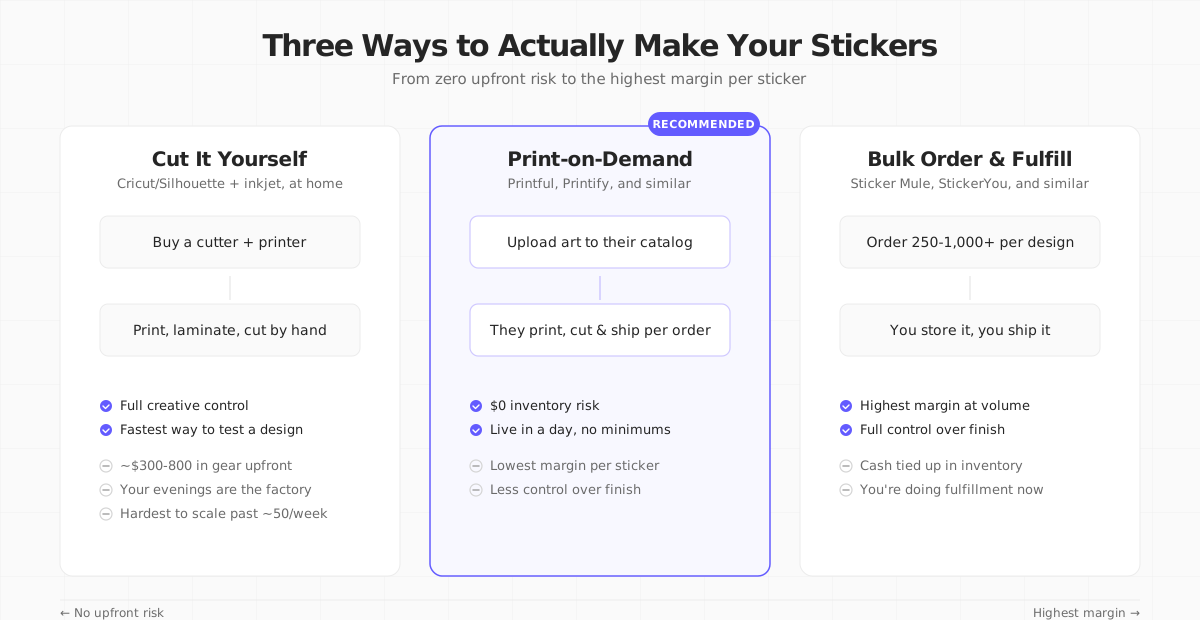
This is the decision that shapes every other number in this guide, and beginners usually only know option one exists.
### Cut them yourself
A vinyl cutter (Cricut, Silhouette, or a step up like a Roland) plus an inkjet printer, laminate, and a cutting mat. [Printful's own breakdown](https://www.printful.com/blog/how-to-start-a-sticker-business) puts a decent cutting machine at roughly $250 to $500 and an inkjet printer anywhere from $100 to $1,000 depending on print quality, so figure $300 to $800 to get a real home setup running. This gives you the most creative control and the fastest turnaround on a single test print, but every sticker you sell is an hour of your own evening, and it stops scaling somewhere around a few dozen orders a week.
### Print-on-demand
Upload your artwork to a POD catalog and they print, cut, and ship each order as it comes in. Zero inventory, zero minimum order, and you can be live the same day.
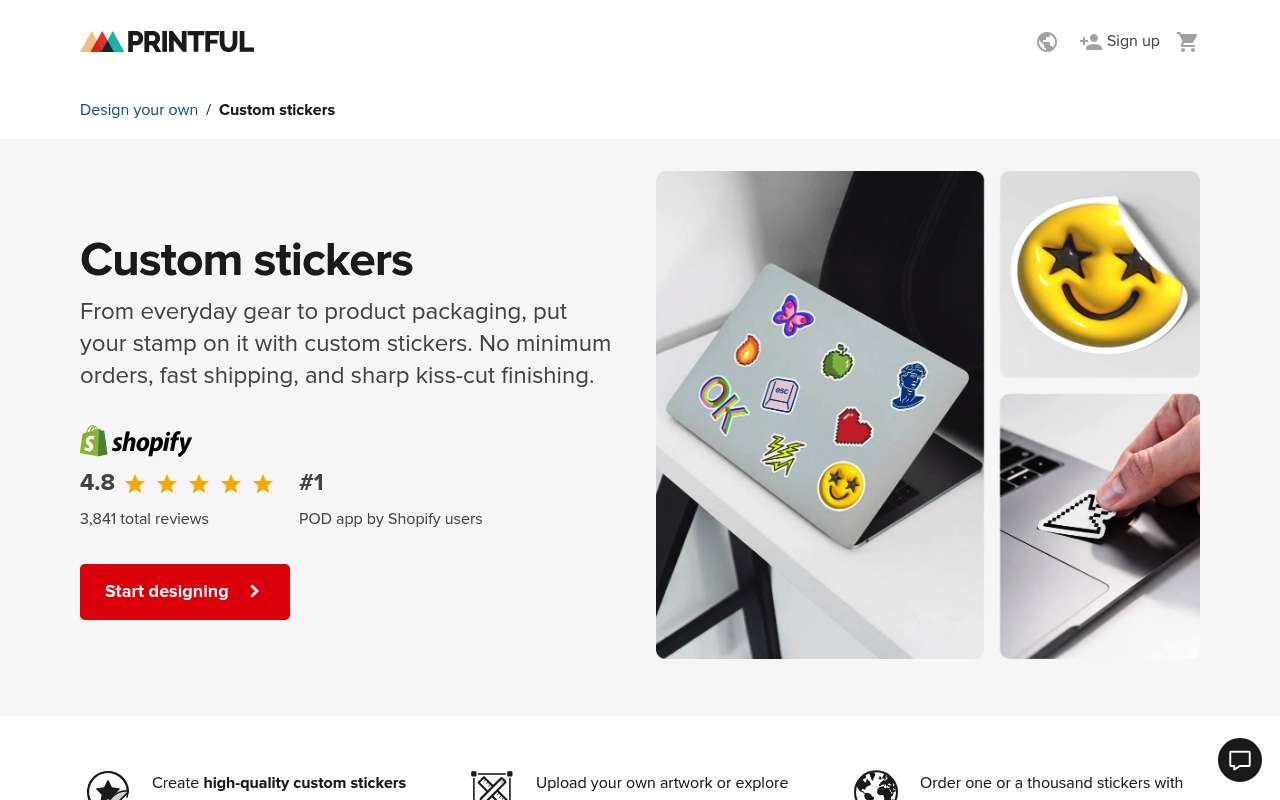
[Printful](https://www.printful.com/custom-stickers) advertises no minimum orders and same-day production on kiss-cut and die-cut stickers, and [Printify](https://printify.com/) connects you to multiple print providers so you can compare price and turnaround per design. The tradeoff is margin: a single 3-inch die-cut sticker typically costs [$2.75 to $3.50 through Printful and $1.02 to $3.78 through various Printify providers](https://merchtitans.com/blog/print-on-demand-stickers-guide) depending on finish and provider, which eats a big chunk of a $4 to $6 retail price. This is the right starting point for almost everyone: it's how you validate a design at zero risk, and it's also the model behind most successful [dropshipping and no-inventory businesses](/blog/how-to-start-dropshipping).
### Bulk order and fulfill yourself
Once a design is proven, order 250 to 1,000+ copies from a bulk sticker printer like Sticker Mule or StickerYou. Bulk vinyl die-cuts run roughly [$0.07 to $0.25 per sticker at 1,000+ units](https://merchtitans.com/blog/print-on-demand-stickers-guide), a fraction of the POD cost per unit. The catch is real: you're now holding inventory, storing it, and packing every order yourself (or paying a fulfillment service to). This is where the actual profit lives, but only after you know a design sells.
**Honest recommendation:** start every new design on print-on-demand. Move a design to a bulk order only after it has sold at least 20 to 30 units on its own, so you know the demand is real before you tie up cash in inventory.
## Step 4: Do the Boring Legal Work
This is the step almost every new sticker seller skips, and it's the one most likely to actually shut a shop down. Unlike candles or cosmetics, stickers don't need fire or ingredient safety testing. What they need is a clean answer to one question: **do you actually have the right to sell this design?**
### Copyright and trademark: the real risk in this business
Copyright protects the artwork itself (the specific drawing, the character's visual design). Trademark protects brand identifiers used in commerce (a character's name, a franchise logo, a catchphrase). A fan-art sticker of a popular cartoon character can violate both at once: copyright in the drawing, trademark in the name printed next to it.
In the **United States**, fair use is a real legal doctrine, but it's judged case-by-case on four factors (purpose, nature of the work, how much was used, and market effect), and [the US Copyright Office is explicit](https://www.copyright.gov/fair-use/) that there's no formula that guarantees a use is fair. A hand-drawn version of a Pokémon character on a sticker doesn't stop being an infringement of Nintendo's copyright just because you drew it yourself, and [Etsy's own fan-art guidance for sellers](https://www.etsy.com/seller-handbook/article/39402098770) walks through exactly this: most fan art sold as merchandise doesn't meet the bar for fair use. If a rights holder files a complaint, the platform removes the listing and the strike lands on your account regardless of any disclaimer in your shop description.
The **EU and UK** run on the same underlying logic (copyright protects the expression, trademark protects the brand), just through different institutions. A trademark registered with the [EUIPO](https://www.euipo.europa.eu/en/trade-marks) covers all 27 EU member states in one filing, while the UK has run its own separate trademark register through the [UK Intellectual Property Office](https://www.gov.uk/how-to-register-a-trade-mark) since Brexit, so a mark protected in the EU isn't automatically protected in the UK or vice versa. The UK's copyright exceptions (called "fair dealing") are narrower than US fair use and don't include a general commercial carve-out, so don't assume a use that might survive scrutiny in the US is automatically fine to sell into the UK.
The safe list: your own original art, art you've licensed with commercial rights, work that's genuinely in the public domain, or designs built around words, patterns, and jokes rather than someone else's copyrighted characters. If you're not sure, that's the signal to redesign, not to add a disclaimer and hope.
Order a physical sample pack from any bulk printer before you commit to a real order. Screens lie: gloss laminate looks warmer in person than on a monitor, and holographic finishes render completely differently under indoor light versus daylight. A $10 sample pack is the cheapest insurance in this entire business.
### Business registration, sales tax, and VAT
In the **US**, a basic business license (usually $50 to $100/year from your city or county) and a sales tax permit in any state where you have "nexus" are the baseline. Since [South Dakota v. Wayfair](https://www.supremecourt.gov/opinions/17pdf/17-494_j4el.pdf) (2018), most states set that economic nexus threshold around $100,000 in sales or 200 transactions per year, so a small side-hustle shop usually only needs to register in its home state at first.
In the **EU**, once your cross-border sales to consumers in other member states pass a combined €10,000/year, you register for VAT through the [One-Stop-Shop scheme](https://europa.eu/youreurope/business/taxation/vat/vat-e-commerce/index_en.htm) rather than registering separately in every country you ship to. In the **UK**, [VAT registration becomes mandatory](https://www.gov.uk/vat-registration/when-to-register) once your taxable turnover passes £90,000 in a rolling 12-month period.
One more thing worth a sentence: if you specifically market a design as a kids' product, the **US** [CPSC's toy safety rules](https://www.cpsc.gov/Business--Manufacturing/Business-Education/Toy-Safety) require third-party lead and small-parts testing for products aimed at children 12 and under, and the **EU's** [General Product Safety Regulation](https://www.etsy.com/seller-handbook/article/1093438529659), in force since December 2024, requires an EU-based responsible person listed on the product page even for sellers outside the EU. Almost no adult sticker shop needs to think about this, but a "sticker book for toddlers" listing does.
## Step 5: Price So the Math Actually Works
The classic mistake: "stickers on Amazon cost $3, so I'll charge $3." That math only works for a factory buying vinyl by the pallet. Here's the honest version for a small shop.
**Rule of thumb for bulk or DIY production:** [price individual stickers at 2.5 to 3x your all-in unit cost, and sticker sheets or packs at 2 to 2.5x](https://merchtitans.com/blog/print-on-demand-stickers-guide), since sheets don't cost proportionally more to make. That multiplier only really works once your unit cost is low, which is exactly why the two paths from Step 3 land at such different margins below. Sticker sheets are also the single best margin booster in this business: production cost is barely higher than a single sticker, but you can [charge $8 to $15 for a sheet](https://merchtitans.com/blog/print-on-demand-stickers-guide) instead of $4 to $6 for one design.
Two worked examples, same design, two production paths:
**Print-on-demand, sold on Etsy.** A 3-inch die-cut sticker costs $2.95 to produce through a POD provider. You sell it for $5.99.
| Where the money goes | $ |
|---|---|
| Production (POD) | $2.95 |
| Etsy transaction fee (6.5%) | $0.39 |
| Etsy payment processing (3% + $0.25) | $0.43 |
| Amortized listing fee | $0.05 |
| **What you keep** | **~$2.17 (36%)** |
**Bulk order, sold on your own site.** Same design, ordered 500 at a time at $0.18/sticker plus a $0.10 mailer. Sold for $4.50 on your own storefront using Stripe.
| Where the money goes | $ |
|---|---|
| Production + mailer (bulk) | $0.28 |
| Card processing (2.9% + $0.30) | $0.43 |
| **What you keep** | **~$3.79 (84%)** |
Same sticker, more than triple the margin, once you're confident enough in the design to put cash into inventory. That gap is the entire argument for Step 3's "start on POD, graduate to bulk" advice: you pay for that 84% margin with cash risk, so don't take it on a design you haven't proven yet.
## Step 6: Set Up a Place People Can Actually Buy From
By now you've got a validated design, a production plan, and pricing that survives fees. Time to give people somewhere to buy.
Your realistic options in 2026, honestly ranked:
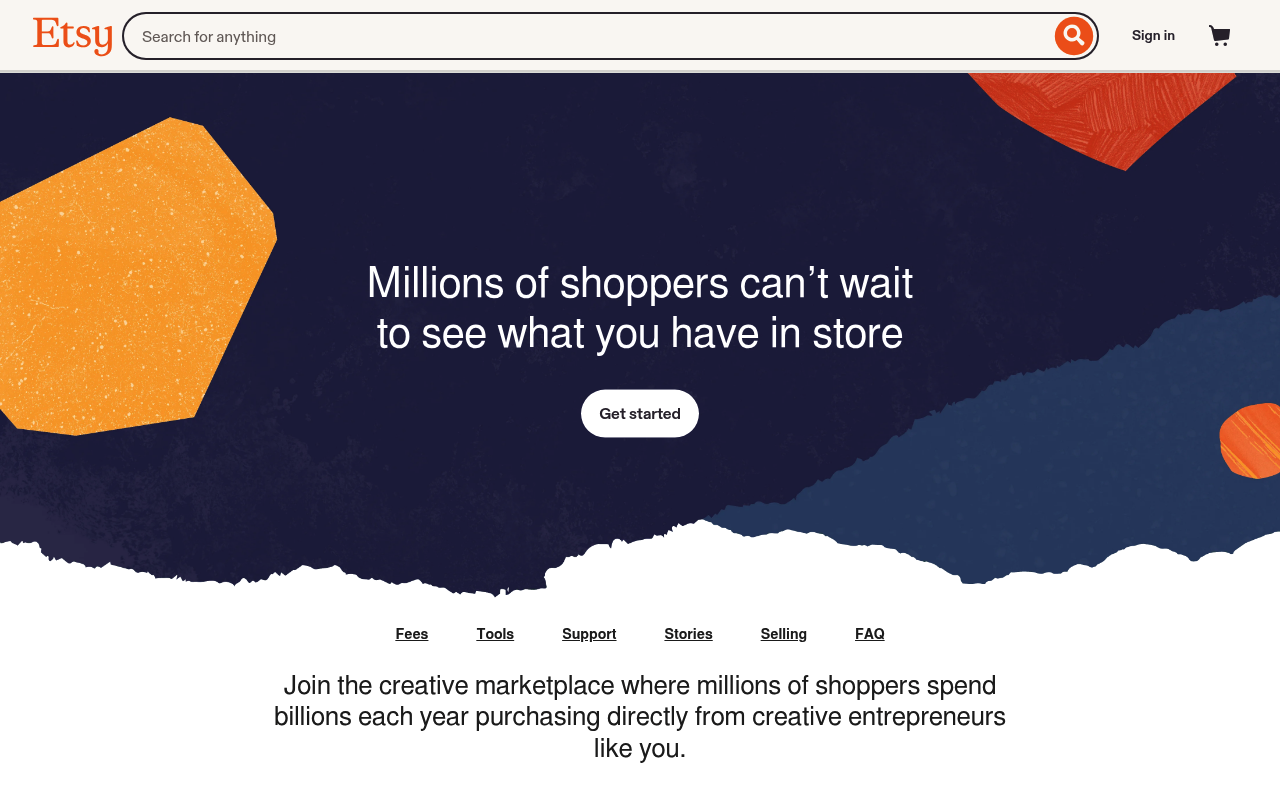
- **[Etsy](https://www.etsy.com/sell)** is where most first-time sticker sellers start, and for good reason: built-in search traffic and buyers who already trust the platform. The cost is real, though: a [$0.20 listing fee, a 6.5% transaction fee, and 3% + $0.25 payment processing](https://printify.com/blog/how-much-does-etsy-take-per-sale/) add up to roughly 10% of every sale before you've spent a cent on marketing, and the customer relationship belongs to Etsy, not you.
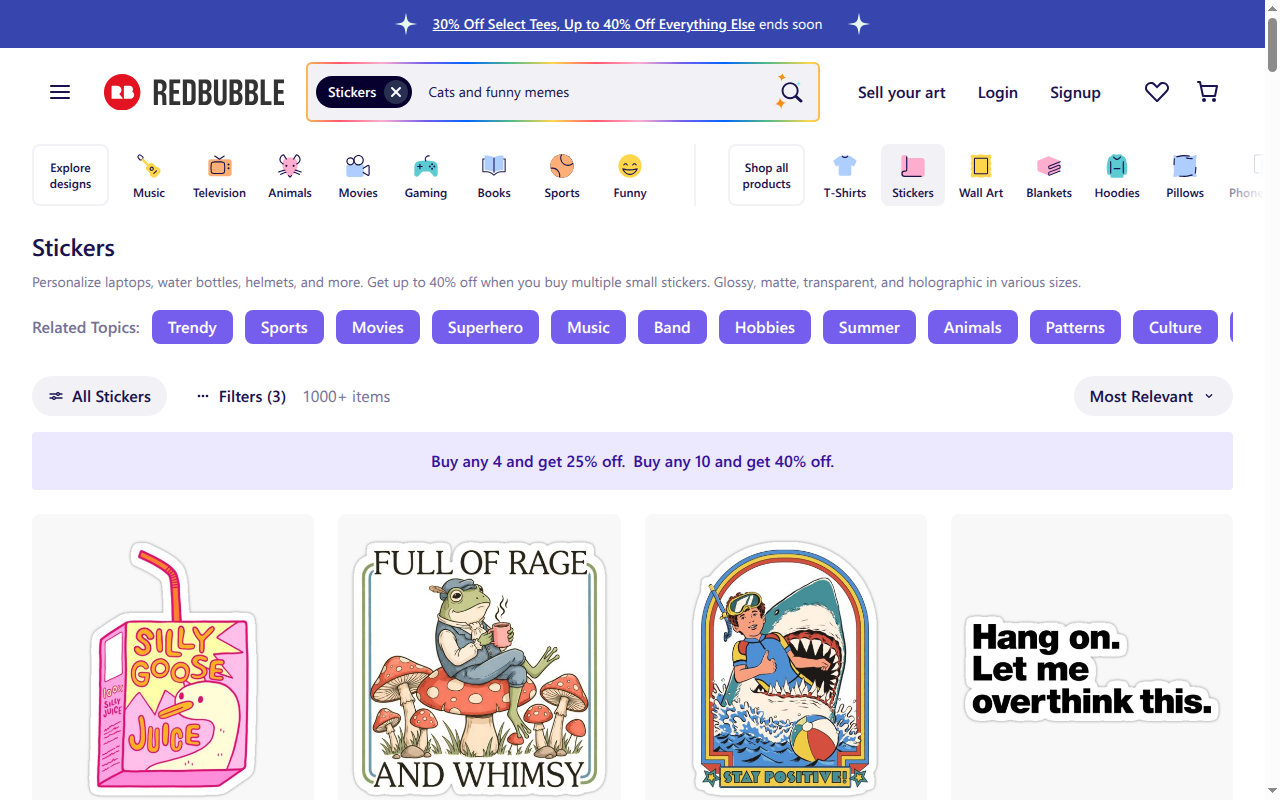
- **[Redbubble](https://www.redbubble.com/shop/stickers)** and similar POD marketplaces handle production, printing, and shipping entirely, in exchange for a much smaller cut of each sale than you'd keep selling direct. Good for pure passive-income designs; bad if you want a real brand people remember.
- **[Your Next Store](https://yournextstore.com/)** (us, to be upfront) gets you a real website instead of just a marketplace listing. Plans start at $30/month ($25/month billed yearly) with **0% platform transaction fees**, an AI-powered builder that sets up product pages and checkout from a description of what you sell, and search, reviews, and email already built in. The advantage over a marketplace: repeat buyers remember your brand, not "that one Etsy shop."
- **[Shopify](https://www.shopify.com/)** is the safe middle ground at $39/month, with an app for almost anything you'll eventually want. Those apps add up fast, though, and Shopify still takes a [small extra fee on every sale](/blog/how-much-does-shopify-take-from-a-100-sale) if a customer pays with something other than Shop Pay.
- **A simple [Stripe payment link](/blog/how-to-sell-online-with-stripe)** plus Instagram DMs works if you only have a handful of designs and your audience is already following you. It's the $0 option, but it doesn't scale past a few orders a day.
**Honest recommendation for most first-time sellers:** run Etsy and your own website at the same time from day one. Etsy brings the traffic; your own site builds the brand and the customer list you actually own. Move repeat buyers to your site with a note in every package, and don't be afraid to drop the marketplace later. You can't easily rebuild the audience you'd lose by skipping it early on.
**0% extra fees on every sale.** A real website for your sticker brand, ready in minutes.
## Step 7: Pick One Channel to Get Discovered
New sticker brands almost always win on one channel first, then expand. Trying five channels at once, badly, is the most common way beginners burn out in month two.
Your honest options:
- **Instagram and TikTok.** Stickers are inherently visual and satisfying to film (the peel, the lay-down on a laptop lid). Works if you can post consistently for 3 to 6 months before judging it. Most sellers quit at week three.
- **Local markets and conventions.** A $30 to $75 table at a farmers market, craft fair, or artist alley in your niche's convention (anime cons for fandom art, maker fairs for design-forward work) puts your product in front of exactly the right stranger. You'll also learn which designs people actually pick up, which no amount of Instagram analytics tells you.
- **Etsy SEO.** Slow (think months, not weeks) but compounding. Titles and tags that match how buyers actually search ("cottagecore mushroom sticker" beats "cute sticker") matter more than a pretty shop banner.
- **Wholesale to small shops.** Once you can reliably produce 100+ stickers a week, a sample pack dropped off at 10 local boutiques, coffee shops, or bookstores in your aesthetic typically converts 2 to 3 into standing orders. Standard wholesale is 50% off retail, so make sure your bulk-order math still works at that price.
- **Sending free stickers to small creators.** Pick 20 to 30 creators in your niche with modest followings, mail them a free sticker pack with a handwritten note. This costs almost nothing per creator and regularly outperforms paid ads for a brand-new shop.
- **Paid ads.** Skip these until an organic channel is already converting. Cold-start ads on a $4 to $6 product rarely survive their own cost per click.
Pick one primary channel and one backup. Give both six months before adding a third.
## What It Actually Costs to Start a Sticker Business in 2026
| Your approach | Upfront cost | What you get |
|---|---|---|
| **POD side hustle** | $0-50 | A few Etsy listings, zero inventory, testing multiple designs risk-free |
| **DIY home setup** | $300-800 | Cutting machine, inkjet printer, laminate, full creative control |
| **First bulk launch** | $800-2,000 | 3-5 proven designs at 250-500 units each, packaging, a real website |
| **Established sticker brand** | $5,000+ | Wholesale accounts, custom packaging, paid creator sends, multiple SKUs |
Two honest notes on that table. First, the **$0 POD path is genuinely the only one with no real downside**, which is exactly why Step 2 tells you to validate there before you spend a dollar on equipment or bulk inventory. Second, a **$2,000 first bulk launch will not feel profitable in month one**: between the wholesale-style unit pricing kicking in only at higher volumes and the time it takes to build repeat buyers, plan for a slower ramp than the margin math in Step 5 implies on paper.
The sticker shops that are still around in two years aren't the ones with the trendiest launch design. They're the ones that picked a specific person to make stickers for, only used art they actually had the right to sell, and priced with the fees already subtracted. Everything else in this guide is just execution.
## FAQ
### How much does it cost to start a sticker business in 2026?
Anywhere from **$0 to $2,000**, depending on the path. Print-on-demand is genuinely free to start beyond a few dollars in Etsy listing fees, since there's no inventory or equipment to buy. A DIY home setup with a cutting machine and printer runs $300 to $800. A first serious bulk order across a handful of proven designs, plus packaging and a website, lands around $800 to $2,000.
### Is a sticker business actually profitable?
Yes, and the margins are unusually good once you're past print-on-demand. A print-on-demand sticker sold on Etsy nets roughly 35-40% after production and platform fees; the same design ordered in bulk and sold on your own site can net 80%+, because bulk production costs pennies per unit while retail prices stay close to the same $4-6 range. The catch is that bulk margin requires upfront cash and unsold-inventory risk that POD doesn't.
### Can I sell fan art stickers legally?
Almost never, if the fan art depicts a copyrighted character or trademarked logo without a license. In the **US**, fair use is a real but narrow legal defense that rarely covers a for-profit sticker of a recognizable character, and Etsy's own seller guidance walks sellers through why most fan-art merchandise doesn't clear that bar. The **EU and UK** protect copyright and trademarks the same way in principle, through separate national and EU-level registries, and the UK's "fair dealing" exceptions are narrower than US fair use. Stick to your own original art, properly licensed designs, or public-domain material.
### What's the best way to produce stickers as a beginner?
**Print-on-demand.** It has no minimum order, no upfront equipment cost, and lets you test as many designs as you want before committing real money. Move a design to a DIY setup or a bulk order only after it's proven itself with actual sales.
### Should I sell on Etsy or build my own website?
**Both, starting on day one.** Etsy gives you instant search traffic from buyers who already trust the platform, for roughly 10% in combined fees. Your own website gives you a brand, your customer list, and the ability to email people who already bought from you. Run both and route repeat buyers to your site over time.
### How long does it take to launch a sticker business?
As little as **a weekend** on the fast path (a few designs, print-on-demand, Etsy) and **4 to 8 weeks** on the more deliberate path (validated designs, a first bulk order, a proper website, a launch plan). The step people skip to launch faster is almost always Step 4's legal check, and it's the one most likely to get a shop suspended later.
### Do sticker sheets sell better than individual stickers?
They sell for more per transaction, which is different from "better." Individual die-cuts are the easiest first purchase for a new customer, but a sticker sheet costs barely more to produce and can be priced at $8-15 instead of $4-6, making it the better margin booster once you have repeat buyers or a themed collection to bundle.
## Related Blog Posts
- [How to Start an Online Store in 2026: A Beginner's Playbook](/blog/how-to-start-an-online-store)
- [How to Start Dropshipping in 2026: A Realistic Guide](/blog/how-to-start-dropshipping)
- [How to Start a Coloring Book Business in 2026](/blog/how-to-start-a-coloring-book-business)
- [How to Start a Fitness Apparel Brand: The Honest Playbook](/blog/how-to-start-a-fitness-apparel-brand)
- [How to Sell Online with Stripe in 2026: 5 Options](/blog/how-to-sell-online-with-stripe)