# How to Start a Jewelry Business in 2026: Materials, Rules, Costs
How to start a jewelry business in 2026: materials, US, EU and UK rules, sourcing vs making, real costs, pricing and a launch plan. Read before you buy metal.
*Published 2026-10-19*
Jewelry looks like the perfect small business: light to ship, high margin on paper, and easy to photograph. It is also a category where the metal on the label has to match the metal in the piece, where returns eat margin, and where photography decides whether anyone clicks. This guide to starting a jewelry business in 2026 covers the materials and rules first, then the money, the brand and the launch, in the order that keeps you out of trouble.
**A small disclosure:** I help run a company that makes online-store software, and our product appears in Step 7. The rest of this guide has nothing to do with us. Where a figure is an example, not a benchmark, I say so.
## The 7 Steps, in Order
1. **Pick a niche and a price band, not just "jewelry."**
2. **Choose your materials and know what you can legally call them.**
3. **Decide how it gets made: you, a workshop or a manufacturer.**
4. **Learn the labeling and safety rules for every market you sell to.**
5. **Price from your real cost, including returns and photography.**
6. **Build the brand and the photos.**
7. **Set up a store, then pick one channel to win.**
## Step 1: Pick a Niche and a Price Band
Jewelry is crowded at every price point, so "pretty necklaces" is not a position. Look at how two well-known direct brands stand apart.
[Mejuri](https://mejuri.com/) sells "everyday fine jewelry" in solid gold and builds its identity on design and a recycled-gold story. [gorjana](https://www.gorjana.com/) sells layered, giftable pieces at accessible prices and leans on a wide range of stackable styles.

You do not need their budgets. You need a corner they are not covering:
- **A material or story:** recycled metals, lab-grown stones, birthstones, mixed-metal pieces.
- **A customer:** men's jewelry, bridal party gifts, sensitive-ear wearers, plus-size friendly rings and bracelets.
- **A style:** minimalist stackables, chunky statement pieces, vintage-inspired, cultural motifs you are part of.
- **A price band:** under $50 impulse buys, $50 to $200 gifts, or $200+ considered purchases. Pick one for your first collection.
Test the idea before you cut a single mold. Post the sketches, run a small pre-order, or sell ten pieces at a market and see which one people ask for twice.
## Step 2: Choose Materials and Know What You Can Call Them
The metal decides your cost, your risk and your claims. There is a ladder, and most first collections sit in the middle.
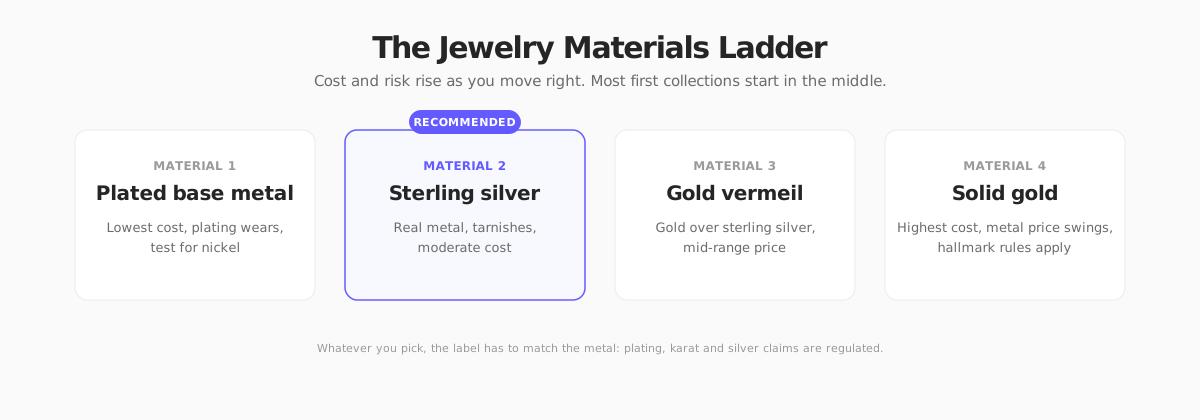
| Material | What it is | Cost | Watch out for |
|----------|-----------|------|---------------|
| **Plated base metal** | Brass, copper or steel with a thin coating | Lowest | Plating wears, and nickel in the base can cause reactions |
| **Sterling silver (925)** | An alloy of at least 92.5% silver | Moderate | It tarnishes, and silver prices move |
| **Gold vermeil** | A thick gold layer over sterling silver | Mid-range | The term has a specific meaning, so claim it carefully |
| **Solid gold (10K to 18K)** | Gold alloy all the way through | Highest | Gold price swings, theft risk and the strictest marking rules |
Two honest notes. First, "gold" on its own is a claim. In the US, the FTC's [Jewelry Guides](https://www.ecfr.gov/current/title-16/chapter-I/subchapter-B/part-23) say how you can describe karat gold, gold plating, gold filled and silver, and they target deceptive descriptions. Second, a cheap plated piece sold as "everyday wear" that turns skin green in a week produces refunds and bad reviews, and the plating story matters more than the price.
If you want a point of comparison for how a gem-and-stone niche is run, our guide to [starting a crystal shop](/blog/how-to-start-a-crystal-shop) covers sourcing and authenticity claims for stones.
## Step 3: Decide How It Gets Made
You have three real options.
| Option | Upfront cost | Control | Best for |
|--------|--------------|---------|----------|
| **Make it yourself** | Tools, metal, workspace | Highest | Handmade brands, small runs, one-of-a-kind pieces |
| **Local workshop or casting house** | Per-piece and setup fees | High | Moving from hobby to repeatable designs |
| **Manufacturer (overseas or domestic)** | Minimums, samples | Medium | Scaling a design you have already sold |
Making it yourself is the cheapest way to learn what sells, but it caps your output and your time. A workshop or caster lets you keep quality control while you grow. A manufacturer brings the lowest unit cost, but expect **minimum order quantities, sample rounds and weeks of lead time**.
Ask every supplier the same questions: what is the minimum order, who owns the design files, what is the plating thickness, how do you test for nickel and lead, and can you send a sample before the run. Request quotes from at least three suppliers, and keep the sample pieces: they are your reference if a batch comes back wrong.
Dropshipping jewelry is possible, but you inherit someone else's quality and a lot of identical stores. Our [dropshipping guide](/blog/how-to-start-dropshipping) covers the trade-offs.
## Step 4: Learn the Labeling and Safety Rules
This is where jewelry differs most by country, so name your markets first.
### In the United States
- **Metal claims.** The FTC [Jewelry Guides](https://www.ecfr.gov/current/title-16/chapter-I/subchapter-B/part-23) cover how you can describe karat gold, plated and filled pieces and silver. Describe what the piece is made of, plainly.
- **Karat marking.** If you stamp a karat mark on gold, US practice is to add the maker's trademark next to it. Confirm the current requirement before you order stamps.
- **Children's jewelry.** If a piece is aimed at children 12 and under, it falls under CPSC rules, including limits on lead and cadmium. See the [CPSC website](https://www.cpsc.gov/).
- **State rules.** California's Proposition 65 can require warnings for listed chemicals, so check state-level rules if you sell there.
### In the EU and UK
- **Nickel, lead and cadmium.** In the EU, REACH sets limits on nickel release from items that touch the skin, and on lead and cadmium in jewelry. The [REACH regulation](https://eur-lex.europa.eu/eli/reg/2006/1907/oj) and its Annex XVII restrictions list are the place to start, and the UK keeps its own version of REACH.
- **Hallmarking in the UK.** Under the [Hallmarking Act 1973](https://www.legislation.gov.uk/ukpga/1973/43), precious metal items above certain weights must be hallmarked by a UK assay office before you can sell them as gold, silver, platinum or palladium. Small items below the weight thresholds are exempt, but the thresholds differ by metal.
- **EU hallmarking.** The EU has no single hallmarking regime, and rules vary by country, so check each market you ship to.
- **EU product safety.** The General Product Safety Regulation expects an identifiable EU contact and traceability for products you sell to EU consumers.
**Always check the current rules where you sell.** This guide summarizes US, EU and UK jewelry rules as of October 2026. Regulations change and vary by country and state, so confirm the details with your local regulator, an assay office or a product compliance specialist before you produce or sell. This is general information, not legal advice.
If you plan to sell across borders, our guides on [selling internationally](/blog/how-to-sell-internationally) and [ecommerce sales tax](/blog/ecommerce-sales-tax) cover duties and VAT.
## Step 5: Price From Your Real Cost
Jewelry looks like a margin machine because a $6 piece can sell for $60. Then you subtract everything else.
Here is an illustrative example for a $60 sterling silver necklace sold direct to the customer:
- **Materials and making:** about $14
- **Packaging and shipping:** about $6
- **Payment fees:** about $2
- **Marketing:** about $18
- **Refunds and exchanges (spread across orders):** about $4
- **What is left:** about $16, before rent, tools and your time
These numbers are an example, not a benchmark, and they swing by niche. The lesson holds: the cost of the metal is the smallest part, so the levers are **order value, repeat customers and returns**.
Rules of thumb:
- **Retail at roughly 2.5 to 4 times your landed cost** for direct sales, then test the whole stack.
- **Wholesale at about half of retail.** A boutique expects to double what it pays.
- **Sell sets.** A pair of earrings plus a necklace raises order value and spreads shipping.
- **Offer a gift option.** Jewelry is bought as a gift, so gift wrap, a note and a clear delivery date convert.
- **Consider a repair or resize policy.** It is cheaper than a refund and builds trust on higher-priced pieces.
- **Watch precious metal prices** if you sell solid gold or silver, and review prices every quarter.
Our [ecommerce shipping strategy](/blog/ecommerce-shipping-strategy) guide covers how to pack and price small, valuable parcels, including insurance and signature options.
## Step 6: Build the Brand and the Photos
Jewelry is bought with the eyes first, and a bad photo reads as a cheap piece. Look at [gorjana](https://www.gorjana.com/): the homepage sells lifestyle first and the product second.

What to decide:
- **A name** that is easy to say, spell and search. Check the trademark databases for your country before you order packaging.
- **A visual system:** one backdrop, one light, one crop. Consistency reads as a brand.
- **Product shots on a body and on a plain background.** Customers want to see scale, so include a model or a hand in every listing.
- **A size and care page.** Chain lengths, ring sizing and how to avoid tarnish cut questions and returns.
- **Packaging.** For jewelry, the unboxing is part of the product, and it is where gift buyers decide whether to buy again.
Our [product photography guide](/blog/ecommerce-product-photography) covers the basics of lighting and angles you can do with a phone.
## Step 7: Set Up a Store, Then Pick One Channel
You need clean product pages with variants for metal, length and ring size, a size guide, gift options, shipping rates that handle insured parcels, and a checkout that is fast on mobile.

Options for a first jewelry brand:
- **[Your Next Store](https://yournextstore.com/)** (us, to be upfront) lets you describe the shop to an AI assistant and get a storefront with products, variants, collections, discount codes and shipping rates. Plans start at $25/month on the yearly plan with 0% platform transaction fees, so only Stripe's standard processing fees apply.
- **[Shopify](https://www.shopify.com/)** has the biggest app ecosystem, including reviews, engraving and size-guide apps, at a monthly cost that grows with the apps you add.
- **[Etsy](https://www.etsy.com/sell)** brings built-in demand for handmade jewelry, but you pay listing and transaction fees and compete directly with thousands of similar shops.
- **Squarespace or Wix** work for a small first drop.
Our [guide to starting an online store](/blog/how-to-start-an-online-store) covers the choices, and [how to sell online with Stripe](/blog/how-to-sell-online-with-stripe) explains payments.
**0% platform fees on every sale.** A fast store for your jewelry brand, ready in minutes.
### Pick one channel first
- **Markets and craft fairs.** The best place to learn which piece people pick up first. You see reactions, set prices in real time and collect emails.
- **Instagram and TikTok.** Short clips of the making process, stacking ideas and unboxings are made for it. Consistency matters more than polish.
- **Etsy as a demand test.** Use it to learn what sells, then drive repeat buyers to your own store.
- **Gifting and seasonal moments.** Valentine's Day, Mother's Day and the holidays carry a large share of jewelry demand, so plan stock and shipping cutoffs early.
- **Boutiques and wholesale.** Once you can fill repeat orders, wholesale adds volume at lower margins. Our [B2B ecommerce guide](/blog/b2b-ecommerce) covers terms.
- **Creators and micro-influencers.** Send pieces to creators in your niche. It is often the best return in the first year.
- **Email.** The most profitable channel once you have customers, especially for gift reminders.
## What It Costs to Start a Jewelry Business in 2026
These are planning ranges, not quotes. Costs vary by material, supplier and country.
| Your approach | Upfront cost | Monthly spend | What you get |
|---------------|--------------|---------------|--------------|
| **Handmade side hustle** | $500 to $2,500 | $50 to $200 | Basic tools, silver or plated stock, photos, a small store |
| **Serious small brand** | $3,000 to $12,000 | $300 to $1,000 | Workshop or sampled manufacturing, a first run, packaging, photography |
| **Real launch** | $15,000+ | $1,500+ | Multiple lines, hallmarking and testing, ads, wholesale |
Where the money goes: metal and stones, tooling and samples, testing or hallmarking, packaging, insurance, photography and the store. **Product liability insurance** is worth pricing early, and many markets and retailers ask for it.
Two honest warnings:
1. **Metal prices and plating quality are not in your control.** Re-check costs every quarter, and test plating on your own wrist before you promise "everyday wear."
2. **Returns and chargebacks sting more on small, high-value parcels.** Photograph every outgoing order and insure what you ship.
The jewelry brands that last are not the shiniest. They are the ones with a clear point of view, claims that match the metal, and a price that survives the cost of photos and returns.
## FAQ
### Do I need a license to sell jewelry?
Usually you need a general business registration and, in some places, a seller's permit for sales tax. Precious metal items add marking rules: in the UK, hallmarking is required above certain weights. Check with your local authority.
### How much does it cost to start a jewelry business?
Roughly $500 to $2,500 for a handmade start, $3,000 to $12,000 for a serious small brand with a first run, and more for a full launch. Photography, packaging and testing are the line items beginners forget.
### What jewelry sells best online?
Everyday pieces like earrings, necklaces and stackable rings tend to sell well, along with gifts and personalized items. Test your own niche before you commit to a large run, since results vary.
### What is the difference between gold plated and gold vermeil?
Both put gold over another metal. Vermeil is generally understood as a thicker gold layer over sterling silver, while plated pieces use thinner coatings, often over base metals. The exact thresholds depend on the market, so check the rules before you use either term in your listings.
### How do I price jewelry?
Start at roughly 2.5 to 4 times your landed cost for direct sales, price wholesale at about half of retail, and check the full stack including shipping, fees and returns.
### Where can I sell jewelry online?
Your own store is best for your brand and customer list. Marketplaces add reach, but you pay fees and compete on price.
## Related Blog Posts
- [How to Start an Online Store in 2026: A Beginner's Playbook](/blog/how-to-start-an-online-store)
- [How to Start a Crystal Shop](/blog/how-to-start-a-crystal-shop)
- [How to Start a Clothing Brand](/blog/how-to-start-a-clothing-brand)
- [Ecommerce Product Photography](/blog/ecommerce-product-photography)
- [Ecommerce Shipping Strategy](/blog/ecommerce-shipping-strategy)