# How to Start a Hot Sauce Business in 2026: Rules, Costs, Launch
How to start a hot sauce business in 2026: FDA and EU/UK rules, co-packer vs home kitchen, real costs, pricing and a launch plan. Read before you cook.
*Published 2026-10-16*
Hot sauce looks like the easiest food business on earth: peppers, vinegar, a blender, a cute label. It is also a regulated, shelf-stable food in a crowded aisle, and the step most beginners skip, getting the recipe cleared for safe bottling, decides whether you can legally sell a single bottle. This guide to starting a hot sauce business in 2026 covers the rules first, then the money, the brand and the launch, in the order that keeps you out of trouble.
**A small disclosure:** I help run a company that makes online-store software, and our product appears in Step 7. The rest of this guide has nothing to do with us. Where a figure is an example, not a benchmark, I say so.
## The 7 Steps, in Order
1. **Find a flavor and a customer, not just a recipe.**
2. **Make the recipe safe and get it reviewed before you scale.**
3. **Choose where to make it: a licensed kitchen, a shared kitchen or a co-packer.**
4. **Label it properly in every market you sell to.**
5. **Price from your real cost, including shipping glass.**
6. **Design the brand and the bottle.**
7. **Set up a store, then pick one channel to win.**
## Step 1: Find a Flavor and a Customer, Not Just a Recipe
The US hot sauce market is large and growing slowly. Estimates vary with how each firm defines it: [IMARC](https://www.imarcgroup.com/united-states-hot-sauce-market) puts the US market at about $1.45 billion in 2025, while other research firms land lower or higher. Treat all of them as approximate. What matters is that the shelf is full, so "good hot sauce" is not a position.
Look at how the brands people talk about stand apart:
- **Fly By Jing** is built on Sichuan chili crisp and a strong cultural point of view.
- **Truff** sells a premium, black-truffle identity at a premium price.
- **Secret Aardvark** is built around a bold, instantly recognizable label.

Pick the angle that is yours:
- **A flavor profile:** fermented, smoky, fruity, garlic-forward, mild-but-flavorful.
- **A heat level for a buyer:** "hot sauce for people who say they hate hot sauce."
- **A cultural or family recipe** with a real story.
- **A use case:** a sauce for eggs, for pizza, for wings, for noodles.
Then test it on strangers, not friends. Hand out small samples at a farmers market or a tasting and watch what they do. The sauce people ask to buy on the spot is your product.
## Step 2: Make the Recipe Safe and Get It Reviewed
This is the step that turns a hobby into a business, and where the rules differ most by country.
### In the United States
A bottled shelf-stable hot sauce usually counts as an **acidified food**: a low-acid ingredient (peppers, garlic, vegetables) preserved with acid so the finished product has a pH of 4.6 or below. The FDA regulates these under [21 CFR Part 114](https://www.ecfr.gov/current/title-21/chapter-I/subchapter-B/part-114). In practice, that tends to mean:
- **The recipe and process are reviewed by a recognized process authority** who confirms the finished pH and the heat or hold step make it safe. Do not skip this, and do not rely on a pH strip and a guess.
- **The facility is registered with the FDA** and the process is filed with the agency. These are the FCE registration and SID process filings you will hear about from co-packers and process authorities. Confirm the current forms and deadlines on the [FDA's page](https://www.fda.gov/food/registration-food-facilities-and-other-submissions/establishment-registration-and-process-filing-acidified-and-low-acid-canned-foods) rather than a blog.
- **A trained supervisor** is required for acidified food processing, which in practice means completing an approved course such as the Better Process Control School.
- **Good manufacturing practices** apply to the kitchen, the labeling and the records.
Some producers get a second path through state cottage food laws, but that varies a lot. Some states list acidified foods in their cottage rules with pH testing and a written food safety plan, while others exclude them, and a home kitchen is not automatically allowed to make shelf-stable acidified sauce. Check your own state's statute and your state department of agriculture or health before you assume.
### In the EU and UK
There is no single "acidified foods" regime like the FDA's. Instead:
- You register as a **food business** with your local authority, and in the UK you register with your local council through [GOV.UK](https://www.gov.uk/food-business-registration).
- Your process must follow **HACCP-based food safety** principles, with documented controls on the acidity and heat step.
- **Allergen and ingredient labeling** follows [Regulation (EU) No 1169/2011](https://eur-lex.europa.eu/eli/reg/2011/1169/oj), with the UK keeping its own retained version.
If the rules look like a lot, that is the best argument for Step 3.
## Step 3: Choose Where to Make It
You have three real options.
| Option | Upfront cost | Control | Best for |
|--------|--------------|---------|----------|
| **Licensed or shared commercial kitchen** | Rent by the hour or month | High | Early batches, recipe tuning, farmers markets |
| **Co-packer (contract manufacturer)** | Minimums and setup fees | Medium | Scaling once the recipe is proven |
| **Your own facility** | Highest | Full | Brands with real volume |
Most new brands should start in a **shared commercial kitchen** while they tune the recipe and test demand, then move to a **co-packer** when they need volume. A co-packer often handles the process filing, the bottling line and the paperwork, and quotes a minimum run. Ask early about minimum order quantities, who owns the recipe, how the process filing is handled, and whether they will make a small first batch.
Get quotes from at least three co-packers. The cheapest is rarely the best, since they differ in bottling formats, label handling and how they treat small brands.
## Step 4: Label It Properly
A hot sauce label is a legal document before it is marketing. In the US you will generally need:
- A **statement of identity** (what the product is) and a **net quantity** in both US and metric units.
- An **ingredient list** in descending order by weight.
- **Allergen declarations** for the major allergens. Check the [FDA's allergen page](https://www.fda.gov/food/food-allergens-gluten-free-guidance-documents-regulatory-information/food-allergies) for the current list, and watch for ingredients like soy, wheat (in some soy sauces) or fish (in some Worcestershire).
- The **name and place of business** of the manufacturer or distributor.
- **Nutrition facts**, unless you qualify for a small business exemption. Confirm the exemption rules with the FDA before you rely on it.
In the EU and UK, the label has to include the allergens emphasized in the ingredient list, the net quantity, a best-before date and the business address, and it must be in the local language.
Never label a sauce with health claims ("boosts metabolism," "anti-inflammatory") without legal advice. Those claims change how a product is regulated.
**Always check the current rules where you sell.** This guide summarizes US, EU and UK food rules for hot sauce as of October 2026. Regulations change and vary by state and country, so confirm the details with your local food authority, the FDA or a food regulatory specialist before you produce or sell. This is general information, not legal advice.
## Step 5: Price From Your Real Cost
Hot sauce is cheap to make and expensive to ship. A 5 oz glass bottle is heavy, breakable and usually bought in ones and twos, which is the opposite of what shipping rates reward.
Here is an illustrative example for a $12 bottle sold direct to the customer:
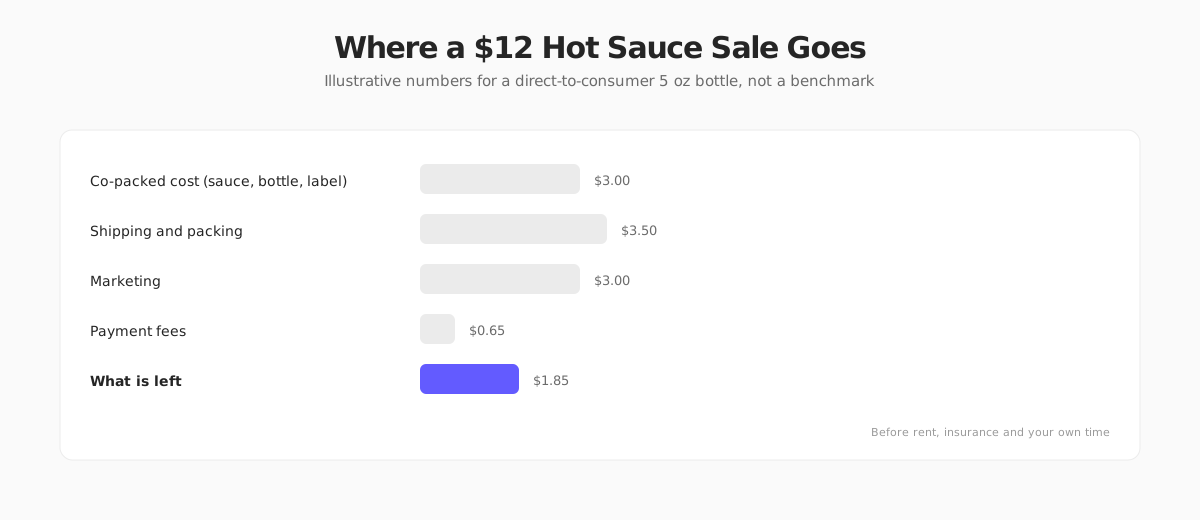
In this example the bottle costs about $3 to make, but only about $1.85 is left after shipping, ads and payment fees. That is why most sauce brands push **bundles, subscriptions and wholesale** instead of single bottles.
Rules of thumb:
- **Aim for a retail price of roughly 3 to 4 times your landed cost** per bottle, then test the full stack.
- **Wholesale at about half of retail.** Shops typically expect to double what they pay, so a $12 shelf price means a wholesale price near $6. Check that you still make money at that number.
- **Sell sets.** A trio or a "heat ladder" raises order value and spreads shipping.
- **Set a free shipping threshold** that pushes people to three bottles.
- **Offer a subscription** if people use it weekly. Repeat customers are cheaper than new ones. Our guide to [selling subscriptions online](/blog/how-to-sell-subscriptions-online) shows how.
See our [ecommerce shipping strategy](/blog/ecommerce-shipping-strategy) guide for how to price and pack heavy, breakable orders.
## Step 6: Design the Brand and the Bottle
The label does the selling in the first three seconds, in a feed or on a shelf. Look at [Secret Aardvark](https://secretaardvark.com/): the packaging is unmistakable, and the site looks like the bottle.

What to decide:
- **A name** that is easy to say, spell and search. Search it, and check the trademark databases for your country before you print labels.
- **A bottle format.** A 5 oz woozy bottle is the classic. Smaller formats ship cheaper and make better gifts.
- **A heat story.** A simple scale or a name per heat level makes the range easy to choose from.
- **Photography.** Bottles on food sell better than bottles on white. Shoot the sauce on eggs, tacos and noodles. Our [product photography guide](/blog/ecommerce-product-photography) covers the basics.
## Step 7: Set Up a Store, Then Pick One Channel
Food is a repeat-purchase category, so own your customer list from day one. You need clean product pages, variants for bottle size and heat level, bundles, shipping rates that handle weight, and a checkout that is fast on mobile.


Options for a first sauce brand:
- **[Your Next Store](https://yournextstore.com/)** (us, to be upfront) lets you describe the shop to an AI assistant and get a storefront with products, variants, collections, discount codes and shipping rates. Plans start at $25/month on the yearly plan with 0% platform transaction fees, so only Stripe's standard processing fees apply.
- **[Shopify](https://www.shopify.com/)** has the biggest app ecosystem, including subscription apps, at a monthly cost that grows with the apps you add.
- **[Etsy](https://www.etsy.com/sell)** is better for crafts than food, and food listings have their own policies, so check before you plan around it.
- **Squarespace or Wix** work for a small first drop.
Our [guide to starting an online store](/blog/how-to-start-an-online-store) covers the choices, and [how to sell online with Stripe](/blog/how-to-sell-online-with-stripe) explains payments.
**0% platform fees on every sale.** A fast store for your hot sauce brand, ready in minutes.
### Pick one channel first
- **Farmers markets and food festivals.** The best channel for a new sauce. Sampling is the product, and you build an email list on the spot.
- **Local retail.** Specialty grocers, butchers, bottle shops and gift stores often take a new local sauce. Bring a sample and a price sheet.
- **Instagram and TikTok.** Taste tests, heat challenges and recipe clips are made for it. Consistency matters more than polish.
- **Food creators.** Send bottles to creators in your niche. It is often the best return under $10,000 in sales.
- **Wholesale and distributors.** Once you can fill repeat orders, wholesale adds volume at lower margins. Our [B2B ecommerce guide](/blog/b2b-ecommerce) covers terms.
- **Email and subscriptions.** The most profitable channel once you have customers.
- **Paid ads.** Wait until you have a bundle and an offer that already sells organically.
## What It Costs to Start a Hot Sauce Business in 2026
These are planning ranges, not quotes. Costs vary by state, country, co-packer and recipe.
| Your approach | Upfront cost | Monthly spend | What you get |
|---------------|--------------|---------------|--------------|
| **Shared kitchen side hustle** | $1,500 to $4,000 | $100 to $300 | Process review, small batches, labels, markets |
| **Serious small brand** | $5,000 to $15,000 | $300 to $1,000 | Co-packed first run, a store, photography, samples |
| **Real launch** | $20,000+ | $1,500+ | Multiple flavors, retail pushes, ads, trade shows |
Where the money goes: the process review and registration, ingredients, bottles and labels, insurance, the store and photography. **Product liability insurance** is not optional for food. Many retailers and markets require it before they will stock or host you.
Two honest warnings:
1. **Food is slow to scale.** Minimum runs tie up cash, and a recipe change can restart the paperwork.
2. **The cheapest mistake is a small first batch.** The most expensive one is 5,000 labels with the wrong allergen statement.
The sauces that last are not the hottest. They are the ones with a clear flavor, a safe and documented process, and a price that survives the cost of shipping glass.
## FAQ
### Do I need a license to sell hot sauce?
Almost always, yes. You need a food business registration with your local or state authority, and in the US a shelf-stable sauce is usually an acidified food with FDA rules for registration and process filing. In the EU and UK you register as a food business and follow HACCP-based safety rules. Check with your authority.
### Can I sell hot sauce made in my home kitchen?
It depends on where you live. Some US states allow certain acidified foods under cottage food laws with testing and a safety plan, while others do not. Selling across state lines and online usually brings federal rules into play. Check your state's statute, or use a licensed shared kitchen.
### How much does it cost to start a hot sauce business?
Roughly $1,500 to $4,000 for a shared-kitchen start, $5,000 to $15,000 for a serious small brand with a co-packed first run, and more for a full launch. The process review, packaging and insurance are the line items beginners forget.
### What pH does hot sauce need to be?
In the US, an acidified food needs a finished equilibrium pH of 4.6 or below, and most hot sauces are well under that. The number alone does not make a sauce legal, since the process and filing still apply. Have a process authority review your recipe.
### How do I price hot sauce?
Start at 3 to 4 times your landed cost per bottle, price wholesale at about half of retail, and check the full stack including shipping and fees. Bundles and subscriptions protect your margin.
### Where can I sell hot sauce online?
Your own store is best for your brand and customer list. Marketplaces and specialty retailers add reach, but check each platform's food policy first.
## Related Blog Posts
- [How to Start an Online Store in 2026: 7 Steps to Your First Sale](/blog/how-to-start-an-online-store)
- [How to Start a Chocolate Business](/blog/how-to-start-a-chocolate-business)
- [How to Start a Coffee Brand](/blog/how-to-start-a-coffee-brand)
- [How to Sell Subscriptions Online](/blog/how-to-sell-subscriptions-online)
- [Ecommerce Shipping Strategy](/blog/ecommerce-shipping-strategy)