# How to Start a Home Decor Brand in 2026: Costs, Sourcing, Launch
How to start a home decor brand in 2026: pick a niche, source products, price for breakage and returns, and launch online. See real costs before you order.
*Published 2026-10-16*
Home decor is an easy category to fall in love with and a hard one to make money in. The photos are beautiful, the starting orders are small, and almost everything you sell is fragile, bulky or both. This guide covers how to start a home decor brand in 2026 the unglamorous way: pick one corner of the home, choose how you will source, do the margin math before you order, and launch with a store that can show a vase on a shelf as well as it sells it.
**A small disclosure:** I help run a company that makes online-store software, and our product shows up in Step 6. The other steps have nothing to do with us. Where a number is an example rather than a benchmark, I say so.
## The 7 Steps, in Order
1. **Pick one corner of the home and one style.** "Home decor" is not a niche. "Textured ceramics for small kitchens" is.
2. **Choose how you will source: make it, print it, or buy it.** This decides your margin, your risk and your timeline.
3. **Test with a small first run before you commit to inventory.**
4. **Price for shipping, breakage and returns, not just the product.**
5. **Handle the safety and compliance basics for what you sell.**
6. **Set up a store that shows the product in a room.**
7. **Pick one channel to win first.**
## Step 1: Pick One Corner of the Home and One Style
Walk through any big home retailer's site and you will see the problem: ten thousand products, no point of view. A new brand cannot win that fight on range or price. It wins by being the obvious answer for one kind of room and one kind of person.
Narrow it in two cuts:
- **A category:** wall art, ceramics and vases, throw pillows and textiles, candles and scent, lighting, mirrors, shelving and storage, seasonal decor.
- **A style and a buyer:** "warm minimal for first apartments," "maximalist color for renters," "Japandi for small bedrooms," "farmhouse for people who hate farmhouse."
A useful test: can you describe your best customer's living room in one sentence? If you can, you can also pick the product, the photos and the words on your site.
Look at how established small brands stay narrow. [Juniper Print Shop](https://juniperprintshop.com/) is built around framed art and prints, and the homepage sells a room ("your walls need a refresh") rather than a catalog.

If you are still deciding whether decor is the right category at all, our [guide to starting an online store](/blog/how-to-start-an-online-store) covers the customer and category decisions first. If your idea leans toward larger pieces, read [how to start a furniture brand](/blog/how-to-start-a-furniture-brand) before you commit, because furniture adds freight, assembly and tip-over rules that decor mostly avoids.
## Step 2: Choose How You Will Source
There are four realistic ways to get product, and most first brands should start with the one that has the least inventory risk.
| Model | Upfront cost | Typical gross margin | Biggest risk |
|-------|--------------|----------------------|--------------|
| **Print on demand** (art, pillows, mugs, blankets) | Near $0 | Roughly 30 to 50% | Thin margin, sameness, quality you do not control |
| **Dropshipping** from a supplier catalog | Near $0 | Roughly 20 to 40% | No differentiation, long shipping, supplier stock-outs |
| **Private label or wholesale** (you pick, brand and stock) | $1,500 to $10,000 | Roughly 50 to 65% | Minimum order quantities, cash tied up in stock |
| **Make it yourself** (ceramics, woodwork, textiles) | $500 to $5,000 in tools and materials | Varies widely | Your time is the real cost, and it does not scale |
Those ranges are rules of thumb from how small brands usually describe their economics, not published benchmarks. Your supplier quotes are the only numbers that matter.
### Print on demand for art and textiles
Print on demand is the cheapest way to test a decor idea because nothing is made until someone buys. [Printful](https://www.printful.com/), for example, prints and ships framed posters, canvases, pillows and blankets to your customers, and connects to common store platforms. The trade-off is margin and sameness: if your design could be on anyone's store, it will be.

Print on demand works best when the design is the product: original illustration, photography, typography, or a niche theme nobody else serves. Order samples of every product yourself before you list it. Color and paper quality vary more than the mockups suggest. Our [dropshipping guide](/blog/how-to-start-dropshipping) covers the model in more depth, including where it breaks.
### Private label and wholesale for objects
If you sell objects with a point of view (vases, trays, lamps, linen), the usual path is working with a manufacturer or a wholesale supplier, either by customizing their existing designs or by commissioning your own. Expect minimum order quantities, sample rounds and lead times of several weeks to a few months, longer if the product ships by sea.
Two habits save new brands real money:
1. **Order samples from at least three suppliers** and compare them side by side, including packaging. A beautiful vase in a flimsy carton is a refund waiting to happen.
2. **Ask for a drop test and a packed weight** before you agree to a quantity. Your shipping cost is set by the packed box, not the vase.
### Making it yourself
Makers have the strongest story and the weakest scale. If you throw ceramics or pour concrete planters, price the hours honestly. A piece that takes two hours and sells for $48 is a hobby, not a business. Many makers launch handmade and move the best sellers to a small-batch workshop once demand is proven.
## Step 3: Test Before You Commit to Inventory
You do not need 500 units to find out whether people want your idea. Three cheap tests, in order of how much they tell you:
1. **Styled photos plus a waitlist.** Mock up a room with prototypes or print-on-demand samples, shoot it, and put it on a one-page site with an email field. Send a few hundred dollars of traffic to it. If almost nobody signs up, change the idea, not the ad.
2. **Pre-orders for a first run.** "Ships in six weeks" with a real checkout is the strongest signal short of a sale. Ten strangers paying beats a thousand likes.
3. **A craft fair or pop-up table.** Decor is tactile. People pick things up, turn them over and tell you exactly what is wrong. A weekend table costs a booth fee and teaches you more than a month of ads.
Keep the first order small enough that you could write it off. A first run that costs $1,000 and teaches you the real return rate is cheaper than a $10,000 run that teaches you the same thing.
## Step 4: Price for Shipping, Breakage and Returns
This is where decor brands quietly lose money. Home goods are heavy for their price, awkward to pack and easy to break. The product cost is the smallest surprise on the invoice.
Here is an illustrative example for a $48 ceramic vase sold direct to the customer:
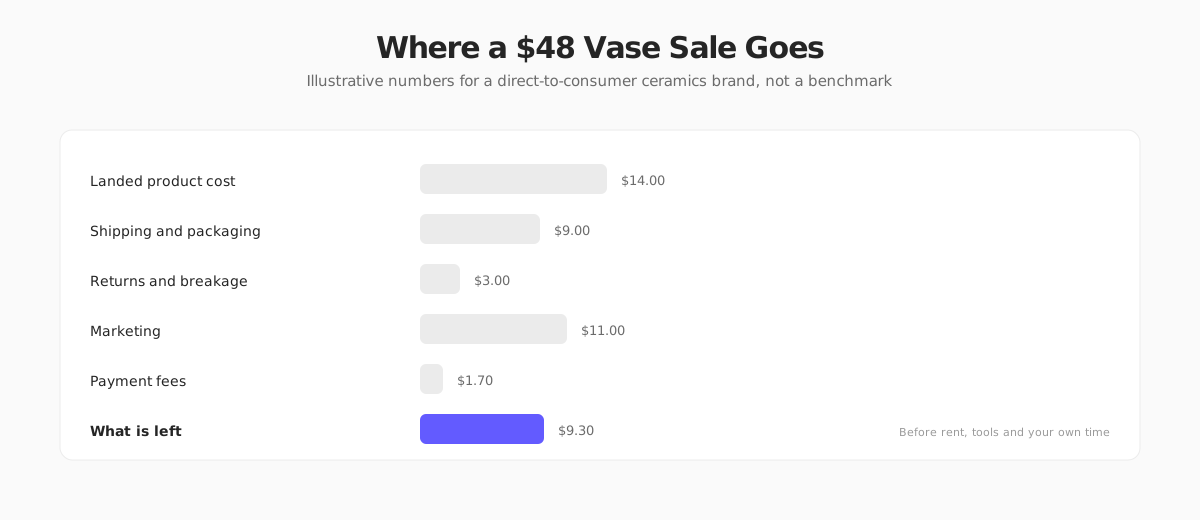
In this example the vase costs $14 landed, but only about $9 of the $48 is left once shipping, breakage, ads and payment fees are paid. That is roughly 19%, before rent, tools or your own pay. The numbers will differ for you, but the shape rarely does.
A workable rule of thumb: **aim for a retail price of at least 3 to 4 times your landed product cost**, then check the full stack above. If the margin disappears at 3x, the product is too heavy, too fragile or too cheap for direct-to-consumer.
Levers that actually move the number:
- **Set a free-shipping threshold** above your average order value so customers add a second item.
- **Bundle** (a vase plus stems, a frame plus a print, a set of three). Bundles raise order value without raising ad cost.
- **Design for the box.** Nesting shapes, flat-pack frames and lighter materials cut freight more than negotiating does.
- **Charge for shipping honestly** on heavy items rather than hiding it in the price, and test both.
- **Insure or reserve for breakage.** Plan for a few percent of fragile orders arriving damaged and decide your replacement policy up front.
Returns deserve a written policy before launch. Decor is bought on screens, so color and scale disappoint more often than in categories with a standard size. Shoot with a scale reference (a hand, a book, a chair), list exact dimensions, and send fabric or finish swatches for anything where color matters.
For a deeper look at the shipping side, see our [ecommerce shipping strategy](/blog/ecommerce-shipping-strategy) guide.
## Step 5: Handle the Safety and Compliance Basics
Decor feels low-risk, but a few product types carry real rules. Which ones apply depends on what you make and where you sell.
### In the United States
- **Ceramics and glass that touch food.** Mugs, plates and serving bowls are regulated as food-contact items by the FDA, and lead or cadmium in glazes is the classic problem. If a piece is decorative only, say so clearly on the label and listing.
- **California Proposition 65.** Products sold in California can need a warning if they contain listed chemicals above set levels. Metal, painted and vinyl items are common triggers. The state's [Proposition 65 site](https://oehha.ca.gov/proposition-65) lists the chemicals.
- **Candles.** If you sell candles, the labeling and burn-testing rules are their own topic, covered in our [candle business guide](/blog/how-to-start-a-candle-business).
- **Furniture and freestanding units.** Dressers, shelving and similar items can fall under tip-over safety rules. See our [furniture brand guide](/blog/how-to-start-a-furniture-brand).
### In the EU and UK
- **EU:** the [General Product Safety Regulation](https://eur-lex.europa.eu/eli/reg/2023/988/oj) has applied since December 2024. For non-food consumer products sold into the EU, it expects an identifiable manufacturer and, for sellers based outside the EU, an economic operator established in the EU who is responsible for the product, with contact details on the product or packaging. Marketplaces are enforcing this on listings.
- **UK:** consumer products sold in Great Britain fall under the General Product Safety Regulations 2005, with their own traceability and labeling expectations.
Beyond the safety rules, check sales tax or VAT, and customs duties if you ship across borders. Our guides to [ecommerce sales tax](/blog/ecommerce-sales-tax) and [selling internationally](/blog/how-to-sell-internationally) cover both.
**Always check the current rules where you sell.** This guide summarizes US, EU and UK product rules for home decor as of October 2026. Regulations change and vary by country and by product type, so confirm the details with your local regulator or a product compliance specialist before you manufacture, label or sell. This is general information, not legal advice.
## Step 6: Set Up a Store That Shows the Product in a Room
Decor sells on photographs. A product on a white background answers "what is it?" A product on a shelf, in a corner, next to a plant answers "what would it do for my room?" The second question sells.
You need three things from your store:
1. **Great image handling.** Large photos, zoom, several angles and a room shot per product. Our guide to [ecommerce product photography](/blog/ecommerce-product-photography) covers how to shoot them on a budget.
2. **Variants that make sense.** Size, color and finish should be options on one product, not five separate listings.
3. **Fast pages.** Decor pages are image-heavy, and slow image loading is the quickest way to lose a visitor on mobile.

The main options for a first decor brand:
- **[Your Next Store](https://yournextstore.com/)** (us, to be upfront) lets you describe the store to an AI assistant and get a modern storefront with products, variants, collections, search and checkout. Plans start at $25/month on the yearly plan, with 0% platform transaction fees, so only Stripe's standard processing fees apply. It is a good fit if you want a fast, image-first store you can keep customizing.
- **[Etsy](https://www.etsy.com/sell)** is where many makers begin. You get built-in traffic and a trusting audience, at the cost of listing and transaction fees and a customer who thinks of themselves as an Etsy shopper.
- **[Shopify](https://www.shopify.com/)** is the safe middle ground, with the largest app ecosystem. Apps and themes can add up as you grow.
- **Squarespace or Wix** are design-led and quick for a small first drop, though many brands outgrow them.
- **Print on demand platforms** can run storefronts too, but your brand and customer list are better on a store you control.
For most first-time decor brands, a sensible start is a store you own for your brand and customer list, plus one marketplace for discovery. Our [Stripe selling guide](/blog/how-to-sell-online-with-stripe) explains how payments work behind any of these.
**0% platform fees on every sale.** An image-first store for your decor brand, ready in minutes.
## Step 7: Pick One Channel to Win First
New decor brands almost always win on one channel first. The beginner trap is spreading a small budget across six.
- **Pinterest.** Decor is what people plan on Pinterest, and pins keep working long after you post them. It is slow to start but unusually good for a visual category.
- **Instagram and TikTok.** Room makeovers, styling videos and "how I use it" clips sell the feeling. Plan to post consistently for months, not weeks.
- **Interior designers and stylists.** One designer who likes your work can buy repeatedly. Offer a trade discount and fast samples.
- **Wholesale to boutiques.** Once you can fill repeat orders, wholesale adds volume at about half your retail price. Check that the math still works at that price. Our [B2B ecommerce guide](/blog/b2b-ecommerce) covers terms and tiers.
- **SEO.** Searches such as "textured vase for small shelf" or "boho wall art set" convert well, but take months. Our [ecommerce SEO guide](/blog/ecommerce-seo) shows where to start.
- **Email.** The most profitable channel once you have customers. Collect an email from the first day.
- **Paid ads.** Wait until you have content and offers that already work organically.
Pick one main channel and one backup, and run both for six months before you add a third.
## A Word on Seasonality
Decor demand clusters around a few moments: spring refreshes, moving season, the autumn nesting months and the holiday gift period. Build your calendar backward from them. A holiday collection needs to be shot and in stock before the season starts, and sea freight lead times mean orders for peak season are often placed months earlier. Use the quiet months to shoot new room scenes and test your next collection with a small pre-order.
## What It Costs to Start a Home Decor Brand in 2026
These are planning ranges, not quotes. Real costs depend on your product, supplier and country.
| Your approach | Upfront cost | Monthly spend | What you get |
|---------------|--------------|---------------|--------------|
| **Print on demand test** | $200 to $800 | $30 to $100 | Samples, a store, a handful of designs |
| **Small private label run** | $2,000 to $6,000 | $100 to $400 | One collection, branded packaging, styled photos |
| **Maker studio** | $1,000 to $5,000 | $100 to $500 | Tools, materials, small batches, craft fairs |
| **Serious launch** | $10,000+ | $1,000+ | Multiple products, professional photography, ads, wholesale samples |
Two honest warnings:
1. **Photography is not optional.** For decor it is closer to the product than to marketing. Budget for it.
2. **Inventory is the cash trap.** Stock sitting in a spare room does not pay for the next order. Keep the first run small.
The brands that last are not the ones with the most products. They are the ones that picked a clear style, priced for the real cost of a fragile box, and showed the product in a room people wanted to live in.
## FAQ
### How much does it cost to start a home decor brand?
From a few hundred dollars for a print on demand test to $10,000 or more for a private label launch with professional photography. The biggest costs are inventory, photography and shipping supplies, with the store itself usually the cheapest part.
### Is a home decor business profitable?
It can be, but margins are squeezed by shipping and breakage. Many decor items are heavy for their price, so a product that looks like a 60% margin on paper can fall well below that after shipping, returns and ads. Price against the full cost, not just the product.
### Do I need a business license to sell home decor?
In most places you need a basic business registration and a sales tax or VAT registration once you pass local thresholds. Product-specific rules apply to food-contact ceramics, candles and furniture. Check with your local authority.
### What is the best way to source home decor products?
Print on demand has the lowest risk for art and textiles, private label suits objects with a clear style, and making your own suits a craft story. Whichever you choose, order samples and test packaging first.
### Should I sell on Etsy or my own website?
Both, ideally. A marketplace gives you discovery, and your own store gives you the brand and the customer list. Move repeat customers to your own store over time.
### How do I price home decor?
Start at 3 to 4 times landed product cost, then check the full stack: shipping, packaging, breakage, returns, ads and payment fees. If the margin only works at a price your customer will not pay, change the product.
## Related Blog Posts
- [How to Start an Online Store in 2026: 7 Steps to Your First Sale](/blog/how-to-start-an-online-store)
- [How to Start a Furniture Brand](/blog/how-to-start-a-furniture-brand)
- [How to Start a Candle Business in 2026](/blog/how-to-start-a-candle-business)
- [How to Start a Bedding Brand](/blog/how-to-start-a-bedding-brand)
- [Ecommerce Product Photography](/blog/ecommerce-product-photography)