# How to Start a Furniture Brand in 2026: The Honest Playbook
How to start a furniture brand in 2026: pick a niche, choose a manufacturer, price freight and returns in, meet safety rules, and sell online. Start here.
*Published 2026-10-14*
Most furniture brands do not fail because the design was ugly. They fail because a $1,000 sofa leaves $130 on the table once freight, returns and ads are paid. This guide covers how to start a furniture brand, meaning your own line with your own name on it, in seven steps, with the margin math and the safety rules most beginner guides skip.
**A small disclosure:** I work on the team behind Your Next Store, an online store builder. It shows up in Step 6 as one option among several. The rest of the guide has nothing to sell you.
If you want to open a shop that resells other people's furniture, read our [furniture store playbook](/blog/how-to-start-a-furniture-store) instead. This one is for people who want to design a product and put a brand on it.
## The 7 Steps, in Order
1. **Pick one piece and one customer.** Not "modern furniture for everyone."
2. **Validate with renders, samples and pre-orders before you pay for tooling.**
3. **Choose your production model:** white label, custom manufacturer, or local maker.
4. **Handle safety and compliance before the first unit ships.**
5. **Price with freight, returns and ads baked in.**
6. **Set up a website built for big, expensive purchases.**
7. **Pick one channel to get noticed.**
## Step 1: Pick One Piece and One Customer
Furniture is the opposite of candles. Every unit is big, heavy, expensive to ship and slow to remake if the first version is wrong. That is why a narrow start is not a limitation, it is the plan.
Good starting points share three traits: a clear buyer, a small number of SKUs, and a piece that ships flat or in a manageable box.
- **Renters in small apartments** who need a desk that folds away or a bed with storage.
- **Remote workers** who want a standing desk that does not look like an office catalogue.
- **Parents** who want a kid's dresser that will not tip over and survives a decade.
- **Outdoor entertainers** who will spend on a durable teak or aluminum dining set.
[Floyd](https://floydhome.com/) is a good example of the principle. They started with one idea, a bed frame and furniture you could assemble without tools and take with you when you move, and let the catalogue grow from there. The homepage tells you who it is for within a second.

Pick your hero piece the way you would pick a first product for any store. Our guide to [starting an online store](/blog/how-to-start-an-online-store) covers the customer questions in more depth.
## Step 2: Validate Before You Pay for Tooling
Furniture has a cruel feature: the factory wants a minimum order quantity (MOQ) before you have a single customer. Typical MOQs for a custom piece run from a few dozen units to several hundred, depending on material and factory, so validation matters more here than in almost any other category.
Three cheap tests, in order of cost:
1. **A page with renders and a waitlist.** A freelance 3D artist can produce photoreal renders of a piece that does not exist yet. Send a few hundred dollars of traffic to the page. If under 2% of visitors leave an email, rethink the piece.
2. **Pre-orders for the first run.** Put a price, a deposit and an honest ship date on it. A $50 deposit from 30 strangers is worth more than 3,000 likes. Be clear about refund terms.
3. **One physical prototype.** Pay for a single sample, sit on it, drop a coffee on it, move it up a flight of stairs. Samples cost real money and take weeks, but they are cheaper than a container of the wrong chair.
Skipping this step is how brands end up with a container of 500 chairs and no buyer.
## Step 3: Choose Your Production Model
There are three realistic ways to get furniture made. Each trades control for risk.
| Model | What it is | Typical start | Best for | Main risk |
|-------|-----------|---------------|----------|-----------|
| **White label** | Rebrand a manufacturer's catalogue piece, with small tweaks | Low MOQ, lowest cost | Testing a market fast | Competitors can sell the same chair |
| **Custom manufacturer** | Your design, made in a factory (often overseas) | Higher MOQ, lowest unit cost | Brands with a real design point of view | Cash tied up in inventory, long lead times |
| **Local maker or small workshop** | Made-to-order in your region | Low MOQ, higher unit cost | Premium, small-batch, "made here" stories | Capacity limits, slow scaling |
A few honest notes on each:
- **White label** is the fastest way to test demand, but you are one search away from a copycat. Use it to learn what sells, then commission something that is yours.
- **Custom manufacturing** is where the margin is. It is also where first-timers get hurt by quality drift, so build in a pre-shipment inspection (third-party inspectors are widely available and usually cheaper than one bad batch) and approve a pre-production sample before the run starts.
- **Local makers** can be a great fit for a premium brand, and shipping distances are shorter. Your cost per unit will be higher, so your price and story have to carry it.
Whichever you pick, get three quotes, ask for references, and negotiate sample costs into the first order.
### Do not forget the materials
Solid hardwood, veneer, MDF, plywood, metal and upholstery foam all behave differently in transit and in a customer's home. Solid wood can move with humidity. Flat-pack designs lower freight costs but raise the bar for assembly instructions. If you plan to sell in several climates, ask the manufacturer how the piece is dried and finished.
## Step 4: Handle Safety and Compliance First
Furniture is regulated more than most beginners expect, and the rules are different by market. Name the market you sell in and check its rules before you place a production order.
### In the United States
- **Tip-over stability.** Under the [STURDY Act](https://www.cpsc.gov/Business--Manufacturing/Business-Education/Business-Guidance/Clothing-Storage-Units), free-standing clothing storage units (chests, dressers, armoires) that are at least 27 inches tall, weigh at least 30 pounds and have 3.2 cubic feet or more of enclosed storage must meet the stability requirements of ASTM F2057, codified at 16 CFR part 1261. If you make dressers, this is non-negotiable and needs lab testing.
- **Flammability.** California's TB 117-2013 sets smolder resistance for upholstered furniture, and many US manufacturers comply nationwide. Ask your factory for the test reports.
- **Composite wood formaldehyde.** Products using plywood, MDF or particleboard fall under EPA formaldehyde emission rules (TSCA Title VI). Your supplier should be able to certify compliance.
- **Wood imports.** The Lacey Act requires import declarations for certain plant products, including some wood furniture, and bans trade in illegally sourced wood.
- **Children's furniture.** Cribs, bunk beds and similar items have their own CPSC rules and testing requirements.

### In the EU and the UK
- **EU:** the General Product Safety Regulation (GPSR) applies to consumer products, including furniture. You need a responsible person in the EU, traceability information on the product and a way for customers to report safety issues. Wood products also fall under the EU Deforestation Regulation, whose application dates have been postponed more than once, so check the current timeline.
- **UK:** the Furniture and Furnishings (Fire) (Safety) Regulations set fire resistance requirements for upholstered furniture, foam fillings and fabrics. Selling in Great Britain also means following UK product safety rules, which are separate from the EU's.
**Always check the current rules where you sell.** This guide summarizes US, EU and UK furniture rules as of October 2026. Regulations change and vary by country and by product type, so confirm the details with your local regulator or a product compliance specialist before you manufacture, label or sell. This is general information, not legal advice.
Two more practical things: buy product liability insurance (quotes vary widely by product and sales volume), and write clear assembly instructions with weight limits and wall-anchor guidance. Most furniture incidents are an assembly or misuse story.
## Step 5: Price With Freight, Returns and Ads Baked In
Here is the mistake that sinks furniture brands: pricing off the factory cost, then discovering that delivery, returns and marketing eat the rest.
A rough example for a $1,000 sofa, using illustrative numbers:
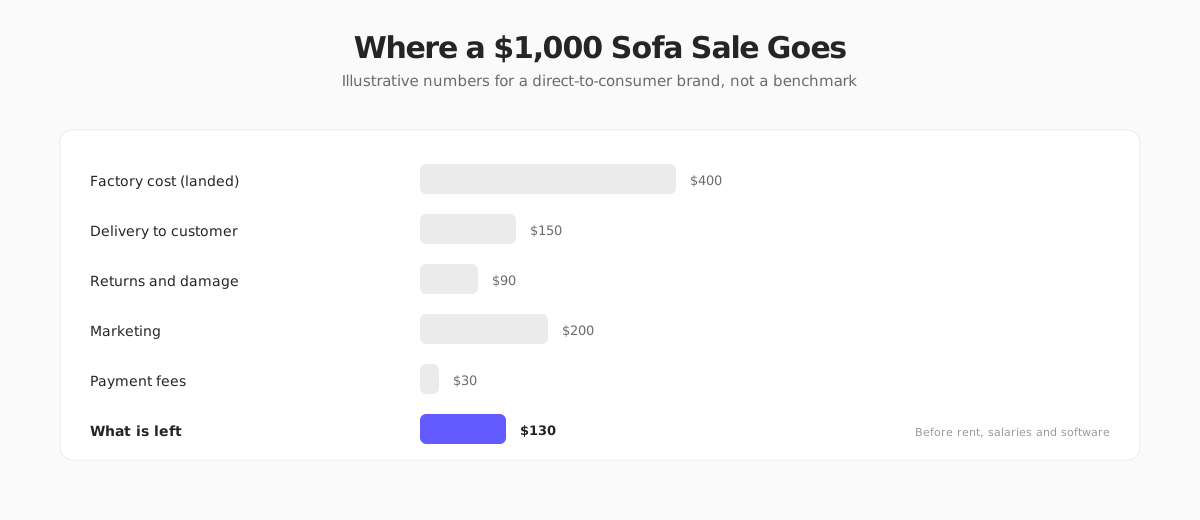
Those numbers are not a benchmark, they are a warning: **a 2.5x markup on factory cost can still leave you around 13% of revenue.** Your real numbers will differ, so build your own version in a spreadsheet before you commit.
The line that surprises people most is returns. One [consultancy's benchmark](https://eightx.co/blog/average-furniture-and-home-return-rate-benchmarks) puts online furniture and home returns around 19 to 23%, and a returned large item can cost $55 to $108 or more once freight, inspection and write-offs are counted. Treat those as modeled estimates, not audited data, but plan for returns being a real cost line.
How to protect margin:
- **Aim for at least 3x to 4x factory cost** for DTC pricing, then check the full waterfall.
- **Offer free swatches or samples** for upholstery and finishes. [Burrow](https://burrow.com/) does this, which cuts "color did not match" returns before they happen.
- **Be explicit about dimensions.** Show the piece next to a doorway, a person or a standard sofa. Size mismatch is a common reason furniture goes back.
- **Charge for shipping on big items** or build it into the price. "Free shipping" on a 90 lb box is not free.
- **Write a returns policy that is fair and survivable:** restocking fees, return shipping by the customer for non-defective items, and a clear window.

Our broader notes on [ecommerce shipping strategy](/blog/ecommerce-shipping-strategy) cover carrier choices and shipping rules for bulky goods.
## Step 6: Set Up a Website Built for Big Purchases
People do not impulse-buy a $1,200 dining table. They compare, measure, ask a partner and come back twice. Your site has to carry that journey.
What a furniture product page needs:
- **Many photos, including real rooms and real scale.** A few lifestyle shots plus close-ups of joints, fabric and finish.
- **Exact dimensions and weight,** with a clear "will it fit through your door" note.
- **Variants that are easy to choose:** fabric, wood tone, size, and lead time per variant.
- **Honest delivery windows,** especially for made-to-order pieces.
- **Swatch requests,** a reviews section and a visible returns policy.

The main options in 2026, honestly:
- **[Your Next Store](https://yournextstore.com/)** (us) starts at $25/month on the yearly plan with 0% transaction fees on top of Stripe's processing fees. An AI helper builds the store with you, and search, reviews and email are built in. It is a good fit if you want a modern, fast storefront with products, variants and inventory handled for you.
- **[Shopify](https://www.shopify.com/)** is the safe default, with a huge app ecosystem for 3D viewers, AR previews and shipping rates. Plan for the app costs to add up. If you want the numbers, we broke down [what Shopify takes from a $100 sale](/blog/how-much-does-shopify-take-from-a-100-sale).
- **[Squarespace](https://www.squarespace.com/)** and **[Wix](https://www.wix.com/)** are cheap to start and visual, but you will likely outgrow them if you need complex variants or freight rate logic.
- **A marketplace like Etsy or Amazon** can test demand for small pieces, but heavy furniture and a brand story do better on your own site.
**0% extra fees on every sale.** A modern website for your furniture brand, ready in minutes.
## Step 7: Pick One Channel to Get Noticed
Furniture brands tend to win on one channel first. Pick one, run it for six months, then add a second.
- **Instagram and Pinterest.** Furniture is visual and people save things for months. Pinterest in particular rewards room-scene content that keeps working long after posting.
- **Showrooms and pop-ups.** People want to sit on a sofa. A weekend pop-up, a shared showroom or a design-week table lets customers touch the product and gives you content.
- **Interior designers and trade.** Designers buy repeatedly and influence many purchases. A trade program with a clear discount and fast samples can be your most efficient early channel.
- **Free swatches and sample boxes.** Low-cost way to move a hesitant buyer closer to a purchase.
- **SEO and content.** Slow, but searches like "small apartment desk" or "dresser for nursery" convert well.
- **Paid ads.** Skip until you know your margin waterfall. Customer acquisition on high-ticket items can be expensive.
- **Email.** Furniture has a long consideration window, so a good abandoned cart and browse-follow-up sequence is worth setting up early. See our post on [abandoned cart emails](/blog/abandoned-cart-emails).
## What It Actually Costs to Start a Furniture Brand in 2026
These are ranges, not quotes. Prices vary by material, country and order size.
| Approach | Upfront cost | What you get |
|----------|--------------|--------------|
| **White label test** | A few thousand dollars | 1 to 3 pieces, small first order, simple website |
| **Custom single hero product** | $10,000 to $40,000 | Design, samples, an MOQ run, testing and a launch budget |
| **Small collection** | $50,000+ | Several SKUs, photography, showroom or pop-up, inventory in a warehouse |
Where the money goes: tooling and samples, the first production run, compliance testing, inbound freight and duties, storage, photography, the website and your launch marketing. The big risk is not any single line, it is cash locked in inventory for months.
If your plan only works when every unit sells at full price, the plan is wrong. Budget for markdowns, a second sample round and a delay.
The brands that survive year one are not the ones with the best sofa. They are the ones who priced freight honestly, tested before tooling, and chose one customer to serve well.
## FAQ
### How much does it cost to start a furniture brand?
A white-label test can start with a few thousand dollars. A custom hero product with samples, testing and a first production run commonly lands in the tens of thousands, and a full collection costs more. Inventory and freight are the biggest lines.
### Do I need a manufacturer to start a furniture brand?
Yes, unless you build the pieces yourself. Most brands use a white-label supplier to test, a custom manufacturer for scale, or a local workshop for small-batch premium pieces. Always get a pre-production sample and consider a third-party inspection before shipment.
### What safety rules apply to furniture in the US?
It depends on the product. Dressers and similar clothing storage units must meet tip-over stability requirements under 16 CFR part 1261. Upholstered furniture often needs to meet California TB 117-2013, composite wood products have formaldehyde limits, and children's furniture has its own rules. Check the current CPSC and EPA guidance for your product.
### What about selling furniture in the EU or UK?
The EU's General Product Safety Regulation requires a responsible person in the EU and traceability details, and the UK has fire safety rules for upholstered furniture. The two markets are now separate. Check the current rules for each one you sell into.
### Can I sell furniture through dropshipping?
You can, but margins and control are limited, and delivery quality is hard to guarantee. It is a reasonable way to test demand, less so to build a lasting brand. Read our guide to [starting dropshipping](/blog/how-to-start-dropshipping) for the trade-offs.
### How much should I mark up furniture?
Many direct-to-consumer brands aim for at least 3x to 4x factory cost, but the right number depends on freight, returns and marketing. Build the full waterfall before you set a price.
### How long does it take to launch a furniture brand?
Plan for several months from idea to first delivery: design and samples, production, and ocean freight if you manufacture overseas. Local makers can be faster. Validate demand while you wait.
## Related Blog Posts
- [How to Start a Furniture Store in 2026: The Honest Playbook](/blog/how-to-start-a-furniture-store)
- [How to Start an Online Store in 2026: 7 Steps to Your First Sale](/blog/how-to-start-an-online-store)
- [Ecommerce Shipping Strategy](/blog/ecommerce-shipping-strategy)
- [How to Start a Bedding Brand](/blog/how-to-start-a-bedding-brand)
- [How Much Does an Ecommerce Website Cost?](/blog/how-much-does-an-ecommerce-website-cost)