# How to Start a Fitness Apparel Brand: The Honest Playbook
How to start a fitness apparel brand in 2026: real fabric costs, MOQs, sizing math, and the labeling rules activewear founders miss.
*Published 2026-09-08*
The global activewear market is on track to hit $439.74 billion in 2026 and grow to $650.97 billion by 2032, a 6.59% CAGR, according to [a market report covered by GlobeNewswire](https://www.globenewswire.com/news-release/2026/07/20/3329932/28124/en/activewear-market-to-reach-usd-650-97-billion-by-2032-expanding-at-a-6-59-cagr.html). It's also one of the least forgiving categories in ecommerce to get sizing wrong in. This is the guide I'd hand a friend before they spend a dollar on how to start a fitness apparel brand: eight steps, in the right order, with honest 2026 numbers for fabric costs, MOQs, landed duty, and the return-rate math that decides whether you actually keep any of the money.
**A small disclosure:** I help run a company that makes online-store software. In Step 7 ("set up a website"), our product is one of several options. The other seven steps have nothing to do with us, and I'll be straight with you the whole way through, especially about the returns math.
## How to Start a Fitness Apparel Brand: The 8 Steps, in Order
1. **Pick one very specific kind of athlete, or one specific workout, to make it for.** Not "activewear." One body of movement, for one clearly-defined person.
2. **Get real people to say "yes, I'd buy this" before you order anything.**
3. **Decide the fabric, stretch, and compression level.** This is where most of the cost and most of the fit complaints come from.
4. **Decide how your pieces actually get made.** There are four real paths, and they trade capital for margin very differently.
5. **Price with duties, freight, and returns baked in,** not just fabric and labor.
6. **Handle the labeling and legal work.** Fiber content and performance claims are regulated, not a nice-to-have.
7. **Set up a website that can actually show fit and real sizing.**
8. **Pick one place to get noticed. Not all the places. One.**
Now the long version.
## Step 1: Pick One Very Specific Kind of Fitness Apparel to Make
Let's start with the part most guides skip. "I'm going to sell leggings" is not a business, it's a category. Search "seamless leggings" or "sports bra" today and you're competing with Lululemon, Alo, Gymshark, and a thousand Amazon listings, none of which you can out-price or out-distribute. You win by being the obvious answer for one specific athlete, one specific workout, or one specific fit problem, not by having activewear that's fine for everyone.
Here's the honest scorecard, fitness apparel compared to an easier first apparel product:
| | Fitness apparel (leggings, sports bras) | A typical easy first apparel item (tees, totes) |
|---|---|---|
| Average order value | $45 to $120+ | $15 to $35 |
| Return rate | [~30% on average](https://gowarpspeed.com/industries/apparel-fashion/activewear), driven mostly by fit and compression feel | Often 10 to 15% |
| Size/support matrix per style | Leggings: 6 to 9 sizes x 2 to 3 inseams; a best-selling sports bra can carry [30 or more band/cup variants](https://gowarpspeed.com/industries/apparel-fashion/activewear) | 1 to 3 sizes, a handful of SKUs |
| Sample cost before you commit | Real cash: pattern grading across sizes, plus performance-fabric yardage | A print run costs almost nothing to test |
| Selling season | Year-round, with a real spike every January | Year-round |
None of that means don't do it. It means the niche you pick in this step is what makes the size-and-fit problem in Step 5 manageable or brutal. Activewear built for one clearly-defined body type and one movement pattern has a much smaller size-return problem than a "one size tries to fit everyone" legging.
Good, specific answers look like this:
- **A single, obsessively refined product for one activity.** [Bandit Running](https://banditrunning.com/pages/about), a Brooklyn running brand, started when founder Tim West got tired of finishing ultras with, in his words, puddles in his shoes, and began prototyping running socks with feedback from his local track club before ever building a full catalog. They didn't launch a general activewear line. They launched one category, for one sport, and got extremely good at it first.
- **Extended or adaptive sizing that mainstream activewear brands skip.** [Girlfriend Collective](https://girlfriend.com/) built its name on compression leggings offered from XXS to 6XL, a range most legacy activewear brands still don't carry, engineered from [recycled polyester spun out of used water bottles](https://www.yahoo.com/lifestyle/girlfriend-collective-started-making-leggings-175300080.html). That sizing commitment, not a logo, is the actual brand.
- **A niche built around one specific support or fit need.** High-impact sports bras for larger cup sizes, postpartum-safe compression, or adaptive fitness apparel for wheelchair athletes (magnetic closures instead of clasps, seams that don't chafe against a wheelchair frame) are real, underserved gaps, because most activewear patterns are graded from a single mid-size, mid-bust block.
If you're still deciding whether apparel is the right category at all before you narrow into fitness apparel specifically, our broader [playbook for starting a clothing brand](/blog/how-to-start-a-clothing-brand) covers the customer and production decisions that apply across categories.
The test: if a big-box sporting goods chain could put your exact legging on a rack tomorrow without changing anything about who they are, the idea isn't sharp enough yet. Your advantage as a small fitness apparel brand isn't a bigger factory. It's caring about one specific athlete more than a company with ten thousand SKUs ever will.
## Step 2: Get People to Say "Yes" Before You Order Anything
Activewear involves more upfront cash per style than a basic tee: pattern grading across a real size run, and performance-fabric yardage that costs more per yard than plain cotton, even for a single sample. You don't want to discover your niche or your fit was wrong after paying for a first production run.
Three cheap ways to test demand before you spend real money:
1. **A one-page site with a "Join the waitlist" button.** Show renderings or a single hand-sewn sample on a real body, describe the specific athlete and the specific problem the piece solves, and spend $100 to $250 on Instagram or TikTok ads sending your target person there. If fewer than 1 in 50 visitors sign up, the idea isn't landing yet. Go back to Step 1.
2. **Take pre-orders on your first small run.** Same page, but "Pre-order, ships in 6 to 10 weeks" instead of "Join the waitlist." People who hand over a card are the only signal that actually counts.
3. **List a single style through print-on-demand first** (more in Step 4), before you ever commit to a private-label production run. If a specific legging or sports bra sells reliably for 60 to 90 days through print-on-demand, you have real proof before you commit real capital to a minimum order.
This step costs a weekend and a few hundred dollars in ads. Skipping it can cost you a full private-label MOQ (often 100 to 300 units per style, more in Step 4) sitting in a closet because nobody actually wanted that specific fit.
## Step 3: Decide the Fabric, Stretch, and Compression Level
This is the decision that drives most of a piece's cost, and it's more specific to activewear than to almost any other apparel category, because the fabric isn't just how the garment looks. It's the entire product.
**Base fiber blend.** Nylon-spandex is the standard for premium leggings and sports bras: a smoother hand-feel, better recovery after stretching, and a higher price point per yard. Polyester-spandex is the budget-friendly default: cheaper, still performs reasonably well, but degrades faster with washing and heat exposure. The blend you pick isn't just a feel decision, it's a cost and a durability decision.
**Stretch direction.** [Two-way stretch fabric moves in one direction](https://stretchhouse.com/2-way-vs-4-way-stretch/), usually across the width, and is fine for a simple tee or a loose short. Four-way stretch moves in both directions and is what any legging, sports bra, or compression top actually needs, since it accommodates the multi-directional movement of a squat, a lunge, or a downward dog. Skipping four-way stretch to save on fabric cost is the single most common beginner mistake in this category, and customers notice immediately.
**Compression and moisture management.** "Compression" isn't one setting. It's a spectrum, from a light, supportive second-skin feel up to genuine athletic compression in the 15 to 20 mmHg range used by recovery and running brands. Moisture-wicking is usually a fiber-level property (how the yarn itself moves sweat) or a topical DWR-style finish, and it degrades over the garment's life differently depending on which one you used, something worth knowing before you make a durability claim (more in Step 6).
**Construction complexity.** Flatlock seams (flat, non-chafing stitching) cost more labor time than a standard overlock seam, but they're close to mandatory in a legging's inner thigh and a sports bra's underband. A squat-proof, double-layer waistband adds fabric and sewing time on top of that. Every extra construction feature is extra labor minutes, and labor is priced per minute in most factories.
Here's what that actually costs per unit, based on [production cost breakdowns from Argus Apparel](https://argusapparel.com/blog/custom-leggings-production-cost/) and [their sports bra pricing guide](https://argusapparel.com/blog/custom-bra-cost/):
| Product type | Typical per-unit cost | What drives it |
|---|---|---|
| Basic gym leggings (poly-spandex, two-way stretch) | $8 to $15 | Simple waistband, standard seaming |
| Premium yoga/training leggings (nylon-spandex, four-way stretch) | $14 to $25 | Compression knit, flatlock seams, side pockets |
| Sports bra, light-medium support | $5 to $15 | Simple molded cup or bralette construction |
| Sports bra, high support / moisture-wicking mesh | $20 to $30+ | Encapsulation cups, multiple panels, wicking mesh |
| Performance tee or tank | $6 to $14 | Lightweight wicking knit, minimal construction |
Pick your fabric and compression level based on what your specific niche from Step 1 actually needs, not based on what looks most impressive on a mood board. A HIIT-class customer cares about a squat-proof waistband more than a soft hand-feel. A yoga customer cares about four-way stretch and breathability more than compression grade. Spend the cost where your specific customer will notice it.
## Step 4: Decide How Your Fitness Apparel Actually Gets Made
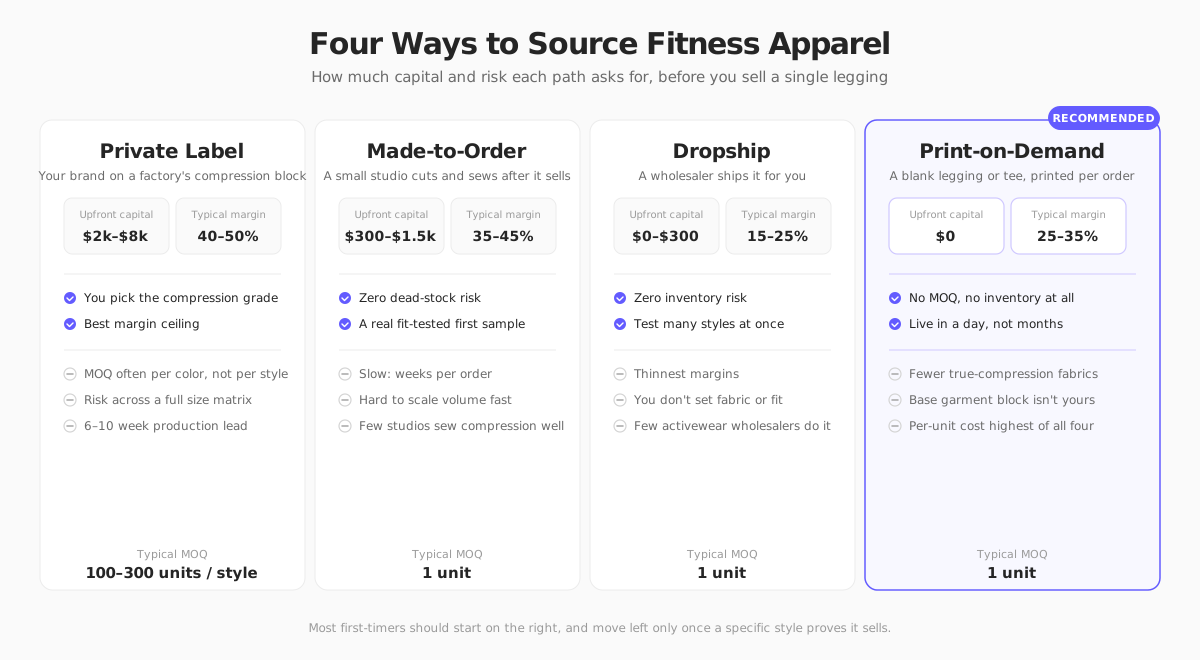
This is the biggest decision in the whole guide, and like jackets, activewear genuinely has four distinct, real paths, not two.
### Print-on-demand (the safe way to start)
**Print-on-demand (POD)** means a supplier holds a blank base garment and prints or sublimates your design onto it only after a customer orders. No inventory, no MOQ, and you can be selling within a day.
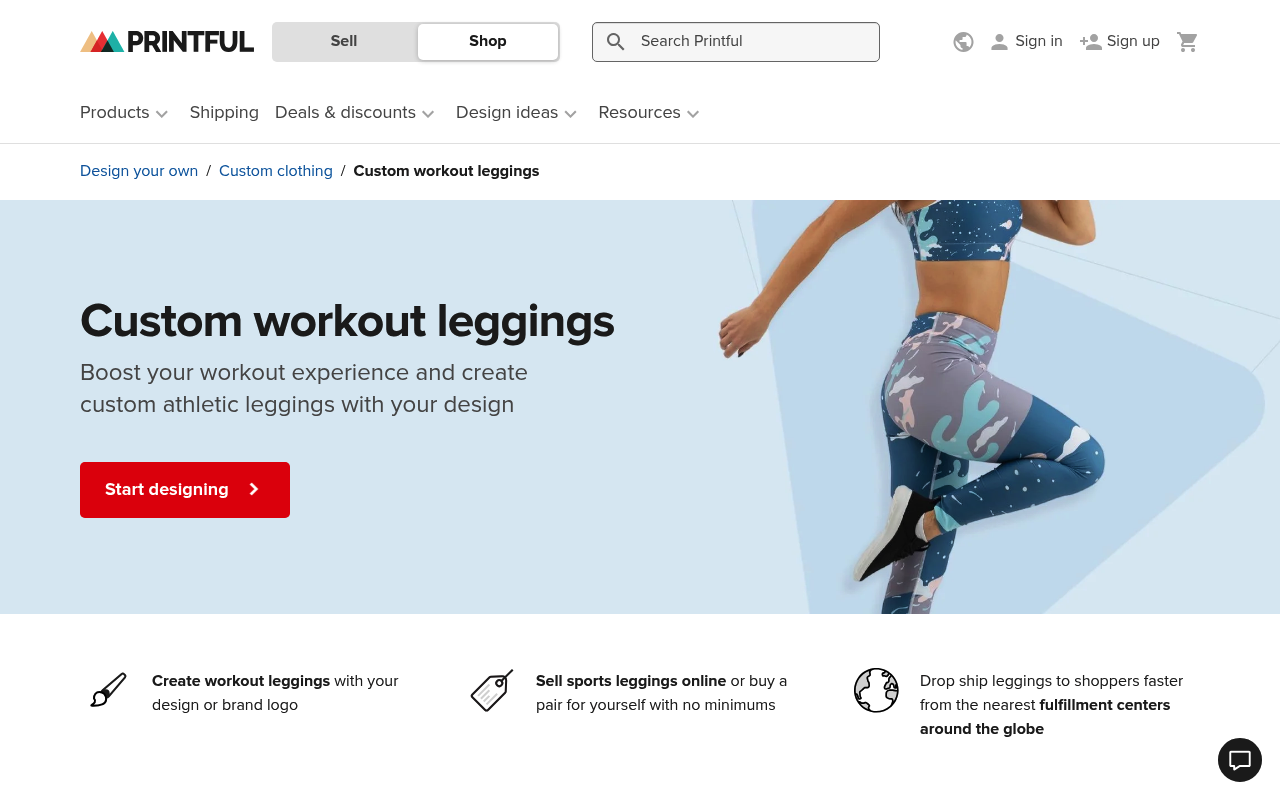
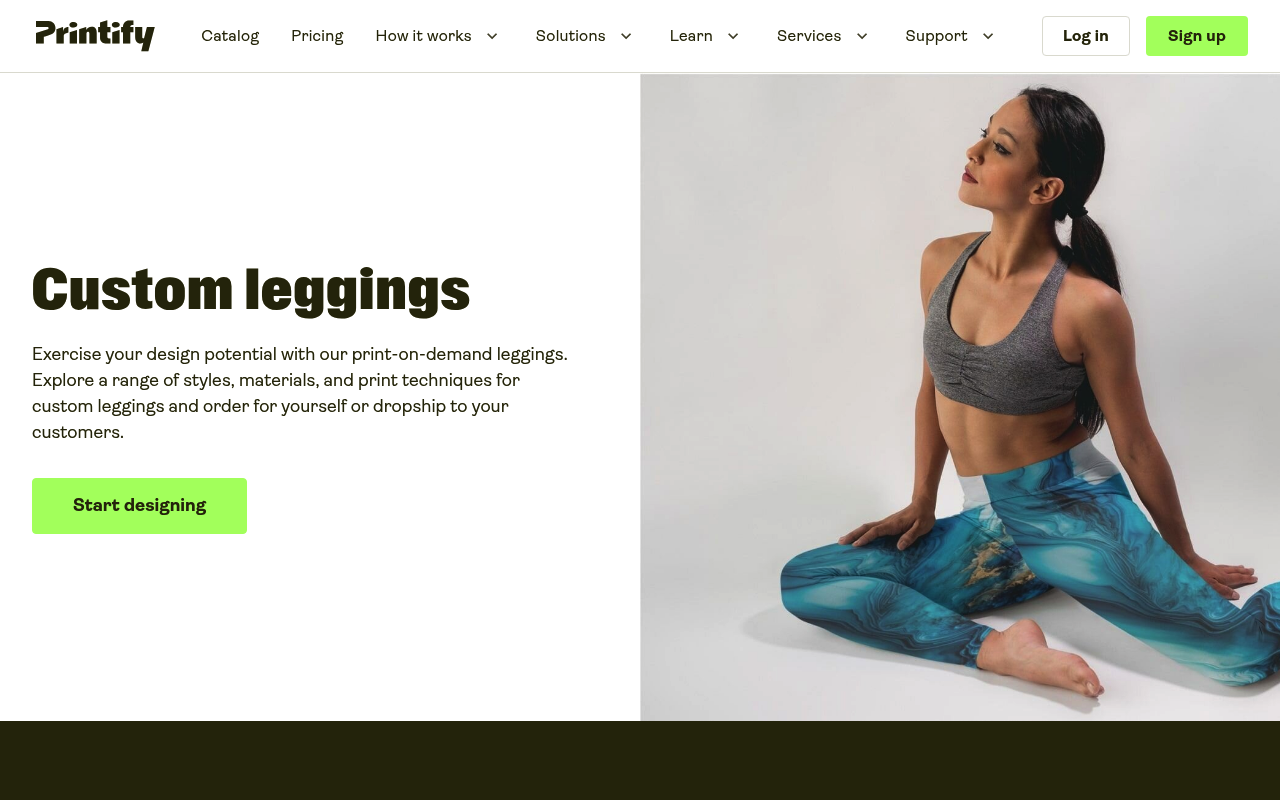
[Printful](https://www.printful.com/workout-leggings) offers custom workout leggings, sports bras, and performance tees with no minimum order: order one pair or hundreds, and bulk orders unlock volume discounts. [Printify](https://printify.com/custom-leggings/) carries all-over-print leggings with the same zero-minimum policy, and both integrate directly with Shopify and most storefronts.
The trade-off: base garments are typically polyester-spandex with a moderate stretch rating, not the true four-way, high-compression nylon blend a dedicated athletic brand uses, and per-unit cost is the highest of the four models since you're paying single-unit pricing on every order. This is a testing ground for validating a design and an audience, not usually a permanent model once you know a specific style sells.
### Private label (the most control, and the real margin)
A manufacturer builds a legging or sports bra on an existing compression block, and you put your own brand, label, and sometimes small fabric or trim tweaks on it. This is where the best margins live, but it comes with a real minimum order.
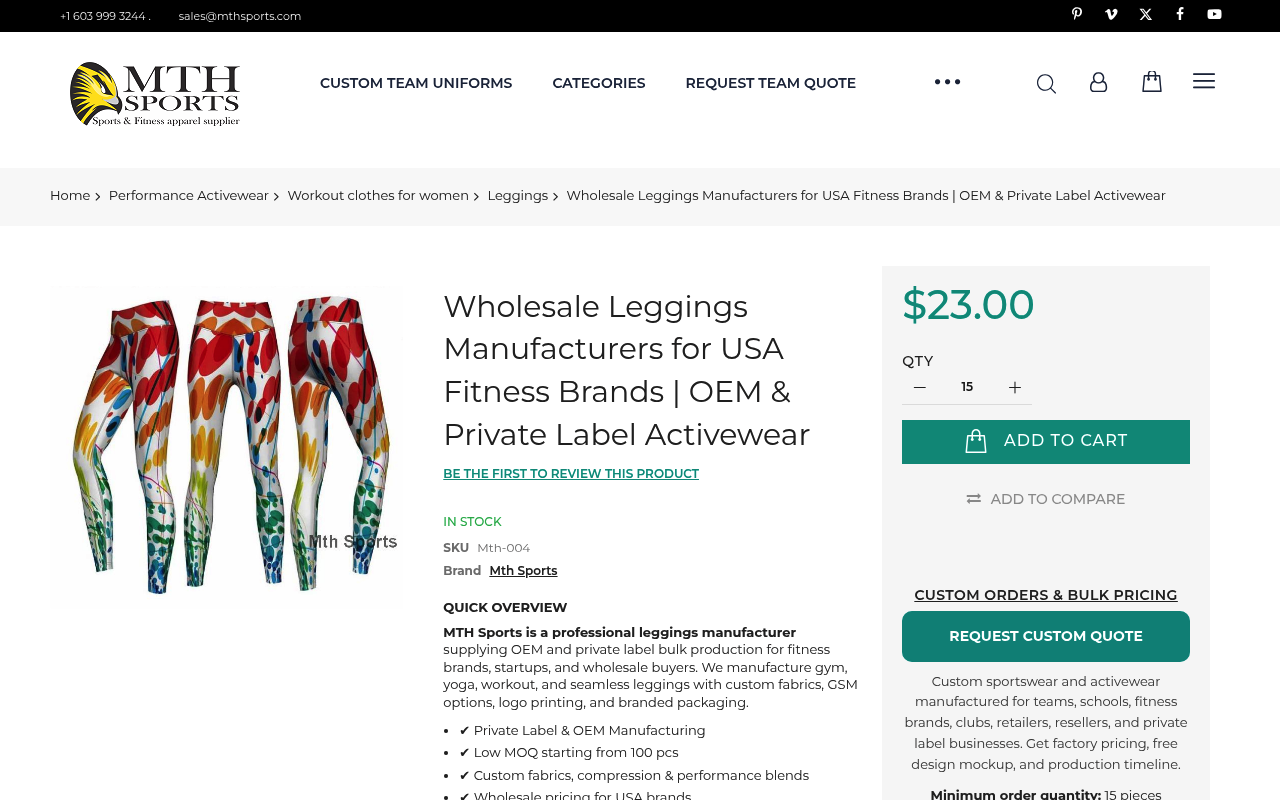
[MTH Sports](https://mthsports.com/leggings-manufacturers), a wholesale and private-label activewear supplier, lists a minimum order as low as 15 pieces on an individual legging style, with a listed capability for private-label and OEM production, custom fabrics, and compression/performance blends starting around 100 pieces once you move to a fully custom design. Other manufacturers quote MOQs anywhere from roughly 50 to 300 pieces per style depending on the factory and how much customization you want beyond the base pattern.
This model gives you real control over fabric, compression grade, and branding, and margins commonly in the **40% to 50%** range. It also means real cash tied up before you've made a single sale, a production lead time of 6 to 10 weeks, and inventory risk spread across an entire size and color matrix, not just one SKU. **Save this path for a style you've already validated** through print-on-demand or made-to-order.
### Made-to-order (best for a premium, low-volume piece)
A small sewing studio builds each piece only after it sells. No dead stock, and often genuinely better construction than a mass-produced run, since a maker working one piece at a time can catch a fit issue a factory line won't.
The catch is scale. This model is realistically limited to a handful of studios and a few dozen units a month, and turnaround typically runs several weeks per piece. It also fits a narrow set of studios, since flatlock seaming and true compression construction are specialized skills that not every local sewing shop has. It's a good fit for a narrow, premium niche where customers already expect to wait, not a broad catalog across a full size run.
### Dropship (rare, but real, for activewear)
A wholesale apparel distributor keeps stock and ships directly to your customer after it sells. True activewear dropshipping is uncommon, since most performance-fabric wholesalers sell in case packs to retailers, not one unit at a time to an end customer, so this path usually means partnering with a wholesale marketplace that explicitly supports single-unit fulfillment, or treating overstock inventory as a dropship source. Margins land thin, typically 15% to 25%, and you have no control over the compression grade or fabric quality your customer actually receives.
**Start on the right side of the diagram, not the left.** Validate a specific style with print-on-demand or a small made-to-order run first. Move it to private label only once you know, from real sales, that the fit and the demand are both real. A 100-plus-unit MOQ across 6 sizes and 3 colors is a bad place to discover your compression grade was wrong.
## Step 5: Price With Duties, Freight, and Returns Baked In
The classic beginner mistake in every category is pricing off a competitor's sticker price. In fitness apparel specifically, two costs get skipped more than in almost any other category: import duties and the return rate, and activewear's return rate is higher than nearly any other apparel category.
### The duty surprise
If you're importing a private-label legging from China, budget for real duty, not an afterthought. A women's legging made of synthetic fiber with 5% or more elastomeric (spandex) content, HTS 6104.63.2006, carries a base MFN duty of **28.2%**, according to [Customs and Border Protection tariff classification rulings](https://rulings.cbp.gov/ruling/N302897), plus a Section 301 tariff of **7.5%** on top for apparel sourced from China as of 2026, per [Section 301 tariff analysis](https://www.tarifflens.ai/blog/section-301-tariffs-apparel-china-2026), for a **total duty around 35.7%**. Sports bras and other knit tops are classified under different HTS codes with their own rates, so confirm the exact classification with your customs broker before you quote a landed cost. Fabric choice from Step 3 isn't just a cost and feel decision, it's a duty-rate decision too.
### The return rate is an activewear-specific tax on every order
Sizing and compression feel, not damage, are the real hidden cost here. Activewear returns run [around 30%](https://gowarpspeed.com/industries/apparel-fashion/activewear), with fit issues driving [roughly 60 to 70% of all apparel returns](https://gowarpspeed.com/industries/apparel-fashion/activewear), and that share skews even higher for fitted categories like leggings and sports bras. Processing a single apparel return costs [$25 to $35 all-in](https://eightx.co/blog/average-ecommerce-returns-processing-cost-per-item-by-vertical-2026) once you count reverse shipping, inspection, and restocking. That's a real line item, not a rounding error, and it belongs in your price from day one.
### A worked example: a private-label nylon-spandex legging
Landed cost (factory price plus duty and inbound freight) comes to about **$15**. Price it at 4x landed cost, a reasonable floor for a category with this much return risk, and you get **$60**:
| Where the money goes | $ |
|---|---|
| Landed cost (product + duty + inbound freight) | $15.00 |
| Card fee (Stripe, 2.9% + $0.30) | $2.04 |
| Outbound shipping to customer (parcel, light) | $6.00 |
| Return and processing reserve (~30% of orders x ~$30) | $9.00 |
| Marketing (~20% of revenue) | $12.00 |
| **What you actually keep** | **~$15.96** |
That's roughly 27% of revenue kept, a healthy margin for a first activewear product. Now watch what happens at a 3x markup instead, $45 instead of $60. The landed cost, shipping, and return reserve barely move since they're mostly fixed dollar costs, not percentages of the sale price, so what you keep drops to roughly **$4.40, about 10% of revenue.** One extra return on that order and you're at a loss. **If a 4x markup makes your legging too expensive for your niche, the niche or the sourcing model is wrong, not the price.**
## Step 6: Handle the Labeling and Legal Work
Fitness apparel carries more scrutiny than a plain tee, because it's one of the few categories where the product itself makes a performance claim, "moisture-wicking," "compression," "four-way stretch," and those claims sit in a different regulatory bucket than the fabric label.
**Fiber content and care labeling in the US** work the same as any other garment. The [Textile Fiber Products Identification Act](https://www.ftc.gov/legal-library/browse/statutes/textile-fiber-products-identification-act) requires a permanent label stating fiber content by percentage, country of origin, and the manufacturer's identity or a registered RN number, and the [FTC's Care Labeling Rule](https://www.ftc.gov/business-guidance/resources/clothes-captioning-complying-care-labeling-rule) requires permanent washing, drying, and ironing instructions you have a reasonable basis to make. The FTC does allow a shortened hang-tag to carry fiber names and non-deceptive performance claims without repeating the full fiber breakdown, [under a specific carve-out in the rule](https://www.ftc.gov/business-guidance/resources/threading-your-way-through-labeling-requirements-under-textile-wool-acts), but the full label still has to be on the garment itself.
**Performance claims need their own reasonable basis, separate from the fiber label.** Under general FTC Act Section 5, any marketing claim you make, including "moisture-wicking," "quick-dry," or a specific compression rating, needs a reasonable basis before you publish it. Nobody pre-approves these claims the way the FDA pre-approves a drug label. If you claim a UPF (sun protection) rating, follow [ASTM D6603's labeling guide](https://windrider.com/blogs/tips-and-tricks/how-upf-ratings-are-tested-the-lab-science-behind-50-claims) and get the fabric tested to AATCC 183 before you print a number on a hang tag. A UPF claim with no test behind it is exactly the kind of unsubstantiated claim the FTC has authority to act on.
**Compression claims have one extra line you don't want to cross.** [Athletic compression garments](https://cw-x.com/blogs/news/medical-grade-vs-athletic-compression-understanding-the-differences-and-best-uses), typically in the 15 to 20 mmHg range, aren't regulated as medical devices in the US. But the moment you claim your leggings treat, cure, or improve a diagnosed condition, like circulation disorders or lymphedema, rather than describing an athletic support fit, you move into [FDA medical device territory](https://www.lymphedivas.com/blog/what-is-the-difference-between-medical-and-commercial-compression-garments/), a different and much heavier compliance category than any apparel brand wants to be in. Keep the language athletic ("supportive compression fit for training") and you avoid the entire problem.
**In the EU**, [Regulation (EU) No 1007/2011](https://europa.eu/youreurope/business/product-rules-compliance/textiles-and-footwear/textile-label/index_en.htm) requires every textile product to carry a fibre-composition label in descending order by weight, translated into the official language of every EU member state where you sell it, not just English. **In the UK**, the [Textile Products (Labelling and Fibre Composition) Regulations 2012](https://www.compliancegate.com/clothing-regulations-united-kingdom/) still apply post-Brexit and largely mirror the EU regulation. Neither jurisdiction has a specific "activewear performance claims" statute, so the same reasonable-basis standard that applies to your marketing generally applies to a "moisture-wicking" or "compression" claim there too: don't say it unless you can back it up.
**Get a lab test before you print a number on a hang tag.** A UPF rating, a specific mmHg compression figure, or a "wicks 3x faster" claim all sound like marketing copy, but each one is a factual claim the FTC (and equivalent EU/UK regulators) can ask you to substantiate. A single fabric test from an accredited lab typically costs a few hundred dollars and removes the risk entirely. Skip it and you're making a legal claim you can't actually prove.
## Step 7: Set Up a Website That Can Actually Show Fit
By now you have a validated style, a sourcing model, and a real landed cost. Time to give people a place to buy.
Activewear buyers need more reassurance than most apparel shoppers: real measurements per size (not just S/M/L), photos on multiple body types and skin tones, a clear fabric and compression-level description, and an honest, visible return policy before checkout, not a surprise after the sale. A generic product page built for a single-size candle will lose activewear sales.
The main options in 2026, honestly ranked for a first-time fitness apparel seller:
- **[Your Next Store](https://yournextstore.com/)** (us, to be upfront) is a modern storefront with an AI-powered builder, starting at $25/month on the yearly plan with **0% platform transaction fees** on every plan. Product pages support multiple images and custom variant attributes, so you can show a real size and compression chart instead of just a price and an "Add to cart" button.
- **[Shopify](https://www.shopify.com/)** is the most common choice for activewear sellers because of its size-chart and variant apps, and its direct integrations with Printful and Printify for the print-on-demand path. It starts at $39/month, and Shopify takes [a small extra fee on every sale](/blog/how-much-does-shopify-take-from-a-100-sale) unless you use their own payment processor.
- **Squarespace or Wix** are fine for a small first catalog of a few styles, but most fitness apparel sellers outgrow their variant and size-chart handling once they carry more than one or two silhouettes across multiple sizes and colors.
**Honest recommendation for most first-time fitness apparel sellers:** get a simple, real website live before you spend marketing money anywhere, even while you're validating on print-on-demand. You need a place with an honest size chart and a visible return policy, and you need to own the customer relationship, since an athlete who fits well in your sizing comes back for the next style, and print-on-demand storefronts rarely capture that repeat customer for you.
**0% extra fees on every sale.** A modern website for your fitness apparel brand, ready in minutes.
## Step 8: Pick One Place to Get Noticed
New fitness apparel sellers almost always win on exactly one channel first, then expand. Trying everything at once, on top of the sizing and sourcing work activewear already demands, is how founders burn out before their first quarter ends.
Your options, honestly:
- **Instagram and TikTok, showing the piece actually moving in a workout.** Activewear sells on how it performs mid-rep, not on a flat product shot. Works if you can post 3 to 5 times a week and you're comfortable filming real training content.
- **A small ambassador or gifting program.** Fitness apparel has an unusually strong gifting-to-content pipeline: send free product to 20 to 50 real trainers, coaches, or gym-goers in your exact niche (not general fashion influencers), and a meaningful share will post workout content wearing it. This converts better in fitness than in almost any other apparel category.
- **In-person at gyms, studios, and races.** A pop-up table at a local run club, CrossFit box, or studio event puts your product on real bodies doing the actual movement it was built for, and gets you photo and video content you can't fake in a studio shoot.
- **Google and SEO.** Slow, 6 to 12 months, but durable for a specific search like "adaptive fit workout leggings" or "postpartum-safe compression shorts." Plant this now, don't expect it to carry your first quarter.
- **Email, captured from the waitlist in Step 2.** Athletes research gear for days before buying, especially once they've been burned by a bad-fitting online purchase before. Capture the email, follow up, don't rely on a first-visit conversion.
- **Paid ads.** Wait until organic content is already working. A 30% return rate already eats margin, and a bad ad campaign stacked on top of that is how a promising first quarter loses money.
Pick one main channel and one backup. Run both for a full quarter, at minimum, before adding a third.
## What It Actually Costs to Start a Fitness Apparel Brand in 2026
The real-world ranges, by sourcing model:
| Your approach | Upfront cost | Monthly spend | What you get |
|---|---|---|---|
| **Print-on-demand test** | $0–$300 | $30–$100 | Unlimited styles to test, a real website, 25–35% margins, zero inventory |
| **Made-to-order** | $500–$2,000 | $150–$300 | A few signature pieces, no dead stock, 35–45% margins |
| **Private label, first run** | $3,000–$12,000 | $500–$1,500 | Full control of compression and branding, 40–50% margins, real MOQ risk |
| **Full first collection, multiple styles** | $20,000–$60,000+ | $2,500+ | A real seasonal line, wholesale accounts, staff |
Two honest warnings hidden in that table:
1. **A private-label first run will not break even in one season.** Between the 6 to 10 week production lead, duties, and the return reserve from Step 5, plan for two to three selling seasons before things turn consistently green.
2. **Print-on-demand is the only row where you can validate a real style without capital sitting in a specific size run.** Every row past it carries real risk that a size, color, or compression grade that doesn't move turns into a cash-flow problem fast.
If your plan depends on every size selling evenly, your plan is wrong. Budget for at least one size that undersells the rest, because in a category with a 30% average return rate, one usually does.
The fitness apparel brands that make it past their first year aren't the ones with the biggest influencer budget. They're the ones who picked one specific athlete to obsess over, priced the return rate into the number from day one, and proved a single style sells before they ever touched a 100-plus-unit MOQ. Do those three things and the rest is patience, an accurate size chart, and a factory that actually understands spandex.
## FAQ
### How much does it cost to start a fitness apparel brand in 2026?
Anywhere from **$0 to $60,000+**, depending entirely on your sourcing model. Print-on-demand through a supplier like Printful or Printify can start with no upfront spend at all, since there's no minimum order and no inventory. Made-to-order through a small sewing studio runs $500 to $2,000 for your first few pieces. Private label, the model with the best margins, typically needs $3,000 to $12,000 for a first MOQ run of 100 to 300 units, once you add duty and inbound freight to the factory price. Most of the cost difference comes down to inventory risk, not the website.
### Is print-on-demand activewear actually profitable?
Yes, but margins are the thinnest of the four models, typically **25% to 35%**, because you're paying single-unit pricing on every base garment instead of a volume discount, and base garments are usually polyester-spandex rather than a true high-compression nylon blend. It's genuinely useful for validating which specific style and design actually sells before committing to a private-label minimum order. Treat it as a testing ground first, and a possible long-term channel second, not necessarily your only model forever.
### What's a realistic MOQ for private label leggings and sports bras?
Most private-label activewear manufacturers quote **100 to 300 pieces per style**, though some list minimums as low as 15 to 50 pieces on a specific existing legging pattern before you add full custom fabric or branding. Confirm whether the MOQ is per style or per style-per-color before you commit; some factories count each colorway separately, which can quietly turn a "100-piece" order into 400 or 600 units once you add sizes and colors.
### Can I legally call my leggings "compression" or "moisture-wicking"?
Yes, as long as you have a reasonable basis for the claim before you make it, under general FTC advertising rules. That means a fabric test or manufacturer spec sheet backing up the specific claim, not just marketing instinct. Keep any compression language athletic ("supportive compression fit"), not medical ("improves circulation" or "treats swelling"), since medical claims can pull your product into FDA medical device territory, a different and much heavier compliance category than apparel.
### How do you reduce the return rate on fitness apparel sold online?
The single biggest lever is an accurate, size-specific measurement chart, not just S/M/L, since fit issues drive 60 to 70% of apparel returns and that share skews even higher for compression-fit categories. Publish waist, hip, and inseam measurements per size for leggings, and band/cup measurements for sports bras, show the piece on multiple body types in real photos, and be explicit about compression level (light, medium, high) in the product description. None of this eliminates returns entirely in a 30%-average category, but it meaningfully reduces the fit-driven share, which is the largest chunk.
### How long does it take to launch a fitness apparel brand?
On the print-on-demand path, plan for **2 to 4 weeks**: a bit of time to validate a design and set up your website, then launch with zero production lead time. On the private-label path, plan for **3 to 5 months**, since sourcing a factory, developing a sample in the right compression grade, and waiting through a 6 to 10 week production run for your first MOQ order usually takes longer than beginners expect, especially the first time through a fitting round.
## Related Blog Posts
- [How to Start a Clothing Brand in 2026: The Honest Playbook](/blog/how-to-start-a-clothing-brand)
- [How to Start a Jacket Brand in 2026: The Honest Playbook](/blog/how-to-start-a-jacket-brand)
- [How to Start a Shoe Brand in 2026: The Honest Playbook](/blog/how-to-start-a-shoe-brand)
- [How to Market to Gen Z: An Ecommerce Guide for 2026](/blog/how-to-market-to-gen-z)
- [How Much Does Shopify Take From a $100 Sale?](/blog/how-much-does-shopify-take-from-a-100-sale)