# How to Start a Crystal Shop in 2026: Sourcing, Pricing and Selling Online
How to start a crystal shop in 2026: find suppliers, price stones, stay on the right side of health-claim rules and open an online store. Get your plan.
*Published 2026-10-12*
A crystal shop is a low-cost, visual, giftable business that fits neatly into an online store. Stones are small, they do not expire, and a good photo does half the selling. The catch is that the category is crowded, quality varies wildly, and the wrong words on a product page can get you into trouble. This guide covers how to start a crystal shop in the right order: choose an angle, find honest suppliers, price with real margins, follow the rules on claims, and sell online.
**A small disclosure:** I help run a company that makes online-store software. It appears in Step 6, next to other options. The rest of the guide has nothing to do with us.
## The 7 Steps, in Order
1. **Pick an audience and an angle.** "Crystals" is a category, not a brand.
2. **Choose a business model:** resell wholesale stones, curate kits, or work with rough stone.
3. **Find suppliers you can trust** and test small before you buy big.
4. **Know the rules** on claims, labeling, imports and tax.
5. **Price for margin,** including breakage and shipping.
6. **Open a store that shows the stones well.**
7. **Win one channel first.**
## Step 1: Pick an Audience and an Angle
Search for "crystals" online and you will find thousands of shops with the same amethyst clusters and the same rose quartz hearts. What sets the memorable brands apart is who they are for.
Four examples of different angles:
- [Energy Muse](https://energymuse.com) positions crystals as personal intentions, with a quiz that matches you to stones and jewelry.
- [Crystal Council](https://www.thecrystalcouncil.com) mixes crystal boxes, a stone identifier app and a community.
- [Sage Goddess](https://www.sagegoddess.com) sells a broad range of crystals and spiritual tools alongside classes and a library of teachings.
- [Moon Room](https://www.moonroomshop.com) is a small, personality-led gift shop where crystals sit next to incense, jewelry and art.


Four different businesses selling stones. Ideas for a narrower angle:
- **Crystals for collectors,** with specimen-quality pieces, locality information and good photography of each individual stone.
- **Gifts for people new to crystals,** with starter sets and plain-language guides.
- **Home and desk decor,** where stones are styled as objects, not talismans.
- **Jewelry-first,** where crystals are the material and design is the product.
- **A single region or mineral family,** such as stones from one country or one type like agates.
Whatever you pick, decide how you feel about the spiritual side. Some customers buy for beauty and geology, others for wellbeing. Your tone, packaging and copy should be consistent with the people you want to serve.
If you are still deciding whether to open a shop at all, our guide to [starting an online store](/blog/how-to-start-an-online-store) covers the customer and category questions first.
## Step 2: Choose a Business Model
### Resell wholesale stones: the simplest start
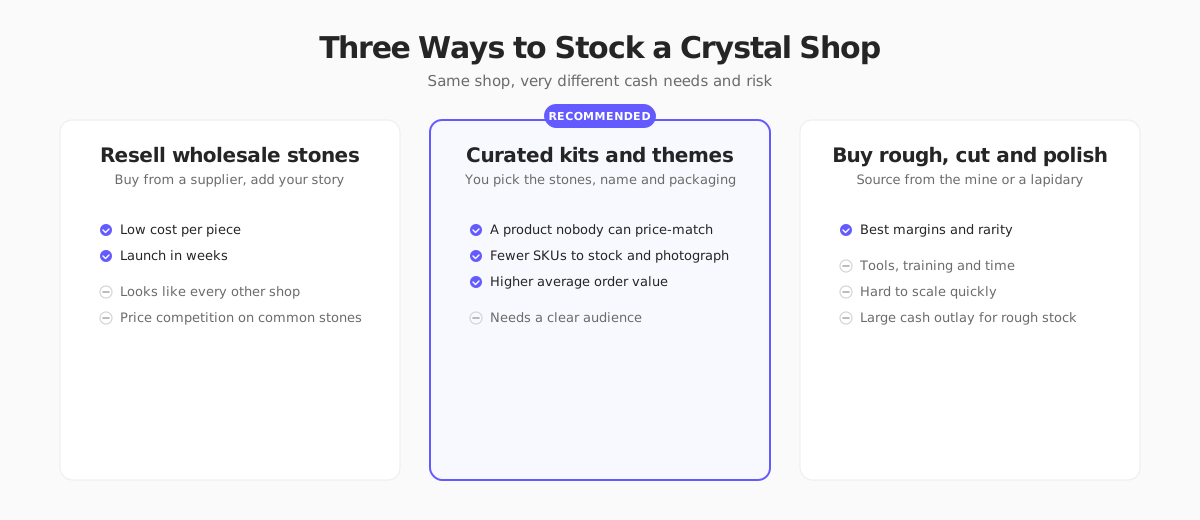
You buy tumbled stones, points, spheres and clusters from a wholesaler and resell them. Startup cost per piece is low and you can launch quickly. The downside is that many shops carry the same pieces, so price is the only way to compete. That is a hard fight for a new store.
### Curated kits and themes: the best starting point for most
Instead of listing every stone, you build products around a purpose or a person. A "desk starter set," a "new home set" or a "birthstone gift box" is harder to compare on price because it is your combination, your packaging and your card. You carry fewer SKUs, photograph fewer items and get a higher average order value.
This is where I would start. You still buy wholesale, but you sell a product, not a commodity.
### Rough stone, cutting and polishing: for craftspeople
If you enjoy lapidary work, buying rough material and shaping it gives you rarity and the best margins. It also requires tools, training and time, and it does not scale quickly. Treat it as a second phase unless it is the reason you want the business.
## Step 3: Find Suppliers You Can Trust
Supplier quality decides whether your shop has a future. Customers notice dyed stones, glued clusters and mislabeled minerals, and they leave reviews.
Where shops source stock:
- **Wholesale suppliers and distributors** that ship in bulk, often with minimums.
- **Gem and mineral shows.** The [Tucson Gem & Mineral Show](https://www.tgms.org/) and the large shows around it are a major annual meeting point for dealers, and many regions have their own shows.
- **Direct from exporters** in countries with major mineral production, with more variance and more paperwork.
- **Local rock shops and collectors** for one-off specimens.
How to vet a supplier:
1. **Order a small sample lot** before a large one. Compare what arrives with their photos.
2. **Ask direct questions:** Is it natural, heat-treated, dyed, stabilized, reconstituted or lab-grown? Where was it mined or collected?
3. **Ask about labor and mining practices.** Crystal mining can involve unsafe conditions and environmental damage. Suppliers who can explain their chain and show how they work are a better bet than those who dodge the question. You cannot verify everything, but you can choose to ask.
4. **Check for consistency.** The 200th piece should look like the first.
Disclose treatments on your product pages. "Dyed agate," "heat-treated citrine" and "lab-grown" are fine to sell. Passing them off as untreated natural stone is not.
Safety matters too. Some minerals are toxic, release dust when cut or are damaged by water. Selenite dissolves in water, and malachite and some other stones should not be used in anything that touches drinks. Do not sell "crystal water bottles" or gem elixirs unless you have verified that every stone is safe for that use.
## Step 4: Know the Rules
Crystals are not a heavily regulated product, but the words you use and the way you import and sell still matter.
### Health and wellness claims
This is the biggest risk. Saying a stone "cures anxiety," "heals illness" or "prevents disease" is a health claim. Regulators in many countries expect health claims to be backed by evidence, and crystals do not have it.
- **In the US,** the FTC expects advertising claims to be truthful and substantiated. See the [FTC's advertising and marketing guidance](https://www.ftc.gov/business-guidance/advertising-marketing).
- **In the EU,** the [Unfair Commercial Practices Directive](https://eur-lex.europa.eu/eli/dir/2005/29/oj) prohibits misleading claims, and national authorities enforce it.
- **In the UK,** the [Advertising Standards Authority](https://www.asa.org.uk/) applies strict rules on health and wellbeing claims.
Safer wording describes tradition and use without promising results: "Traditionally associated with calm," "A popular choice for meditation," "Chosen by customers for their desk." Keep it descriptive, and avoid before-and-after promises.
### Jewelry labeling
If you sell crystal jewelry, claims about the stone type, treatment and precious metal content can fall under rules such as the [FTC's Jewelry Guides](https://www.ftc.gov/legal-library/browse/rules/guides-jewelry-precious-metals-pewter-industries) in the US. Describe "sterling silver," "gold plated" and "synthetic" accurately.
### Importing and tax
If you import stones or ship across borders, you may owe customs duties and import VAT, and the rules differ between the US, EU and UK. Our guides on [ecommerce sales tax](/blog/ecommerce-sales-tax) and [how to sell internationally](/blog/how-to-sell-internationally) explain the basics. Also register your business, get a sales tax or VAT number where required, and consider product liability insurance.
**Always check the current rules where you sell.** This guide summarizes US, EU and UK advertising, labeling and import rules as of October 2026. Regulations change and vary by country, so confirm the details with your local regulator, customs authority or a specialist before you source, label or sell. This is general information, not legal advice.
## Step 5: Price for Margin
Crystals can carry healthy margins, but breakage, shipping and your time eat into them. Here is an illustrative example for a $24 "desk starter set" of three tumbled stones. These numbers are estimates to show the structure, not a quote.
| Line | Example cost |
|------|--------------|
| Three tumbled stones, wholesale | $3.00 |
| Box, tissue, card and sticker | $1.80 |
| Postage to the customer | $5.00 |
| Breakage and replacement reserve (about 5%) | $1.20 |
| Payment processing (about 2.9% + $0.30) | $1.00 |
| Marketing (about 20% of revenue) | $4.80 |
| **What you keep** | **about $7.20** |
A common rule of thumb is to price at three to four times your product cost, then check that shipping and marketing still leave room. A few ways to improve the numbers:
- **Bundle** so postage is spread across more items.
- **Set a free shipping threshold** above your typical single-item price.
- **Charge for the story.** Hand-sourced, labeled and well-packaged stones justify more than a bag of loose pieces.
- **Watch weight.** Large clusters and spheres are heavy and expensive to ship. Price them accordingly or do not stock them.
Pack stones carefully. Points chip and clusters shed fragments. Use padding, a rigid box and clear "fragile" labeling. Read more in our [shipping strategy guide](/blog/ecommerce-shipping-strategy).
## Step 6: Open a Store That Shows the Stones Well
Crystals are visual and tactile, so your store has to do the work of a shelf. Pictures are your main tool.
- **Photograph each unique piece.** Natural stones vary, so for one-of-a-kind specimens, sell the exact piece in the photo.
- **Show scale.** A hand or a coin next to the stone prevents returns.
- **Use natural light and a plain background.** Our [product photography guide](/blog/ecommerce-product-photography) covers a cheap setup.
- **Write honest descriptions:** type, size, weight, origin if known, and any treatment.
- **Make gifts easy:** a gift note field and a clean unboxing experience.


Your options, honestly:
- **[Your Next Store](https://yournextstore.com/)** (us, to be upfront) starts at $25/month on the yearly plan with 0% transaction fees from us (Stripe's processing fees still apply). An AI builder designs the store with you, and checkout runs on Stripe. Good for founders who want a modern storefront and predictable monthly costs.
- **[Shopify](https://www.shopify.com/)** has the biggest app ecosystem. Price the plan plus the apps you will need, not just the headline fee.
- **[Etsy](https://www.etsy.com/sell)** brings buyers who already search for crystals. The trade-off is fees and the fact that shoppers think of themselves as Etsy customers, not yours.
- **Squarespace or Wix** work well for a small, design-led shop.
- **Instagram plus a payment link** is a fair way to test demand. See [how to sell online with Stripe](/blog/how-to-sell-online-with-stripe).
**0% platform fees on every sale.** A modern store for your crystal shop, ready in minutes.
## Step 7: Win One Channel First
Crystal shops tend to take off on one channel. Pick one, give it six months, then add another.
- **Instagram and TikTok.** Unboxing, "pick a stone with me" videos and close-ups of new arrivals suit the format. Consistency beats polish.
- **Live selling.** Showing a stone and selling it on the spot works well for one-of-a-kind pieces.
- **Markets, fairs and pop-ups.** People like to hold stones before they buy, and a booth builds your email list.
- **Local shops.** Wholesale a curated set to gift shops, cafes and wellness studios, and check the margin works at half your retail price.
- **Email.** Collect addresses from day one and send "new arrivals" drops. Repeat buyers are your best customers.
- **Search.** Slow but useful for terms like "gift set for new home" once you have content. See our [ecommerce SEO guide](/blog/ecommerce-seo).
- **Paid ads.** Wait until you know which products reorder.
## What Does It Cost to Start a Crystal Shop?
Rough ranges for planning. Get quotes from your own suppliers.
| Approach | Upfront | What you get |
|----------|---------|--------------|
| **Test with a few curated sets** | $300 to $1,000 | Small stock, packaging, simple store or Etsy shop |
| **Small shop** | $2,000 to $5,000 | Wider range, photography, branded packaging, your own store |
| **Specimen or rough-stone business** | $10,000 and up | Rare inventory, tools or travel to shows, insurance |
Two warnings:
1. **Inventory is cash.** Stones do not spoil, but they do not sell themselves. Buy for the next two or three months and see what moves.
2. **Photos and trust drive sales.** A shop with honest descriptions and good images outsells a bigger shop with vague listings.
The crystal shops that last are not the ones with the biggest inventory. They pick a clear audience, tell the truth about what they sell and package it so a gift feels like a gift.
## FAQ
### How much does it cost to start a crystal shop?
A small test can start at a few hundred dollars for stock, packaging and a simple store. A fuller launch with photos, branded packaging and a wider range is more likely to run a few thousand. Rare specimens and equipment push the budget higher.
### Is a crystal shop profitable?
It can be. Tumbled stones and small pieces are cheap to buy and can carry solid margins. Shipping, breakage and marketing take a real share, so bundles and a clear audience matter more than a large catalog.
### Where do I buy crystals to resell?
Wholesale suppliers, gem and mineral shows, direct exporters and local collectors are the main sources. Start with a small sample order, check what arrives against the listing and ask about treatments and origin.
### Can I say crystals heal or cure things?
No. Health claims need evidence, and regulators in the US, EU and UK can act on misleading ones. Describe traditional uses and how customers use stones, and avoid promises about medical results.
### Should I sell crystals on Etsy or my own website?
Both can work. Etsy gives you a search audience and quick setup, but with fees and less control of the customer relationship. Your own store builds your brand and email list. Many shops start on Etsy and move repeat buyers to their own site.
### Do I need a license to sell crystals?
Usually you need the standard business registration and tax setup for your country or state, such as a business license and a sales tax or VAT number. Crystals themselves generally do not need a special license, but jewelry, imports and health-related claims can bring extra rules. Check with your local authorities.
## Related Blog Posts
- [How to Start an Online Store in 2026: 7 Steps to Your First Sale](/blog/how-to-start-an-online-store)
- [How to Start a Candle Business in 2026](/blog/how-to-start-a-candle-business)
- [How to Start a Gift Basket Business](/blog/how-to-start-a-gift-basket-business)
- [Ecommerce Product Photography](/blog/ecommerce-product-photography)
- [How to Sell Internationally](/blog/how-to-sell-internationally)