# How to Start a Coffee Brand in 2026: A Step-by-Step Playbook
How to start a coffee brand in 2026: sourcing, roasting options, real costs, labeling rules, pricing math and where to sell. Launch with a clear plan.
*Published 2026-10-12*
Coffee is one of the easiest products to start selling and one of the hardest to stand out with. Everyone drinks it, bags ship cheaply, and customers reorder every few weeks. But thousands of roasters already compete for the same shoppers. This guide shows how to start a coffee brand in the right order: pick a niche, choose how you will source the beans, price with real margins, handle the paperwork, and open a store that sells subscriptions from day one.
**A small disclosure:** I help run a company that makes online-store software. It shows up in Step 6, next to other options. The rest of the guide has nothing to do with us.
## The 7 Steps, in Order
1. **Pick a narrow audience and a point of view.** "Good coffee" is not a brand.
2. **Decide how the coffee gets made:** white label, contract roasting, or your own roaster.
3. **Source beans and nail one or two products** before you build a range.
4. **Handle the legal and labeling work** in the country where you sell.
5. **Price for margin,** including shipping and the subscription discount.
6. **Open a store built for repeat orders.**
7. **Win one channel first,** then add the next.
## Step 1: Pick a Narrow Audience and a Point of View
Walk into any grocery aisle and you will see dozens of roasters promising "bold, smooth, rich" coffee. None of them are memorable. The brands people talk about have a point of view about a specific kind of drinker.
Look at how the established names differ:
- [Counter Culture Coffee](https://counterculturecoffee.com) leads with sustainability and teaching, with wholesale for cafes next to a consumer shop.
- [Trade](https://www.drinktrade.com) is a discovery service. It matches you with roasters based on taste instead of roasting its own beans.
- [Death Wish Coffee](https://www.deathwishcoffee.com) built a loud, merch-friendly identity around "the world's strongest coffee."
- [Onyx Coffee Lab](https://onyxcoffeelab.com) sells a premium, competition-level experience and moody, design-driven branding.


Four very different brands, all selling roasted beans. None of them tries to be "for everyone." Some better angles for a new brand:
- **Office coffee** for small teams that want to stop buying supermarket beans.
- **Decaf that actually tastes good,** with water-process decaf and transparent sourcing.
- **Cold brew at home:** coarse-ground blends and brew guides built for a pitcher.
- **A single origin or region** you know firsthand, such as the farms you visited or a cooperative you buy from.
- **Espresso for home machines:** dialed-in blends with grind and recipe notes for popular home setups.
If you are weighing whether to sell physical goods at all, our guide on [how to start an online store](/blog/how-to-start-an-online-store) covers the customer and category decisions before you commit to a product.
A quick test: can you describe your customer in one sentence, and would they recognize themselves? "Remote workers who want café-quality espresso at home without buying a $2,000 machine" passes. "Coffee lovers" fails.
## Step 2: Decide How the Coffee Gets Made
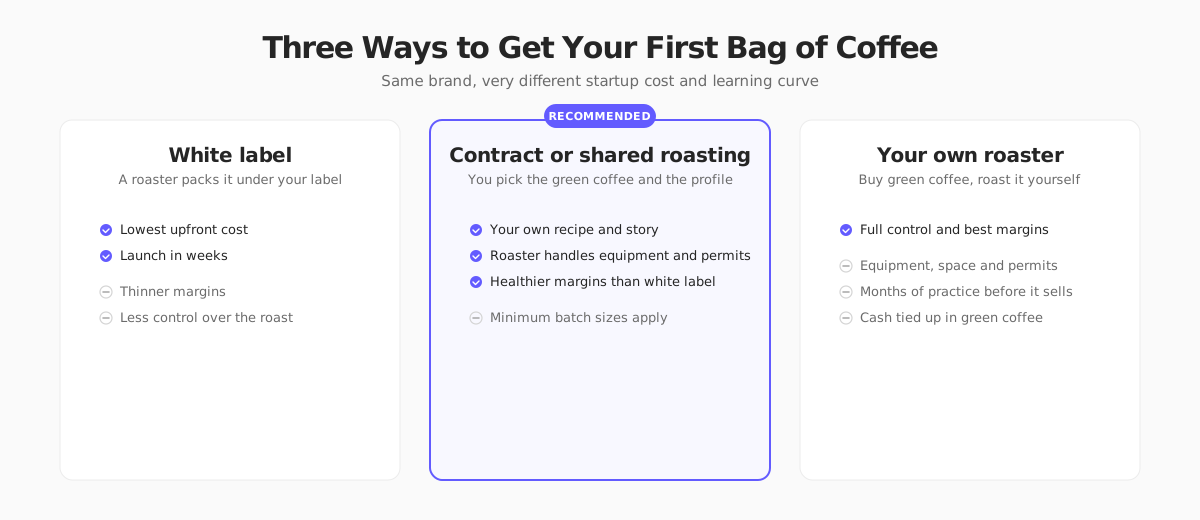
This decision drives your startup cost more than anything else. There are three realistic paths for a new brand.
### White label: fastest and cheapest
A roaster already has blends, packs them in your bag with your label, and ships to you or to your customers. You pick from their menu. You need little more than a brand, a label and a minimum order.
The trade-off is margin and differentiation. Your coffee may be the same blend ten other brands sell with different stickers. This path works for testing demand, not for building a brand people remember.
### Contract or shared roasting: the best path for most new brands
You choose the green coffee and the roast profile with a roaster who has the equipment and the permits. Some roasters offer "co-roasting" where you use their roaster by the hour with their guidance. Either way, the recipe is yours, the story is yours, and you skip the capital cost of a machine.
This is where I would point most first-time founders. You learn the craft without buying a roaster and renting a unit. Expect minimum batches, often in the range of tens of pounds per roast, and expect to spend time cupping samples with the roaster.
### Your own roaster: maximum control, maximum commitment
A small commercial roaster costs thousands of dollars, and that is before ventilation, a space that suits the local fire code, and a scale. Roasting also takes months of practice to produce consistent results. Buying beans in bulk ties up cash.
Choose this path if roasting is the point of the business, not just the means. If your plan is to sell great coffee online, start with contract roasting. You can buy a roaster later with real sales data.
## Step 3: Source Beans and Launch With One or Two Products
New founders often launch with eight coffees. Resist that. A small range keeps your inventory fresh, your photos consistent and your first reviews focused.
A sensible launch range:
| Product | Why it belongs | Notes |
|---------|----------------|-------|
| **House blend** | The easy yes: a balanced coffee for daily drinking | Your best subscription candidate |
| **A single origin** | Shows off your sourcing story | Rotate it seasonally to give people a reason to come back |
| **Decaf or espresso blend** | Fills a clear need in your niche | Add only if your audience asks for it |
Two sourcing tips:
- **Ask for samples and cup them blind.** Order small sample sets from importers or your roaster, then taste them side by side. Choose with your palate, not the label.
- **Understand the green coffee market.** Prices move with harvests and weather, so ask your supplier how often they re-price and whether you can lock in a quantity for a few months.
Roasted coffee is best in the weeks after roasting, so print the **roast date** on every bag. It is cheap trust: shoppers have learned to look for it. Plan your batches so a bag does not sit in your spare room for a month.
## Step 4: Handle the Legal and Labeling Work
Coffee is food, and food comes with rules. The details differ by country, so here is what to check in the main markets.
### In the US
- **FDA registration.** Facilities that manufacture, process, pack or hold food for US consumption generally have to [register with the FDA](https://www.fda.gov/food/guidance-regulation-food-and-dietary-supplements/registration-food-facilities-and-other-submissions). If a contract roaster does the roasting, they are usually the registered facility. Confirm that with them.
- **Cottage food laws** vary by state, and many do not cover roasted coffee or require specific permits. Check your state's department of agriculture or health before roasting at home.
- **Labeling.** Packaged food needs an identity statement (for example "roasted coffee"), net weight, and the name and address of the business. Flavored coffees must list ingredients.
- **Business basics.** A business license, a sales tax permit if you collect tax directly, and product liability insurance. Our guide on [ecommerce sales tax](/blog/ecommerce-sales-tax) explains when you must collect.
### In the EU and UK
- **Register as a food business.** In the UK, you must [register with your local authority](https://www.gov.uk/set-up-a-food-business) at least 28 days before you start trading. EU member states have their own registration rules with the local food authority.
- **Labeling.** The EU's [Food Information Regulation](https://eur-lex.europa.eu/eli/reg/2011/1169/oj) sets requirements such as the product name, net quantity, a best-before date, storage conditions and the business name and address. The UK has similar rules with its own details.
- **Deforestation rules.** The EU has adopted a [deforestation regulation](https://environment.ec.europa.eu/topics/forests/deforestation/regulation-deforestation-free-products_en) that covers coffee, and its application dates have been postponed before. If you import green coffee into the EU, check the current timetable and what due diligence you must show.
### Claims on the bag
Words like "organic," "fair trade," "direct trade" and "specialty grade" have specific meanings or certifiers behind them. Only use them if you can prove them. "Organic" in particular requires certification in the US, the EU and the UK, and it applies to the supply chain, not just the beans.
**Always check the current rules where you sell.** This guide summarizes US, EU and UK food business and labeling rules as of October 2026. Regulations change and vary by country and state, so confirm the details with your local food authority or a regulatory specialist before you roast, label or sell. This is general information, not legal advice.
## Step 5: Price for Margin
Coffee margins look generous until you add shipping, packaging and discounts. Here is an illustrative example for a 12 oz (340 g) bag. These numbers are estimates to show the structure. Your own costs will differ.
| Line | Example cost |
|------|--------------|
| Green coffee (about 14 oz in, 12 oz out after roast loss) | $4.50 |
| Contract roasting and packing | $2.00 |
| Bag, valve and label | $0.80 |
| Shipping box and fillers | $0.70 |
| Postage to the customer | $5.00 |
| Payment processing on a $20 sale (about 2.9% + $0.30) | $0.88 |
| **Total cost to deliver one bag** | **about $13.90** |
At a $20 retail price, that leaves about $6 before marketing. That works, but not by much. Levers that improve it:
- **Raise the price** if your niche supports it. Specialty bags commonly sell for more than supermarket coffee, but your audience decides, not me.
- **Bundle bags** (two or three per order) so shipping is spread across more coffee. [Shipping strategy](/blog/ecommerce-shipping-strategy) matters more here than for most products.
- **Offer a free shipping threshold** just above your single-bag price.
- **Sell subscriptions** so that acquisition cost is spread over many orders.
Wholesale to cafes and offices often runs at roughly half of retail, so make sure the numbers still work before you quote a price.
## Step 6: Open a Store Built for Repeat Orders
Coffee is a consumable, which is the best thing about it. A customer who likes your house blend will buy again in three weeks. Your store should make that easy.

What the store needs:
- **Subscriptions,** with a simple choice of frequency (every 2, 3 or 4 weeks) and an easy way to skip or pause. Customers who can pause stay longer than customers who have to cancel. Our guide on [how to sell subscriptions online](/blog/how-to-sell-subscriptions-online) covers the mechanics.
- **Grind options** at checkout: whole bean, espresso, filter, French press.
- **Clear roast dates** and tasting notes on every product page.
- **Good photos.** Bags look alike on a screen, so lean on lifestyle shots. Our [product photography guide](/blog/ecommerce-product-photography) has a cheap setup.
- **Fast pages on mobile,** where most coffee shoppers browse.

Your options, honestly:
- **[Your Next Store](https://yournextstore.com/)** (us, to be upfront) starts at $25/month on the yearly plan with 0% transaction fees from us (Stripe's processing fees still apply). An AI builder designs the store with you, and checkout runs on Stripe. It suits founders who want a fast, modern storefront without stacking plug-ins.
- **[Shopify](https://www.shopify.com/)** has the biggest app ecosystem, including mature subscription apps. The monthly total grows with each app, so price the full stack, not just the plan.
- **[Etsy](https://www.etsy.com/sell)** is possible for small-batch coffee, though shoppers there are not primarily looking for a repeat-delivery coffee habit.
- **Squarespace or Wix** are fine for a simple first launch.
- **A payment link** works for a first test batch. See [how to sell online with Stripe](/blog/how-to-sell-online-with-stripe).
**0% platform fees on every sale.** A modern store for your coffee brand, ready in minutes.
## Step 7: Win One Channel First
New coffee brands tend to win on a single channel in the first year. Pick one, run it for six months and then add another.
- **Email and subscriptions.** The most profitable channel once you have customers. Ask for an email at checkout and send a short welcome series that explains how to brew your coffee.
- **Instagram and TikTok.** Brew videos, farm stories and behind-the-scenes roasting work well. Consistency matters more than polish.
- **Local cafes, offices and gyms.** One regular wholesale account can sell more than a month of social posts.
- **Farmers markets and pop-ups.** A table with a brewer lets people taste before they buy, which is a big advantage for coffee.
- **Creator samples.** Send free bags to a short list of creators in your niche, with a handwritten note.
- **Search.** Slow, but useful for terms like "decaf whole bean coffee" once you have content. See our [ecommerce SEO guide](/blog/ecommerce-seo).
- **Paid ads.** Wait until you know your repeat rate. Ads pay for themselves only if customers reorder.
Pick one main channel and one backup, and give them time.
## What Does It Cost to Start a Coffee Brand?
Rough ranges for planning. Treat them as starting points and get quotes from your own roaster and suppliers.
| Approach | Upfront | What you get |
|----------|---------|--------------|
| **White label test** | A few hundred dollars | One or two blends under your label, a simple website, first customers |
| **Contract roasting launch** | $2,000 to $6,000 | Your own blend, custom bags, photos, a store with subscriptions |
| **Own roaster** | $15,000 and up | Equipment, space, permits, green coffee inventory and your time |
Two warnings:
1. **Inventory is cash.** Green coffee, bags and boxes sit on a shelf until you sell them. Buy for the next two or three months, not the next year.
2. **Shipping is a bigger line item than most founders expect.** Model it before you set your price.
The coffee brands that last are not the ones with the fanciest bag. They pick a specific customer, roast something they would drink every day, and make reordering effortless.
## FAQ
### How much does it cost to start a coffee brand?
It depends on the path. A white label test can start with a few hundred dollars, while a contract roasting launch with custom packaging and a store is more likely to run a few thousand. Owning a roaster pushes the budget well past that once equipment, space and inventory are included.
### Do I need my own roaster to start a coffee brand?
No. Most new brands start with white label or contract roasting, which lets you validate demand before buying equipment. You can invest in a roaster once you have steady orders and a clear sense of the roast profiles your customers love.
### Can I sell coffee from home?
It depends on where you live. Some US states allow limited home production under cottage food laws, but many do not cover roasted coffee. In the UK you must register your food business, and EU countries have their own rules. Check with your local food authority before you start.
### What is the best way to sell coffee online?
A store with subscriptions, grind options and clear roast dates, plus email to bring customers back. Coffee is a repeat purchase, so the ability to reorder in two clicks matters more than a clever homepage.
### Is a coffee business profitable?
It can be, but margins are thin until you have repeat customers. Shipping, packaging and payment fees take a real share of a $15 to $25 bag. Subscriptions, bundles and wholesale accounts are the usual ways to improve the numbers.
## Related Blog Posts
- [How to Start an Online Store in 2026: 7 Steps to Your First Sale](/blog/how-to-start-an-online-store)
- [How to Sell Subscriptions Online](/blog/how-to-sell-subscriptions-online)
- [How to Start a Chocolate Business](/blog/how-to-start-a-chocolate-business)
- [How to Start a Candle Business in 2026](/blog/how-to-start-a-candle-business)
- [Ecommerce Shipping Strategy](/blog/ecommerce-shipping-strategy)