# How to Prevent Chargebacks (and Win the Ones You Get)
How to prevent chargebacks in ecommerce: causes, 3D Secure, clear descriptors, evidence that wins disputes and ratio limits. Protect your store today.
*Published 2026-11-05*
**A chargeback costs you the sale, the product, the shipping and a dispute fee, and too many of them can get your payment account shut down.** Knowing how to prevent chargebacks is mostly about boring operations: be recognizable on the statement, be honest in the listing, answer support fast, and keep evidence. This guide covers all of it, plus how to win disputes you could not avoid.
## What Is a Chargeback?
A chargeback is a forced reversal of a card payment. The cardholder asks their bank (the issuer) to take the money back, the issuer pulls the funds from your processor, and you get a chance to submit evidence that the charge was legitimate. It is different from a refund, where you choose to return the money.
The sequence looks like this:
1. The customer disputes the charge with their bank.
2. Funds are withdrawn from your balance immediately, plus a dispute fee. In the US, [Stripe's dispute fee](https://stripe.com/pricing) has been around $15 per dispute at the time of writing; other processors and regions differ, so check yours.
3. You have a limited window (often one to three weeks, set by your processor) to respond with evidence.
4. The issuer decides. If you win, the funds return. If you lose, they stay gone.
Even a **won** dispute costs you time, and a high count hurts you regardless of outcome, which is why prevention beats rebuttal.
## Why Chargebacks Happen
Chargebacks fall into three buckets, and each needs a different fix.
| Type | What happened | Share of the problem | Main defense |
|------|---------------|----------------------|--------------|
| True fraud | A stolen card or hijacked account was used | Common in high-value, digital and rush orders | 3D Secure, risk rules, address checks |
| Friendly fraud | The real cardholder disputes a valid order: forgot it, did not recognize the charge, or regrets it | Often the largest bucket for small stores | Clear descriptor, easy refunds, evidence |
| Merchant error | Late shipping, wrong item, listing mismatch, duplicate charge, cancelled subscription still billed | Fully in your control | Operations and communication |
Notice how much of this is not criminal. Many "fraud" disputes are customers who could not tell what the charge on their statement was, or who found it easier to call the bank than to find your return policy. For the criminal side, see our guide to [ecommerce fraud prevention](/blog/ecommerce-fraud-prevention).
## The Chargeback Ratio You Need to Watch
Card networks monitor the share of your transactions that end in disputes. Cross their thresholds and you can face extra fees, a rolling reserve, mandatory remediation programs, or termination. The numbers move: Visa and Mastercard have revised their monitoring programs repeatedly. As [reported by Chargebacks Gurus](https://www.chargebackgurus.com/blog/visa-announces-even-more-vamp-changes), Visa's excessive threshold was set to drop to 1.5 percent from April 2026, with regional exceptions. Acquirers often set stricter internal limits, and many processors want you well under 1 percent.
How to track it:
- **Dispute ratio** = disputes in a month divided by transactions in the same month (some programs count by prior-month sales, so confirm the formula with your processor).
- **Alert at 0.5 percent**, not 1 percent. By the time you hit the limit, the damage is done.
- Look at disputes **by cause**, product, country and campaign. One bad supplier or one ad audience can drive most of them.
**Always check the current rules where you sell.** This guide summarizes US, EU and UK card dispute practices as of November 2026. Card network rules, thresholds, evidence windows and consumer-protection law (such as the EU's Payment Services rules or UK Section 75) change and vary by processor and country, so confirm the details with your payment processor or a payments specialist. This is general information, not legal advice.
## 10 Ways to Prevent Chargebacks
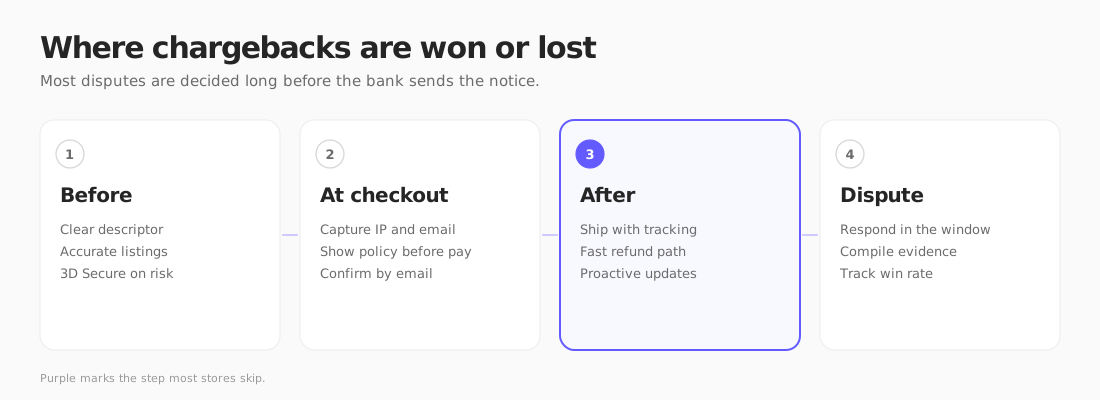
### 1. Make your statement descriptor recognizable
If the charge shows up as `STRP*XYZ LLC 8005551234`, customers dispute it. Set a descriptor that matches the brand on your website and include a support phone or URL if the processor allows. This single change removes a surprising share of "I don't recognize this" disputes.
### 2. Describe products accurately
"Not as described" is a top dispute reason. Show real photos, accurate sizes, materials and what is in the box. If an item runs small, say so. Honest listings lower returns as well (see our [ecommerce return policy guide](/blog/ecommerce-return-policy)).
### 3. Publish clear policies before payment
Show shipping times, returns and cancellation terms on the product page and at checkout, and require nothing hidden. In disputes, the issuer asks whether the customer was told. A policy link visible at the pay button is evidence.
### 4. Turn on 3D Secure where risk is higher
When a payment is authenticated with 3D Secure, liability for fraud disputes generally shifts to the issuer. [Stripe documents the flows](https://docs.stripe.com/payments/3d-secure) and how to trigger it conditionally. In the EU and UK, strong customer authentication is required for most online card payments under PSD2, so 3DS is largely built in; in the US it is optional and usually a trade-off against conversion, so apply it to risky orders rather than all of them.

### 5. Use risk scoring and simple rules
Tools like [Stripe Radar](https://stripe.com/radar) score each payment and let you block, review or challenge. Useful starter rules: review orders where shipping and billing countries differ, block high-risk scores, and hold first orders above a value limit for manual review.

### 6. Confirm the order and keep customers informed
Send an order confirmation immediately, a shipping email with a tracking link, and a delivery notice. Each email is timestamped evidence and also reduces "where is my order?" anxiety, which turns into disputes when support is slow.
### 7. Ship fast, with tracking and signature when warranted
"Item not received" disputes are won with carrier proof of delivery to the address on the order. Use tracked services always. For high-value items consider signature confirmation, and never ship to an address that differs from billing without a risk check.
### 8. Make refunds easier than disputes
If the fastest path to getting money back is the bank, customers take it. A visible returns page, a human reply within one business day and a quick refund cost you the sale but not the fee, the ratio hit, or the product. Some processors can also deflect disputes if you refund early; ask yours.
### 9. Handle subscriptions carefully
Recurring billing is a dispute magnet. Send a reminder before renewals and trial conversions, make cancellation as easy as sign-up, and send a receipt each cycle. See [selling subscriptions online](/blog/how-to-sell-subscriptions-online) for the full setup.
### 10. Keep a clean support trail
Answer every email and log it. Disputes get decided on documentation: if you can show you offered a fix and the customer ignored it, you have a case.
## How to Respond to a Chargeback
You usually get one shot, so assemble it properly and on time.
1. **Check the reason code.** It tells you which evidence the issuer expects. Fraud, product not received, product unacceptable and subscription cancelled each need different proof.
2. **Decide if it is worth fighting.** For a low-value, clearly valid dispute you cannot support, accepting the loss can be rational. Do not accept disputes you could win.
3. **Collect evidence** (see the table below).
4. **Write a short, factual rebuttal.** Dates, order number, what was delivered, what policy applied. No emotion.
5. **Submit before the deadline.** Late evidence is rejected, no exceptions.

| Dispute reason | Evidence that helps |
|----------------|--------------------|
| Fraud / unrecognized | AVS and CVC match, 3D Secure result, IP and device, prior undisputed orders from the same customer, delivery to the cardholder's address |
| Product not received | Tracking showing delivery, signature or photo, matching address |
| Not as described | Product page snapshot, photos, customer messages, returns policy, proof you offered a remedy |
| Subscription cancelled | Terms accepted, renewal reminder emails, cancellation log, usage records |
| Duplicate charge | Both transaction records showing distinct orders |
For fraud disputes, Visa's Compelling Evidence 3.0 program lets you show that the same customer made earlier undisputed purchases with matching identifiers such as IP and device, which can shift liability. Eligibility rules are detailed and change, so read your processor's current guidance.
## Chargebacks in the EU and UK
The mechanics are the same, but two differences matter. First, PSD2 strong customer authentication means authenticated payments are better protected against fraud claims, while unauthenticated ones are riskier for you. Second, consumer-law rights, such as the EU 14-day withdrawal right for most distance sales and Section 75 in the UK for certain credit card purchases, mean some "chargebacks" are really valid returns arriving through the bank. Fixing your returns flow removes many of them.
## Where Your Next Store Fits
Payments in [Your Next Store](https://yournextstore.com/) run through Stripe, so you get Stripe's tools: 3D Secure, Radar and the dispute dashboard. The store adds order records, refunds from the admin, invoices and customer data in one place, which is the evidence pack you assemble when a dispute lands. YNS charges 0 percent platform transaction fees; Stripe's processing and dispute fees still apply. Keep your descriptor and policy pages configured before launch, not after the first dispute.

For the payment setup itself, see [how to sell online with Stripe](/blog/how-to-sell-online-with-stripe).
## Chargeback Prevention Checklist
- [ ] Descriptor matches your brand, with a support contact
- [ ] Accurate listings and visible policies before payment
- [ ] 3D Secure on risky or high-value orders
- [ ] Risk rules and manual review for first big orders
- [ ] Confirmation, shipping and delivery emails, all logged
- [ ] Tracked shipping, signature on expensive items
- [ ] Fast, human refund path
- [ ] Subscription reminders and easy cancellation
- [ ] Alert at 0.5 percent dispute ratio, review causes monthly
- [ ] Evidence templates ready per reason code
## FAQ
### How long do you have to respond to a chargeback?
It depends on the processor and card network, but evidence deadlines are often between one and three weeks from the dispute notice. Check the exact date in your dashboard, because late submissions are not considered.
### What if a customer gets a refund and still files a dispute?
Submit the refund confirmation as evidence. Issuers generally expect a refunded charge not to be paid twice, but outcomes vary, so respond anyway. Always refund to the original payment method and keep the confirmation.
### Do chargebacks affect your credit?
Not your personal credit directly, but a high ratio can lead to reserves, higher processing rates or account termination, and some merchants end up on shared industry lists that make it hard to open a new account.
## The Short Version
Most chargebacks are a communication failure wearing a fraud costume. Be recognizable, be clear, answer quickly, and keep receipts for everything. Then the disputes that remain are the ones worth fighting.
## Related Blog Posts
- [Ecommerce Fraud Prevention: How to Protect Your Store](/blog/ecommerce-fraud-prevention)
- [How to Sell Online with Stripe in 2026: 5 Options](/blog/how-to-sell-online-with-stripe)
- [Ecommerce Return Policy: EU and US Rules (Plus a Template)](/blog/ecommerce-return-policy)
- [How to Sell Subscriptions Online: Models, Tools and Churn](/blog/how-to-sell-subscriptions-online)
- [Ecommerce Checkout Optimization: The 2026 Playbook](/blog/ecommerce-checkout-optimization)