# Ecommerce Shipping Strategy: How to Set Rates Without Losing Money
Set ecommerce shipping rates that protect your margin: flat, calculated or free-over-threshold. Includes the math, carriers, and a worked example.
*Published 2026-10-08*
Shipping is the one line item that can turn a profitable order into a loss before the box leaves the building. **A good ecommerce shipping strategy is not about picking the cheapest carrier. It is about choosing a rate model your margins can carry, and checking it against your worst order, not your average one.** This guide walks through the four rate models, the math behind free shipping, and how to set it all up without guessing.
## Why Shipping Rates Quietly Eat Your Margin
Customers treat shipping as part of the price, and they punish surprises. [Baymard's checkout research](https://baymard.com/lists/cart-abandonment-rate) consistently finds that unexpected extra costs, shipping above all, are the most common reason shoppers abandon a cart. So you are squeezed from both sides: charge too much and you lose the sale, charge too little and you lose money on the sale you did win.
Three things make that squeeze worse than it looks:
- **Dimensional weight.** Carriers bill the greater of actual weight and the size of the box. A light but bulky product (a pillow, a hat, a candle set) is billed as if it were heavy.
- **Zones.** The same parcel costs more the farther it travels. A flat price that works for your home region can lose money three zones away.
- **Surcharges.** Fuel, residential delivery, oversize and remote-area fees are added after the headline rate. They are easy to forget when you model costs in a spreadsheet.
Before you pick a model, find out what shipping actually costs you. Pack 10 real orders, weigh them, measure the boxes, and quote each one to your three most common destinations. That table is the input for everything below.
## The Four Shipping Rate Models
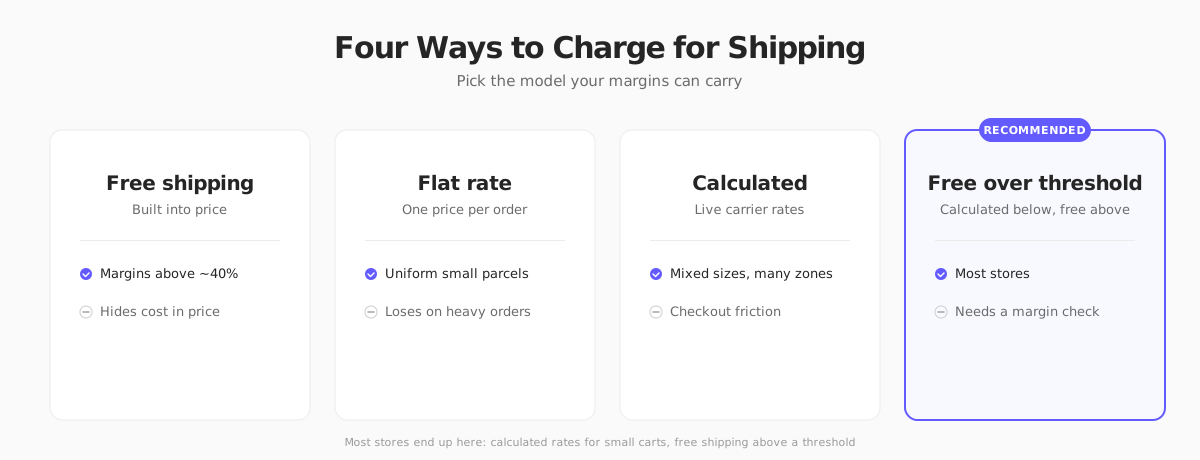
### 1. Free shipping on everything
Simple to communicate and great for conversion, but you pay for it. It only works when the cost is genuinely absorbed by the price: high-margin products, low-weight goods, or an average order value large enough that a few dollars of postage disappears. If you choose this, raise your product prices to cover the average shipping cost rather than treating it as a loss leader forever.
### 2. Flat rate
One price per order (or per region) regardless of contents. It is easy to understand and easy to build. It works well when your parcels are uniform, for example stickers, jewelry or small apparel. It breaks down when you sell a mix of light and heavy items, because the heavy orders subsidize nothing and the light ones overpay.
### 3. Calculated (live carrier) rates
The checkout asks the carrier for a price based on weight, dimensions and destination. It is the most accurate model and it removes your risk of undercharging. The trade-off is friction: a customer sees the number late, and a high number appears at the worst moment. Use it when product sizes vary a lot or when you ship to many zones.
### 4. Free over a threshold (the default we recommend)
Charge a calculated or flat rate below a cart value, and free shipping above it. It does two jobs: it covers your cost on small orders and it nudges shoppers to add one more item. Most stores should start here. The only real work is picking the threshold, which is a margin question, not a marketing one.
| Model | Best for | Main risk |
|-------|----------|-----------|
| Free on everything | High margin, light products | Margin erosion on heavy or far orders |
| Flat rate | Uniform small parcels | Over- or under-charging mixed carts |
| Calculated | Mixed sizes, many zones | Checkout friction, late price reveal |
| Free over threshold | Most stores | A threshold that ignores your margin |
## The Math: How to Set a Free Shipping Threshold
Take three numbers from your own data:
1. **Average order value (AOV)** before shipping.
2. **Gross margin** on a typical order, after product cost.
3. **Average shipping cost** you pay the carrier, including packaging.
A threshold only makes sense if the margin on an order at the threshold is comfortably above the shipping cost. As a worked example, with made-up numbers: your AOV is $48, your gross margin is 50%, and shipping costs you $7.
- At $48, margin is $24. Free shipping leaves $17. Fine.
- At a $35 order, margin is $17.50. Free shipping leaves $10.50. Still fine.
- At a $20 order, margin is $10. Free shipping leaves $3. Too thin once you count payment fees.
So a threshold around $35 to $50 is defensible, and setting it a little above your current AOV encourages bigger baskets. Do not copy a competitor's number. Their margin and their carrier contract are not yours.
Here is the same logic as code, so it can live in your store instead of a spreadsheet:
```ts
type Order = { subtotal: number; shippingCost: number; grossMargin: number };
const FLOOR = 0.15; // keep at least 15% of the subtotal after free shipping
export function canOfferFreeShipping(order: Order) {
const left = order.subtotal * order.grossMargin - order.shippingCost;
return left / order.subtotal >= FLOOR;
}
export function suggestThreshold(grossMargin: number, shippingCost: number) {
// smallest subtotal that still leaves FLOOR after free shipping
return Math.ceil(shippingCost / (grossMargin - FLOOR));
}
suggestThreshold(0.5, 7); // 20
```
The function returns the break-even subtotal. In practice you set the public threshold above it to leave room for payment fees, returns and the odd heavy order.
**Don't forget payment fees.** Every order also pays a card processing fee. If you have not modeled it, our breakdown of [what platforms really take from a sale](/blog/shopify-transaction-fees) shows how the percentage plus fixed fee eats into a thin margin.
## Carriers and Shipping Software
You rarely need to negotiate with carriers directly. Shipping software gives small merchants access to discounted commercial rates and prints labels in bulk.
**[Pirate Ship](https://www.pirateship.com/)** is popular with small US sellers because it charges no monthly fee and offers discounted USPS and UPS rates. It is a label tool, not a storefront integration platform, so you copy orders in or connect through a supported channel.

**[Shippo](https://www.goshippo.com/)** is built for developers: an API and an app that return rates across USPS, UPS, FedEx and DHL and generate labels. If you want live carrier rates inside your own checkout, this is the shape of tool you need.

**[ShipStation](https://www.shipstation.com/)** is a full order and fulfillment workflow tool: multi-channel order import, automation rules, batch labels, returns. It makes sense once you ship enough volume that rules and batching save real time.

Whichever you choose, compare the same three sample parcels across tools and zones. Discounts are real but they vary by service and weight band, and published promo percentages are best case.
## Packaging, Dimensional Weight and Other Cost Levers
Before changing prices, shrink the cost:
- **Right-size your boxes.** Oversized boxes are billed on size. Cutting a box by an inch on each side can drop a weight band.
- **Use poly mailers** for soft goods that survive being squashed.
- **Weigh the packaging** too. A heavy box can cost more than the margin on a small item.
- **Negotiate with volume.** At a few hundred parcels a month, a regional carrier or a fulfillment partner may beat the national carriers on short zones.
- **Test the return label cost.** If you offer free returns, price that into your model, because returns can double the shipping bill of an order.
## International Shipping: Duties, Taxes and Who Pays
Selling abroad adds a question domestic shipping never raises: who pays import duties and taxes at the border?
- **Delivered Duty Unpaid (DDU).** The customer pays duties on delivery. Cheaper at checkout, painful at the door, and a common cause of refused parcels.
- **Delivered Duty Paid (DDP).** You collect duties and taxes at checkout and remit them. A smoother experience, but you need to estimate them accurately.
Jurisdiction matters, and the rules keep changing:
- **In the US,** the long-standing duty-free allowance for low-value imports has been scaled back, so shipments into the US from abroad can now incur duties that they did not before.
- **In the EU,** goods imported from outside the bloc owe VAT, and the EU has been moving to end its low-value customs duty exemption, so check the current position on the [European Commission customs pages](https://taxation-customs.ec.europa.eu/).
- **In the UK,** import VAT is collected at the border or at checkout for consignments of £135 or less, with customs duty handled separately.
Our deeper guide to [selling internationally](/blog/how-to-sell-internationally) covers currency, VAT and localization. For tax at the destination in the US, see [ecommerce sales tax](/blog/ecommerce-sales-tax).
**Always check the current rules where you sell.** This guide summarizes US, EU and UK import duty and VAT treatment as of October 2026. Customs thresholds and carrier surcharges change often and vary by country, so confirm the details with your carrier, a customs broker or a tax specialist before you set international rates. This is general information, not legal or tax advice.
## Setting Shipping Up in Your Store
However you build it, a good setup has the same parts:
1. **Shipping zones** with different rates for domestic, nearby and far destinations.
2. **Product weights and dimensions** stored on every variant. Without them, calculated rates are guesses.
3. **Rules for free shipping,** driven by cart subtotal after discounts.
4. **A carrier integration** for labels and tracking numbers that flow back to the customer.
5. **Honest delivery estimates** shown in the cart, not just at the end.
If you are choosing a platform, ask how it handles these. [Your Next Store](https://yournextstore.com/) connects shipping through Shippo, takes payments through Stripe Checkout with 0% platform transaction fees, and exposes carts and orders through a REST API, so rate logic like the snippet above can live in your own storefront code. Shipping is one of several costs to model when you [open an online store](/blog/how-to-start-an-online-store), and our [cost breakdown](/blog/how-much-does-an-ecommerce-website-cost) puts it next to hosting, apps and fees.

## What Nobody Tells You About Shipping
- **Your worst order sets your real margin.** Average shipping cost hides the one customer ordering three heavy items to a remote zone.
- **Free shipping is a marketing spend,** so review it like one. Revisit the threshold every quarter.
- **Rates change every year.** Carriers raise prices annually and adjust surcharges mid-year. A threshold set once and forgotten drifts into a loss.
- **Delivery speed matters as much as price** for many categories. A cheap, slow option next to a paid fast one often beats a single middling choice.
- **Dropshipping changes the math.** Supplier shipping times and costs are not yours to control, which we cover in [how to start dropshipping](/blog/how-to-start-dropshipping).
## FAQ
### How do I calculate shipping costs for my online store?
Weigh and measure real packed orders, quote each one to your top destinations through a shipping tool, and add packaging and labor. Use the worst realistic order, not the average, as your safety check, then pick a rate model that your margin supports.
### Should I offer free shipping?
Offer it when your margin can carry it, usually as free shipping over a threshold rather than on every order. The threshold should sit above your average order value so it encourages larger baskets.
### What is the cheapest way to ship small packages?
For lightweight US parcels, discounted USPS commercial rates through a tool such as Pirate Ship or Shippo are usually the cheapest. Compare against UPS and regional carriers for your own zones and weights before committing.
### What is dimensional weight?
Dimensional weight is a billing weight calculated from a package's size. Carriers charge the higher of actual weight and dimensional weight, so a large, light box can cost as much as a heavy one.
## Related Blog Posts
- [Ecommerce Checkout Optimization](/blog/ecommerce-checkout-optimization)
- [How to Sell Internationally](/blog/how-to-sell-internationally)
- [Shopify Transaction Fees](/blog/shopify-transaction-fees)
- [How to Start Dropshipping](/blog/how-to-start-dropshipping)
- [Ecommerce Sales Tax](/blog/ecommerce-sales-tax)