# Ecommerce Product Recommendations: How to Personalize Sales
Ecommerce product recommendations that sell: where to place them, which logic fits your volume, the rules, tools and how to measure lift. Start here.
*Published 2026-11-18*
**Most ecommerce product recommendations fail for a boring reason: they suggest the wrong thing at the wrong moment.** A "you might also like" row of near-identical products under a product page, a $90 jacket offered in a cart worth $30, a reorder email for the item the customer returned last week. Good recommendations do the opposite. They answer the question the shopper is asking right now, and they can be built without a data science team. This guide covers where recommendations earn their place, which logic fits your store's size, the merchandising rules that matter more than the algorithm, how to build "frequently bought together" yourself, and how to measure whether any of it adds sales.
## Do Product Recommendations Actually Increase Sales?
Yes, but by less than the most quoted number suggests. The famous claim that 35% of Amazon's purchases come from recommendations traces back to a 2013 McKinsey report, and it has been repeated ever since without much scrutiny.
A more careful estimate comes from a field experiment on a large fashion retailer's site by Anuj Kumar (University of Florida) and Kartik Hosanagar (Wharton). They compared shoppers who saw recommendations with a control group who didn't, across more than two million product page views. [Recommendations raised overall product sales by about 11%](https://warrington.ufl.edu/news/how-valuable-are-online-product-recommendations/), and some of that came at the expense of the products shoppers were originally looking at. Kumar called the higher industry figures "hard to believe" because recommended products are often ones shoppers would have found anyway through search and browsing.
An 11% lift on product sales is still a lot of money for a feature you build once. The takeaways:
- **Recommendations work best as cross-sell,** adding something to an order, not as a way to switch people from one product to another.
- **Vendor "influenced revenue" numbers overstate the effect,** for the same reason the 35% figure does. Measure with a control group (see below).
- **Popular products benefit most.** Niche items can lose sales when recommendations steer attention toward bestsellers.
## Where Ecommerce Product Recommendations Belong
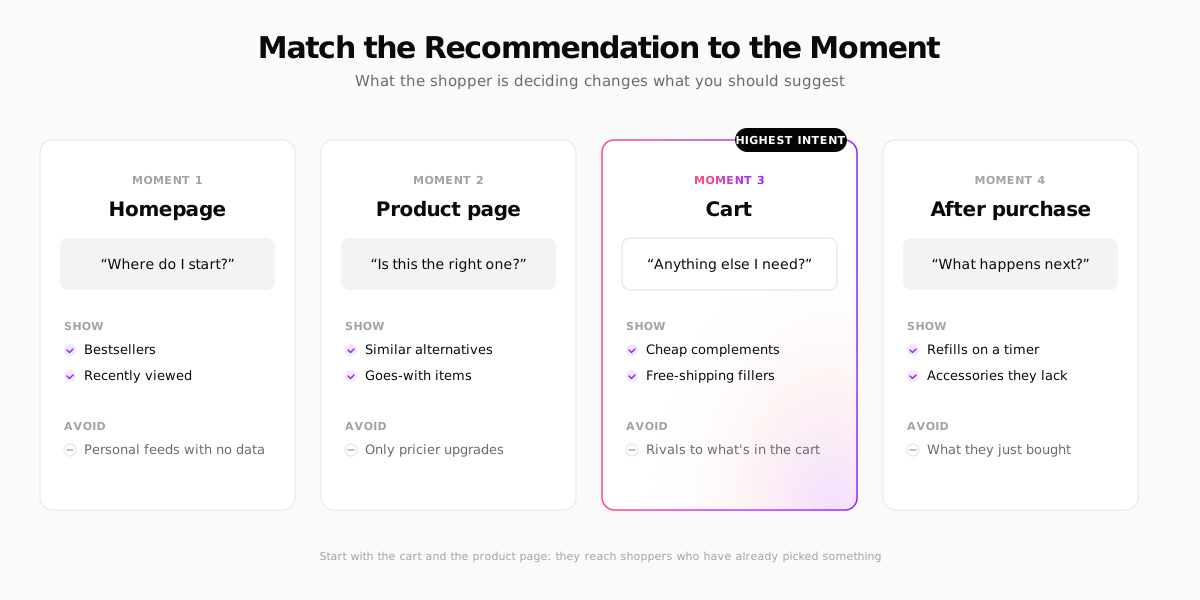
The same product in the same widget performs very differently depending on what the shopper is deciding at that moment. Start by mapping the moment, then pick what to show.
### Product page: help them choose, then complete the look
A shopper on a product page is asking "is this the right one?" Two kinds of recommendations help:
- **Similar alternatives,** for shoppers who like the category but not this exact item: a different color, size range or price point. They keep someone who would otherwise bounce. They matter most when the product is out of stock.
- **Goes-with items,** for shoppers who have decided: the case for the phone, the wine for the cheese, the refill for the bottle.
Label them differently. "Similar styles" and "Goes well with" tell the shopper what each row is for. A single "You might also like" row that mixes both does neither job well. Our guide to [product page design](/blog/product-page-design) covers where these sit relative to the buy button.
### Cart: small, obvious add-ons
The cart is the highest-intent page in your store, and the easiest place to raise average order value, because the big decision is already made. What works:
- **Cheaper complements.** A common rule of thumb is to keep cart add-ons well below the cart's value, often under a quarter of it. A $12 accessory in a $60 cart is an easy yes; a second $60 item is a new decision.
- **Free-shipping fillers.** If the cart is $8 short of your free-shipping threshold, suggest items in the $8-15 range. It is the most persuasive recommendation you can make, because it partly pays for itself.
- **Nothing that competes with the cart.** Suggesting a rival product makes people second-guess what they chose, and second-guessing causes [cart abandonment](/blog/how-to-reduce-cart-abandonment).
Keep recommendations above the checkout button but out of its way. They should be an option, never a step.
### Checkout and after purchase
**Post-purchase upsells,** offers shown on the thank-you page that add an item to the order with one click, can work well because the payment details are already in. They need a checkout that supports adding to a paid order, so check your platform before planning around them. Our guide to [ecommerce checkout optimization](/blog/ecommerce-checkout-optimization) covers what belongs in checkout and what slows it down.
**Post-purchase emails** carry the rest: one cross-sell after delivery for an accessory the customer doesn't have yet, and a refill reminder timed to when the product runs out. Never recommend the item they just bought, unless it is consumable and the timing is right. These emails are flows, so the same trigger, wait, check and exit logic applies; see our guide to [ecommerce marketing automation](/blog/ecommerce-marketing-automation).
### Homepage, search and empty states
- **Homepage:** bestsellers and "recently viewed" work for everyone, including first-time visitors. Personalized feeds need data most small stores don't have.
- **Zero-result searches and 404 pages:** show bestsellers instead of a dead end.
- **Out-of-stock product pages:** show the closest in-stock alternatives above the fold, next to a back-in-stock signup.
## Recommendation Logic: From Hand-Picked to AI
"Recommendation engine" covers very different approaches. Which one fits depends mostly on how many orders you have, because every data-driven method needs enough history to separate real patterns from coincidence.
| Logic | How it works | Data needed | Fits |
| --- | --- | --- | --- |
| **Hand-picked** | You choose the related products for each item | Product knowledge | Any store, best under a few hundred products |
| **Rules** | Same category, shared attributes, price range | A tidy catalog | Any store, and the fallback for new products |
| **Bestsellers and trending** | Ranked by recent sales or views | Sales history | Any store with steady orders |
| **Frequently bought together** | Products that appear in the same orders | Hundreds of orders at least | Growing stores |
| **Behavioral (collaborative filtering)** | "Shoppers like you viewed or bought" | Many sessions and orders | Larger stores, usually via a vendor |
| **AI-ranked** | A model combines catalog, behavior and context | A lot of data, or a vendor's model | Larger stores, or AI shopping assistants |
Two practical points get lost in vendor pitches:
**Hand-picked plus rules beats a starved algorithm.** With a few hundred orders a month, co-purchase data is mostly noise. You know that the grinder goes with the coffee; an algorithm would need thousands of orders to learn it. Pick suggestions by hand for your top 20-50 products and let a category rule fill the rest. We cover the data-driven patterns in more depth in our post on [product personalization trends](/blog/product-personalization-trends-in-ecommerce).
**Every method has a cold-start problem.** New products have no sales history, so co-purchase and behavioral logic ignore them. Rules based on category and attributes are what gets new products recommended at all, so keep that fallback even after you buy a fancy engine.
## Merchandising Rules That Matter More Than the Algorithm
The logic decides what is related. Your rules decide what is actually shown. These filters improve almost any setup:
- **Hide what can't be bought:** out-of-stock items, drafts, products not shipped to the shopper's country.
- **Hide what is already in the cart** and, in emails, what the customer already owns (unless it is consumable).
- **Respect margin.** If two complements are equally relevant, show the one you make more on. Recommendations are one of the few places where you can steer the mix without discounting.
- **Keep the row short.** Four to six products on desktop, a swipeable row on mobile. Twelve options is a catalog, not a recommendation.
- **Explain the link.** "Goes with," "Completes the set" or "Often bought with" tells the shopper why they are seeing it.
- **Don't let one product take over.** A bestseller that appears in every row on every page trains people to ignore the row. Cap how often one product can appear.
## How to Build "Frequently Bought Together" Yourself
If you have a few thousand orders and access to your order data, you can compute co-purchase pairs with a single query. This is market basket analysis in its simplest form: count how often two products appear in the same order, then keep pairs that appear together more often than chance would explain.
```sql
-- order_lines: one row per product in an order (order_id, product_id)
with pairs as (
select a.product_id as product, b.product_id as goes_with, count(distinct a.order_id) as together
from order_lines a
join order_lines b on a.order_id = b.order_id and a.product_id <> b.product_id
group by 1, 2
),
totals as (
select product_id, count(distinct order_id) as orders from order_lines group by 1
),
all_orders as (select count(distinct order_id) as n from order_lines)
select
p.product,
p.goes_with,
p.together,
round(p.together::numeric / ta.orders, 3) as confidence, -- share of orders with A that also have B
round((p.together::numeric * o.n) / (ta.orders * tb.orders), 2) as lift -- above 1 = more often than chance
from pairs p
join totals ta on ta.product_id = p.product
join totals tb on tb.product_id = p.goes_with
cross join all_orders o
where p.together >= 10 -- ignore coincidences
order by p.product, lift desc;
```
Two columns do the work:
- **Confidence** is the share of orders containing product A that also contain B. High confidence on its own often just means B is a bestseller that appears in every basket.
- **Lift** corrects for that: it compares how often the pair occurs with how often it would by chance. A lift well above 1 is a real pairing; around 1 means B is simply popular.
Run it weekly or monthly, take the top three to five pairs per product with enough orders behind them, and fall back to hand-picked or category rules for everything else. Limit it to the last 6-12 months so seasonal or discontinued pairings drop out.
## How to Measure Product Recommendations
Recommendation tools report revenue "from" recommendations: any order that included a clicked recommended product. That number always looks impressive, because it includes everything shoppers would have bought anyway. To find the real effect:
- **Run an A/B test with a holdout.** Show recommendations to most visitors and hide them from a random 10-20%. Compare revenue per visitor and average order value between the groups. Our guide to [ecommerce A/B testing](/blog/ecommerce-ab-testing) covers sample sizes and how long to run it.
- **Track attach rate per placement.** What share of orders with product A also include a recommended item? It tells you which pairs and which placements work.
- **Watch average order value and items per order,** not clicks. A row that gets clicks but no added items is just distracting.
- **Check conversion rate didn't drop.** A cart crowded with suggestions can raise order value and cost you orders. The holdout test catches this; dashboards usually don't.
Our list of [ecommerce KPIs](/blog/ecommerce-kpis) explains how average order value and conversion rate fit together.
## Privacy and Rules for Personalized Recommendations
Recommendations based on the product being viewed or what is in the cart use no personal profile and raise few privacy questions. Personalized ones, based on a shopper's history across visits, are different:
- **EU and UK:** tracking browsing behavior across visits with cookies or similar technologies generally needs consent under the ePrivacy rules (PECR in the UK), and building a profile for personalization must have a lawful basis under the GDPR and be explained in your privacy notice. Without consent, fall back to non-personalized recommendations. See our guide to [GDPR for ecommerce](/blog/gdpr-ecommerce).
- **EU marketplaces:** the Digital Services Act requires online platforms that use recommender systems to explain the main parameters in their terms, and the largest platforms must offer an option not based on profiling. A single-brand store selling its own products is generally not an "online platform" under the DSA; a marketplace hosting third-party sellers usually is.
- **US:** state privacy laws such as California's give consumers rights over personal data, including opting out of its "sale" or "sharing" for cross-context behavioral advertising. On-site recommendations based on your own first-party data are generally lower risk, but ad-based retargeting with the same data is covered.
**Always check the current rules where you sell.** This guide summarizes EU, UK and US privacy and platform rules that affect personalized recommendations as of November 2026. These rules change and vary by country and US state, so confirm the details with a privacy lawyer or your local data protection authority before you launch personalization. This is general information, not legal advice.
## Product Recommendation Tools
If your platform's built-in recommendations aren't enough, these are established options. The first two are built mainly for Shopify; the other two are platform-independent and work on headless stores.
### Rebuy
[Rebuy](https://www.rebuyengine.com/) is one of the most widely used personalization apps for Shopify brands: AI-driven recommendations on product pages, a smart cart with upsells, post-purchase offers and recommendation blocks in emails. It is aimed at growing brands, with pricing that reflects that.

### LimeSpot
[LimeSpot](https://www.limespot.com/) covers recommendations, upsells and bundles across website, mobile and email, with a strong focus on reporting how much each placement contributes. It is quick to set up for Shopify stores without developer help.

### Algolia Recommend
[Algolia](https://www.algolia.com/products/ai-recommendations) offers recommendations as an API next to its search product: frequently bought together, related products, trending items and "looking similar" based on images. It suits developer teams on headless stores that already use Algolia for search, since both learn from the same events.

### Clerk.io
[Clerk.io](https://www.clerk.io/) combines search, recommendations and email personalization in one product, popular with European retailers. It connects to most major platforms and has an API for custom builds.

Enterprise personalization suites such as Nosto and Dynamic Yield are covered in our [personalization trends](/blog/product-personalization-trends-in-ecommerce) post. And if you are considering a chat-based approach, where an assistant recommends products in conversation, our post on [AI shopping assistants](/blog/ai-shopping-assistant) looks at whether they increase sales.
## Product Recommendations in Your Next Store
[Your Next Store](https://yournextstore.com/) is an AI-powered commerce platform with a managed backend and an open-source Next.js storefront. It covers the first two rungs of the ladder without a separate app:
- **[Suggested products](/help/products/suggested-products)** on each product page. You hand-pick up to 12 per product in your order, and the storefront fills any remaining places with products from the same category. Drafts and out-of-stock picks are skipped automatically and return when they are back. Elliot, the built-in AI assistant, can propose suggestions for you, and saves them only when you approve.
- **[Cart recommendations](/help/marketing/cart-recommendations)** in the cart drawer, chosen automatically from what is already in the cart, shown as an inline strip or a side panel.
- **[Bundles](/help/products/bundles)** for fixed pairings at one price, including "pick any 3" bundles where shoppers choose the combination.

To be clear about the limits: there is no built-in co-purchase or behavioral engine today, and you can't hand-pick what the cart suggests. If you have the order volume for "frequently bought together", compute the pairs with a query like the one above and set them as suggested products through the API (`relatedProductIds`), or plug in a tool like Algolia on the open-source storefront. The storefront reads the shopper-ready list from [`GET /api/v1/products/{idOrSlug}/related`](/docs/api-reference/products#suggested-products), which already leaves out drafts and items that are out of stock.

Plans start at $30 a month with 0% platform transaction fees, and the storefront code is [open source on GitHub](https://github.com/yournextstore/yournextstore).
## FAQ
### What is the best type of product recommendation for a small online store?
Hand-picked "goes with" products on your top sellers, plus a category rule for everything else, and a few cheap complements in the cart. They need no data and no extra software, and they cover the placements that matter most. Add co-purchase logic once you have thousands of orders.
### Where should product recommendations go on a product page?
Put "goes with" items close to the add-to-cart button, where the shopper is deciding, and "similar" alternatives further down for people who aren't convinced. When the product is out of stock, move the alternatives up, next to a back-in-stock signup.
### How do I know if my recommendations increase sales?
Run a holdout test: hide recommendations from a random 10-20% of visitors and compare revenue per visitor, average order value and conversion rate. The "revenue from recommendations" figure in most tools includes orders that would have happened anyway, so it overstates the effect.
### Do personalized recommendations need cookie consent?
In the EU and UK, recommendations based on tracking a shopper's behavior across visits generally need consent, while recommendations based only on the current page or cart do not use a personal profile. Rules differ by country and US state, so check with a privacy specialist for your setup.
## Related Blog Posts
- [Product Personalization Trends in Ecommerce for 2026](/blog/product-personalization-trends-in-ecommerce)
- [Product Page Design: How to Build a Page That Sells](/blog/product-page-design)
- [Ecommerce Marketing Automation: How to Automate Your Funnel](/blog/ecommerce-marketing-automation)
- [Ecommerce A/B Testing: What to Test and How](/blog/ecommerce-ab-testing)
- [Ecommerce KPIs: The Metrics That Actually Matter](/blog/ecommerce-kpis)