# Ecommerce Fulfillment: In-House, 3PL or Amazon FBA?
Ecommerce fulfillment compared: in-house, 3PL or Amazon FBA. What each really costs, when to switch, and how to pick a partner. Choose your model today.
*Published 2026-11-16*
**Ecommerce fulfillment is where your brand promise meets a cardboard box.** Every model works: packing orders on your kitchen table, handing them to a third-party logistics warehouse (3PL), or sending stock to Amazon. What breaks stores is picking the wrong one for their stage, or comparing the models on per-order price alone. This guide explains how each option works, what it really costs, when to switch, and how to choose a 3PL without regretting it.
## What Ecommerce Fulfillment Covers
Ecommerce fulfillment is everything between "order placed" and "parcel delivered", plus the trip back when something is returned:
1. **Receiving** stock from suppliers and checking it in.
2. **Storing** it so every unit can be found.
3. **Picking** the right items for each order.
4. **Packing** them safely, with the right packaging and inserts.
5. **Shipping**: buying the label, handing the parcel to a carrier, sending tracking.
6. **Returns**: receiving, inspecting, restocking or writing off.
Shipping rates are a separate decision from who does the packing. If you're still working out what to charge customers for delivery, start with our guide to [ecommerce shipping strategy](/blog/ecommerce-shipping-strategy), then come back here.
## The Three Ecommerce Fulfillment Models
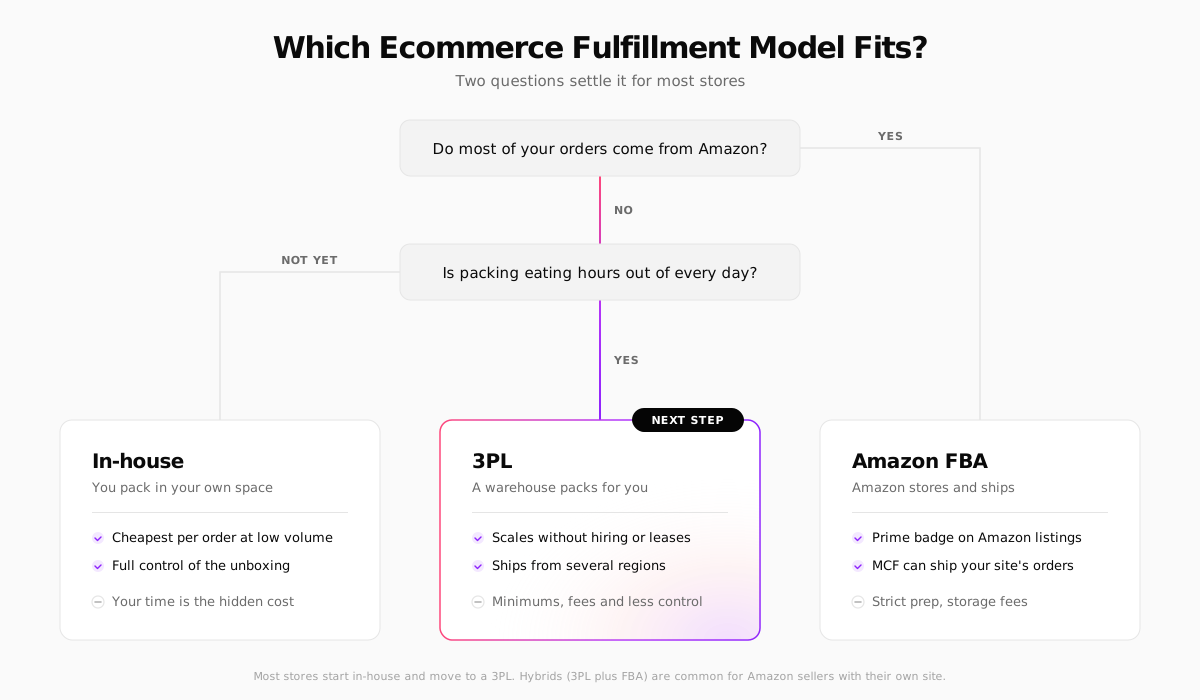
| | In-house | 3PL | Amazon FBA |
| --- | --- | --- | --- |
| **Who packs** | You or your team | A fulfillment company's warehouse | Amazon |
| **Best for** | Early stage, custom or fragile products, small volume | Growing stores with steady volume | Stores selling mostly on Amazon |
| **Main costs** | Your time, space, packaging, labels | Receiving, storage, pick and pack, shipping | Per-unit fulfillment fees, storage, inbound fees |
| **Control** | Full | Shared, via contract and software | Low: Amazon's rules |
| **Scales by** | Hiring and renting space | Signing a bigger contract | Sending more stock |
| **Unboxing** | Anything you like | Custom inserts and boxes, usually for a fee | Amazon's packaging by default |
There's a fourth option that skips holding stock entirely: dropshipping and print-on-demand, where the supplier ships for you. It trades margin and control for zero inventory risk, and we cover it in our [guide to starting dropshipping](/blog/how-to-start-dropshipping).
## In-House Fulfillment: Pack It Yourself
Nearly every store starts here, and for good reason. You see every order, you learn which packaging breaks, you can slip in a handwritten note, and you spend no money you don't have to.
**What it costs:** packaging, labels, a label printer and scale, maybe a shelving unit, and shipping, which you buy yourself through a carrier account or label software. Tools like [Shippo](https://goshippo.com/) compare discounted rates across carriers and print labels in a few clicks, which is how most small US stores ship. In Europe, carrier aggregators and parcel lockers play the same role.

**What it really costs:** your time. Picking, packing, printing and dropping off parcels takes minutes per order, and minutes add up. At 10 orders a day that's a part-time job; at 50 it's a full-time one. Put an honest hourly value on that time before you decide in-house is "free."
**Do it well:**
- Give every product a fixed shelf location and every variant a barcode. Picking errors drop sharply once you scan instead of eyeball.
- Standardize on three or four box sizes. Fewer sizes, fewer decisions, cheaper bulk buys.
- Batch your day: pick everything, pack everything, then print and hand over everything.
- Set a cut-off time ("orders before 2 p.m. ship today") and keep it.
## 3PL Fulfillment: Outsource the Warehouse
A third-party logistics provider (3PL) stores your inventory in its warehouse, packs your orders and ships them, usually with discounted carrier rates you couldn't get on your own. Your store sends orders to the 3PL's software automatically, and tracking numbers come back the same way.
Providers range from local warehouses that handle a few dozen brands to national networks like [ShipBob](https://www.shipbob.com/) and [ShipMonk](https://www.shipmonk.com/), which split your stock across several regional warehouses so parcels travel shorter distances.


### How 3PL pricing works
Most 3PLs quote a custom price, but the line items are nearly always the same:
| Fee | What it covers | How it's usually charged |
| --- | --- | --- |
| **Onboarding** | Account setup, integration, first stock intake | One-off, sometimes waived |
| **Receiving** | Unloading and checking in your stock | Per hour, per pallet, carton or unit |
| **Storage** | Space your stock occupies | Per pallet, shelf, bin or cubic foot per month |
| **Pick and pack** | Picking and packing each order | Per order, plus a fee per extra item |
| **Packaging** | Boxes, mailers, void fill | Per package, or free if you supply your own |
| **Shipping** | The carrier label | Pass-through at the 3PL's negotiated rates |
| **Returns** | Receiving and inspecting returned items | Per return |
| **Minimums** | Covers the 3PL's fixed costs | Monthly minimum spend or order count |
ShipBob, for example, lists implementation, receiving, warehousing, and pick, pack and ship as its standard fee categories, and quotes each brand individually.
### When a 3PL makes sense
- Packing takes hours every day and steals time from marketing and product.
- You're running out of room at home or in a small unit.
- You need faster delivery to customers far from you, or need to ship from another country.
- Your volume is steady enough to clear the 3PL's minimums every month.
### When it doesn't (yet)
- You ship a handful of orders a day. Minimums and fixed fees can make each order more expensive than doing it yourself.
- Your products are fragile, oversized, perishable or heavily customized, and no nearby 3PL handles them well.
- Unboxing is the product: hand-wrapped orders, personalized notes, gift-ready packaging. Some 3PLs do it, but it costs extra.
## Amazon FBA and Multi-Channel Fulfillment
With Fulfillment by Amazon (FBA), you send stock to Amazon's warehouses, and Amazon picks, packs, ships and handles customer service and returns for Amazon orders. The big benefit is the Prime badge on your listings, which matters a lot to conversion on Amazon.

[FBA fees](https://sell.amazon.com/fulfillment-by-amazon) depend on each product's price, weight and dimensions, and storage is charged monthly by the space your stock takes up, measured in cubic feet, with higher rates in the October–December peak. On top of that come inbound placement fees and surcharges for stock that sits too long. Use Amazon's [revenue calculator](https://sellercentral.amazon.com/revcalpublic) with your real product dimensions instead of trusting any blog's averages, including ours.
Two things changed recently that shift the math:
- **Prep is now your job.** Amazon [ended its US prep and labeling services](https://www.packaginginsights.com/news/amazon-fba-packaging-labeling-changes-2026.html) for shipments created from January 1, 2026. Labeling, poly-bagging and bundling now happen before the stock reaches Amazon: in-house or at a prep center (often a 3PL).
- **FBA can ship your other channels.** Amazon's **Multi-Channel Fulfillment (MCF)** ships orders from your own website and other marketplaces out of the same inventory, in unbranded packaging if you ask for it. It's convenient if most of your stock already sits at Amazon, but it typically costs more per order than FBA, and your site's customers get an Amazon-run delivery experience.
**FBA is the right call** when Amazon is your main channel. It's a weaker fit when your own store is the main channel: you give up control over packaging and inserts, and a stockout at Amazon hits every channel at once.
## What Ecommerce Fulfillment Really Costs: A Worked Example
Per-order prices are misleading on their own. Compare the **total monthly cost** for the same volume instead. Here's an illustrative store shipping 600 orders a month with 1.5 items per order. The numbers are examples to show the method, not quotes: plug in your own.
| Cost per month | In-house | 3PL (example quote) |
| --- | --- | --- |
| Labor | 600 orders × 6 min = 60 h × $20 = **$1,200** | Included in pick and pack |
| Pick and pack | – | 600 × $3.00 + 300 extra items × $0.75 = **$2,025** |
| Storage | Spare room or small unit: **$300** | 4 pallets × $40 = **$160** |
| Packaging | **$420** | **$300** (bulk pricing) |
| Shipping | 600 × $7.50 = **$4,500** | 600 × $6.50 = **$3,900** (negotiated rates) |
| Receiving and returns | Your time: **$100** | **$150** |
| **Total** | **$6,520** (about $10.87 per order) | **$6,535** (about $10.89 per order) |
In this example the two models cost almost exactly the same: the 3PL's shipping discount pays for its pick-and-pack fees, and you get 60 hours a month back. Change a single input, like your labor rate or the 3PL's minimum, and the answer flips. That's the point: run the numbers with real quotes, and never compare pick-and-pack fees without the shipping rate attached.
**Ask every 3PL for a quote on your real order history.** Send three months of orders (items per order, weights, destinations) and ask them to price it line by line. A quote built on your data is comparable; a rate card isn't.
## How to Choose a 3PL
Treat a 3PL like a hire, not a vendor. Ask:
1. **Do they integrate with your store?** Orders out, tracking and stock back, automatically. Ask which platforms they support natively and whether they have an API.
2. **What are the minimums and contract terms?** Monthly minimums, notice period, and what it costs to leave with your stock.
3. **Where are their warehouses?** Close to your customers means cheaper, faster shipping.
4. **What are the cut-off times and same-day ship rates?** Ask for their measured on-time rate, not the promise.
5. **How do they handle accuracy and damage?** Mis-pick rate, who pays for mistakes, and how claims work.
6. **Can they do your packaging?** Custom boxes, inserts, gift notes, kitting and bundles, and what each costs.
7. **How do returns work?** Inspection, grading, restocking, and how fast refunds can be triggered.
8. **Who's your contact?** A named account manager beats a ticket queue in November.
9. **Can you visit?** A walk through the warehouse tells you more than any sales deck.
## Fulfillment Across Borders: US, EU and UK
Where your stock sits has tax consequences, so check them before you sign with a warehouse.
**In the US**, inventory stored in a state can create physical nexus there, which means collecting and remitting that state's sales tax. That includes stock held by a 3PL or by Amazon, which spreads FBA inventory across fulfillment centers in several states. Marketplace facilitator laws mean Amazon collects the tax on Amazon sales, but nexus can still require you to collect it on your own site's orders. Our guide to [ecommerce sales tax](/blog/ecommerce-sales-tax) covers how nexus works.
**In Europe**, two rules shape where you keep stock:
- **Storing stock in another EU country usually means VAT registration there.** The One-Stop Shop (OSS) covers distance sales to consumers in other EU countries, but goods held in a warehouse in another member state generally need a local VAT number. That's the trade-off of spreading stock across Amazon's European warehouses or a multi-country 3PL. Our [EU VAT OSS guide](/blog/eu-vat-oss) explains the basics.
- **The UK is a separate customs territory.** Shipping from the EU to UK customers (or the reverse) means customs declarations and import VAT on every parcel. Many stores that sell heavily in both keep stock with a 3PL on each side.
Packaging rules follow you too. In Germany, for example, anyone who sends packaged goods to consumers must register with the [LUCID packaging register](https://lucid.verpackungsregister.org/) and join a recycling scheme, even when a 3PL does the packing. Exporting to the US? The end of the de minimis exemption changed the math for cross-border parcels, as covered in our guide to [US import duties for ecommerce](/blog/us-import-duties-for-ecommerce).
**Always check the current rules where you sell.** This section summarizes US sales tax nexus and EU, UK and German VAT and packaging rules as of November 2026. Rules and thresholds change and vary by country, so confirm the details with a tax adviser or your local authority before you move stock across borders. This is general information, not legal or tax advice.
## What Nobody Tells You About Switching Fulfillment
- **Onboarding takes longer than the sales call suggests.** Plan for weeks, not days: integration, product data, receiving and a test period. Don't switch in Q4.
- **Your product data has to be perfect.** A 3PL needs weights, dimensions and barcodes for every variant. Missing data is the most common cause of a slow start.
- **Stock in transit is stock you can't sell.** Moving inventory to a 3PL or Amazon takes days. Run a sale-free week, or keep a buffer at home until the new warehouse is live.
- **Peak season changes everything.** Ask what happens to cut-off times and accuracy in November and December, and whether peak surcharges apply.
- **Hybrid is normal.** Plenty of brands keep bulky or custom items in-house, send best-sellers to a 3PL, and use FBA for Amazon only. You don't have to pick a single model forever.
## Where Your Next Store Fits
[Your Next Store](https://yournextstore.com/) supports both ends of the journey: packing orders yourself today, and handing them to a 3PL or warehouse system later.

**If you fulfill in-house**, the admin includes a [packing station](/help/orders/packing-station): it works through the queue of paid orders one at a time, lets you scan each item into the box with a barcode scanner, and sorts items by shelf location so you walk the shelves once. [Workstations](/help/orders/workstations) give each packing desk its own queue when more than one person packs. In the US, the [Shippo integration](/help/shipping/carriers-usa) compares live rates from USPS, UPS, FedEx and more, buys the label and sends the customer tracking; in Poland, labels come from InPost, GLS, DPD, FedEx or Furgonetka. Counting items at the packing station works on every plan; marking orders packed and creating labels from it need the Growth plan or above.
**If you move to a 3PL**, the REST API is the connection point: the 3PL (or your middleware) polls new and changed orders with [`GET /api/v1/orders?updatedSince=…`](/docs/api-reference/orders), sends tracking and status back on the order, and keeps stock in sync per SKU through the [inventory endpoint](/docs/api-reference/inventory). If you run operations in Base.com (formerly BaseLinker), the [Base.com integration](/help/integrations/baselinker) syncs orders, statuses, tracking and stock in both directions.
What YNS doesn't do: it's not a 3PL and doesn't run warehouses, and it doesn't ship ready-made connectors for ShipBob, ShipMonk or Amazon MCF today, so those connect through the API. For the wider picture of connecting back-office systems, see our guide to [ecommerce ERP integration](/blog/ecommerce-erp-integration), and check [pricing](/pricing) for what each plan includes.
## FAQ
### What is ecommerce fulfillment?
Ecommerce fulfillment is the process of receiving and storing inventory, picking and packing online orders, shipping them to customers and handling returns. You can do it in-house, outsource it to a third-party logistics provider (3PL), or use Amazon FBA.
### When should I switch from in-house fulfillment to a 3PL?
When packing takes hours every day, you're running out of space, or you need faster delivery in regions far from you, and your volume is steady enough to clear the 3PL's monthly minimums. Compare the total monthly cost, including your own time, not just per-order fees.
### Is Amazon FBA cheaper than a 3PL?
For Amazon orders, FBA is often the simplest choice because it brings the Prime badge. For orders from your own website, Amazon's Multi-Channel Fulfillment usually costs more per order than FBA, and a 3PL can be cheaper and gives you more control over packaging. Price both with your real product sizes.
### How much does ecommerce fulfillment cost per order?
It depends on item size, items per order, destination and volume. Shipping is usually the largest part. Build a monthly model with real quotes for pick and pack, storage, packaging and shipping, as in the worked example above, instead of relying on industry averages.
## The Bottom Line
Start in-house, learn what your orders actually need, and move to a 3PL when your time is worth more than the fees. Use FBA when Amazon is the channel that matters. Whatever you choose, compare total monthly cost, insist on clean product data, and never switch in November. **The cheapest fulfillment model is the one your customers never notice.**
## Related Blog Posts
- [Ecommerce Shipping Strategy: How to Set Rates Without Losing Money](/blog/ecommerce-shipping-strategy)
- [Best Inventory Management Software for Ecommerce in 2026](/blog/best-inventory-management-software-for-ecommerce)
- [Ecommerce Return Policy: EU and US Rules (Plus a Template)](/blog/ecommerce-return-policy)
- [Marketplace vs Your Own Website: Where Should You Sell?](/blog/marketplace-vs-own-website)
- [How to Sell Internationally: An Ecommerce Guide for 2026](/blog/how-to-sell-internationally)