# Buy Now, Pay Later for Ecommerce: Is It Worth Adding?
Buy now, pay later can lift order value, but it costs more than cards. See fees, who it suits, EU and UK rules and a test plan. Decide with real numbers.
*Published 2026-10-30*
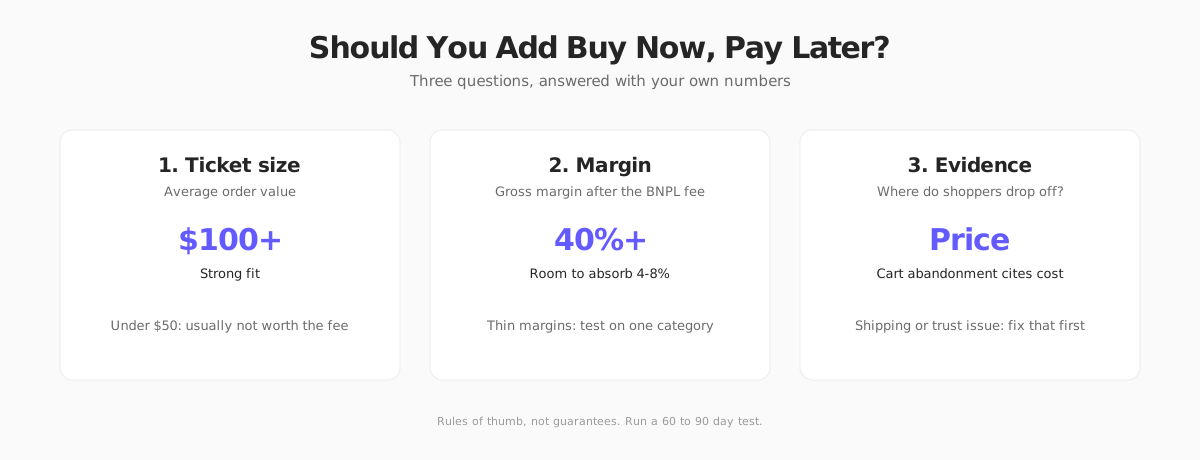
**Buy now, pay later (BNPL) is worth adding when your average order is $100 or more, your margin can absorb a fee of roughly 4 to 8%, and shoppers are leaving at the price step.** It is a poor fit for $20 orders or thin margins. This guide covers what BNPL costs, who it suits, the regulation shift in the EU and UK, and how to test it in 60 to 90 days before you commit.
## What Buy Now, Pay Later Means for a Store Owner
BNPL lets a shopper split a purchase into installments, usually four interest-free payments over six weeks, or longer plans for bigger baskets. The key point for you as a merchant: **you are paid up front**, minus a fee. The provider takes on the repayment and the credit risk.
The main providers you will see at checkout:
- **[Klarna](https://www.klarna.com/)**: strong in Europe, with pay in 30 days, installments and longer financing.
- **[Afterpay](https://www.afterpay.com/en-US)** (called Clearpay in the UK): pay in four, popular with younger shoppers in fashion and beauty.
- **[Affirm](https://www.affirm.com/)**: strongest in the US, with a mix of 0% and interest-bearing plans for larger purchases.
- **PayPal Pay Later**: tied to PayPal checkout, so it shows up where shoppers already pay.


## What BNPL Costs You
BNPL is more expensive than a card payment. Card processing through Stripe in the US is [2.9% + $0.30](https://stripe.com/pricing) per successful transaction. BNPL providers generally charge a higher percentage plus a fixed fee, and the rate depends on the provider, your country, your volume and sometimes the plan the shopper picks.
| Cost item | Cards (Stripe, US) | Typical BNPL |
|---|---|---|
| Percentage fee | 2.9% | Often roughly 3% to 8%, higher for riskier plans |
| Fixed fee | $0.30 | Commonly $0.30 and up |
| Refund handling | Fee usually not returned | Varies by provider, check the contract |
| Chargeback exposure | You carry it | The provider usually carries credit risk, not every dispute |
Treat those BNPL figures as ranges, not quotes. Rates change, and enterprise merchants negotiate. Always get the current rate card from the provider or from your payment processor before modeling.
### Run the margin math first
Take your gross margin and subtract the BNPL fee. On a $120 order with a 45% gross margin you keep $54 before costs. A 6% fee takes $7.20, leaving $46.80, which is still healthy. On a 20% margin the same fee takes 30% of your profit. That is the whole decision in one paragraph.
## What BNPL Can Actually Do for Sales
Providers publish impressive numbers about conversion and basket size, but those are marketing claims from the party that earns the fee. Treat them as hypotheses to test, not facts about your store. Here is what is reasonable to expect:
- **Higher average order value.** Shoppers who see "4 payments of $30" are more willing to buy the $120 item or add a second one. The effect is bigger on considered purchases (furniture, electronics, jewelry, gear).
- **Fewer price-driven abandons.** If your checkout data shows people leaving at the total, BNPL addresses the cause. If they leave over shipping costs or surprise taxes, it does not. Our [cart abandonment guide](/blog/how-to-reduce-cart-abandonment) helps you tell the difference.
- **New customers.** Some shoppers only buy with an installment option, or use a BNPL app as a discovery channel.
- **Little effect on low-ticket stores.** When the average basket is $25, installments save nobody anything meaningful, and the fee eats the margin.
## Who Should Add BNPL (and Who Shouldn't)
### Good fit
- Average order value of roughly $100 or more
- Gross margin around 40% or better
- Considered purchases where shoppers compare and wait
- A checkout with evidence of price-related drop-off
### Poor fit
- Consumables and low-ticket items under about $50
- Thin-margin resellers who already run discounts
- Subscriptions and recurring billing, where BNPL rarely applies. See [how to sell subscriptions online](/blog/how-to-sell-subscriptions-online) for better-suited options
- Stores with high return rates, since returns complicate settlement and refunds
## The Risks Nobody Puts on the Landing Page
- **Returns and refunds.** A refunded BNPL order is a refund on an installment plan. Check whether the provider returns its fee on refunds. Many do not, so a high-return category quietly loses margin.
- **Brand and customer experience.** Shoppers who miss payments blame the provider, but the order and the brand are yours. Make sure the checkout labels the plan clearly.
- **Over-promising.** "Pay later" copy that hides the repayment terms invites complaints and, in some regions, regulatory attention.
- **Provider approval can fail.** Not every shopper is approved, and a declined BNPL attempt should fall back gracefully to a card, not an error page.
- **Another dependency.** Each provider is a contract, a dashboard and a support channel. Start with one.
## Regulation: US, EU and UK
BNPL is moving from lightly regulated to regulated credit in several markets. This is where merchants get caught out, because the obligations often land on the provider but the checkout wording is yours.
- **United States.** BNPL is not governed by one federal rulebook. The Consumer Financial Protection Bureau issued an interpretive rule in 2024 treating some BNPL lenders like card issuers, and its enforcement stance has since shifted, so rules are still moving. Providers handle disclosures, but you remain responsible for accurate advertising.
- **European Union.** The revised [Consumer Credit Directive (EU) 2023/2225](https://eur-lex.europa.eu/eli/dir/2023/2225/oj) brings many BNPL products into scope, with member states applying it from November 2026. Expect stricter creditworthiness checks and pre-contract information requirements for providers. See our [European payment methods guide](/blog/european-payment-methods) for how local preferences vary.
- **United Kingdom.** The FCA is bringing deferred payment credit (BNPL) into regulation, with the regime starting in 2026. Check the [FCA's BNPL pages](https://www.fca.org.uk/firms/buy-now-pay-later) for the current position. If you advertise BNPL, your promotions may also need to meet financial promotion rules, so rely on the provider's approved messaging.
**Always check the current rules where you sell.** This section summarizes US, EU and UK buy now, pay later rules as of October 2026. Regulations change and vary by country, so confirm the details with your payment provider, a local regulator or a legal specialist before you advertise or launch. This is general information, not legal advice.
## How to Add BNPL to Your Checkout
You have two practical routes.
1. **Through your payment processor.** Stripe supports several BNPL methods (Klarna, Afterpay/Clearpay and Affirm among them) in Stripe Checkout, subject to country, currency and order-size eligibility, and you enable them in the dashboard. One integration, one payout and one reconciliation flow is the lowest-effort option. Check the [Stripe payment methods page](https://stripe.com/payments/payment-methods) for what your account can enable.
2. **Directly with the provider.** More control over messaging and, at volume, sometimes better rates. More work to integrate and reconcile.
For most small stores, route one is right. See our guide to [selling online with Stripe](/blog/how-to-sell-online-with-stripe) for the base setup, and [headless checkout](/blog/headless-checkout) if you run a custom storefront.
### Show the option before checkout
BNPL only influences a decision if shoppers see it early. Add a short line on product and cart pages such as "or 4 payments of $30", using the provider's own messaging component so the terms stay compliant. Hiding it until the final step wastes most of the effect.
## A 60 to 90 Day Test Plan
Do not decide on opinion. Run a test and read the numbers.
1. **Baseline.** Record conversion rate, average order value, and checkout abandonment for the 30 days before launch.
2. **Launch one provider** on a limited range, for example products over $80, or one market.
3. **Track separately:** share of orders paid with BNPL, AOV for BNPL vs card orders, refund rate, and fees paid.
4. **Compare after 60 to 90 days.** Net the extra gross profit from higher AOV and new customers against the fees and any increase in refunds.
5. **Decide.** Keep it if net profit rose. Cut it if sales merely shifted from cards to BNPL at a higher fee.
The most common outcome is not "it doubled our sales". It is "10 to 20% of orders moved to BNPL, a few were incremental, and the fees roughly matched the gain". That is only a win if the incremental part is real, which is why the baseline matters.
## Where Your Next Store Fits
[Your Next Store](https://yournextstore.com/) uses Stripe for payment processing and Stripe Checkout Sessions for checkout, so the payment methods you can offer follow what Stripe supports and what you enable on your Stripe account. We do not run a BNPL product of our own, and the availability of a given method depends on your country, currency and the cart. Check your Stripe dashboard to see which methods are eligible. Plans start at $30/month with 0% platform transaction fees, so the only per-sale costs are Stripe's processing fees plus whatever the BNPL method adds.

## Alternatives If Margins Are Thin
If BNPL does not pencil out, these often work better:
- **Bundles and volume discounts** that lift AOV without a per-order fee
- **Free shipping thresholds** set slightly above your current average order
- **Other local payment methods** that shoppers in your market already trust. See [European payment methods](/blog/european-payment-methods)
- **Abandoned cart emails** that bring back price-sensitive shoppers. Our [abandoned cart emails guide](/blog/abandoned-cart-emails) walks through the sequence
## FAQ
### Does buy now, pay later increase conversion rates?
It can, mainly on higher-priced items where cost is the main barrier. Provider-reported lifts are marketing figures, so measure it on your own store with a before and after comparison over 60 to 90 days.
### Who pays the BNPL fee, the shopper or the merchant?
The merchant pays. Shoppers on standard pay-in-four plans pay no interest if they pay on time. Some longer plans, such as those at Affirm, can carry interest paid by the shopper, but the merchant fee still applies.
### Is buy now, pay later regulated?
Increasingly, yes. The EU's revised Consumer Credit Directive applies from November 2026, the UK is regulating deferred payment credit, and the US picture is a patchwork. The provider carries most obligations, but you should use their approved checkout messaging.
### Should a small store offer BNPL?
Only if the average order is around $100 or more and your margin can absorb the fee. For smaller baskets, bundles and free shipping thresholds usually return more per dollar.
## The Short Version
BNPL is a margin-for-conversion trade. Price it, test it on one provider for 60 to 90 days, and keep it only if the incremental profit beats the fee.
## Related Blog Posts
- [How to Sell Subscriptions Online](/blog/how-to-sell-subscriptions-online)
- [European Payment Methods](/blog/european-payment-methods)
- [How to Reduce Cart Abandonment](/blog/how-to-reduce-cart-abandonment)
- [How to Sell Online with Stripe](/blog/how-to-sell-online-with-stripe)
- [Ecommerce Checkout Optimization](/blog/ecommerce-checkout-optimization)