# Base44 vs Shopify: Can an AI App Builder Run Your Store?
Base44 vs Shopify compared: real September 2026 pricing, what each AI actually does, and whether an app builder can replace a commerce platform.
*Published 2026-09-28*
Base44 will turn a chat prompt into a working app in a few minutes, complete with a database, logins, and a Stripe button. Shopify will turn a product list into a working store, complete with variants, stock counts, and a tax engine, in about the same amount of time. Both look like magic in the demo. Only one of them was built to run a store for the next five years. Here's where Base44 and Shopify actually diverge, and where the line is blurrier than either marketing page admits.
**Bias disclosure:** We build [Your Next Store](https://yournextstore.com/), an AI-native store builder that competes with both of these for ecommerce. We'll name our own weak spots plainly and won't shade the parts where Base44 or Shopify simply do it better. If you spot an error, [open an issue on GitHub](https://github.com/yournextstore/yournextstore/issues).
## The Short Answer
**Pick Shopify** if the job is selling physical or digital products online: you want a product catalog, inventory, tax, and checkout that already exist, and you're fine picking a theme (or paying for headless) instead of describing a design in a chat box.
**Pick Base44** if the job is an app, not a store: a customer portal, an internal tool, a booking system, a subscription SaaS with a simple paywall. Base44's chat-to-app workflow is genuinely good at this, and it does have a way to accept payments.
**Pick neither** if you want the "describe it, watch AI build it" experience Base44 offers but with a real commerce backend underneath, not a bolt-on Stripe button. That's a third bucket, and we cover where [Your Next Store](https://yournextstore.com) fits later in this post.
## Quick Comparison
| | Base44 | Shopify |
|--|--------|---------|
| **What it is** | AI app builder, chat generates a full-stack app | Ecommerce platform, theme-based or headless |
| **Built for** | Apps, internal tools, portals, simple SaaS | Selling products online |
| **Entry price** | Free (25 message / 100 integration credits) | $39/mo (Basic, monthly) / $29/mo (annual) |
| **Mid-tier price** | $40/mo (Builder, annual) | $105/mo (Grow, monthly) / $79/mo (annual) |
| **Top self-serve price** | $160/mo (Elite, annual) | $399/mo (Advanced, monthly) / $299/mo (annual) |
| **Product catalog** | None natively; products live in Stripe | Native, with variants, collections, and inventory |
| **AI role** | Builds and edits the whole app by chat | [Sidekick](https://www.shopify.com/sidekick) assists inside a normal admin; a separate free AI tool drafts a starting theme |
| **App ecosystem** | No public app marketplace | 8,000+ apps |
| **Code export** | Gated to Builder plan ($40/mo) and up | Theme stays on Shopify unless you pay for headless or Plus |
Prices are what each vendor showed on its own pricing page in September 2026. Both change often, so check before you commit.
## What Base44 Actually Is

[Base44](https://base44.com/) calls itself a "vibe coding" platform: you describe an app, website, game, or AI agent in plain language, and it generates the full thing, frontend, database, authentication, and hosting, then keeps editing as you chat with it. It's not narrowly an ecommerce tool. The homepage's own examples lean toward dashboards, internal tools, and small consumer apps, and the pricing page's FAQ still opens with "What is Base44 and how does it work," pitched at builders in general, not store owners specifically.
Payments work through a built-in Stripe integration: you connect a Stripe account, and Base44 wires up a checkout flow using [products and prices you create directly in Stripe](https://docs.base44.com/documentation/setting-up-your-app/setting-up-payments). That's a meaningful detail. Base44 isn't storing your catalog in its own database and syncing it to Stripe; Stripe's product catalog *is* the catalog. That's fine for a handful of SKUs or a subscription paywall. It gets thin fast once you need variants (sizes, colors), stock counts, abandoned-cart recovery, or a returns flow, none of which Stripe's product catalog was built to hold. We went deep on this gap, plus the credit system's fine print, in our [Base44 alternatives for ecommerce](/blog/base44-alternatives-for-ecommerce) post.
## What Shopify Actually Is

[Shopify](https://www.shopify.com/) needs less introduction. It's the default answer to "how do I start an online store," with a mature checkout, a Liquid-based theme system a huge number of freelancers already know, and an app store that covers almost anything a niche eventually asks for. Its AI layer is newer and sits on top of that foundation rather than replacing it: a free [AI store builder](https://www.shopify.com/tools/ai-store-builder) generates a starting theme from a short questionnaire, and [Sidekick](https://www.shopify.com/sidekick) is a chat assistant inside the admin that drafts product copy, edits theme settings, and answers questions like "show me orders from last week." Neither one builds your storefront from scratch the way Base44 or [Your Next Store's AI builder](https://yournextstore.com/) does; you're still working inside an ecommerce admin that existed long before the AI features did. We've covered Shopify's architecture and real costs in more depth in [Next.js vs Shopify](/blog/nextjs-vs-shopify) and [Shopify's actual transaction fees](/blog/shopify-transaction-fees).
## Head-to-Head
### 1. What Happens When Someone Clicks "Buy"
This is the real fork in the road, and it's more structural than a feature checklist.
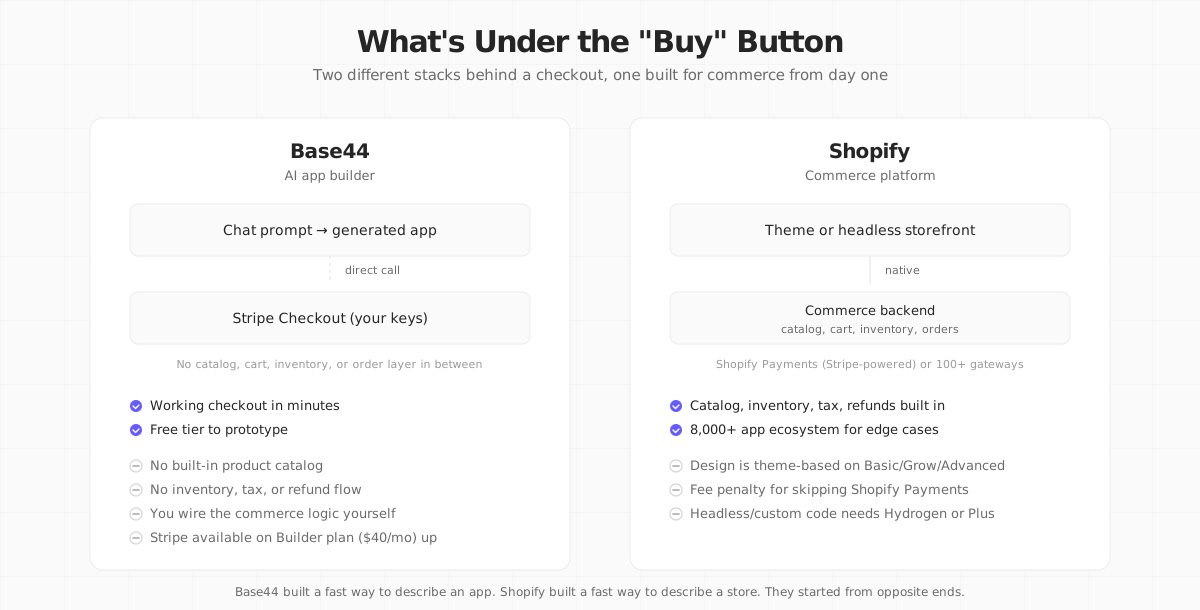
On Base44, the generated app talks to Stripe directly. Nothing sits in between to manage stock, apply a discount code, calculate tax, or trigger a refund workflow; those are things you'd build yourself on top of what's generated, and Stripe itself only unlocks on the Builder plan ($40/mo billed annually) and up, not the free tier or the $16/mo Starter plan. On Shopify, the storefront (theme or headless) talks to Shopify's own commerce backend, which already owns the catalog, cart, inventory, and order history; Shopify Payments (Stripe-powered under the hood) or [one of 100+ third-party gateways](https://www.shopify.com/payment-gateways) handles the money on top of that.
Neither approach is wrong for what it's built for. An app that occasionally takes a payment doesn't need a full commerce backend. A store that sells 40 product variants across three warehouses does.
### 2. Pricing, Side by Side

| Tier | Base44 (annual billing) | Shopify (annual billing) |
|------|--------------------------|---------------------------|
| Entry | Free (25 message / 100 integration credits) | $29/mo (Basic) |
| Mid | $40/mo (Builder, 250 message / 10,000 integration credits) | $79/mo (Grow) |
| Top self-serve | $160/mo (Elite, 1,200 message / 50,000 integration credits) | $299/mo (Advanced) |
Base44's free plan is a real free plan, not a trial, which is more generous than anything on Shopify's side (Shopify's cheapest full plan is $29/mo annual; its $5/mo Starter tier is a link-in-bio tool, not a store). But Base44's numbers hide a second cost dimension that Shopify doesn't have: **two separate credit types**. *Message credits* are what you spend chatting with the AI to build or change something. *Integration credits* are what your visitors spend when they use the deployed app, Stripe checkouts, database reads, third-party API calls. A small store with a hundred visitors a day can burn through integration credits on ordinary traffic well before it burns through message credits, and then real customers start hitting rate limits. We break down exactly how that credit math plays out in the [Base44 alternatives](/blog/base44-alternatives-for-ecommerce) post.
Shopify's cost structure is the opposite problem: the subscription looks simple, but card processing (2.9% + 30¢ on Basic, dropping to 2.5% + 30¢ on Advanced), apps, and a penalty for skipping Shopify Payments all stack on top. We've done the full math in [how much Shopify actually takes from a $100 sale](/blog/how-much-does-shopify-take-from-a-100-sale).
Base44's Stripe integration ships with a sandbox environment by default, so you can test a full checkout flow with Stripe's test cards before connecting a real account and paying anyone. That's a genuinely nice detail for prototyping a paid feature quickly, even if it isn't a substitute for a real store backend.
### 3. What the AI Actually Does
Base44's AI is the product: every plan, including the free tier, includes the chat interface that generates the app, and you keep talking to it to add features, fix bugs, and adjust the design. There's no separate "AI store builder" step; the whole app is AI-generated from the first prompt onward.
Shopify's AI is additive. The free AI store builder generates a starting theme from a short questionnaire, useful for skipping the blank-page problem, but it's a one-time generation step, not an ongoing conversation about your storefront's design. Sidekick, separately, lives inside the admin you already know: draft a product description, adjust a setting, pull up a report. If "the AI builds the whole thing and keeps building it" is the appeal, Base44 is closer to that. If "the AI helps me inside tools I already understand" is what you want, Shopify's approach will feel more familiar.
### 4. Ecosystem: What Happens When You Need Something Specific
Shopify's advantage here isn't close. Over 8,000 apps cover loyalty programs, subscriptions, complex shipping rules, and B2B ordering; almost anything a niche eventually asks for already has an app, typically for $10-$50/month on top of the platform fee.
Base44 doesn't have a public app marketplace. What it does have is a [Zapier integration that can connect a Base44 app to Shopify](https://zapier.com/apps/base44/integrations/shopify), which is a telling detail: even Base44's own integration ecosystem treats "connect to a real store platform" as a supported workflow rather than something to compete with. If you specifically want the Base44 chat-building experience but need real commerce underneath, wiring the two together through Zapier or a similar tool is a more realistic path than expecting Base44 to grow a catalog and inventory system on its own.
### 5. Can You Take Your Data With You?
On Base44, code export (downloading the actual generated app as source code) is gated to the Builder plan ($40/mo annual) and above; on the free or Starter plan, you can't download your code at all. Since your product catalog lives in Stripe rather than in Base44's own database, your product data is arguably more portable than the app itself, Stripe's dashboard and API give you that regardless of your Base44 plan.
On Shopify, products, customers, and orders all export as CSV from any plan. The theme itself is the part that doesn't travel: it runs on Shopify unless you go headless with [Hydrogen](https://hydrogen.shopify.dev/), Shopify's free React framework included on every plan except the $5 Starter link-in-bio tier, or pay for Shopify Plus to fully decouple the frontend. Neither platform, on standard plans, hands you a storefront you can self-host elsewhere as freely as an open-source template would.
## A Note for EU and UK Sellers
Both platforms route card processing through Stripe underneath (Base44 directly, Shopify via Shopify Payments), but Shopify Payments is only available in [around 39 countries](https://help.shopify.com/en/manual/payments/shopify-payments/supported-countries); if yours isn't on the list, Shopify defaults you to a third-party gateway plus its markup, not by choice. Neither platform automatically registers and files your VAT. Stripe Tax can calculate and collect VAT once you turn it on, but the registration thresholds and filing obligations in each EU country, and in the UK, are still on you regardless of which builder generated your checkout.
## What Nobody Tells You
**Base44's "free" store is a Stripe integration, not a store.** The moment you need variants, stock counts, or a discount code, you're writing that logic yourself on top of the generated app, and Stripe itself doesn't unlock until the $40/mo Builder plan. Budget for that plan from the start if commerce is genuinely part of the plan, not an afterthought.
**A lean Shopify store and an appified one are different products.** The slow, expensive Shopify horror stories people share usually describe a store running fifteen apps for edge cases a real commerce backend would otherwise cover natively. A store with a clean theme and two or three well-chosen apps performs and costs very differently.
**"Integration credits" are the number to watch on Base44, not message credits.** They're consumed by your visitors, not by you, which means normal traffic (not just a launch spike) can eat through a plan's allowance faster than the marketing page implies. Ask directly what happens mid-checkout if a customer's session hits the cap.
**Neither platform's standard export gives you the design as portable code.** Shopify's theme stays on Shopify below Plus; Base44's code export is a paid-plan feature and, even then, exports the generated app rather than a store built on commerce primitives you could plug into something else.
## Where Your Next Store Fits
We built [Your Next Store](https://yournextstore.com) because we wanted the "describe your store, watch AI build it" experience Base44 offers, on top of a real commerce backend instead of a bolted-on Stripe button. **(Bias flag: this is our product.)**

Describe what you sell in the chat box, and our AI (we call it Elliot) builds a real store: products with variants and stock counts, cart, checkout, taxes, and shipping already wired up, not a generated frontend waiting for you to add those pieces. You keep chatting to change it afterward, the same iterative loop Base44 popularized, except the thing underneath was a commerce platform on day one.
**Where we're honestly behind both:** no public app marketplace like Shopify's, and payments run through Stripe only today. **Where we differ from Base44:** the storefront template is [open-source on GitHub](https://github.com/yournextstore/yournextstore), there's no separate "integration credits" meter that your customers' traffic can quietly burn through, and the catalog, inventory, and orders are native from the first prompt, not something you wire up yourself once you outgrow a Stripe product list.
Your Next Store is open source. Star the repo on GitHub: [github.com/yournextstore/yournextstore](https://github.com/yournextstore/yournextstore)
**Want the "AI builds it" experience with a real store underneath, not a Stripe button bolted onto a generated app?** Describe your shop in plain English and see products, cart, and checkout working from the first prompt.
## Decision Framework
**You're building an app, portal, or internal tool that happens to take a payment or two:** Base44.
**You're selling products and want the biggest ecosystem, with a mature checkout behind it:** Shopify.
**You want the AI-native "describe it and watch it build" experience, but for an actual store with the commerce logic already in place:** [Your Next Store](https://yournextstore.com).
**You're not sure yet:** our [best AI store builders guide](/blog/best-ai-store-builders) puts both of these, plus Wix, Squarespace, Lovable, and half a dozen others, next to each other on the same set of questions.
## FAQ
### Can Base44 integrate with Shopify instead of replacing it?
Yes. There's a [published Zapier integration connecting Base44 to Shopify](https://zapier.com/apps/base44/integrations/shopify), which is the realistic pattern for anyone who wants Base44's chat-building experience for an app or portal while keeping an actual store on Shopify underneath: use Base44 for the app, use a real store platform for the store.
### Is Base44 cheaper than Shopify?
At the entry point, yes: Base44 has a genuine free plan, versus Shopify's $29/mo (annual) Basic plan. But Base44's free and Starter tiers don't include Stripe at all (that starts on the $40/mo Builder plan), and Shopify's price includes a full commerce backend, checkout, and catalog that Base44 doesn't have at any price. Comparing the sticker prices without comparing what's actually included understates Shopify's side of the math.
### Can I build a real online store entirely on Base44?
You can build a working page that lists products (stored as Stripe products and prices) and takes payment through Stripe Checkout. Once you need variants, inventory tracking, abandoned-cart recovery, tax calculation, or a refund workflow, you're building that logic yourself on top of what Base44 generates, since none of it exists as a built-in commerce layer. Most people who try end up either wiring Base44 to Shopify through Zapier or moving the store itself to a platform built for commerce.
## Related Blog Posts
- [Base44 Alternatives for Ecommerce in 2026](/blog/base44-alternatives-for-ecommerce)
- [Amboras vs Shopify: Which Should You Build On in 2026?](/blog/amboras-vs-shopify)
- [Best AI Store Builders 2026](/blog/best-ai-store-builders)
- [Next.js vs Shopify](/blog/nextjs-vs-shopify)
- [Shopify Transaction Fees: The Real Cost of Selling on Shopify](/blog/shopify-transaction-fees)
Base44 built a fast way to describe an app. Shopify built a fast way to describe a store. The question worth answering before you sign up for either isn't "which AI is more impressive in the demo," it's "does the thing I'm building need a commerce backend, or does it need an app that happens to take a payment." Answer that honestly, and the rest of the decision gets a lot easier.
Want the "AI builds it" experience with commerce built in from the first prompt? [Try Your Next Store](https://yournextstore.com/). Describe your shop in plain English, and keep the code if you ever leave.